
BuddhistCatholicContemplativeEvangelicalGeneral ChristianHinduJewishLatter-day SaintMuslimNew VisionsProgressive Christian
Beliefs
- Buddhist
- Catholic
- Contemplative
- Evangelical
- General Christian
- Hindu
- Jewish
- Latter-day Saint
- More Voices
- Muslim
- New Visions
- Pagan
- Progressive Christian
Topics
- Religion News
- Food and Religion
- Sports and Religion
- Religious Art
- Religious Music and Entertainment
- Religious Events
- History and Religion
- Style and Religion
- Politics and Religion
- Women in Religion
- Recreation Outdoors and Religion
- Business Finance and Religion
- Careers Workplace and Religion
- Education and Religion
- Family Parenting and Religion
- Health Fitness and Religion
- Home and Religion
- Relationships and Religion
- Technology and Religion
- Travel and Religion
Columnists
- Buddhist Columnists
- Business Finance and Religion Columnists
- Careers Workplace and Religion Columnists
- Catholic Columnists
- Contemplative Columnists
- Education and Religion Columnists
- Evangelists Columnists
- Family Parenting and Religion Columnists
- General Christian Columnists
- Health Fitness and Religion Columnists
- Hindu Columnists
- History and Religion Columnists
- Home and Religion Columnists
- Jewish Columnists
- More Voices Columnists
- Latter Day Columnists
- Muslim Columnists
- New Visions Columnists
- Nonreligious Columnists
- Pagan Columnists
- Politics and Religion Columnists
- Progressive Columnists
- Recreation Outdoors and Religion Columnists
- Relationships and Religion Columnists
- Religion News Columnists
- Religious Art Columnists
- Religious Events Columnists
- Religious Music and Entertainment Columnists
- Sports and Religion Columnists
- Style and Religion Columnists
- Technology and Religion Columnists
- Travel and Religion Columnists
- Women in Religion Columnists
Resource Library
- 2026 Calendar
- Library of World Religions
- The 100 Most Holy Places on Earth
- Patheos Answers
- Podcasts
- Videos
- Faith Leaders Database
- Anglican Episcopalian
- Bahai
- Baptist
- Buddhism
- Christianity
- Confucianism
- Eastern Orthodoxy
- Hinduism
- Holiness and Pentecostal
- ISKCON
- Islam
- Judaism
- Lutheran
- Methodist
- The Church of Jesus Christ of Latter-day Saints
- New Age
- Paganism
- Presbytarian and Reformed
- Protestantism
- Religion Behind the Scenes
- Roman Catholic
- Scientology
- Shia Islam
- Sikhism
- Sufism
- Sunni Islam
- Taoism
- Zen
- See all religions
Research Tools
 Ad-Free & Subscriber Log-In Subscription Support
Ad-Free & Subscriber Log-In Subscription Support
Follow Patheos 

- Trending:
- Forgiveness
- |
- Marriage
- |
- Consciousness
- |
- Death Penalty
- |
- Election
- |
- Halloween

- Home
- Latter-day Saint
- Revision 4.14. “Prayer in Islam”
Revision 4.14. “Prayer in Islam”
Last updated on: September 2, 2020 at 1:33 pm by Dan Peterson
Revision 4.14. “Prayer in Islam” 2020-09-02T13:33:50-06:00 Dan Peterson
Patheos Explore the world's faith through different perspectives on religion and spirituality! Patheos has the views of the prevalent religions and spiritualities of the world.
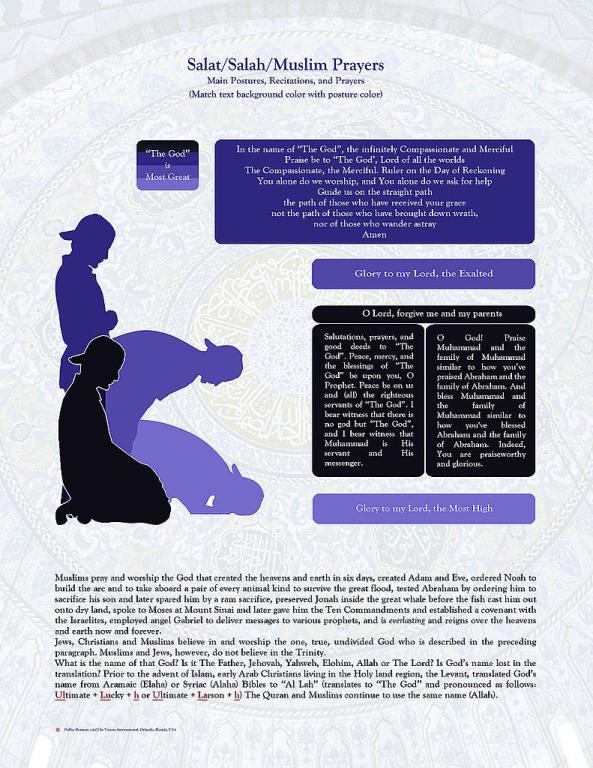
The physical postures of the form of Muslim prayer known as “salaat” illustrate submission to God.
(Wikimedia Commons public domain image)
There are essentially two kinds of prayer in Islam. The one with which we in the West are most familiar is, paradoxically, the one most foreign to us. This is the formal prayer known as salat.[1] Five times daily—at sunrise, midday, afternoon, evening, and night— pious Muslims prostrate themselves before God, bowing low and touching foreheads to the ground a fixed number of times. A somewhat complex set of gestures and motions accompanies the recitation of certain phrases during these prayers, which actually resemble some sort of liturgical worship more than they do the kinds of prayers that Latter-day Saints generally offer. The other kind of prayer is far more spontaneous and lacks the prescribed recitations and motions. It can be offered anywhere and at any time and is quite similar to private Christian prayer.
The liturgical prayers, too, can be performed anywhere, and there is little shyness among Muslims about offering them in public. Male Muslims should, whenever possible, perform the Friday noon prayer in a formal Islamic place of worship known as a “mosque.”[2] (Female Muslims may also attend the mosque but are not obliged to do so.) In the mosque, worshipers line up in rows behind a man bearing the title of imam.[3] Closely following his actions as he prays, they move in impressive unison. They are praying toward Mecca, the holy city of Islam. The direction of that city is marked on the wall by a recessed niche known as a mihrab, which is invariably the most elaborately decorated spot in the mosque. (It is a common misconception among Westerners, by the way, that Muslims pray toward the east. This may derive from the fact that the West is in the west. Thus, any Muslims that we are likely to encounter will tend to pray toward the east. In fact, Muslims pray toward Mecca. Therefore, the direction of their prayer will vary depending upon where they are and the direction of Mecca. If they are south of Mecca, they will pray to the north. Indonesian Muslims pray roughly toward the west.) It is necessary to make ablutions—that is, to wash oneself until one is ritually clean—before prayer, and virtually every mosque will have a fountain for this purpose. Sometimes these ablution fountains are architectural landmarks in their own right; in many modern mosques, on the other hand, they are simple water spigots. If no water is available, sand may be used in its stead.[4]
[1] The emphasis is on the second syllable: “sa-LAT.”
[2] The English word is a corruption of the Arabic masjid, meaning “a place of prostration.”
[3] From the Arabic preposition amama, meaning “in front of,” the word is pronounced “ih-MAM,” with the emphasis on the second syllable. In Sunni Islam, the imam is simply a prayer leader in a mosque. Among the Shiites, the term has come to signify the true leader of all Islam—a descendant of Ali—or his stand-in.
[4] 4:43; 5:6.
Previous Post

August 31, 2020
Nature and "Natural Theology"
Next Post
September 1, 2020 "The extremes of small and large upon which we depend"
Browse Our Archives
Select a Category Uncategorized
Select a Month October 2026 September 2026 August 2026 July 2026 June 2026 May 2026 April 2026 March 2026 February 2026 January 2026 December 2025 November 2025 October 2025 September 2025 August 2025 July 2025 June 2025 May 2025 April 2025 March 2025 February 2025 January 2025 December 2024 November 2024 October 2024 September 2024 August 2024 July 2024 June 2024 May 2024 April 2024 March 2024 February 2024 January 2024 December 2023 November 2023 October 2023 September 2023 August 2023 July 2023 June 2023 May 2023 April 2023 March 2023 February 2023 January 2023 December 2022 November 2022 October 2022 September 2022 August 2022 July 2022 June 2022 May 2022 April 2022 March 2022 February 2022 January 2022 December 2021 November 2021 October 2021 September 2021 August 2021 July 2021 June 2021 May 2021 April 2021 March 2021 February 2021 January 2021 December 2020 November 2020 October 2020 September 2020 August 2020 July 2020 June 2020 May 2020 April 2020 March 2020 February 2020 January 2020 December 2019 November 2019 October 2019 September 2019 August 2019 July 2019 June 2019 May 2019 April 2019 March 2019 February 2019 January 2019 December 2018 November 2018 October 2018 September 2018 August 2018 July 2018 June 2018 May 2018 April 2018 March 2018 February 2018 January 2018 December 2017 November 2017 October 2017 September 2017 August 2017 July 2017 June 2017 May 2017 April 2017 March 2017 February 2017 January 2017 December 2016 November 2016 October 2016 September 2016 August 2016 July 2016 June 2016 May 2016 April 2016 March 2016 February 2016 January 2016 December 2015 November 2015 October 2015 September 2015 August 2015 July 2015 June 2015 May 2015 April 2015 March 2015 February 2015 January 2015 December 2014 November 2014 March 2014 August 2013 February 2012
Follow Us!
TAKE THE
Religious Wisdom Quiz
What does "Maranatha" mean?
Select your answer to see how you score.
Praise the Lord Come, Lord Jesus God is great The Lord is my rock
Related posts from Sic et Non

Islam in America or Islam versus America?

A basic working chronology of Islamic-era Iran

Actual Data and Actual Crusades

TRENDING AT PATHEOS Latter-day Saint

The Real AI Story Is Adoption Without Trust
Artificial intelligence has crossed a political threshold. It is no longer a...

A new article, written by Jeff Lindsay and Gale L. Pooley,...

Swimfan: Forgotten Aughts Pleasures
This is a recovery effort. In 2002, My Big Fat Greek Wedding...

Top Three Anti-Catholic Lies About Catholicism
This is my initial transcript for the video, "THE 3 WORST...

Pope Leo Celebrates Mass for Nurses & Docs...
I don't have any idea how he did it, but Pope Leo...

The Sermon on the Mount, Part I: Matthew...
The Sermon on the Mount, Part I (Matthew 4:12-5:12) St. Matthew moves...
view all Latter-day Saint blogs
Ad-Free & Subscriber Log-In Subscription Support
- About Us
- 2026 Calendar
- Videos
- Podcasts
- Library of World Religions
- Faith In Media Tracker
- Advertise With Us
- Write for Us
- Privacy Policy
- Terms of Service
- Do Not Sell My Data
- Contact Us
- Radiant Digital
- Manage Newsletter Subscriptions
- Unsubscribe From Notifications
- Sitemap
Copyright 2008-2026, Patheos. All rights reserved.
Subscription Support Ad-Free & Subscriber Log-In
Follow Patheos