
BuddhistCatholicContemplativeEvangelicalGeneral ChristianHinduJewishLatter-day SaintMuslimNew VisionsProgressive Christian
Beliefs
- Buddhist
- Catholic
- Contemplative
- Evangelical
- General Christian
- Hindu
- Jewish
- Latter-day Saint
- More Voices
- Muslim
- New Visions
- Pagan
- Progressive Christian
Topics
- Religion News
- Food and Religion
- Sports and Religion
- Religious Art
- Religious Music and Entertainment
- Religious Events
- History and Religion
- Style and Religion
- Politics and Religion
- Women in Religion
- Recreation Outdoors and Religion
- Business Finance and Religion
- Careers Workplace and Religion
- Education and Religion
- Family Parenting and Religion
- Health Fitness and Religion
- Home and Religion
- Relationships and Religion
- Technology and Religion
- Travel and Religion
Columnists
- Buddhist Columnists
- Business Finance and Religion Columnists
- Careers Workplace and Religion Columnists
- Catholic Columnists
- Contemplative Columnists
- Education and Religion Columnists
- Evangelists Columnists
- Family Parenting and Religion Columnists
- General Christian Columnists
- Health Fitness and Religion Columnists
- Hindu Columnists
- History and Religion Columnists
- Home and Religion Columnists
- Jewish Columnists
- More Voices Columnists
- Latter Day Columnists
- Muslim Columnists
- New Visions Columnists
- Nonreligious Columnists
- Pagan Columnists
- Politics and Religion Columnists
- Progressive Columnists
- Recreation Outdoors and Religion Columnists
- Relationships and Religion Columnists
- Religion News Columnists
- Religious Art Columnists
- Religious Events Columnists
- Religious Music and Entertainment Columnists
- Sports and Religion Columnists
- Style and Religion Columnists
- Technology and Religion Columnists
- Travel and Religion Columnists
- Women in Religion Columnists
Resource Library
- 2026 Calendar
- Library of World Religions
- The 100 Most Holy Places on Earth
- Patheos Answers
- Podcasts
- Videos
- Faith Leaders Database
- Anglican Episcopalian
- Bahai
- Baptist
- Buddhism
- Christianity
- Confucianism
- Eastern Orthodoxy
- Hinduism
- Holiness and Pentecostal
- ISKCON
- Islam
- Judaism
- Lutheran
- Methodist
- The Church of Jesus Christ of Latter-day Saints
- New Age
- Paganism
- Presbytarian and Reformed
- Protestantism
- Religion Behind the Scenes
- Roman Catholic
- Scientology
- Shia Islam
- Sikhism
- Sufism
- Sunni Islam
- Taoism
- Zen
- See all religions
Research Tools
 Ad-Free & Subscriber Log-In Subscription Support
Ad-Free & Subscriber Log-In Subscription Support
Follow Patheos 

- Trending:
- Forgiveness
- |
- Marriage
- |
- Consciousness
- |
- Death Penalty
- |
- Election
- |
- Halloween

- Home
- Latter-day Saint
- Reconsidering the emotions of God, with the help of Moses 7
Reconsidering the emotions of God, with the help of Moses 7
Last updated on: September 17, 2020 at 11:53 pm by Dan Peterson
Reconsidering the emotions of God, with the help of Moses 7 2020-09-17T23:53:19-06:00 Dan Peterson
Patheos Explore the world's faith through different perspectives on religion and spirituality! Patheos has the views of the prevalent religions and spiritualities of the world.
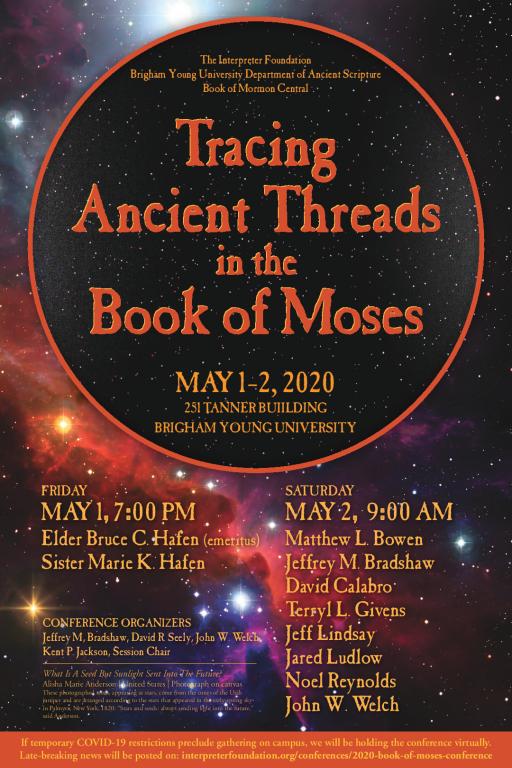
The official poster for our conference. We hope that you’ll be able to attend, even if only virtually.
Don’t forget the Tracing Ancient Threads in the Book of Moses Conference, which begins on Friday evening, 18 September 2020, and continues on Saturday, 19 September 2020. You can watch it at no charge.
In honor of the conference, I share again a column that I first published in the Deseret News on 30 January 2014:
The scripture John 11:35 (“Jesus wept”) is well known as the shortest verse in the King James Bible. It’s less known, however, as one of the Bible’s most significant passages. But it is precisely that.
Why? Because it demonstrates the Savior’s personal care for humanity and shows him, though divine, to be emotionally involved with us.
But, in that regard, Moses 7:28-29 in the Pearl of Great Price is even more remarkable:
“And it came to pass that the God of heaven looked upon the residue of the people, and he wept; and Enoch bore record of it, saying: How is it that the heavens weep, and shed forth their tears as the rain upon the mountains? And Enoch said unto the Lord: How is it that thou canst weep, seeing thou art holy, and from all eternity to all eternity?”
How is it possible for God to weep? For centuries, classical Jewish, Christian and Islamic theologians have agreed that it isn’t. Such behavior would be unworthy of him. God’s emotions seem, it’s true, to be on display throughout the scriptures, but the passages describing them have typically been dismissed as metaphorical, as symbolic of something else.
Recent biblical scholarship, however, is reconsidering the emotions of God. The sections of the book of Jeremiah that precede the Babylonian captivity, to choose from among many possible examples, are absolutely replete with images and divine statements that depict God as deeply caring, worried even, about the punishment that he himself has to impose upon his people.
In Jeremiah 12:7-8, for instance, the Lord is represented as saying, “I have given the dearly beloved of my soul into the hands of her enemies.”
These words remind us of the internal conflict within the soul of a father who loves his children, but who must still punish them and to not intervene when consequences occur. The God speaking here is no distant, uninvolved, unemotional monarch. He loves Israel.
But even while biblical scholars increasingly recognize God’s “passions” as genuinely scriptural, doing so is deeply problematic in the view of many traditional systematic theologians.
For how is it possible to have emotions without a body? Emotions are inseparably connected with such things as tears, rapid heartbeat, “feelings.” Pure mind, if such a thing exists, would seem incapable of anything remotely recognizable as emotion. If, these theologians argue, God has emotions, it must follow that he has some sort of body. But he cannot have a body. Thus, he can have no emotions. Which means not only that he can’t be angry with us but that he can’t love us in any human-like sense of the word, or care for us, or feel our pain, or mourn our poor choices.
Like Enoch, theological commentators have been astonished at the sheer notion that God might weep. Unlike Enoch, though, who was an eyewitness, they flatly reject it. Classical theology has historically tended to depict God as a distant, dispassionate and literally apathetic being unmoved by emotion. The unmoved mover doesn’t weep. He (or, perhaps better, it) moves, but is not moved. Nothing can have any impact on him.
If emotional displays such as tears require a body, classical theism’s solution is to deny all the emotions mentioned for God in the Bible, just as it denies or reinterprets the many passages that seem to describe him as having bodily form. (The embodied Jesus of John 11:35 can be permitted emotions precisely because he assumed flesh and human nature; it’s far less acceptable to grant such “feelings” to his Heavenly Father or to God before the Incarnation.)
The question is whether Christians will in the final analysis opt for their traditional theology, or for the Bible. The two are difficult if not impossible to reconcile.
The Pearl of Great Price’s account of Enoch offers a spectacular instance of a suffering and weeping God, far clearer, even, than anything in the Bible. Fortunately, members of The Church of Jesus Christ of Latter-day Saints are entirely comfortable with an embodied deity.
For those who accept the scriptures of the Restoration, Heavenly Father is not only a being with emotions, but a God who, because he is perfect and perfectly embodied, feels more deeply than we can even begin to imagine. “God is love,” says 1 John 4:8. He not only has and enjoys an emotional life, but the most perfect emotional life possible. His love is richer, deeper, than any love we can imagine. Therefore, he feels both pain and sorrow for his children, and boundless love and joy for them.
Church of Jesus Christ of Latter-day Saints
Previous Post

September 17, 2020
“The Design Inference” (Part 4)
Next Post
September 18, 2020 "The Expanse of Joseph Smith’s Translation Vision"
Browse Our Archives
Select a Category Uncategorized
Select a Month October 2026 September 2026 August 2026 July 2026 June 2026 May 2026 April 2026 March 2026 February 2026 January 2026 December 2025 November 2025 October 2025 September 2025 August 2025 July 2025 June 2025 May 2025 April 2025 March 2025 February 2025 January 2025 December 2024 November 2024 October 2024 September 2024 August 2024 July 2024 June 2024 May 2024 April 2024 March 2024 February 2024 January 2024 December 2023 November 2023 October 2023 September 2023 August 2023 July 2023 June 2023 May 2023 April 2023 March 2023 February 2023 January 2023 December 2022 November 2022 October 2022 September 2022 August 2022 July 2022 June 2022 May 2022 April 2022 March 2022 February 2022 January 2022 December 2021 November 2021 October 2021 September 2021 August 2021 July 2021 June 2021 May 2021 April 2021 March 2021 February 2021 January 2021 December 2020 November 2020 October 2020 September 2020 August 2020 July 2020 June 2020 May 2020 April 2020 March 2020 February 2020 January 2020 December 2019 November 2019 October 2019 September 2019 August 2019 July 2019 June 2019 May 2019 April 2019 March 2019 February 2019 January 2019 December 2018 November 2018 October 2018 September 2018 August 2018 July 2018 June 2018 May 2018 April 2018 March 2018 February 2018 January 2018 December 2017 November 2017 October 2017 September 2017 August 2017 July 2017 June 2017 May 2017 April 2017 March 2017 February 2017 January 2017 December 2016 November 2016 October 2016 September 2016 August 2016 July 2016 June 2016 May 2016 April 2016 March 2016 February 2016 January 2016 December 2015 November 2015 October 2015 September 2015 August 2015 July 2015 June 2015 May 2015 April 2015 March 2015 February 2015 January 2015 December 2014 November 2014 March 2014 August 2013 February 2012
Follow Us!
TAKE THE
Religious Wisdom Quiz
What Christian denomination is known for circuit riders and revival meetings in America?
Select your answer to see how you score.
Presbyterian Episcopalian Catholic Methodist
Related posts from Sic et Non


Notes on Women, Priesthood, and General Conference

"The Book of Moses as a Temple Text"

TRENDING AT PATHEOS Latter-day Saint

Swimfan: Forgotten Aughts Pleasures
This is a recovery effort. In 2002, My Big Fat Greek Wedding...

Top Three Anti-Catholic Lies About Catholicism
This is my initial transcript for the video, "THE 3 WORST...

Pope Leo Celebrates Mass for Nurses & Docs...
I don't have any idea how he did it, but Pope Leo...

The Sermon on the Mount, Part I: Matthew...
The Sermon on the Mount, Part I (Matthew 4:12-5:12) St. Matthew moves...

What's up from Crossway: Reviewing some of their latest A few weeks...

Janie Learns the Way of the Cross: A...
Teaching children about Jesus' Passion can be challenging. Many parents and educators...
view all Latter-day Saint blogs
Ad-Free & Subscriber Log-In Subscription Support
- About Us
- 2026 Calendar
- Videos
- Podcasts
- Library of World Religions
- Faith In Media Tracker
- Advertise With Us
- Write for Us
- Privacy Policy
- Terms of Service
- Do Not Sell My Data
- Contact Us
- Radiant Digital
- Manage Newsletter Subscriptions
- Unsubscribe From Notifications
- Sitemap
Copyright 2008-2026, Patheos. All rights reserved.
Subscription Support Ad-Free & Subscriber Log-In
Follow Patheos