
BuddhistCatholicContemplativeEvangelicalGeneral ChristianHinduJewishLatter-day SaintMuslimNew VisionsProgressive Christian
Beliefs
- Buddhist
- Catholic
- Contemplative
- Evangelical
- General Christian
- Hindu
- Jewish
- Latter-day Saint
- More Voices
- Muslim
- New Visions
- Pagan
- Progressive Christian
Topics
- Religion News
- Food and Religion
- Sports and Religion
- Religious Art
- Religious Music and Entertainment
- Religious Events
- History and Religion
- Style and Religion
- Politics and Religion
- Women in Religion
- Recreation Outdoors and Religion
- Business Finance and Religion
- Careers Workplace and Religion
- Education and Religion
- Family Parenting and Religion
- Health Fitness and Religion
- Home and Religion
- Relationships and Religion
- Technology and Religion
- Travel and Religion
Columnists
- Buddhist Columnists
- Business Finance and Religion Columnists
- Careers Workplace and Religion Columnists
- Catholic Columnists
- Contemplative Columnists
- Education and Religion Columnists
- Evangelists Columnists
- Family Parenting and Religion Columnists
- General Christian Columnists
- Health Fitness and Religion Columnists
- Hindu Columnists
- History and Religion Columnists
- Home and Religion Columnists
- Jewish Columnists
- More Voices Columnists
- Latter Day Columnists
- Muslim Columnists
- New Visions Columnists
- Nonreligious Columnists
- Pagan Columnists
- Politics and Religion Columnists
- Progressive Columnists
- Recreation Outdoors and Religion Columnists
- Relationships and Religion Columnists
- Religion News Columnists
- Religious Art Columnists
- Religious Events Columnists
- Religious Music and Entertainment Columnists
- Sports and Religion Columnists
- Style and Religion Columnists
- Technology and Religion Columnists
- Travel and Religion Columnists
- Women in Religion Columnists
Resource Library
- 2026 Calendar
- Library of World Religions
- The 100 Most Holy Places on Earth
- Patheos Answers
- Podcasts
- Videos
- Faith Leaders Database
- Anglican Episcopalian
- Bahai
- Baptist
- Buddhism
- Christianity
- Confucianism
- Eastern Orthodoxy
- Hinduism
- Holiness and Pentecostal
- ISKCON
- Islam
- Judaism
- Lutheran
- Methodist
- The Church of Jesus Christ of Latter-day Saints
- New Age
- Paganism
- Presbytarian and Reformed
- Protestantism
- Religion Behind the Scenes
- Roman Catholic
- Scientology
- Shia Islam
- Sikhism
- Sufism
- Sunni Islam
- Taoism
- Zen
- See all religions
Research Tools
 Ad-Free & Subscriber Log-In Subscription Support
Ad-Free & Subscriber Log-In Subscription Support
Follow Patheos 

- Trending:
- Forgiveness
- |
- Marriage
- |
- Consciousness
- |
- Death Penalty
- |
- Election
- |
- Halloween

- Home
- Latter-day Saint
- Brigham Young and those “damned rascals”
Brigham Young and those “damned rascals”
Last updated on: September 29, 2020 at 9:57 pm by Dan Peterson
Brigham Young and those “damned rascals” 2020-09-29T21:57:56-06:00 Dan Peterson
Patheos Explore the world's faith through different perspectives on religion and spirituality! Patheos has the views of the prevalent religions and spiritualities of the world.
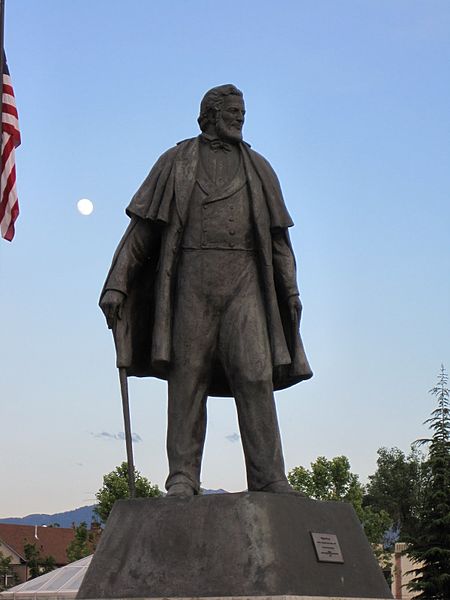
This statue of Brigham Young stands in front of the Provo (Utah) City Library, formerly Brigham Young Academy (the precursor of Brigham Young University).
No. No. Darn it, I just can’t get tonight’s ugly, toxic fiasco out of my head.
The just-concluded presidential debate, in my judgment, substantially strengthened the case for (a) restoring the separation of powers between the three branches of the federal government (e.g., by shrinking the power of the executive branch), (b) greater federalism — that is, returning power from Washington DC to the states and to local communities — and (c) limiting the power of government overall.
“I love the government and the constitution of the United States, but I do not love the damned rascals who administer the government.” (Governor Brigham Young, Journal History [8 Sep 1851] 3-4)
***
While I’m thinking of Brigham Young, I’m reminded of an interesting episode recounted in his important book Religion of a Different Color by Paul Reeve:
An early mixed-race (Black and American Indian) member of the Church named William McCary — as it turned out, a rather tenuous and somewhat erratic and even unbalanced fellow, who ultimately didn’t endure faithfully to the end — had encountered racial prejudice among some Church members.
In response to this, President Young counseled the Saints to “use the man with respect.” (The verb to use is employed here in a somewhat archaic sense common in Shakespeare. See below. In today’s English, we would employ the verb to treat.)
But some problems persisted. And he continued to complain.
Was he in some way sub- or even non-human?
“Its nothing to do with the blood,” replied President Young, “for of one blood has God made all flesh.”
Professor Reeve comments on this exchange:
“It was an echo of the same New Testament verse (Acts 17:26) that [Joseph] Smith quoted in his presidential platform three years earlier. Both drew upon the Bible to assert a broad commonality among humankind and were simultaneously acknowledging a wider racial debate then animating the scientific and Christian communities. In paraphrasing Acts 17:26, Young and Smith were referencing an important verse then commonly cited among nineteenth-century Christians. Believers used the verse to defend against a polygenesis theory then stirring scientific arguments about the origins of the various races. Scientists who promoted the polygenesis theory believed that there were multiple independent creations rather than just a single biblical creation. Each creation gave rise to a new race, which meant that whites and blacks were in fact from different species. Even though the two species could biologically reproduce, one argument was that an innate repugnance against interracial mixing was intended to preserve ‘species distinction.’ Those who violated the innate repugnance were really violating nature, which was a sure sign of their moral degradation. Physical degeneracy followed and within a few generations the offspring of such unions would be sterile.” (See W. Paul Reeve, Religion of a Different Color: Race and the Mormon Struggle for Whiteness [New York and Oxford: Oxford University Press, 2015], 128-131.)
(For historical examples of “scientific racism” in the pages of Scientific American, no less, see my recent article “Reckoning with the Mortally Inevitable.”)
It’s fashionable, of late, to demonize Brigham Young as a racist, even a vicious one — and, in some cases, essentially to forget that there was anything else to the man.
I resist this.
He wasn’t perfect, of course.
Nor is Russell M. Nelson. Nor am I. Nor are his critics.
“Use every man after his desert,” wrote Shakespeare (in Hamlet II.ii), “and who should ‘scape whipping?” Or, to paraphrase: Treat everybody purely according to his or her merits, and who wouldn’t be worthy of censure or even punishment?
In racial matters, Brigham Young said some things that jar us today — to put it mildly — and that we cannot endorse. There’s no denying this. He was, as we all are — even the prophets among us — a man of his time and culture and background.
But he was a good man, indeed a great man, a sincere disciple of the Lord and a prophet who sought to do God’s will.
I choose to stand with him. “The soul that on Jesus hath leaned for repose I will not, I cannot, desert to his foes.” And, on the specific racial issue described above, President Brigham Young was — notwithstanding the dismissive stereotype of him that’s currently in vogue — on the side of the angels.
Previous Post

September 29, 2020
Of the shining city on a hill
Next Post
September 30, 2020 Revision 5.17 "What the West Owes the East" (The Arts)
Browse Our Archives
Select a Category Uncategorized
Select a Month October 2026 September 2026 August 2026 July 2026 June 2026 May 2026 April 2026 March 2026 February 2026 January 2026 December 2025 November 2025 October 2025 September 2025 August 2025 July 2025 June 2025 May 2025 April 2025 March 2025 February 2025 January 2025 December 2024 November 2024 October 2024 September 2024 August 2024 July 2024 June 2024 May 2024 April 2024 March 2024 February 2024 January 2024 December 2023 November 2023 October 2023 September 2023 August 2023 July 2023 June 2023 May 2023 April 2023 March 2023 February 2023 January 2023 December 2022 November 2022 October 2022 September 2022 August 2022 July 2022 June 2022 May 2022 April 2022 March 2022 February 2022 January 2022 December 2021 November 2021 October 2021 September 2021 August 2021 July 2021 June 2021 May 2021 April 2021 March 2021 February 2021 January 2021 December 2020 November 2020 October 2020 September 2020 August 2020 July 2020 June 2020 May 2020 April 2020 March 2020 February 2020 January 2020 December 2019 November 2019 October 2019 September 2019 August 2019 July 2019 June 2019 May 2019 April 2019 March 2019 February 2019 January 2019 December 2018 November 2018 October 2018 September 2018 August 2018 July 2018 June 2018 May 2018 April 2018 March 2018 February 2018 January 2018 December 2017 November 2017 October 2017 September 2017 August 2017 July 2017 June 2017 May 2017 April 2017 March 2017 February 2017 January 2017 December 2016 November 2016 October 2016 September 2016 August 2016 July 2016 June 2016 May 2016 April 2016 March 2016 February 2016 January 2016 December 2015 November 2015 October 2015 September 2015 August 2015 July 2015 June 2015 May 2015 April 2015 March 2015 February 2015 January 2015 December 2014 November 2014 March 2014 August 2013 February 2012
Follow Us!
TAKE THE
Religious Wisdom Quiz
Who was known for interpreting dreams in Babylon?
Select your answer to see how you score.
Daniel Moses Joseph David
Related posts from Sic et Non


Learning more about a region of which I've...

From Serbia's "White City," Belgrade

TRENDING AT PATHEOS Latter-day Saint

The Image: On the Horror of Capitalism and...
The Image Then went the Pharisees, and took counsel how they might...

We are approaching the date of our new American national holiday: October...

Letters on Living the Faith by C.S. Lewis
Most of us met C.S. Lewis as a public intellectual. Mere Christianity....

When Halloween Unmasks Married Hearts
Written by Dr. David K. Ewen from Eternal Truth Bible College Behind...

Aristotle. He’s been called the father of logic, the father of the...

Methodist Central Hall and Westminster Abbey
Situated on the same square is Methodist Central Hall and Westminster Abbey. ...
view all Latter-day Saint blogs
Ad-Free & Subscriber Log-In Subscription Support
- About Us
- 2026 Calendar
- Videos
- Podcasts
- Library of World Religions
- Faith In Media Tracker
- Advertise With Us
- Write for Us
- Privacy Policy
- Terms of Service
- Do Not Sell My Data
- Contact Us
- Radiant Digital
- Manage Newsletter Subscriptions
- Unsubscribe From Notifications
- Sitemap
Copyright 2008-2026, Patheos. All rights reserved.
Subscription Support Ad-Free & Subscriber Log-In
Follow Patheos