
BuddhistCatholicContemplativeEvangelicalGeneral ChristianHinduJewishLatter-day SaintMuslimNew VisionsProgressive Christian
Beliefs
- Buddhist
- Catholic
- Contemplative
- Evangelical
- General Christian
- Hindu
- Jewish
- Latter-day Saint
- More Voices
- Muslim
- New Visions
- Pagan
- Progressive Christian
Topics
- Religion News
- Food and Religion
- Sports and Religion
- Religious Art
- Religious Music and Entertainment
- Religious Events
- History and Religion
- Style and Religion
- Politics and Religion
- Women in Religion
- Recreation Outdoors and Religion
- Business Finance and Religion
- Careers Workplace and Religion
- Education and Religion
- Family Parenting and Religion
- Health Fitness and Religion
- Home and Religion
- Relationships and Religion
- Technology and Religion
- Travel and Religion
Columnists
- Buddhist Columnists
- Business Finance and Religion Columnists
- Careers Workplace and Religion Columnists
- Catholic Columnists
- Contemplative Columnists
- Education and Religion Columnists
- Evangelists Columnists
- Family Parenting and Religion Columnists
- General Christian Columnists
- Health Fitness and Religion Columnists
- Hindu Columnists
- History and Religion Columnists
- Home and Religion Columnists
- Jewish Columnists
- More Voices Columnists
- Latter Day Columnists
- Muslim Columnists
- New Visions Columnists
- Nonreligious Columnists
- Pagan Columnists
- Politics and Religion Columnists
- Progressive Columnists
- Recreation Outdoors and Religion Columnists
- Relationships and Religion Columnists
- Religion News Columnists
- Religious Art Columnists
- Religious Events Columnists
- Religious Music and Entertainment Columnists
- Sports and Religion Columnists
- Style and Religion Columnists
- Technology and Religion Columnists
- Travel and Religion Columnists
- Women in Religion Columnists
Resource Library
- 2026 Calendar
- Library of World Religions
- The 100 Most Holy Places on Earth
- Patheos Answers
- Podcasts
- Videos
- Faith Leaders Database
- Anglican Episcopalian
- Bahai
- Baptist
- Buddhism
- Christianity
- Confucianism
- Eastern Orthodoxy
- Hinduism
- Holiness and Pentecostal
- ISKCON
- Islam
- Judaism
- Lutheran
- Methodist
- The Church of Jesus Christ of Latter-day Saints
- New Age
- Paganism
- Presbytarian and Reformed
- Protestantism
- Religion Behind the Scenes
- Roman Catholic
- Scientology
- Shia Islam
- Sikhism
- Sufism
- Sunni Islam
- Taoism
- Zen
- See all religions
Research Tools
 Ad-Free & Subscriber Log-In Subscription Support
Ad-Free & Subscriber Log-In Subscription Support
Follow Patheos 

- Trending:
- Forgiveness
- |
- Marriage
- |
- Consciousness
- |
- Death Penalty
- |
- Election
- |
- Halloween

- Home
- Latter-day Saint
- The Seventeenth Century and the Birth of Modern Science
The Seventeenth Century and the Birth of Modern Science
Last updated on: August 15, 2020 at 10:52 pm by Dan Peterson
The Seventeenth Century and the Birth of Modern Science 2020-08-15T22:52:42-06:00 Dan Peterson
Patheos Explore the world's faith through different perspectives on religion and spirituality! Patheos has the views of the prevalent religions and spiritualities of the world.
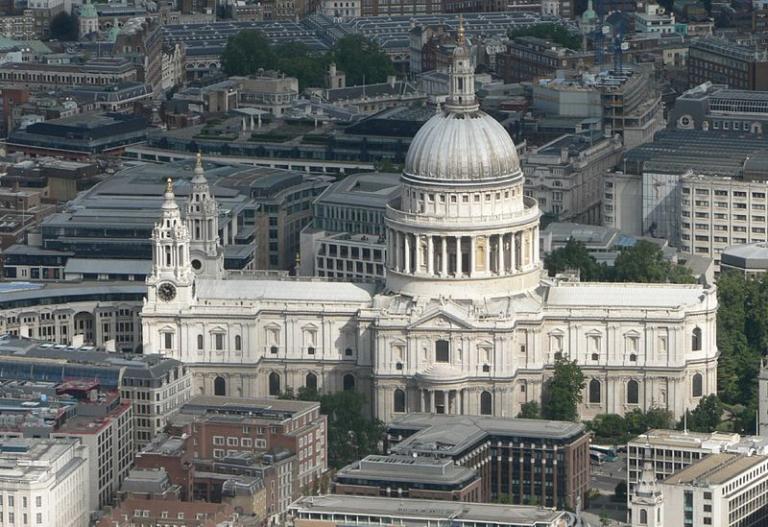
Aerial view of St. Paul’s Cathedral, in London, by Mark Frosh. St. Paul’s was designed by the anatomist, mathematician, astronomer, and physicist Sir Christopher Wren. A close friend of Sir Isaac Newton, Wren was a co-founder with Newton of the Royal Society and eventually became one of its presidents. St. Paul’s is among the fifty-two churches that he designed in London.
(Wikimedia Commons public domain image)
Gemli wonders why anyone cares what people from the 17th century thought about this or that religion. Most were busy dying young of pneumonia and poor sanitation. If they had such great minds, perhaps instead of wasting time thinking about invisible sky spirits they might have investigated the real world that was killing them due to their ignorance.
That’s this board’s amusing resident atheist, “gemli,” speaking of himself, in the third person.
I was struck, when I read gemli’s comment, at his choice of the seventeenth century as a parade example of a period when, instead of “investigating the real world,” all them theists wuz “wasting time thinking about invisible sky spirits.” Two characteristic features of gemli’s thinking are (a) his ignorance of, and disdain for, history and (b) his insistence that theism and science are incompatible rivals. Both of those features are on clear display in the comment above.
Please meet the actual seventeenth century, though. It was genuinely quite religious and, accordingly, gemli imagines that its residents were so preoccupied with “wasting time thinking about invisible sky spirits” that they had neither time nor energy left over to “investigate the real world.” Here are some highlights:
1600 — William Gilbert discovers earth’s magnetic field.
1608 — earliest mention of an optical telescope
1609 — Johannes Kepler formulates the first two laws of planetary motion
1610 — Galileo Galilei publishes his first astronomical observations in the Sidereus Nuncius (“Starry Messenger”)
1614 — John Napier introduces the use of logarithms for calculation
1619 — Johannes Kepler formulates the third law of planetary motion
1619 – René Descartes creates the Cartesian coordinate system and, thus, analytic geometry
1620 — the first compound microscopes appear in Europe
1628 — William Harvey discovers the circulation of blood
1638 — Galileo Galilei formulates the laws of a falling body
1646 — Sir Thomas Browne coins the word electricity, based upon William Gilbert’s work
1654 — Blaise Pascal and Pierre de Fermat create the theory of probability
1660 — first meeting of the Royal Society
1662 — Robert Boyle formulates his law of ideal gas
1662 — Blaise Pascal dies at thirty-nine, having done pioneering work on calculating machines, probability theory, projective geometry, the theory of fluids, vacuums, and pressure
1665 — the first peer-reviewed scientific journal, Philosophical Transactions of the Royal Society, appears
1665 — Robert Hooke discovers the cell
1668 — Francesco Redi disproves the idea of spontaneous generation
1669 — Nicholas Steno proposes that fossils are organic remains embedded in layers of sediment, thus establishing the science of stratigraphy
1672 — Isaac Newton discovers that white light is actually composed of a spectrum of colored rays
1675 — Anton van Leeuwenhoek observes microorganisms by means of a microscope
1675 — Isaac Newton and Gottfried Leibniz develop the infinitesimal calculus and its system of mathematical notation
1675 — Gottfried Leibniz develops the binary number system
1676 — Ole Rømer achieves the first measurement of the speed of light
1680s — Gottfried Leibniz works on symbolic logic
1687 — Isaac Newton formulates the laws of motion and the law of universal gravity, laying the foundation of modern physics
1691 — Gottfried Leibniz discovers the technique of separation of variables for ordinary differential equations
1693 — Edmund Halley creates the first mortality tables that statistically relate death rate to age
Most specialist historians, if asked about the birth of modern science, place it in, precisely, the seventeenth century — a time when, according to gemli, theistic obscurantists were so busy “wasting time thinking about invisible sky spirits” that they couldn’t be bothered with “investigating the real world.”
Posted from Seaside, Oregon
Next Post

August 12, 2020 Revision 3.10 "The Death of Muhammad"
Browse Our Archives
Select a Category Uncategorized
Select a Month October 2026 September 2026 August 2026 July 2026 June 2026 May 2026 April 2026 March 2026 February 2026 January 2026 December 2025 November 2025 October 2025 September 2025 August 2025 July 2025 June 2025 May 2025 April 2025 March 2025 February 2025 January 2025 December 2024 November 2024 October 2024 September 2024 August 2024 July 2024 June 2024 May 2024 April 2024 March 2024 February 2024 January 2024 December 2023 November 2023 October 2023 September 2023 August 2023 July 2023 June 2023 May 2023 April 2023 March 2023 February 2023 January 2023 December 2022 November 2022 October 2022 September 2022 August 2022 July 2022 June 2022 May 2022 April 2022 March 2022 February 2022 January 2022 December 2021 November 2021 October 2021 September 2021 August 2021 July 2021 June 2021 May 2021 April 2021 March 2021 February 2021 January 2021 December 2020 November 2020 October 2020 September 2020 August 2020 July 2020 June 2020 May 2020 April 2020 March 2020 February 2020 January 2020 December 2019 November 2019 October 2019 September 2019 August 2019 July 2019 June 2019 May 2019 April 2019 March 2019 February 2019 January 2019 December 2018 November 2018 October 2018 September 2018 August 2018 July 2018 June 2018 May 2018 April 2018 March 2018 February 2018 January 2018 December 2017 November 2017 October 2017 September 2017 August 2017 July 2017 June 2017 May 2017 April 2017 March 2017 February 2017 January 2017 December 2016 November 2016 October 2016 September 2016 August 2016 July 2016 June 2016 May 2016 April 2016 March 2016 February 2016 January 2016 December 2015 November 2015 October 2015 September 2015 August 2015 July 2015 June 2015 May 2015 April 2015 March 2015 February 2015 January 2015 December 2014 November 2014 March 2014 August 2013 February 2012
Follow Us!
TAKE THE
Religious Wisdom Quiz
I found the Book of the Law in the temple during repairs and wept when it was read to me. Who am I?
Select your answer to see how you score.
Joash Hezekiah Josiah Asa
Related posts from Sic et Non


“Once more unto the breach, dear friends, once...

A case of twin near-death experiences?
TRENDING AT PATHEOS Latter-day Saint

The Sermon on the Mount, Part I: Matthew...
The Sermon on the Mount, Part I (Matthew 4:12-5:12) St. Matthew moves...

What's up from Crossway: Reviewing some of their latest A few weeks...

Janie Learns the Way of the Cross: A...
Teaching children about Jesus' Passion can be challenging. Many parents and educators...

Looking For Good Catholic Writing - October 2026
He alone extends the heavens, and he walks upon the waves of...

In "Irreplaceable," our book on vocation and technology, Trevor Sutton and I...

I was strolling through the top floor of the brand new Parthenon...
view all Latter-day Saint blogs
Ad-Free & Subscriber Log-In Subscription Support
- About Us
- 2026 Calendar
- Videos
- Podcasts
- Library of World Religions
- Faith In Media Tracker
- Advertise With Us
- Write for Us
- Privacy Policy
- Terms of Service
- Do Not Sell My Data
- Contact Us
- Radiant Digital
- Manage Newsletter Subscriptions
- Unsubscribe From Notifications
- Sitemap
Copyright 2008-2026, Patheos. All rights reserved.
Subscription Support Ad-Free & Subscriber Log-In
Follow Patheos