
BuddhistCatholicContemplativeEvangelicalGeneral ChristianHinduJewishLatter-day SaintMuslimNew VisionsProgressive Christian
Beliefs
- Buddhist
- Catholic
- Contemplative
- Evangelical
- General Christian
- Hindu
- Jewish
- Latter-day Saint
- More Voices
- Muslim
- New Visions
- Pagan
- Progressive Christian
Topics
- Religion News
- Food and Religion
- Sports and Religion
- Religious Art
- Religious Music and Entertainment
- Religious Events
- History and Religion
- Style and Religion
- Politics and Religion
- Women in Religion
- Recreation Outdoors and Religion
- Business Finance and Religion
- Careers Workplace and Religion
- Education and Religion
- Family Parenting and Religion
- Health Fitness and Religion
- Home and Religion
- Relationships and Religion
- Technology and Religion
- Travel and Religion
Columnists
- Buddhist Columnists
- Business Finance and Religion Columnists
- Careers Workplace and Religion Columnists
- Catholic Columnists
- Contemplative Columnists
- Education and Religion Columnists
- Evangelists Columnists
- Family Parenting and Religion Columnists
- General Christian Columnists
- Health Fitness and Religion Columnists
- Hindu Columnists
- History and Religion Columnists
- Home and Religion Columnists
- Jewish Columnists
- More Voices Columnists
- Latter Day Columnists
- Muslim Columnists
- New Visions Columnists
- Nonreligious Columnists
- Pagan Columnists
- Politics and Religion Columnists
- Progressive Columnists
- Recreation Outdoors and Religion Columnists
- Relationships and Religion Columnists
- Religion News Columnists
- Religious Art Columnists
- Religious Events Columnists
- Religious Music and Entertainment Columnists
- Sports and Religion Columnists
- Style and Religion Columnists
- Technology and Religion Columnists
- Travel and Religion Columnists
- Women in Religion Columnists
Resource Library
- 2026 Calendar
- Library of World Religions
- The 100 Most Holy Places on Earth
- Patheos Answers
- Podcasts
- Videos
- Faith Leaders Database
- Anglican Episcopalian
- Bahai
- Baptist
- Buddhism
- Christianity
- Confucianism
- Eastern Orthodoxy
- Hinduism
- Holiness and Pentecostal
- ISKCON
- Islam
- Judaism
- Lutheran
- Methodist
- The Church of Jesus Christ of Latter-day Saints
- New Age
- Paganism
- Presbytarian and Reformed
- Protestantism
- Religion Behind the Scenes
- Roman Catholic
- Scientology
- Shia Islam
- Sikhism
- Sufism
- Sunni Islam
- Taoism
- Zen
- See all religions
Research Tools
 Ad-Free & Subscriber Log-In Subscription Support
Ad-Free & Subscriber Log-In Subscription Support
Follow Patheos 

- Trending:
- Forgiveness
- |
- Marriage
- |
- Consciousness
- |
- Death Penalty
- |
- Election
- |
- Halloween

- Home
- Latter-day Saint
- The Book of Moses and a School for Souls
The Book of Moses and a School for Souls
Last updated on: August 28, 2020 at 6:37 pm by Dan Peterson
The Book of Moses and a School for Souls 2020-08-28T18:37:45-06:00 Dan Peterson
Patheos Explore the world's faith through different perspectives on religion and spirituality! Patheos has the views of the prevalent religions and spiritualities of the world.
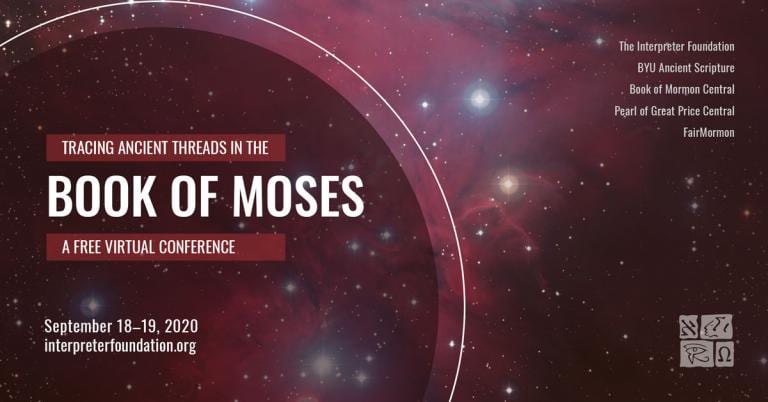
A notice for the upcoming Interpreter Foundation conference on the Book of Moses
(Image from Book of Mormon Central)
I’ve been slow in calling attention to the latest installment of my bi-weekly column for the Deseret News. Here it is:
One of the most familiar of all spirituals is ”Michael, Row the Boat Ashore” and it seems to have been written down first on St. Helena Island, off the coast of South Carolina, during the Civil War
***
“Tracing Ancient Threads in the Book of Moses” (18-19 September 2020)
***
Now up on the website of the Interpreter Foundation:
“Book of Moses Textual Criticism Article Preview 1: Did God or Enoch Weep?”
[In this context, I would like to call attention to my own article from some years ago, “On the Motif of the Weeping God in Moses 7,” which can be downloaded here.]
Interpreter Radio Show — August 23, 2020
The 23 August 2020 broadcast of the Interpreter Radio Show was hosted by Steve Densley, Matthew Bowen, and Mark Johnson. In this episode, which has now been shorn of commercial and other interruptions and made accessible to you at no charge, special guest Jeff Lindsay discusses recent research and the new Interpreter Foundation article on Lehi’s journey through Arabia. The second hour was a roundtable on the upcoming Come, Follow Me Book of Mormon lesson #38 on 3 Nephi 12-16.
And here’s an important announcement regarding one of our publications:
“Black & White Volume 37 of Interpreter: A Journal of Latter-day Saint Faith and Scholarship”
As Jeff Lindsay points out, the color can be seen online when desired.
***
I know. I know. Your Christopher Hitchens Memorial “How Religion Poisons Everything” File has a voracious appetite that demands food. So here are a couple of items for it:
“2020 All Africa Service Day held across West Africa. Day of Service”
“President Bingham Celebrates Women’s Equality Day”
***
Here’s a passage from Fiona Givens and Terryl Givens, The Christ Who Heals: How God Restored the Truth that Saves Us, that really impressed me. It’s from pages 104-105:
No loving parent would propose a plan that shuts the door of happiness to any of his or her children. God reminds Job of a time when “all the sons of God shouted for joy.” Only a proposal that opens the path to salvation for all God’s children would be praiseworthy. And that was clearly understood in the early Christian centuries. Morwenna Ludlow has recently written that, “Indeed, in the early Christian Church there were two important streams of eschatological thought: a universalist stream, which asserted that all people would be saved, and a dualistic stream, which stressed the two parallel fates of eternal heaven and eternal hell.” The first tradition was represented by Origen, Gregory of Nyssa, his sister Macrina, Maximus the Confessor, and others. Origen saw mortality as the crucial second stage in an ongoing saga of eternal progression. “The saints who depart this life,” he wrote, will progress to a
place of instruction, and so to speak, class-room or school of souls, in which they are to be instructed . . . and are to receive also some information respecting things that are to follow in the future, . . . all of which are revealed more clearly and distinctly to the saints in their proper time and place. If any one indeed be pure in heart, and holy in mind, . . . he will indeed, by making more rapid progress, quickly ascend . . . and reach the kingdom of heaven. . . . And thus he will in order pass through all gradations, following him who hath passed into the heavens, Jesus the Son of God, who said, “I will that where I am, these may be also.”
Gregory of Nyssa taught the same consoling truth: “[God’s] end is one, and one only; it is this: when the complete whole of our race shall have been perfected from the first man to the last . . . to offer to every one of us participation in the blessings which are in Him.”
Here is no automatic salvation, but a process in which, following death, we would move on to a “school of souls” in which the departed will continue to be instructed “by word, reason, and doctrine; by a call to a better course of things,” but always “consistently with the preservation of freedom of the will.” Any correction would be medicinal and pedagogical — and therefore not of infinite duration. (Like Joseph, Origen rejected the interpretation of eternal as “nonending.”) Men are educated insofar as they are drawn by love. This was Origen’s emphasis: “the redeeming power of God’s love and the universal scope of Christ’s incarnation and resurrection.” These Greek Fathers championed a God who never shut the door of salvation to their children, here or hereafter.
***
Finally, though, I confess that, having read the following article, I may now be obligated to become an aggressive unbeliever:
“10 Irrefutable Atheist Arguments That Will Explode Your Feeble Christian Brain”
Previous Post

August 27, 2020
David Whitmer's testimony, in verse
Next Post
August 28, 2020 Revision 4.10 "On the Moral Teachings of the Qur’an"
Browse Our Archives
Select a Category Uncategorized
Select a Month October 2026 September 2026 August 2026 July 2026 June 2026 May 2026 April 2026 March 2026 February 2026 January 2026 December 2025 November 2025 October 2025 September 2025 August 2025 July 2025 June 2025 May 2025 April 2025 March 2025 February 2025 January 2025 December 2024 November 2024 October 2024 September 2024 August 2024 July 2024 June 2024 May 2024 April 2024 March 2024 February 2024 January 2024 December 2023 November 2023 October 2023 September 2023 August 2023 July 2023 June 2023 May 2023 April 2023 March 2023 February 2023 January 2023 December 2022 November 2022 October 2022 September 2022 August 2022 July 2022 June 2022 May 2022 April 2022 March 2022 February 2022 January 2022 December 2021 November 2021 October 2021 September 2021 August 2021 July 2021 June 2021 May 2021 April 2021 March 2021 February 2021 January 2021 December 2020 November 2020 October 2020 September 2020 August 2020 July 2020 June 2020 May 2020 April 2020 March 2020 February 2020 January 2020 December 2019 November 2019 October 2019 September 2019 August 2019 July 2019 June 2019 May 2019 April 2019 March 2019 February 2019 January 2019 December 2018 November 2018 October 2018 September 2018 August 2018 July 2018 June 2018 May 2018 April 2018 March 2018 February 2018 January 2018 December 2017 November 2017 October 2017 September 2017 August 2017 July 2017 June 2017 May 2017 April 2017 March 2017 February 2017 January 2017 December 2016 November 2016 October 2016 September 2016 August 2016 July 2016 June 2016 May 2016 April 2016 March 2016 February 2016 January 2016 December 2015 November 2015 October 2015 September 2015 August 2015 July 2015 June 2015 May 2015 April 2015 March 2015 February 2015 January 2015 December 2014 November 2014 March 2014 August 2013 February 2012
Follow Us!
TAKE THE
Religious Wisdom Quiz
How many years did Solomon reign?
Select your answer to see how you score.
30 years 50 years 40 years 35 years
Related posts from Sic et Non

"The Book of Moses as a Temple Text"

"An Early Christian Context for the Book of...

"Was Joseph a Sexual Predator?" and other fun...
TRENDING AT PATHEOS Latter-day Saint

Nearly every morning, I make the drive to Detroit with my high-school-age...

The Real AI Story Is Adoption Without Trust
Artificial intelligence has crossed a political threshold. It is no longer a...

A new article, written by Jeff Lindsay and Gale L. Pooley,...

Swimfan: Forgotten Aughts Pleasures
This is a recovery effort. In 2002, My Big Fat Greek Wedding...

Top Three Anti-Catholic Lies About Catholicism
This is my initial transcript for the video, "THE 3 WORST...

Pope Leo Celebrates Mass for Nurses & Docs...
I don't have any idea how he did it, but Pope Leo...
view all Latter-day Saint blogs
Ad-Free & Subscriber Log-In Subscription Support
- About Us
- 2026 Calendar
- Videos
- Podcasts
- Library of World Religions
- Faith In Media Tracker
- Advertise With Us
- Write for Us
- Privacy Policy
- Terms of Service
- Do Not Sell My Data
- Contact Us
- Radiant Digital
- Manage Newsletter Subscriptions
- Unsubscribe From Notifications
- Sitemap
Copyright 2008-2026, Patheos. All rights reserved.
Subscription Support Ad-Free & Subscriber Log-In
Follow Patheos