
BuddhistCatholicContemplativeEvangelicalGeneral ChristianHinduJewishLatter-day SaintMuslimNew VisionsProgressive Christian
Beliefs
- Buddhist
- Catholic
- Contemplative
- Evangelical
- General Christian
- Hindu
- Jewish
- Latter-day Saint
- More Voices
- Muslim
- New Visions
- Pagan
- Progressive Christian
Topics
- Religion News
- Food and Religion
- Sports and Religion
- Religious Art
- Religious Music and Entertainment
- Religious Events
- History and Religion
- Style and Religion
- Politics and Religion
- Women in Religion
- Recreation Outdoors and Religion
- Business Finance and Religion
- Careers Workplace and Religion
- Education and Religion
- Family Parenting and Religion
- Health Fitness and Religion
- Home and Religion
- Relationships and Religion
- Technology and Religion
- Travel and Religion
Columnists
- Buddhist Columnists
- Business Finance and Religion Columnists
- Careers Workplace and Religion Columnists
- Catholic Columnists
- Contemplative Columnists
- Education and Religion Columnists
- Evangelists Columnists
- Family Parenting and Religion Columnists
- General Christian Columnists
- Health Fitness and Religion Columnists
- Hindu Columnists
- History and Religion Columnists
- Home and Religion Columnists
- Jewish Columnists
- More Voices Columnists
- Latter Day Columnists
- Muslim Columnists
- New Visions Columnists
- Nonreligious Columnists
- Pagan Columnists
- Politics and Religion Columnists
- Progressive Columnists
- Recreation Outdoors and Religion Columnists
- Relationships and Religion Columnists
- Religion News Columnists
- Religious Art Columnists
- Religious Events Columnists
- Religious Music and Entertainment Columnists
- Sports and Religion Columnists
- Style and Religion Columnists
- Technology and Religion Columnists
- Travel and Religion Columnists
- Women in Religion Columnists
Resource Library
- 2026 Calendar
- Library of World Religions
- The 100 Most Holy Places on Earth
- Patheos Answers
- Podcasts
- Videos
- Faith Leaders Database
- Anglican Episcopalian
- Bahai
- Baptist
- Buddhism
- Christianity
- Confucianism
- Eastern Orthodoxy
- Hinduism
- Holiness and Pentecostal
- ISKCON
- Islam
- Judaism
- Lutheran
- Methodist
- The Church of Jesus Christ of Latter-day Saints
- New Age
- Paganism
- Presbytarian and Reformed
- Protestantism
- Religion Behind the Scenes
- Roman Catholic
- Scientology
- Shia Islam
- Sikhism
- Sufism
- Sunni Islam
- Taoism
- Zen
- See all religions
Research Tools
 Ad-Free & Subscriber Log-In Subscription Support
Ad-Free & Subscriber Log-In Subscription Support
Follow Patheos 

- Trending:
- Forgiveness
- |
- Marriage
- |
- Consciousness
- |
- Death Penalty
- |
- Election
- |
- Halloween

- Home
- Latter-day Saint
- Revision 4.9 “Hell and Heaven in the Qur’an”
Revision 4.9 “Hell and Heaven in the Qur’an”
Last updated on: August 28, 2020 at 6:50 pm by Dan Peterson
Revision 4.9 “Hell and Heaven in the Qur’an” 2020-08-28T18:50:21-06:00 Dan Peterson
Patheos Explore the world's faith through different perspectives on religion and spirituality! Patheos has the views of the prevalent religions and spiritualities of the world.
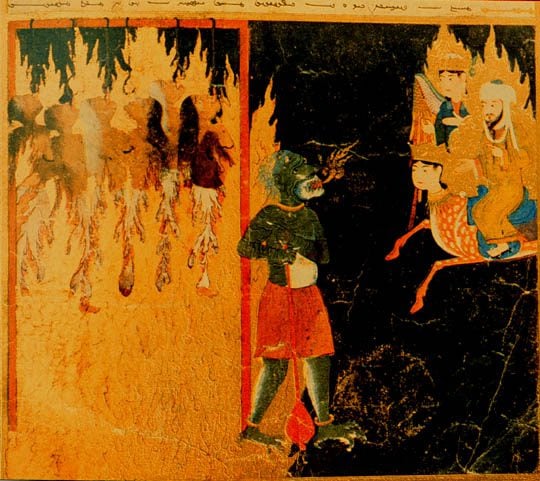
Muhammad visiting Hell
(15th cent Persian ms. Wikimedia CC public domain)
The ultimate destination of the damned is described in the Qur’an with highly picturesque language. Hell is a place of raging and roaring fire, of towering columns of destroying flame, and of scorching winds that drive pitch-black smoke across a blighted landscape. The souls of the unrighteous are prevented from escaping by fetters (hammered out of the very wealth that they lusted after on earth) that bind them to their place of punishment. Still subject to hunger and thirst, they are offered only food that chokes—including a horrific fruit that is said to look like devils’ heads—and a drink as hot as molten brass. “Yet you shall drink it as the thirsty camel drinks.”[1] The unrighteous rich are singled out for special mention.
Proclaim a woeful punishment to those that hoard up gold and silver and do not spend it in God’s cause. The day will surely come when their treasures shall be heated in the fire of Hell, and their foreheads, sides, and backs branded with them. Their tormentors will say to them: “These are the riches which you hoarded. Taste then the punishment which is your due.”[2]
However, it is not only the miserly who have reason to fear. None of the unrighteous will have an easy or pleasant time in the Qur’anic hell. The situation of the sinful soul will be desperate there, yet will have no hope. Of the sinner, the Qur’an says that “death comes upon him from every side, yet he cannot die.”[3] (One thinks of the inscription over the gate of hell in Dante’s Inferno, written in early fourteenth-century Italy: “Abandon all hope, ye who enter here.”)[4] “Those that deny Our revelations We will burn in Hell-fire,” God is quoted as saying. “No sooner will their skins be consumed than We shall give them other skins, so that they may truly taste Our scourge.”[5]
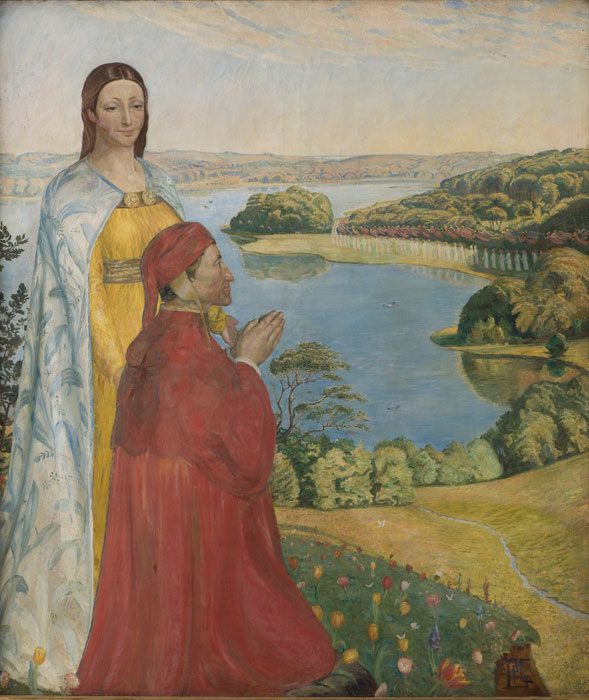
“Dante og Beatrice i Paradis,” by Poul S. Christiansen (1894). Public domain via Wikimedia CC.
Even more detailed than the Qur’an’s portrayal of hell is its depiction of paradise. It is a picture that has inspired much derision among Westerners—most of it quite ignorant and beside the point.
The Qur’anic paradise is a garden, a place of darkest green, filled with palms and pomegranates and running streams. A shady region “as vast as heaven and earth,” it suffers from neither scorching heat nor biting cold. It is a very different place from the hell sketched above.
The saved are radiant. They recline on couches, clothed in garments of fine green silk and rich brocade, with bracelets of silver and gold on their arms. Luscious fruit hangs in clusters above and about them, and beneath them rich carpets are spread. Their lofty mansions provide them a view of the sufferings of the damned in hell, far below them. No idle talk is heard in paradise, but rather reflections upon the goodness of God and upon their lives and the lives of the damned in mortality. Meanwhile, their attendants, young boys whose beauty resembles that of scattered pearls, scurry about with vessels of silver and gold and goblets of crystal, serving to the righteous pure drink from a paradisiacal fountain, a pure wine that neither intoxicates nor gives a hangover.[6]
No aspect of the Qur’anic paradise has brought more leering comment than the so-called houris.[7] According to the Qur’an, these are maidens of bashful glance, dark-eyed and full-breasted. Their beauty resembles that of rubies and corals. Untouched by men, pure, cloistered in the pavilions of paradise where they remain “chaste like hidden pearls” or like “the sheltered eggs of ostriches,” they await the arrival of the blessed to the mansions prepared for them.[8] Are they fully human? Where do they come from? Are they righteous, believing women from the earth? The Qur’an does not say. But one of the great gifts bestowed by paradise upon the righteous is that God will marry them to these dark-eyed houris.[9]
This element of the Qur’anic paradise has, as I say, received much mockery in the West, and such criticism has often put educated Muslims on the defensive. Today and almost since the rise of Islam, there have been claims that these very tangible and material blessings are meant metaphorically. The point, according to many defenders of the Qur’an, is to illustrate even to simple believers that paradise contains “whatever the souls desire, and the eyes delight in.”[10] The metaphor should not, they insist, be taken as literal fact. Moreover, all these material symbols of the joy awaiting the righteous fail to convey adequately what bliss is really there. “No mortal knows,” the Qur’an declares, “what bliss is in store for [the righteous] as a reward for their labours.”[11] The real blessing of paradise, say the nonliteralists, is the blessing next to which all the trees and streams and nonintoxicating wines and houris dwindle into insignificance. In that place “the righteous shall dwell in gardens where rivers flow, honourably seated in the presence of a Mighty King.”[12] Being in the presence of God himself is the crown of all paradisiacal blessings. But one cannot leave the Qur’an’s very literal-sounding and graphic description of paradise without noting that Syriac Christian writings of a few centuries earlier contain almost precisely identical elements.
[1] Representative passages concerning Hell include 3:180; 14:16-17; 18:29; 25:12;
37:62- 74; 38:55-59; 44:43-50; 56:41-56; 73:12-13; 104:4-9.
[2] 9:34 35.
[3] 14:17.
[4] Dante, Inferno, Canto III, line 9: Lasciate ogne speranza, voi ch’entrate.
[5] The Christian Dante assigns a similar punishment to thieves, at Canto XXIV, lines 97-105, of his Inferno. Compare the fate of the sowers of schism and discord–among whom Dante unfairly places Muhammad–at Canto XXVIII.
[6] Representative texts on the Qur’anic paradise include 2:25; 3:15, 133-36; 4:57; 13:35; 18:31; 19:62; 22:23; 29:58; 37:40-61; 43:70-73; 44:51-57; 52:17-28; 55:46-77; 56:15-38; 57:21; 76:5-6, 11-22; 77:41-44; 78:31-36; 83:22-28; 88:8-16; 98:7-8.
[7] The singular, houri, is pronounced something like “HOO-ree.”
[8] On them, see 2:25; 3:15; 4:57; 37:48-49; 38:52; 55:56, 58, 70, 72, 74; 56:22-23, 3538; 78:33.
[9] 2:25; 3:15; 4:57; 44:54; 52:20.
[10] 43:71.
[11] 32:17. Compare the similar claim made by the Apostle Paul at 1 Corinthians 2:9. Paul’s own words show up in later Islamic tradition as a statement made by the Prophet Muhammad.
[12] 54:54-55. Even here, the plain meaning of the Qur’anic text suggests the possibility of literally being in the presence of a God who has spatial location. Actually, though, the Qur’an contains verses that can easily be used against an anthropomorphic view of deity. For example, it says, “Nothing can be compared with Him.” (42:11.) The real question is how such verses are to be received.
Previous Post

August 26, 2020
Greed, Priestcraft, and Me
Next Post
August 27, 2020 No doubt: "There is grandeur in this view of life"
Browse Our Archives
Select a Category Uncategorized
Select a Month October 2026 September 2026 August 2026 July 2026 June 2026 May 2026 April 2026 March 2026 February 2026 January 2026 December 2025 November 2025 October 2025 September 2025 August 2025 July 2025 June 2025 May 2025 April 2025 March 2025 February 2025 January 2025 December 2024 November 2024 October 2024 September 2024 August 2024 July 2024 June 2024 May 2024 April 2024 March 2024 February 2024 January 2024 December 2023 November 2023 October 2023 September 2023 August 2023 July 2023 June 2023 May 2023 April 2023 March 2023 February 2023 January 2023 December 2022 November 2022 October 2022 September 2022 August 2022 July 2022 June 2022 May 2022 April 2022 March 2022 February 2022 January 2022 December 2021 November 2021 October 2021 September 2021 August 2021 July 2021 June 2021 May 2021 April 2021 March 2021 February 2021 January 2021 December 2020 November 2020 October 2020 September 2020 August 2020 July 2020 June 2020 May 2020 April 2020 March 2020 February 2020 January 2020 December 2019 November 2019 October 2019 September 2019 August 2019 July 2019 June 2019 May 2019 April 2019 March 2019 February 2019 January 2019 December 2018 November 2018 October 2018 September 2018 August 2018 July 2018 June 2018 May 2018 April 2018 March 2018 February 2018 January 2018 December 2017 November 2017 October 2017 September 2017 August 2017 July 2017 June 2017 May 2017 April 2017 March 2017 February 2017 January 2017 December 2016 November 2016 October 2016 September 2016 August 2016 July 2016 June 2016 May 2016 April 2016 March 2016 February 2016 January 2016 December 2015 November 2015 October 2015 September 2015 August 2015 July 2015 June 2015 May 2015 April 2015 March 2015 February 2015 January 2015 December 2014 November 2014 March 2014 August 2013 February 2012
Follow Us!
TAKE THE
Religious Wisdom Quiz
What false teaching did Paul correct in 1 Corinthians 15?
Select your answer to see how you score.
Circumcision Animal sacrifice Pagan temple worship Denial of resurrection
Related posts from Sic et Non


Islam in America or Islam versus America?

A basic working chronology of Islamic-era Iran

Actual Data and Actual Crusades
TRENDING AT PATHEOS Latter-day Saint

The Image: On the Horror of Capitalism and...
The Image Then went the Pharisees, and took counsel how they might...

We are approaching the date of our new American national holiday: October...

Letters on Living the Faith by C.S. Lewis
Most of us met C.S. Lewis as a public intellectual. Mere Christianity....

When Halloween Unmasks Married Hearts
Written by Dr. David K. Ewen from Eternal Truth Bible College Behind...

Aristotle. He’s been called the father of logic, the father of the...

Methodist Central Hall and Westminster Abbey
Situated on the same square is Methodist Central Hall and Westminster Abbey. ...
view all Latter-day Saint blogs
Ad-Free & Subscriber Log-In Subscription Support
- About Us
- 2026 Calendar
- Videos
- Podcasts
- Library of World Religions
- Faith In Media Tracker
- Advertise With Us
- Write for Us
- Privacy Policy
- Terms of Service
- Do Not Sell My Data
- Contact Us
- Radiant Digital
- Manage Newsletter Subscriptions
- Unsubscribe From Notifications
- Sitemap
Copyright 2008-2026, Patheos. All rights reserved.
Subscription Support Ad-Free & Subscriber Log-In
Follow Patheos