
BuddhistCatholicContemplativeEvangelicalGeneral ChristianHinduJewishLatter-day SaintMuslimNew VisionsProgressive Christian
Beliefs
- Buddhist
- Catholic
- Contemplative
- Evangelical
- General Christian
- Hindu
- Jewish
- Latter-day Saint
- More Voices
- Muslim
- New Visions
- Pagan
- Progressive Christian
Topics
- Religion News
- Food and Religion
- Sports and Religion
- Religious Art
- Religious Music and Entertainment
- Religious Events
- History and Religion
- Style and Religion
- Politics and Religion
- Women in Religion
- Recreation Outdoors and Religion
- Business Finance and Religion
- Careers Workplace and Religion
- Education and Religion
- Family Parenting and Religion
- Health Fitness and Religion
- Home and Religion
- Relationships and Religion
- Technology and Religion
- Travel and Religion
Columnists
- Buddhist Columnists
- Business Finance and Religion Columnists
- Careers Workplace and Religion Columnists
- Catholic Columnists
- Contemplative Columnists
- Education and Religion Columnists
- Evangelists Columnists
- Family Parenting and Religion Columnists
- General Christian Columnists
- Health Fitness and Religion Columnists
- Hindu Columnists
- History and Religion Columnists
- Home and Religion Columnists
- Jewish Columnists
- More Voices Columnists
- Latter Day Columnists
- Muslim Columnists
- New Visions Columnists
- Nonreligious Columnists
- Pagan Columnists
- Politics and Religion Columnists
- Progressive Columnists
- Recreation Outdoors and Religion Columnists
- Relationships and Religion Columnists
- Religion News Columnists
- Religious Art Columnists
- Religious Events Columnists
- Religious Music and Entertainment Columnists
- Sports and Religion Columnists
- Style and Religion Columnists
- Technology and Religion Columnists
- Travel and Religion Columnists
- Women in Religion Columnists
Resource Library
- 2026 Calendar
- Library of World Religions
- The 100 Most Holy Places on Earth
- Patheos Answers
- Podcasts
- Videos
- Faith Leaders Database
- Anglican Episcopalian
- Bahai
- Baptist
- Buddhism
- Christianity
- Confucianism
- Eastern Orthodoxy
- Hinduism
- Holiness and Pentecostal
- ISKCON
- Islam
- Judaism
- Lutheran
- Methodist
- The Church of Jesus Christ of Latter-day Saints
- New Age
- Paganism
- Presbytarian and Reformed
- Protestantism
- Religion Behind the Scenes
- Roman Catholic
- Scientology
- Shia Islam
- Sikhism
- Sufism
- Sunni Islam
- Taoism
- Zen
- See all religions
Research Tools
 Ad-Free & Subscriber Log-In Subscription Support
Ad-Free & Subscriber Log-In Subscription Support
Follow Patheos 

- Trending:
- Forgiveness
- |
- Marriage
- |
- Consciousness
- |
- Death Penalty
- |
- Election
- |
- Halloween

- Home
- Latter-day Saint
- Revision 3.8 “From Prophet to Prophet-Statesman”
Revision 3.8 “From Prophet to Prophet-Statesman”
Last updated on: August 15, 2020 at 12:52 am by Dan Peterson
Revision 3.8 “From Prophet to Prophet-Statesman” 2020-08-15T00:52:52-06:00 Dan Peterson
Patheos Explore the world's faith through different perspectives on religion and spirituality! Patheos has the views of the prevalent religions and spiritualities of the world.
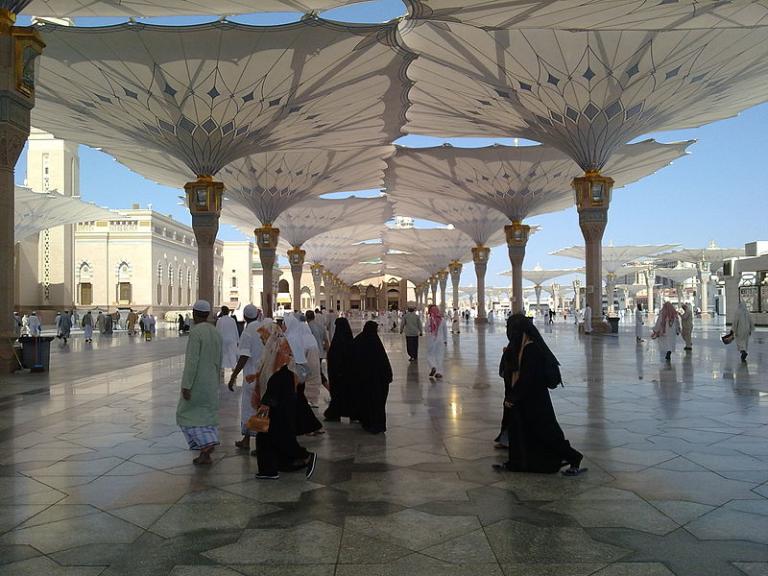
Canopies leading to the Bab al-Salaam (the “Gate of Peace”) at the Masjid al-Nabawi (“The Prophet’s Mosque”) in Medina, Saudi Arabia (Wikimedia CC public domain image by Swerveut)
Nevertheless, Muhammad’s transformation from prophet to prophet-statesman had profound consequences for the nature of the religion that was developing—Islam. This is because the nature of his example to the Muslims changed along with his change of role. Christians who want an ideal model to follow look naturally to Jesus of Nazareth as the person who most perfectly embodies their faith. But Jesus never held any political office or exercised any state power, and this fact allows Christians to concentrate on personal salvation and holiness without fearing that a failure to be politically involved will jeopardize their status in eternity. Muhammad, on the other hand, presided for the last ten years of his life over a community and attempted to enact Islam into law and political practice. A Muslim who seeks the ideal model for his faith turns naturally to Muhammad as the man who best understood and embodied it—and Muhammad was a statesman. Therefore, a pious Muslim cannot be indifferent to law and politics.
This is one of the reasons that Islam has the political tinge to it that so infuriates (or at least puzzles) Westerners. We should not, however, be so puzzled. During the seventh century, nobody anywhere, whether in Mecca or in Constantinople or in Rome, had a very firm notion of or commitment to the separation of church and state. We should not be surprised, then, that Islam does not. And, in a religion whose source of authority is firmly in the past, it is very difficult simply to ignore seventh-century positions on the subject.
And what of Yathrib? Why do we not hear of that important town today? In fact, we do. After the arrival of the Prophet, the old name of the town gradually fell into disuse. Instead, it began to be known as Madinat al-Nabi, “the city of the Prophet,” or, simply, as al-Madina, “the City.” And, today, Medina (as it is generally spelled in English) has come to be regarded as, after Mecca itself, the most holy city of Islam. (Jerusalem, most frequently known in Arabic as al-Quds, “the holy,” is the third.)
In Medina, the Muslims became a kind of superclan, a tribe held together not by ties of kinship but by a common faith. And they began to act in a manner consistent with accepted behavior in early Arabia. They sent out raiding parties and clashed with Quraysh—an unthinkable thing for most of them under old Arabian ideas, since most of them were of Quraysh. But Quraysh had expelled and abused them, and they had declared their loyalty to the new “tribe” of Islam.
Eventually, Muhammad and his followers scored a major victory over the Quraysh of Mecca and won the privilege to make the pilgrimage to the Ka‘ba there. The city fathers, it now became clear, need never have worried. For the victorious Muslims proceeded to “Islamicize” the Ka‘ba. Under the direction of their Prophet, they incorporated its rites and rituals, in a purified form, into the new religion—the legend of Abraham and Ishmael certainly helped here—and those rites and rituals were now on their way to an importance that the early Meccan pagans could scarcely have foreseen. Since then, Mecca has gone from being a pilgrimage center for the Arabian peninsula to being the center of the earth for more than two billion Muslims the world over.
In Medina, as Muhammad’s faith began to spread throughout the Arabian peninsula, Islam began to distinguish itself from the two earlier religions. This was partly because adherents of those religions found no room for Muhammad and his revelation within their traditions. According to the Qur’an, the Jews objected to the notion that God could call anybody he chose, not feeling himself restricted to one of them.[1] “When it is said to them: ‘Believe in what God has revealed,’ they reply: ‘We believe in what was revealed to us.'” But the Qur’an then points out, much as Jesus did in similar circumstances, that they had killed the prophets who had come to them in the past.[2]
However, it was not only the Jews who rejected the claims of the new prophet. The Qur’an describes both Jews and Christians as claiming that they are the only ones who will enter paradise. To this, the Qur’an responds that whoever “surrenders” (aslama) to God and does works of righteousness will be rewarded and need not fear.[3] Indeed, the Qur’an claims to go back beyond Judaism and Christianity, to a time before either one had come into being, to the more basic faith that underlies both.[4] “They say: ‘Accept the Jewish or the Christian faith and you shall be rightly guided.’ Say: ‘By no means! We believe in the faith of Abraham, the upright one. He was no idolater.’ Say: ‘We believe in God and that which is revealed to us; in what was revealed to Abraham, Ishmael, Isaac, Jacob, and the tribes; to Moses and Jesus and the other prophets by their Lord. We make no distinction amongst any of them, and to God we have surrendered ourselves [muslimun].'”[5] The Christians and Jews, according to the Qur’an, have distorted that original revelation, that pure submission (islam), and now they quarrel with one another over issues that none of them really understand. “The Jews say the Christians are misguided, and the Christians say it is the Jews who are misguided. Yet they both read the Scriptures. And the pagans say the same of both.”[6] This is almost precisely the comment made by Joseph Smith about the warring sects of his day:
They “understood the same passages of scripture so differently as to destroy all confidence in settling the question by an appeal to the Bible.”[7] And in each case, the solution was not to tinker with what the sects of the day taught, but to restore the truth in its ancient purity, to go back to a time before it was corrupted.
[1] 2:90.
[2] 2:91; italics in Dawood’s translation.
[3] 2:111-12.
[4] Much as the apostle Paul seems to do in Galatians 3. In doing this, clearly, Muhammad could draw on the awareness of Abraham and Ishmael that was, as we have seen, already present among the Arabians.
[5] 2:135 36; compare 3:84.
[6] 2:133.
[7] Joseph Smith—History 1:12.
Next Post

August 10, 2020 "Everyone Else Makes Such Lonely Heavens," Reprised
Browse Our Archives
Select a Category Uncategorized
Select a Month October 2026 September 2026 August 2026 July 2026 June 2026 May 2026 April 2026 March 2026 February 2026 January 2026 December 2025 November 2025 October 2025 September 2025 August 2025 July 2025 June 2025 May 2025 April 2025 March 2025 February 2025 January 2025 December 2024 November 2024 October 2024 September 2024 August 2024 July 2024 June 2024 May 2024 April 2024 March 2024 February 2024 January 2024 December 2023 November 2023 October 2023 September 2023 August 2023 July 2023 June 2023 May 2023 April 2023 March 2023 February 2023 January 2023 December 2022 November 2022 October 2022 September 2022 August 2022 July 2022 June 2022 May 2022 April 2022 March 2022 February 2022 January 2022 December 2021 November 2021 October 2021 September 2021 August 2021 July 2021 June 2021 May 2021 April 2021 March 2021 February 2021 January 2021 December 2020 November 2020 October 2020 September 2020 August 2020 July 2020 June 2020 May 2020 April 2020 March 2020 February 2020 January 2020 December 2019 November 2019 October 2019 September 2019 August 2019 July 2019 June 2019 May 2019 April 2019 March 2019 February 2019 January 2019 December 2018 November 2018 October 2018 September 2018 August 2018 July 2018 June 2018 May 2018 April 2018 March 2018 February 2018 January 2018 December 2017 November 2017 October 2017 September 2017 August 2017 July 2017 June 2017 May 2017 April 2017 March 2017 February 2017 January 2017 December 2016 November 2016 October 2016 September 2016 August 2016 July 2016 June 2016 May 2016 April 2016 March 2016 February 2016 January 2016 December 2015 November 2015 October 2015 September 2015 August 2015 July 2015 June 2015 May 2015 April 2015 March 2015 February 2015 January 2015 December 2014 November 2014 March 2014 August 2013 February 2012
Follow Us!
TAKE THE
Religious Wisdom Quiz
Who saw the vision of the valley of dry bones?
Select your answer to see how you score.
Ezekiel Daniel Isaiah Jeremiah
Related posts from Sic et Non

"The World's Sixteen Crucified Saviors"?
Is the Church collapsing? And two questions on...

How to Explain the Book of Mormon?
The Book of Mormon, the Qur’an, and "Inimitability"
TRENDING AT PATHEOS Latter-day Saint

Janie Learns the Way of the Cross: A...
Teaching children about Jesus' Passion can be challenging. Many parents and educators...

Looking For Good Catholic Writing - October 2026
He alone extends the heavens, and he walks upon the waves of...

In "Irreplaceable," our book on vocation and technology, Trevor Sutton and I...

I was strolling through the top floor of the brand new Parthenon...

What Does Gêvâh Mean For Kimberley Guifoyle &...
This week, a lot of the news is focused on Kimberly Guilfoyle....

INNER CIRCLE: Profound Mystery (Of Christ In All...
Ephesians 5:31-32 “For this reason, a man will leave his father and...
view all Latter-day Saint blogs
Ad-Free & Subscriber Log-In Subscription Support
- About Us
- 2026 Calendar
- Videos
- Podcasts
- Library of World Religions
- Faith In Media Tracker
- Advertise With Us
- Write for Us
- Privacy Policy
- Terms of Service
- Do Not Sell My Data
- Contact Us
- Radiant Digital
- Manage Newsletter Subscriptions
- Unsubscribe From Notifications
- Sitemap
Copyright 2008-2026, Patheos. All rights reserved.
Subscription Support Ad-Free & Subscriber Log-In
Follow Patheos