
BuddhistCatholicContemplativeEvangelicalGeneral ChristianHinduJewishLatter-day SaintMuslimNew VisionsProgressive Christian
Beliefs
- Buddhist
- Catholic
- Contemplative
- Evangelical
- General Christian
- Hindu
- Jewish
- Latter-day Saint
- More Voices
- Muslim
- New Visions
- Pagan
- Progressive Christian
Topics
- Religion News
- Food and Religion
- Sports and Religion
- Religious Art
- Religious Music and Entertainment
- Religious Events
- History and Religion
- Style and Religion
- Politics and Religion
- Women in Religion
- Recreation Outdoors and Religion
- Business Finance and Religion
- Careers Workplace and Religion
- Education and Religion
- Family Parenting and Religion
- Health Fitness and Religion
- Home and Religion
- Relationships and Religion
- Technology and Religion
- Travel and Religion
Columnists
- Buddhist Columnists
- Business Finance and Religion Columnists
- Careers Workplace and Religion Columnists
- Catholic Columnists
- Contemplative Columnists
- Education and Religion Columnists
- Evangelists Columnists
- Family Parenting and Religion Columnists
- General Christian Columnists
- Health Fitness and Religion Columnists
- Hindu Columnists
- History and Religion Columnists
- Home and Religion Columnists
- Jewish Columnists
- More Voices Columnists
- Latter Day Columnists
- Muslim Columnists
- New Visions Columnists
- Nonreligious Columnists
- Pagan Columnists
- Politics and Religion Columnists
- Progressive Columnists
- Recreation Outdoors and Religion Columnists
- Relationships and Religion Columnists
- Religion News Columnists
- Religious Art Columnists
- Religious Events Columnists
- Religious Music and Entertainment Columnists
- Sports and Religion Columnists
- Style and Religion Columnists
- Technology and Religion Columnists
- Travel and Religion Columnists
- Women in Religion Columnists
Resource Library
- 2026 Calendar
- Library of World Religions
- The 100 Most Holy Places on Earth
- Patheos Answers
- Podcasts
- Videos
- Faith Leaders Database
- Anglican Episcopalian
- Bahai
- Baptist
- Buddhism
- Christianity
- Confucianism
- Eastern Orthodoxy
- Hinduism
- Holiness and Pentecostal
- ISKCON
- Islam
- Judaism
- Lutheran
- Methodist
- The Church of Jesus Christ of Latter-day Saints
- New Age
- Paganism
- Presbytarian and Reformed
- Protestantism
- Religion Behind the Scenes
- Roman Catholic
- Scientology
- Shia Islam
- Sikhism
- Sufism
- Sunni Islam
- Taoism
- Zen
- See all religions
Research Tools
 Ad-Free & Subscriber Log-In Subscription Support
Ad-Free & Subscriber Log-In Subscription Support
Follow Patheos 

- Trending:
- Forgiveness
- |
- Marriage
- |
- Consciousness
- |
- Death Penalty
- |
- Election
- |
- Halloween

- Home
- Latter-day Saint
- Revision 3.3 “The Meccan Chapters of the Qur’an”
Revision 3.3 “The Meccan Chapters of the Qur’an”
Last updated on: August 5, 2020 at 3:59 pm by Dan Peterson
Revision 3.3 “The Meccan Chapters of the Qur’an” 2020-08-05T15:59:09-06:00 Dan Peterson
Patheos Explore the world's faith through different perspectives on religion and spirituality! Patheos has the views of the prevalent religions and spiritualities of the world.
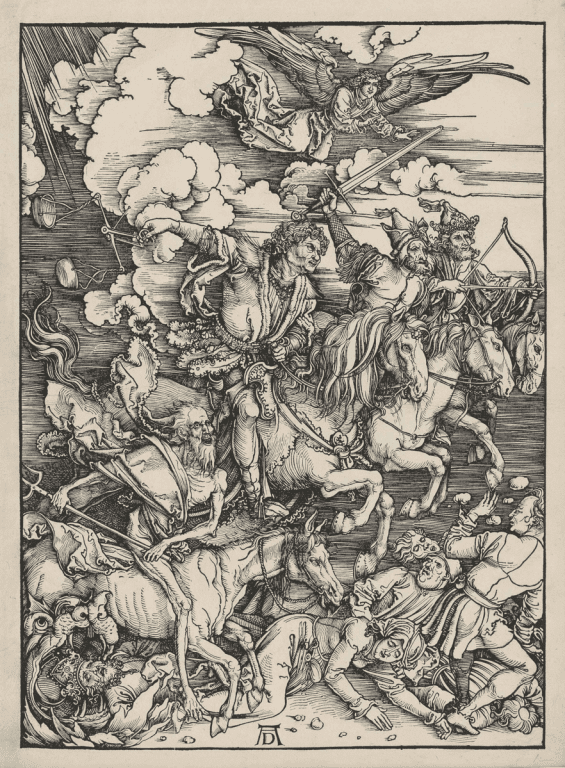
Dürer’s famous woodcut of “The Four Horsemen of the Apocalypse”
(Wikimedia Commons public domain image)
Muslims and Western scholars agree upon a division of the suras or chapters of the Qur’an between those received at Mecca and those later received at the oasis town of Medina. There are differences between the two groups that go considerably beyond the mere time of the reception, however, extending to questions of theme, style, and content. I shall examine the two groups in order.
The revelations of the earliest (Meccan) period of the Prophet’s career have certain recurring themes. One of them is the imminent end of this world. These early revelations are, to use a marvelous hundred-dollar word, eschatological. The hundredth chapter of the Qur’an is a typical example of the vigorous, poetic quality of its language during this period and, even more, of the apocalyptic themes that characterize many of the earliest revelations:
By the snorting war steeds, which strike fire with their hoofs as they gallop to the raid at dawn and with a trail of dust split the foe in two; man is ungrateful to his Lord! To this he himself shall bear witness.
He loves riches with all his heart. But is he not aware that when the dead are thrown out from their graves and men’s hidden thoughts are laid open their Lord will on that day know all that they have done?
Another representative passage occurs in the eighty-second chapter, entitled Infitaar or “The Splitting”:
When heaven is split open, when the stars are scattered,
when the seas swarm over,
when the tombs are overthrown,
then a soul shall know its works, the former and the latter.[1]
Another theme is the denunciation of the wealthy for their greed and selfishness.[2] Using the mercantile language of Mecca, it describes them as “those that barter guidance for error and forgiveness for punishment.”[3] The wealthy were always so, the Qur’an informs Muhammad,[4] and it quotes God as addressing them directly:
You honour not the orphan, and you urge not the feeding of the needy, and you devour the inheritance greedily, and you love wealth with an ardent love.[5]
Muhammad was directed always to remember his own humble origins and to recall the grace of God in delivering him from them:
Did He not find thee an orphan, and shelter thee? Did He not find thee erring, and guide thee?
Did He not find thee needy, and suffice thee?[6]
His rocky reception at the hands of his Meccan neighbors probably helped to keep him humble, too. There were a number of things about Muhammad and his teaching that the Meccans and others in the audience found extremely difficult to take seriously. “When we are turned to hollow bones,” they asked, “shall we be restored to life?”[7] They knew full well what happened to dead bodies, and their question was purely rhetorical. They were already certain of the answer. “There is no other life but this; nor shall we ever be raised to life again.”[8] “There is this life and no other. We live and die; nothing but Time destroys us.”[9] “When we and our fathers are turned to dust, shall we be raised to life? We were promised this once before, and so were our fathers. It is but a fable of the ancients.”[10]
The Qur’an, however, insists upon the literal reality of physical resurrection, which it frequently compares to the resuscitation of fields after a rain.[11] It also points out that God, who was able to create the universe in the first place, and whose creative power gives rise to our physical bodies, will certainly be able to recreate our bodies after their dissolution in death. That, it says, is a relatively small thing.[12] And, finally, the Qur’an points to the motive of the unbelievers in denying the resurrection of the dead. Numerous skeptics today say that belief in life after death is a childish notion, tailor-made for those who fear death. But for many, especially for many in premodern times who believed firmly that any God who existed must be a God of judgment, it was often disbelief in life after death that was comforting. “Eat, drink, and be merry,” the Book of Mormon quotes such people as saying, “for tomorrow we die; and it shall be well with us.”[13] The Qur’an, however, will not allow unbelievers to rest secure in their disbelief. It quotes their familiar rhetorical question and then directs Muhammad how to answer: “`What! When we are dead and turned to dust and bones, shall we be raised to life, we and our forefathers?’ Say: `Yes. And you shall be held in shame. “‘28
[1] 82:1-5; Arberry.
[2] For example, at 70:11-18; 104:1-3.
[3] 2:175. The notion that Islam is somehow a religion of the desert is, on the whole, false. Much nonsense has been written on this theme, trying, for instance to derive the alleged “harshness” of the religion from the severity of the Arabian desert, or to deduce its strict monotheism from the simplicity of Arabian sand and sky. In reality, Islam was born in a commercial center and constantly uses commercial language, in much the same way that Jesus tended to use the language of sheep herding and agriculture, in order to make its points understandable to its audience. The true desert Arabs, the bedouins, are criticized by the Qur’an; their Islam is seen as suspect. (See, for example, 49:14.)
[4] 34:34-35.
[5] 89:17-20; Arberry.
[6] 93:6-8; Arberry.
[7] 79:10-11; compare 13:5; 17:49-52; 19:66; 23:35-37; 34:7; 44:35-36; 50:3; 56:47-48; 64:7.
[8] 6:29.
[9] 45:24.
[10] 27:67-68; compare 23:82-83.
[11] 75:3-4; 7:57; 22:5-8; 30:50; 35:9; 41:39; 43:10-13; 50:6-11.
[12] 36:77-79; 46:33. See also the discussion of these arguments in Daniel C. Peterson, “Does the Qur’an Teach Creation Ex Nihilo?” in By Study and Also By Faith: Essays in Honor of Hugh W Nibley, edited by John M. Lundquist and Stephen D. Ricks, 2 vols. (Salt Lake City and Provo: Deseret Book and the Foundation for Ancient Research and Mormon Studies, 1990), 1:584-610.
[13] 2 Nephi 28:7. The next verse seems to refer to those who do believe in life after death but do not believe that God will truly judge them for their sins.
Previous Post

August 4, 2020
"Remarkably well adjusted in our favor"
Next Post
August 5, 2020 "How the Pandemic Defeated America," and Other Evils of Science
Browse Our Archives
Select a Category Uncategorized
Select a Month October 2026 September 2026 August 2026 July 2026 June 2026 May 2026 April 2026 March 2026 February 2026 January 2026 December 2025 November 2025 October 2025 September 2025 August 2025 July 2025 June 2025 May 2025 April 2025 March 2025 February 2025 January 2025 December 2024 November 2024 October 2024 September 2024 August 2024 July 2024 June 2024 May 2024 April 2024 March 2024 February 2024 January 2024 December 2023 November 2023 October 2023 September 2023 August 2023 July 2023 June 2023 May 2023 April 2023 March 2023 February 2023 January 2023 December 2022 November 2022 October 2022 September 2022 August 2022 July 2022 June 2022 May 2022 April 2022 March 2022 February 2022 January 2022 December 2021 November 2021 October 2021 September 2021 August 2021 July 2021 June 2021 May 2021 April 2021 March 2021 February 2021 January 2021 December 2020 November 2020 October 2020 September 2020 August 2020 July 2020 June 2020 May 2020 April 2020 March 2020 February 2020 January 2020 December 2019 November 2019 October 2019 September 2019 August 2019 July 2019 June 2019 May 2019 April 2019 March 2019 February 2019 January 2019 December 2018 November 2018 October 2018 September 2018 August 2018 July 2018 June 2018 May 2018 April 2018 March 2018 February 2018 January 2018 December 2017 November 2017 October 2017 September 2017 August 2017 July 2017 June 2017 May 2017 April 2017 March 2017 February 2017 January 2017 December 2016 November 2016 October 2016 September 2016 August 2016 July 2016 June 2016 May 2016 April 2016 March 2016 February 2016 January 2016 December 2015 November 2015 October 2015 September 2015 August 2015 July 2015 June 2015 May 2015 April 2015 March 2015 February 2015 January 2015 December 2014 November 2014 March 2014 August 2013 February 2012
Follow Us!
TAKE THE
Religious Wisdom Quiz
Who said "as for me and my house, we will serve the Lord"?
Select your answer to see how you score.
Paul Joshua Abraham Peter
Related posts from Sic et Non

Islam in America or Islam versus America?

A basic working chronology of Islamic-era Iran

Actual Data and Actual Crusades

TRENDING AT PATHEOS Latter-day Saint

'Super Scam Me' Exposes AI Jon Bon Jovi...
Leslie Pickett believed she was in a relationship with Jon Bon Jovi....

The Brazilian Remake of Kendricks' 'Flywheel' Opens in...
“Flywheel,” the story that launched the Kendrick Brothers’ filmmaking career is getting...

The Dangers of Gradual Accommodation (Winking at Sin)
Recently, the “law of gradualness” resurfaced during the opening of a weeklong,...

The Iron Gates and the Lion of the...
Yesterday, I didn't finish my report about, well, yesterday. So I'll...

The Image: On the Horror of Capitalism and...
The Image Then went the Pharisees, and took counsel how they might...

We are approaching the date of our new American national holiday: October...
view all Latter-day Saint blogs
Ad-Free & Subscriber Log-In Subscription Support
- About Us
- 2026 Calendar
- Videos
- Podcasts
- Library of World Religions
- Faith In Media Tracker
- Advertise With Us
- Write for Us
- Privacy Policy
- Terms of Service
- Do Not Sell My Data
- Contact Us
- Radiant Digital
- Manage Newsletter Subscriptions
- Unsubscribe From Notifications
- Sitemap
Copyright 2008-2026, Patheos. All rights reserved.
Subscription Support Ad-Free & Subscriber Log-In
Follow Patheos