
BuddhistCatholicContemplativeEvangelicalGeneral ChristianHinduJewishLatter-day SaintMuslimNew VisionsProgressive Christian
Beliefs
- Buddhist
- Catholic
- Contemplative
- Evangelical
- General Christian
- Hindu
- Jewish
- Latter-day Saint
- More Voices
- Muslim
- New Visions
- Pagan
- Progressive Christian
Topics
- Religion News
- Food and Religion
- Sports and Religion
- Religious Art
- Religious Music and Entertainment
- Religious Events
- History and Religion
- Style and Religion
- Politics and Religion
- Women in Religion
- Recreation Outdoors and Religion
- Business Finance and Religion
- Careers Workplace and Religion
- Education and Religion
- Family Parenting and Religion
- Health Fitness and Religion
- Home and Religion
- Relationships and Religion
- Technology and Religion
- Travel and Religion
Columnists
- Buddhist Columnists
- Business Finance and Religion Columnists
- Careers Workplace and Religion Columnists
- Catholic Columnists
- Contemplative Columnists
- Education and Religion Columnists
- Evangelists Columnists
- Family Parenting and Religion Columnists
- General Christian Columnists
- Health Fitness and Religion Columnists
- Hindu Columnists
- History and Religion Columnists
- Home and Religion Columnists
- Jewish Columnists
- More Voices Columnists
- Latter Day Columnists
- Muslim Columnists
- New Visions Columnists
- Nonreligious Columnists
- Pagan Columnists
- Politics and Religion Columnists
- Progressive Columnists
- Recreation Outdoors and Religion Columnists
- Relationships and Religion Columnists
- Religion News Columnists
- Religious Art Columnists
- Religious Events Columnists
- Religious Music and Entertainment Columnists
- Sports and Religion Columnists
- Style and Religion Columnists
- Technology and Religion Columnists
- Travel and Religion Columnists
- Women in Religion Columnists
Resource Library
- 2026 Calendar
- Library of World Religions
- The 100 Most Holy Places on Earth
- Patheos Answers
- Podcasts
- Videos
- Faith Leaders Database
- Anglican Episcopalian
- Bahai
- Baptist
- Buddhism
- Christianity
- Confucianism
- Eastern Orthodoxy
- Hinduism
- Holiness and Pentecostal
- ISKCON
- Islam
- Judaism
- Lutheran
- Methodist
- The Church of Jesus Christ of Latter-day Saints
- New Age
- Paganism
- Presbytarian and Reformed
- Protestantism
- Religion Behind the Scenes
- Roman Catholic
- Scientology
- Shia Islam
- Sikhism
- Sufism
- Sunni Islam
- Taoism
- Zen
- See all religions
Research Tools
 Ad-Free & Subscriber Log-In Subscription Support
Ad-Free & Subscriber Log-In Subscription Support
Follow Patheos 

- Trending:
- Forgiveness
- |
- Marriage
- |
- Consciousness
- |
- Death Penalty
- |
- Election
- |
- Halloween

- Home
- Latter-day Saint
- Revision 3.2 “Muhammad in Mecca”
Revision 3.2 “Muhammad in Mecca”
Last updated on: August 5, 2020 at 3:57 pm by Dan Peterson
Revision 3.2 “Muhammad in Mecca” 2020-08-05T15:57:24-06:00 Dan Peterson
Patheos Explore the world's faith through different perspectives on religion and spirituality! Patheos has the views of the prevalent religions and spiritualities of the world.
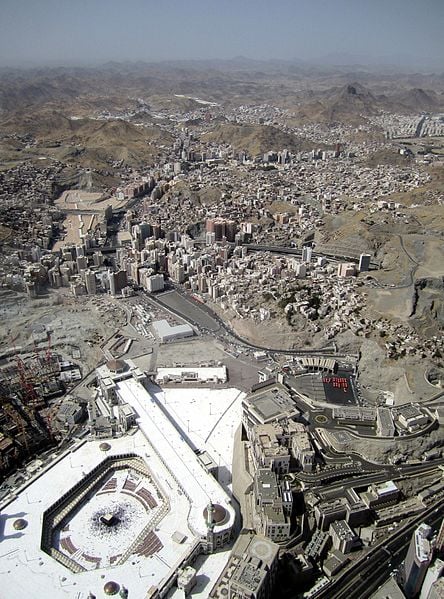
An aerial view of Mecca (Makkah) today, with the Great Mosque (and its Ka‘ba) in the lower left
(Wikimedia Commons public domain photograph)
Muhammad in Mecca
Within a few years of his birth at Mecca in 570 A.D., Muhammad, the future prophet of Islam, became an orphan. He had been born into an important clan of the Quraysh, known as the Banu Hashim. (That is why Jordan, whose king claims descent from the Prophet, is even today officially known as “The Hashemite Kingdom of Jordan.”) But, though the Banu Hashim were important, by this point they had also fallen on somewhat hard times. They were like the proverbial penniless aristocrat: they had a rich heritage but no cash. Muhammad clearly could not relax with inherited wealth, so he had to seek some way of making a living. In Mecca, the most promising way to make a living for anyone with ambition and ability—both of which, as later events clearly demonstrate, Muhammad had in abundance—was in caravan trade, and it was into caravan trading that the young man went.
His capacities were apparent to outsiders. Even if we strip away the layers of accumulated legend that attach to his figure, Muhammad emerges from the past as a man of great talent and integrity. By his early 20s, he was managing camel caravans for a rich Meccan widow by the name of Khadija (pronounced “Kha-DEE-ja”). In this role, he made a considerable impression. In fact, she was so impressed with him and his abilities that she soon asked him to marry her. According to tradition, she was forty years old, and he was twenty-five.
It was a happy marriage. While Khadija lived, she was Muhammad’s most loyal supporter and he took no other wife. The marriage gave him freedom from the financial worries that must otherwise have occupied much of the time and attention of a poor young orphan, and he could now direct his focus to the things that really interested him. And what was it that most deeply occupied his interest? Clearly, it was religion. Muhammad should almost certainly be classed among the people we have met as the hanifs. But he was now in exceptionally good circumstances. With money and security, he now had leisure to ponder the weighty issues of life.
When he was about forty—approximately 610 A.D.—mainstream Islamic tradition represents Muhammad as meditating and praying in a cave of a mountain called Hira, located near Mecca. According to tradition, the angel Gabriel appeared to Muhammad and commanded him to read or (the words are identical in Arabic) to recite:
“Recite: In the Name of thy Lord who created, created Man of a blood-clot. Recite: And thy Lord is the Most Generous, who taught by the Pen, taught Man that which he knew not.”[1]
Thus began the revelation of the Qur’an. Sometimes known in English as the “Koran,” this is the holy book of the Islamic religion.[2] It was, in many ways, an answer to the religious yearnings long felt by the hanifs. For those who wondered why no revelation had come to the Arabs, it announced “There has now come to you a Messenger of your own.”[3] It pointedly identified itself as “an Arabic Qur’an.”
Muhammad’s reception of the Qur’an would continue from this time to nearly the day of his death, twenty-two years later. Its messages were orally delivered and memorized; only later were they written down by Muslims.
The form of the Qur’an is rhymed prose, but it is not and must not be confused with poetry. The Fatiha or “Opener,” which is the first sura or chapter of the Qur’an, will suffice to make this clear:
In the name of God, the Merciful, the Compassionate. Praise belongs to God, the Lord of all Being,
the All-merciful, the All-compassionate,
the Master of the Day of Doom.
Thee only we serve; to Thee alone we pray for succour. Guide us in the straight path,
the path of those whom Thou hast blessed,
not of those against whom Thou art wrathful,
nor of those who are astray.
I have told you that this is rhymed prose, but you can only know that if you read Arabic or if you are very trusting. I shall therefore try to help you read it yourself. In my very unscientific transliteration—where, as before, italicized syllables receive the emphasis— this chapter sounds something like the following:[4]
Bismee laah irahmaan iraheem
Al-hamdoo li laahee rabb al-aalameen
Irahmaan iraheem
Maalik eeyom iddeen
Eeyaaka na‘boodoo wa eeyaaka nasta’een
Ihdinaas siraat al-mustakeem
Siraat alatheena an’umta alayhim wa laa daaleen. Ameen.[5]
Several things can be noted about the Arabic original of this chapter, things that are for the most part also true of the other chapters of the Qur’an that were revealed in Mecca. First, each line of the transliteration represents a verse. Thus, it can be seen that the verses are quite short. This is typical of chapters revealed in Mecca; they are always relatively short and made up of short individual verses. But it will also be noted that the verses are of widely varying lengths. The third verse, for instance, contains only six syllables, while the last, even omitting the Ameen, comprises sixteen.[6] Therefore, although the verses of the Qur’an have rhyme, they do not have meter. Thus, strictly speaking, they are not to be considered poetry.
[1] 96:1-5; Arberry. Almost all of the quotations from the Qur’an in this book are taken from the translation of N. J. Dawood. Those taken from that of A. J. Arberry, or from M. M. Pickthall, or translated by myself, will be so marked. Where a reference is given in the footnotes to chapter and verse, but without an identifying book (e.g. “Mosiah,” or “Genesis”), it is to be understood that the reference is to the Qur’an. I have not infrequently made slight modifications to the translations I have used, for clarity and consistency. (Thus, for example, Dawood’s Allah is routinely changed to God, both in order to match Arberry’s usage and to accord with my own preferences.)
[2] Qur’an is the most accepted spelling of the word among modern authorities because it makes clear the derivation of the title from the verb qara’a, meaning “to read” or “to recite.” Thus, Qur’an could be translated approximately as “Reading” or “Recitation.”
[3] Qur’an 1; Arberry. The phrase “In the name of God, the Merciful, the Compassionate,” occurs at the beginning of every chapter of the Qur’an but one. Only the ninth chapter lacks it, for no obvious reason.
[4] I offer my apologies to any Arabist who might be reading these lines. I have made an effort here to transliterate the Arabic in such a way that non-Arabists, who will make up the overwhelming majority of this book’s readers, will have an approximate idea of how to pronounce it. I am aware that the results look a bit silly—especially, perhaps, in this instance. I can only say that they hurt my eyes, too. Incidentally, the th in alatheena is to be pronounced like the th in English that, rather than like the th in thing.
[5] The final Ameen—which is simply Amen, and which often shows up in Arabic and other Muslim proper names, in the meaning of “faithful” or “true,” as Amin—does not actually occur in the text, but is routinely added by reciters at the conclusion of a chapter of the Qur’an. I like to add it here since it matches the rhyme scheme of the chapter. Of course, not all chapters of the Qur’an have this particular rhyme.
[6] .9:128.
Next Post

August 4, 2020 What I was up to today for FairMormon 2020 and BYU Education Week 2020
Browse Our Archives
Select a Category Uncategorized
Select a Month October 2026 September 2026 August 2026 July 2026 June 2026 May 2026 April 2026 March 2026 February 2026 January 2026 December 2025 November 2025 October 2025 September 2025 August 2025 July 2025 June 2025 May 2025 April 2025 March 2025 February 2025 January 2025 December 2024 November 2024 October 2024 September 2024 August 2024 July 2024 June 2024 May 2024 April 2024 March 2024 February 2024 January 2024 December 2023 November 2023 October 2023 September 2023 August 2023 July 2023 June 2023 May 2023 April 2023 March 2023 February 2023 January 2023 December 2022 November 2022 October 2022 September 2022 August 2022 July 2022 June 2022 May 2022 April 2022 March 2022 February 2022 January 2022 December 2021 November 2021 October 2021 September 2021 August 2021 July 2021 June 2021 May 2021 April 2021 March 2021 February 2021 January 2021 December 2020 November 2020 October 2020 September 2020 August 2020 July 2020 June 2020 May 2020 April 2020 March 2020 February 2020 January 2020 December 2019 November 2019 October 2019 September 2019 August 2019 July 2019 June 2019 May 2019 April 2019 March 2019 February 2019 January 2019 December 2018 November 2018 October 2018 September 2018 August 2018 July 2018 June 2018 May 2018 April 2018 March 2018 February 2018 January 2018 December 2017 November 2017 October 2017 September 2017 August 2017 July 2017 June 2017 May 2017 April 2017 March 2017 February 2017 January 2017 December 2016 November 2016 October 2016 September 2016 August 2016 July 2016 June 2016 May 2016 April 2016 March 2016 February 2016 January 2016 December 2015 November 2015 October 2015 September 2015 August 2015 July 2015 June 2015 May 2015 April 2015 March 2015 February 2015 January 2015 December 2014 November 2014 March 2014 August 2013 February 2012
Follow Us!
TAKE THE
Religious Wisdom Quiz
Who said, "We ought to obey God rather than men"?
Select your answer to see how you score.
James John Peter Paul
Related posts from Sic et Non

"The World's Sixteen Crucified Saviors"?
Is the Church collapsing? And two questions on...
Partially responding to a challenge

How to Explain the Book of Mormon?
TRENDING AT PATHEOS Latter-day Saint

The Sermon on the Mount, Part I: Matthew...
The Sermon on the Mount, Part I (Matthew 4:12-5:12) St. Matthew moves...

What's up from Crossway: Reviewing some of their latest A few weeks...

Janie Learns the Way of the Cross: A...
Teaching children about Jesus' Passion can be challenging. Many parents and educators...

Looking For Good Catholic Writing - October 2026
He alone extends the heavens, and he walks upon the waves of...

In "Irreplaceable," our book on vocation and technology, Trevor Sutton and I...

I was strolling through the top floor of the brand new Parthenon...
view all Latter-day Saint blogs
Ad-Free & Subscriber Log-In Subscription Support
- About Us
- 2026 Calendar
- Videos
- Podcasts
- Library of World Religions
- Faith In Media Tracker
- Advertise With Us
- Write for Us
- Privacy Policy
- Terms of Service
- Do Not Sell My Data
- Contact Us
- Radiant Digital
- Manage Newsletter Subscriptions
- Unsubscribe From Notifications
- Sitemap
Copyright 2008-2026, Patheos. All rights reserved.
Subscription Support Ad-Free & Subscriber Log-In
Follow Patheos