
BuddhistCatholicContemplativeEvangelicalGeneral ChristianHinduJewishLatter-day SaintMuslimNew VisionsProgressive Christian
Beliefs
- Buddhist
- Catholic
- Contemplative
- Evangelical
- General Christian
- Hindu
- Jewish
- Latter-day Saint
- More Voices
- Muslim
- New Visions
- Pagan
- Progressive Christian
Topics
- Religion News
- Food and Religion
- Sports and Religion
- Religious Art
- Religious Music and Entertainment
- Religious Events
- History and Religion
- Style and Religion
- Politics and Religion
- Women in Religion
- Recreation Outdoors and Religion
- Business Finance and Religion
- Careers Workplace and Religion
- Education and Religion
- Family Parenting and Religion
- Health Fitness and Religion
- Home and Religion
- Relationships and Religion
- Technology and Religion
- Travel and Religion
Columnists
- Buddhist Columnists
- Business Finance and Religion Columnists
- Careers Workplace and Religion Columnists
- Catholic Columnists
- Contemplative Columnists
- Education and Religion Columnists
- Evangelists Columnists
- Family Parenting and Religion Columnists
- General Christian Columnists
- Health Fitness and Religion Columnists
- Hindu Columnists
- History and Religion Columnists
- Home and Religion Columnists
- Jewish Columnists
- More Voices Columnists
- Latter Day Columnists
- Muslim Columnists
- New Visions Columnists
- Nonreligious Columnists
- Pagan Columnists
- Politics and Religion Columnists
- Progressive Columnists
- Recreation Outdoors and Religion Columnists
- Relationships and Religion Columnists
- Religion News Columnists
- Religious Art Columnists
- Religious Events Columnists
- Religious Music and Entertainment Columnists
- Sports and Religion Columnists
- Style and Religion Columnists
- Technology and Religion Columnists
- Travel and Religion Columnists
- Women in Religion Columnists
Resource Library
- 2026 Calendar
- Library of World Religions
- The 100 Most Holy Places on Earth
- Patheos Answers
- Podcasts
- Videos
- Faith Leaders Database
- Anglican Episcopalian
- Bahai
- Baptist
- Buddhism
- Christianity
- Confucianism
- Eastern Orthodoxy
- Hinduism
- Holiness and Pentecostal
- ISKCON
- Islam
- Judaism
- Lutheran
- Methodist
- The Church of Jesus Christ of Latter-day Saints
- New Age
- Paganism
- Presbytarian and Reformed
- Protestantism
- Religion Behind the Scenes
- Roman Catholic
- Scientology
- Shia Islam
- Sikhism
- Sufism
- Sunni Islam
- Taoism
- Zen
- See all religions
Research Tools
 Ad-Free & Subscriber Log-In Subscription Support
Ad-Free & Subscriber Log-In Subscription Support
Follow Patheos 

- Trending:
- Forgiveness
- |
- Marriage
- |
- Consciousness
- |
- Death Penalty
- |
- Election
- |
- Halloween

- Home
- Latter-day Saint
- Revision 3.15 “The First Arab Conquests”
Revision 3.15 “The First Arab Conquests”
Last updated on: August 28, 2020 at 7:31 pm by Dan Peterson
Revision 3.15 “The First Arab Conquests” 2020-08-28T19:31:23-06:00 Dan Peterson
Patheos Explore the world's faith through different perspectives on religion and spirituality! Patheos has the views of the prevalent religions and spiritualities of the world.
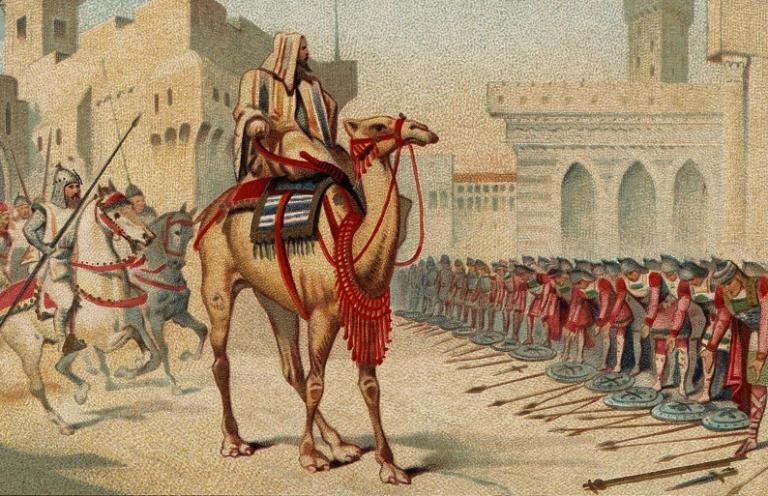
An anonymous nineteenth-century illustration of the AD 638 conquest of Jerusalem by ‘Umar, the second caliph.
(Wikimedia Commons public domain image)
Abu Bakr was the first man to bear the title of caliph, to serve as the political successor of the Prophet.[1] He lived for only two more years beyond the death of Muhammad, but it was during his rule that a series of small campaigns known as the “Wars of the Ridda” reestablished the control of the new Islamic “state” over the Arabian peninsula. Just before his death in 634 A.D., Abu Bakr nominated Umar as his successor. Under Umar’s leadership, the wars that had first been directed against “rebellious” Arabian tribes went on. But when the entire Arabian peninsula had been pacified and put back under Muslim control, the military and raiding energies of the Arabs had to be directed outward. Oddly enough, the Arab empire does not seem to have been planned. It simply happened. (Although perhaps no event in human history is really so simple as that. This one, the rise of an Arab empire, seems quite clearly to have fulfilled the words of the angel to Hagar, exiled in the desert and resigned to the death of her son Ishmael: “Arise, lift up the lad, and hold him in thine hand; for I will make him a great nation.”)[2] One weak state after another fell to the Arabs, who must have been as amazed at their good fortune as we are today in reading about it. Even the Byzantines and the Persians, the two great powers of the day, had been exhausted by their long war with one another and were no match for the upstarts from the desert. (It’s easy to understand why this might seem providential, from a Muslim point of view.)
Arab armies conquered Syria easily (635-636), including Palestine and Jerusalem itself. (The Arabs appear to have been welcomed by the local Jewish population there. After the conquest, the reasoning seems to have gone, things could only get better for the Jews. And they did. Tiberias, the Galilean town where the so-called Jerusalem Talmud was completed, remained a center for Jewish study of the Bible and for the study of the Hebrew language for generations beyond the Arab conquest.) By 637, Arab forces occupied lower Iraq, and by 641 they had taken all of Mesopotamia, the area of the Tigris and Euphrates rivers. The Persian empire, where the Jews again welcomed the Arab liberators, also came under attack. By the 650s, it had ceased to exist. The Byzantines took heavy losses as well. In 642, Egypt, which had been the breadbasket of the Roman empire since the days of the first Caesars, fell to the Arabs. (The invaders were assisted by local Christians, furious at the treatment their denomination was receiving from the imperial governors sent from Constantinople.) Garrison towns were established throughout the conquered territories, including such famous places as Basra and Kufa, and Fustat, which would eventually become the great city of Cairo.
[1] The word caliph is usually pronounced KAY-liff in English, although the Arabic is khalifa (pronounced kha-LEE-fuh). It means something like “stand-in,” or “deputy” (to the Prophet).
[2] Genesis 21:18. Compare Genesis 17:20, already quoted.
Posted from Seaside, Oregon
Previous Post

August 16, 2020
A few ordained scientists
Next Post
August 17, 2020 Seeking the Law of the Lord
Browse Our Archives
Select a Category Uncategorized
Select a Month October 2026 September 2026 August 2026 July 2026 June 2026 May 2026 April 2026 March 2026 February 2026 January 2026 December 2025 November 2025 October 2025 September 2025 August 2025 July 2025 June 2025 May 2025 April 2025 March 2025 February 2025 January 2025 December 2024 November 2024 October 2024 September 2024 August 2024 July 2024 June 2024 May 2024 April 2024 March 2024 February 2024 January 2024 December 2023 November 2023 October 2023 September 2023 August 2023 July 2023 June 2023 May 2023 April 2023 March 2023 February 2023 January 2023 December 2022 November 2022 October 2022 September 2022 August 2022 July 2022 June 2022 May 2022 April 2022 March 2022 February 2022 January 2022 December 2021 November 2021 October 2021 September 2021 August 2021 July 2021 June 2021 May 2021 April 2021 March 2021 February 2021 January 2021 December 2020 November 2020 October 2020 September 2020 August 2020 July 2020 June 2020 May 2020 April 2020 March 2020 February 2020 January 2020 December 2019 November 2019 October 2019 September 2019 August 2019 July 2019 June 2019 May 2019 April 2019 March 2019 February 2019 January 2019 December 2018 November 2018 October 2018 September 2018 August 2018 July 2018 June 2018 May 2018 April 2018 March 2018 February 2018 January 2018 December 2017 November 2017 October 2017 September 2017 August 2017 July 2017 June 2017 May 2017 April 2017 March 2017 February 2017 January 2017 December 2016 November 2016 October 2016 September 2016 August 2016 July 2016 June 2016 May 2016 April 2016 March 2016 February 2016 January 2016 December 2015 November 2015 October 2015 September 2015 August 2015 July 2015 June 2015 May 2015 April 2015 March 2015 February 2015 January 2015 December 2014 November 2014 March 2014 August 2013 February 2012
Follow Us!
TAKE THE
Religious Wisdom Quiz
What is a "cubit's" approximate length according to the Bible?
Select your answer to see how you score.
12 inches 24 inches 18 inches 36 inches
Related posts from Sic et Non

Islam in America or Islam versus America?

A basic working chronology of Islamic-era Iran

Actual Data and Actual Crusades

TRENDING AT PATHEOS Latter-day Saint

Swimfan: Forgotten Aughts Pleasures
This is a recovery effort. In 2002, My Big Fat Greek Wedding...

Top Three Anti-Catholic Lies About Catholicism
This is my initial transcript for the video, "THE 3 WORST...

Pope Leo Celebrates Mass for Nurses & Docs...
I don't have any idea how he did it, but Pope Leo...

The Sermon on the Mount, Part I: Matthew...
The Sermon on the Mount, Part I (Matthew 4:12-5:12) St. Matthew moves...

What's up from Crossway: Reviewing some of their latest A few weeks...

Janie Learns the Way of the Cross: A...
Teaching children about Jesus' Passion can be challenging. Many parents and educators...
view all Latter-day Saint blogs
Ad-Free & Subscriber Log-In Subscription Support
- About Us
- 2026 Calendar
- Videos
- Podcasts
- Library of World Religions
- Faith In Media Tracker
- Advertise With Us
- Write for Us
- Privacy Policy
- Terms of Service
- Do Not Sell My Data
- Contact Us
- Radiant Digital
- Manage Newsletter Subscriptions
- Unsubscribe From Notifications
- Sitemap
Copyright 2008-2026, Patheos. All rights reserved.
Subscription Support Ad-Free & Subscriber Log-In
Follow Patheos