
BuddhistCatholicContemplativeEvangelicalGeneral ChristianHinduJewishLatter-day SaintMuslimNew VisionsProgressive Christian
Beliefs
- Buddhist
- Catholic
- Contemplative
- Evangelical
- General Christian
- Hindu
- Jewish
- Latter-day Saint
- More Voices
- Muslim
- New Visions
- Pagan
- Progressive Christian
Topics
- Religion News
- Food and Religion
- Sports and Religion
- Religious Art
- Religious Music and Entertainment
- Religious Events
- History and Religion
- Style and Religion
- Politics and Religion
- Women in Religion
- Recreation Outdoors and Religion
- Business Finance and Religion
- Careers Workplace and Religion
- Education and Religion
- Family Parenting and Religion
- Health Fitness and Religion
- Home and Religion
- Relationships and Religion
- Technology and Religion
- Travel and Religion
Columnists
- Buddhist Columnists
- Business Finance and Religion Columnists
- Careers Workplace and Religion Columnists
- Catholic Columnists
- Contemplative Columnists
- Education and Religion Columnists
- Evangelists Columnists
- Family Parenting and Religion Columnists
- General Christian Columnists
- Health Fitness and Religion Columnists
- Hindu Columnists
- History and Religion Columnists
- Home and Religion Columnists
- Jewish Columnists
- More Voices Columnists
- Latter Day Columnists
- Muslim Columnists
- New Visions Columnists
- Nonreligious Columnists
- Pagan Columnists
- Politics and Religion Columnists
- Progressive Columnists
- Recreation Outdoors and Religion Columnists
- Relationships and Religion Columnists
- Religion News Columnists
- Religious Art Columnists
- Religious Events Columnists
- Religious Music and Entertainment Columnists
- Sports and Religion Columnists
- Style and Religion Columnists
- Technology and Religion Columnists
- Travel and Religion Columnists
- Women in Religion Columnists
Resource Library
- 2026 Calendar
- Library of World Religions
- The 100 Most Holy Places on Earth
- Patheos Answers
- Podcasts
- Videos
- Faith Leaders Database
- Anglican Episcopalian
- Bahai
- Baptist
- Buddhism
- Christianity
- Confucianism
- Eastern Orthodoxy
- Hinduism
- Holiness and Pentecostal
- ISKCON
- Islam
- Judaism
- Lutheran
- Methodist
- The Church of Jesus Christ of Latter-day Saints
- New Age
- Paganism
- Presbytarian and Reformed
- Protestantism
- Religion Behind the Scenes
- Roman Catholic
- Scientology
- Shia Islam
- Sikhism
- Sufism
- Sunni Islam
- Taoism
- Zen
- See all religions
Research Tools
 Ad-Free & Subscriber Log-In Subscription Support
Ad-Free & Subscriber Log-In Subscription Support
Follow Patheos 

- Trending:
- Forgiveness
- |
- Marriage
- |
- Consciousness
- |
- Death Penalty
- |
- Election
- |
- Halloween

- Home
- Latter-day Saint
- Revision 3.14 “The Succession to Muhammad”
Revision 3.14 “The Succession to Muhammad”
Last updated on: August 28, 2020 at 7:24 pm by Dan Peterson
Revision 3.14 “The Succession to Muhammad” 2020-08-28T19:24:53-06:00 Dan Peterson
Patheos Explore the world's faith through different perspectives on religion and spirituality! Patheos has the views of the prevalent religions and spiritualities of the world.
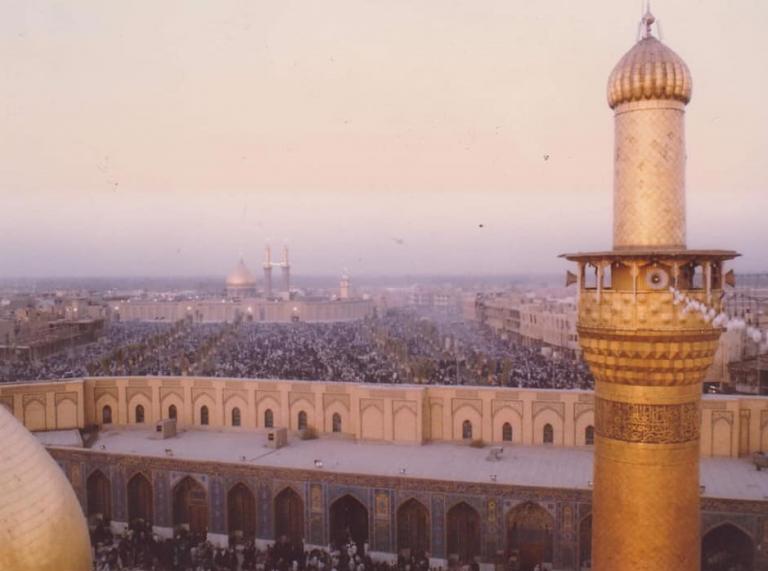
Image of Bayn al-Haramayn (“[The Area] Between the Two Shrines”) from the western minaret of the Imam Husayn shrine on the day of Arba‘een 1996. (Wikimedia Commons public domain photograph)
In AD 632:
Muhammad was dead. Now came the question of succession. The problem was that the founder of Islam left no clear instructions on this question. Some felt that he had designated Ali, his cousin and son-in-law and one of the earliest male converts to Islam, to be his successor, but most in the community, including many whose loyalty to the Prophet cannot plausibly be denied, seem to have known of no such thing.
By the time of his passing, the Prophet had come to control the entire Arabian landmass. Virtually every tribe and individual in the peninsula had pledged obedience to him. Many of the Arabian tribes, however, understood their submission agreements as applying only to Muhammad personally. Now that he was gone, they would certainly feel no allegiance to his successors. They could be expected to go their own way. They would recognize no obligation to do otherwise. (They had, it will be recalled, no notion of government. Their loyalty was to a person; of a continuing institution apart from individuals they had no concept.) Therefore, in all of the chaos surrounding the Prophet’s unexpected death, certain clear thinkers understood that some action had to be taken quickly before the whole structure of Muhammad’s nascent Arabian proto-state unravelled. Umar, the sources say, grabbed Abu Bakr, the elderly and highly respected Muslim whom we have already met, and took him to a place where a meeting on the succession question was underway. (The Prophet was not yet buried, and Ali was busy attending to the details of the funeral.)
At that meeting, perhaps before many of those present had a very clear idea of what was going on, Abu Bakr was acclaimed the leader of the community. All there solemnly pledged their loyalty to him. Then others in the community did so as well.
Some, though, did not. Ali, the Prophet’s cousin and son-in-law who had distinguished himself by heroic deeds on behalf of the faith in earlier military conflicts, felt that it was his right as kinsman to Muhammad to succeed him in the rule of the community.[1] (No man could succeed Muhammad in his prophetic capacity. Muhammad, virtually all of his followers are agreed, was the last of the prophets.) A number of pious Muslims supported Ali’s claim. As the years and generations passed, this group came to be known in Arabic as the shi’at ‘Ali, “the faction of Ali.” This is the origin of the group that we know in English today as the Shi‘ites.[2] The dispute between them and their opponents, who gradually assumed the name of Sunnis, deepened and grew sharper.[3] Where once the dispute had been political, it came to include differences over theology and law. The political disagreement festered. The Shi‘ites grew more and more embittered as their leaders were harassed and kept from power. There is among them a deep sense of grievance, of having been usurped, abused. This tradition or traditional position is kept alive, even nourished, by rituals designed to do just that. The most spectacular and significant instance of these recalls the killing of Husayn, the Prophet’s grandson, at a place in Iraq called Karbala, and the massacre of much of his family. This horrible event occurred on the tenth day of the Muslim month Muharram, in the year 680 A.D.[4] Shi‘ites around the world still commemorate it annually. Indeed, in something very similar to the passion plays of medieval Europe, they actually reenact it, flagellating themselves, chanting lamentations, working themselves to a high pitch of emotion and excitement. This is the holy time of Ashura, or “the tenth.”
[1] Several nineteenth-century Orientalists saw a similarity between the Shi‘ites and the Reorganized Church of Jesus Christ of Latter Day Saints, now renamed the Community of Christ. Both groups expected the succession to the founding prophet to remain in the prophet’s family. But the Shi‘ites arguably have the more radical theology in Islam, whereas the Community of Christ is far closer to mainstream Protestantism than is the Latter-day Saint movement headquartered in Salt Lake City and has now abandoned the notion of family succession.
[2] Pronounced, of course, *“Shee-*ites.”
[3] The singular, Sunni, should be pronounced roughly “Soon-nee.”
[4] 10 October 680 A.D.
Posted from Seaside, Oregon

Browse Our Archives
Select a Category Uncategorized
Select a Month October 2026 September 2026 August 2026 July 2026 June 2026 May 2026 April 2026 March 2026 February 2026 January 2026 December 2025 November 2025 October 2025 September 2025 August 2025 July 2025 June 2025 May 2025 April 2025 March 2025 February 2025 January 2025 December 2024 November 2024 October 2024 September 2024 August 2024 July 2024 June 2024 May 2024 April 2024 March 2024 February 2024 January 2024 December 2023 November 2023 October 2023 September 2023 August 2023 July 2023 June 2023 May 2023 April 2023 March 2023 February 2023 January 2023 December 2022 November 2022 October 2022 September 2022 August 2022 July 2022 June 2022 May 2022 April 2022 March 2022 February 2022 January 2022 December 2021 November 2021 October 2021 September 2021 August 2021 July 2021 June 2021 May 2021 April 2021 March 2021 February 2021 January 2021 December 2020 November 2020 October 2020 September 2020 August 2020 July 2020 June 2020 May 2020 April 2020 March 2020 February 2020 January 2020 December 2019 November 2019 October 2019 September 2019 August 2019 July 2019 June 2019 May 2019 April 2019 March 2019 February 2019 January 2019 December 2018 November 2018 October 2018 September 2018 August 2018 July 2018 June 2018 May 2018 April 2018 March 2018 February 2018 January 2018 December 2017 November 2017 October 2017 September 2017 August 2017 July 2017 June 2017 May 2017 April 2017 March 2017 February 2017 January 2017 December 2016 November 2016 October 2016 September 2016 August 2016 July 2016 June 2016 May 2016 April 2016 March 2016 February 2016 January 2016 December 2015 November 2015 October 2015 September 2015 August 2015 July 2015 June 2015 May 2015 April 2015 March 2015 February 2015 January 2015 December 2014 November 2014 March 2014 August 2013 February 2012
Follow Us!
TAKE THE
Religious Wisdom Quiz
Which Christian festival begins with Ash Wednesday and ends at Easter?
Select your answer to see how you score.
Advent Epiphany Lent Pentecost
Related posts from Sic et Non

Islam in America or Islam versus America?

A basic working chronology of Islamic-era Iran

Actual Data and Actual Crusades

TRENDING AT PATHEOS Latter-day Saint

Letters on Living the Faith by C.S. Lewis
Most of us met C.S. Lewis as a public intellectual. Mere Christianity....

When Halloween Unmasks Married Hearts
Written by Dr. David K. Ewen from Eternal Truth Bible College Behind...

Aristotle. He’s been called the father of logic, the father of the...

Methodist Central Hall and Westminster Abbey
Situated on the same square is Methodist Central Hall and Westminster Abbey. ...

57th Dove Awards Honor Dolly Parton, Crown New...
On gospel music’s biggest night, the 57th annual GMA Dove Awards honored...

The First Eucharistic Controversy: Christ’s Real Presence
For Catholics, the Eucharist is the source and summit of the Christian...
view all Latter-day Saint blogs
Ad-Free & Subscriber Log-In Subscription Support
- About Us
- 2026 Calendar
- Videos
- Podcasts
- Library of World Religions
- Faith In Media Tracker
- Advertise With Us
- Write for Us
- Privacy Policy
- Terms of Service
- Do Not Sell My Data
- Contact Us
- Radiant Digital
- Manage Newsletter Subscriptions
- Unsubscribe From Notifications
- Sitemap
Copyright 2008-2026, Patheos. All rights reserved.
Subscription Support Ad-Free & Subscriber Log-In
Follow Patheos