
BuddhistCatholicContemplativeEvangelicalGeneral ChristianHinduJewishLatter-day SaintMuslimNew VisionsProgressive Christian
Beliefs
- Buddhist
- Catholic
- Contemplative
- Evangelical
- General Christian
- Hindu
- Jewish
- Latter-day Saint
- More Voices
- Muslim
- New Visions
- Pagan
- Progressive Christian
Topics
- Religion News
- Food and Religion
- Sports and Religion
- Religious Art
- Religious Music and Entertainment
- Religious Events
- History and Religion
- Style and Religion
- Politics and Religion
- Women in Religion
- Recreation Outdoors and Religion
- Business Finance and Religion
- Careers Workplace and Religion
- Education and Religion
- Family Parenting and Religion
- Health Fitness and Religion
- Home and Religion
- Relationships and Religion
- Technology and Religion
- Travel and Religion
Columnists
- Buddhist Columnists
- Business Finance and Religion Columnists
- Careers Workplace and Religion Columnists
- Catholic Columnists
- Contemplative Columnists
- Education and Religion Columnists
- Evangelists Columnists
- Family Parenting and Religion Columnists
- General Christian Columnists
- Health Fitness and Religion Columnists
- Hindu Columnists
- History and Religion Columnists
- Home and Religion Columnists
- Jewish Columnists
- More Voices Columnists
- Latter Day Columnists
- Muslim Columnists
- New Visions Columnists
- Nonreligious Columnists
- Pagan Columnists
- Politics and Religion Columnists
- Progressive Columnists
- Recreation Outdoors and Religion Columnists
- Relationships and Religion Columnists
- Religion News Columnists
- Religious Art Columnists
- Religious Events Columnists
- Religious Music and Entertainment Columnists
- Sports and Religion Columnists
- Style and Religion Columnists
- Technology and Religion Columnists
- Travel and Religion Columnists
- Women in Religion Columnists
Resource Library
- 2026 Calendar
- Library of World Religions
- The 100 Most Holy Places on Earth
- Patheos Answers
- Podcasts
- Videos
- Faith Leaders Database
- Anglican Episcopalian
- Bahai
- Baptist
- Buddhism
- Christianity
- Confucianism
- Eastern Orthodoxy
- Hinduism
- Holiness and Pentecostal
- ISKCON
- Islam
- Judaism
- Lutheran
- Methodist
- The Church of Jesus Christ of Latter-day Saints
- New Age
- Paganism
- Presbytarian and Reformed
- Protestantism
- Religion Behind the Scenes
- Roman Catholic
- Scientology
- Shia Islam
- Sikhism
- Sufism
- Sunni Islam
- Taoism
- Zen
- See all religions
Research Tools
 Ad-Free & Subscriber Log-In Subscription Support
Ad-Free & Subscriber Log-In Subscription Support
Follow Patheos 

- Trending:
- Forgiveness
- |
- Marriage
- |
- Consciousness
- |
- Death Penalty
- |
- Election
- |
- Halloween

- Home
- Latter-day Saint
- Revision 3.1 “Mecca and the Quraysh”
Revision 3.1 “Mecca and the Quraysh”
Last updated on: August 3, 2020 at 10:34 pm by Dan Peterson
Revision 3.1 “Mecca and the Quraysh” 2020-08-03T22:34:37-06:00 Dan Peterson
Patheos Explore the world's faith through different perspectives on religion and spirituality! Patheos has the views of the prevalent religions and spiritualities of the world.
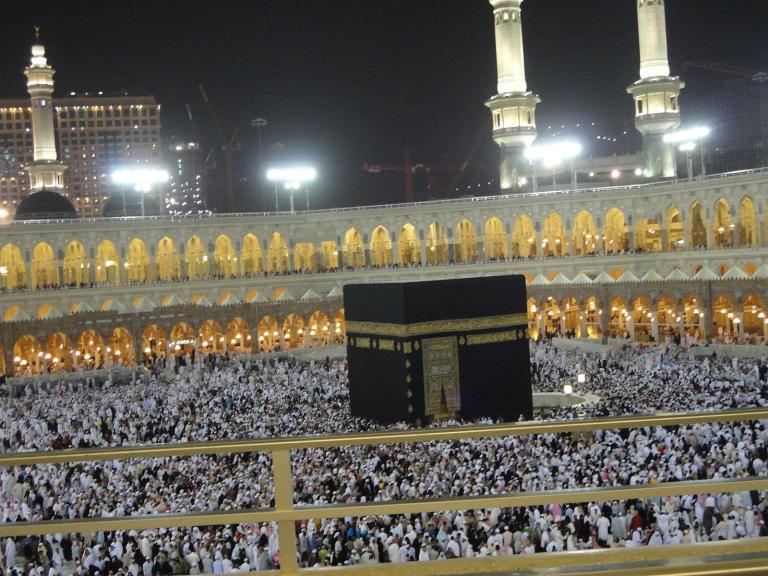
The Ka‘ba in Mecca. (Wikimedia Commons public domain photo)
Although dating to pre-Islamic times, it has been the center of the Muslim world since the early seventh century.
On 23 September 1855, Elder George A. Smith of the Council of the Twelve stood up in the Bowery in Great Salt Lake City—the Tabernacle had not yet been built—and delivered what was, for the time and place, a very well informed and astonishingly positive sermon on Islam. “I am aware,” he said, “that it is a difficult matter to get an honest history of Mahometanism translated into any of the Christian languages.” He was reminded, when he read about Islam as portrayed by Western writers, of ex-Governor Thomas Ford’s biased History of Illinois, which managed to put the governor in a good light and the persecuted and abused Latter-day Saints in quite a bad one.[1] “It is a hard matter, as I have said, to get an honest history of any nation or people by their enemies.” So he thereupon proceeded to give to his audience what was, as I say, a remarkably friendly account of Islam.
Concluding his remarks, though, and perhaps just a little bit embarrassed for having spoken in a Christian religious service on so unusual a topic, he asked his listeners to “excuse me for my Mahometan narrative.“[2] At that, though, Elder Parley P. Pratt jumped to his feet and approached the pulpit. “My brother, George A. Smith,” he remarked, “has wished us to excuse his Mahometan narration, but I would feel more like giving a vote of thanks to the Almighty and to His servant for so highly entertaining and instructing us.”[3]
Such instruction may well have been entertaining. Today, when we have more thrilling modes of entertainment than the spoken word of preaching, we may find it harder to regard instruction on a foreign culture as entertainment. But, if anything, knowledge of other cultures and civilizations is a far more pressing necessity today than it ever was in the remote mountain valleys of mid-nineteenth century Deseret. It is especially pressing for us as we pursue our divinely-given mandate to take the gospel of Jesus Christ to the entire world.
With the crumbling of Marxism and the Communist bloc, one great ideology remains as an alternative to the pluralistic liberal humanism that characterizes much of today’s West. That is Islam. And in Islam, perhaps more than in any other religion or ideology, it is the past that determines the present. We cannot understand today’s Islam without understanding events of the seventh century A.D., for it is through those events as well as through certain events of the intervening years, that Muslims understand themselves. In the next few chapters, therefore, I will offer a capsule history of the rise of Islam and a survey of the immense and wonderful civilization that emerged from it. I do not apologize for doing so. Failure to understand the religion of Islam and its seventh century roots has created many problems for the West. We owe it to ourselves—to say nothing of our obligation to our Muslim brothers and sisters—to overcome our misperceptions and our ignorance.
Mecca and the Quraysh
In the period immediately before the rise of Islam, a tribe known as Quraysh had assumed a special place in Arabian society. It had done so by taking control of the town of Mecca, a settlement that sat astride the major caravan route, dividing that route almost equally midway down the coast of Arabia.
Mecca was an important shrine center. It was built around a structure known as the Ka‘ba, which Arabian legend said had been erected by Abraham and his son Ishmael. The Ka‘ba stood as it stands today, in an enclosure known as the haram.[4] At certain times of the year, pilgrims came to the haram, in their thousands, from around the peninsula. This was a major source of revenue for the town, which had few natural resources of its own. But Mecca had also become, probably in the century or so preceding the rise of Islam, an important center of commerce. This was not unrelated to the town’s position as a center for pilgrimage. Central markets had been set up, and objects representing the gods of the entire peninsula had been placed in the Ka‘ba. (If that structure ever had been Abraham’s, it was certainly pagan now.) Fighting was banned during the market and pilgrimage times and was always banned within the haram precincts. This created an international marketplace.
It is not possible to reconstruct with certainty the process by which Mecca transformed itself into a center for caravan trade as well as a marketplace, but it may have run something along the following lines: Caravans, as we know, had been running up and down the Arabian coast for centuries. The residents of Mecca, with their central position in the peninsula and with their knowledge of the terrain and, most importantly, of where the few crucially important water holes were, had managed to establish themselves as guides to the caravans. They made a reasonably adequate living from such service. (They may also have run something of a protection racket: “Gee, that’s a nice caravan you have there. Lots of nice stuff. You sure are alone out here, though. It’d be a pity if something were to happen to you around these parts, what with nobody to help you and all. You know—just thinking, of course—for a nominal fee we could make it a whole lot less likely that something nasty would happen to you. What do you say?”) At some point in the sixth century, someone seems to have realized that it would make great sense, not to mention great profit, if the Meccans simply took over the trade themselves. Without their cooperation, nobody could compete with them, and they would be able to take all of the profits instead of just a fee and perhaps some protection money.
Mecca was roughly equidistant from both the Sasanian Persian empire and the Byzantine empire, which is to say from both the Christians and the Zoroastrians. This was fitting, since Mecca was pagan, and was thus, so to speak, neutral in the conflict between the two great religions. As we have seen, there were Christians and Jews in the Arabian peninsula, but their influence was quite limited in Mecca.
Another religious possibility, however, became available in and around the area of Mecca. A number of men known as hanifs—it would be claiming too much to describe them as a group, or as a movement—were growing dissatisfied with Arabian paganism.[5] In the increasingly sophisticated merchant society of Mecca, they were undoubtedly aware of the advanced religions of the Byzantines and the Persians, and they knew something of the Jews. They were puzzled that God appeared to have spoken to other peoples, but not to them. (The Arabic hanif could perhaps be loosely translated as “generic monotheist,” in contrast to the “brand name” monotheists of the great religious traditions.)[6] They were also dissatisfied with what was happening to their society.
Part of their dissatisfaction was based on the changing economics of Mecca. As residents of the city became involved in international caravan trade, it was predictable that some would grow wealthier than others. Whether for reasons of intelligence or diligence or sheer dumb luck, some people will always prosper more than others. But the rise of social and economic classes in a town that had really never known these classes was bound to have some effects. The old tribal values, under which people were responsible for their kinfolk, and especially for widows and orphans, began to break down. It had been easier, oddly enough, to live according to such values when everyone was on more or less the same level of poverty than it was proving to be when some were growing rich.[7] The temptation to plow one’s money right back into the business, or at least to spend it on some well-earned luxuries and not to “waste” it on unproductive people, was just too strong.[8]
The problem, in the eyes of the hanifs, seems to have been that the tribal paganism of the Arabs did not oblige them to do any better than that. It had no ethical code to speak of, and suggested few standards of moral behavior. Allah was a distant being, too far away in the eyes of the pagans to be of any practical significance in everyday life. As for the jinn, well, they weren’t always so good themselves and could probably be bought off with a small offering every now and then. The hanifs were aware of the higher religions elsewhere, religions that made real moral demands upon their adherents and hence offered a moral contribution to society. But those religions were the religions of other people. The hanifs, for some reason, could not—or at least did not—bring themselves to accept either Christianity or Judaism or Zoroastrianism.
Several reasons may be offered for this. For one thing, the Jews of Arabia seemed not to encourage conversions. For another, given the political climate of the period, to have accepted either Christianity or Zoroastrianism might have implied that one was joining up with either the Byzantine or the Persian party, in much the same way that joining the Communist Party in the Congo would at one time have aligned someone, like it or not, with the Soviet Union. Finally, there was an expectant air in the Arabia of the period. If God had so far not seen fit to reveal himself to the Arabs, some seem to have felt, perhaps he soon would. (In this respect, the situation in Arabia may recall the mood in upstate New York, where many people were anticipating some sort of restoration, some kind of American revelation. Many of the early converts and future leaders of the Church came from a background of what is often called “Restorationism.”)
[1] Journal of Discourses 3:35.
[2] Journal of Discourses 3:37.
[3] Journal of Discourses 3:38.
[4] The root idea behind the Arabic root hrm is “to forbid” or “to be forbidden.” Most Westerners will be familiar with the word harem (Arabic harim; pronounced “hareem”), signifying a place for women, off-limits to all but certain men.
[5] The singular of the Arabic word hanif is pronounced “ha-NEEF.”
[6] I once thought that this suggestion was original with me. I have since found out, however, that Professor Marilyn Waldman of Ohio State University, an eminent American Islamicist, makes precisely the same comparison. So I must be right.
[7] The Book of Mormon, of course, illustrates such a tendency at numerous points in Nephite history.
[8] See King Benjamin’s remarks at Mosiah 4:16-26.
Next Post

August 3, 2020 "Heavy drinking drove hundreds of thousands of Americans to early graves"
Browse Our Archives
Select a Category Uncategorized
Select a Month October 2026 September 2026 August 2026 July 2026 June 2026 May 2026 April 2026 March 2026 February 2026 January 2026 December 2025 November 2025 October 2025 September 2025 August 2025 July 2025 June 2025 May 2025 April 2025 March 2025 February 2025 January 2025 December 2024 November 2024 October 2024 September 2024 August 2024 July 2024 June 2024 May 2024 April 2024 March 2024 February 2024 January 2024 December 2023 November 2023 October 2023 September 2023 August 2023 July 2023 June 2023 May 2023 April 2023 March 2023 February 2023 January 2023 December 2022 November 2022 October 2022 September 2022 August 2022 July 2022 June 2022 May 2022 April 2022 March 2022 February 2022 January 2022 December 2021 November 2021 October 2021 September 2021 August 2021 July 2021 June 2021 May 2021 April 2021 March 2021 February 2021 January 2021 December 2020 November 2020 October 2020 September 2020 August 2020 July 2020 June 2020 May 2020 April 2020 March 2020 February 2020 January 2020 December 2019 November 2019 October 2019 September 2019 August 2019 July 2019 June 2019 May 2019 April 2019 March 2019 February 2019 January 2019 December 2018 November 2018 October 2018 September 2018 August 2018 July 2018 June 2018 May 2018 April 2018 March 2018 February 2018 January 2018 December 2017 November 2017 October 2017 September 2017 August 2017 July 2017 June 2017 May 2017 April 2017 March 2017 February 2017 January 2017 December 2016 November 2016 October 2016 September 2016 August 2016 July 2016 June 2016 May 2016 April 2016 March 2016 February 2016 January 2016 December 2015 November 2015 October 2015 September 2015 August 2015 July 2015 June 2015 May 2015 April 2015 March 2015 February 2015 January 2015 December 2014 November 2014 March 2014 August 2013 February 2012
Follow Us!
TAKE THE
Religious Wisdom Quiz
According to Galatians 5:22-23, what are these called: love, joy, peace, patience, kindness, goodness, faithfulness, gentleness, self-control?
Select your answer to see how you score.
The Ten Commandments The Gifts of the Spirit The Beatitudes The Fruit of the Spirit
Related posts from Sic et Non

Notes on Women, Priesthood, and General Conference

"The Book of Moses as a Temple Text"


Some notes on the archaeology of the Bible
TRENDING AT PATHEOS Latter-day Saint

A new article, written by Jeff Lindsay and Gale L. Pooley,...

Swimfan: Forgotten Aughts Pleasures
This is a recovery effort. In 2002, My Big Fat Greek Wedding...

Top Three Anti-Catholic Lies About Catholicism
This is my initial transcript for the video, "THE 3 WORST...

Pope Leo Celebrates Mass for Nurses & Docs...
I don't have any idea how he did it, but Pope Leo...

The Sermon on the Mount, Part I: Matthew...
The Sermon on the Mount, Part I (Matthew 4:12-5:12) St. Matthew moves...

What's up from Crossway: Reviewing some of their latest A few weeks...
view all Latter-day Saint blogs
Ad-Free & Subscriber Log-In Subscription Support
- About Us
- 2026 Calendar
- Videos
- Podcasts
- Library of World Religions
- Faith In Media Tracker
- Advertise With Us
- Write for Us
- Privacy Policy
- Terms of Service
- Do Not Sell My Data
- Contact Us
- Radiant Digital
- Manage Newsletter Subscriptions
- Unsubscribe From Notifications
- Sitemap
Copyright 2008-2026, Patheos. All rights reserved.
Subscription Support Ad-Free & Subscriber Log-In
Follow Patheos