
BuddhistCatholicContemplativeEvangelicalGeneral ChristianHinduJewishLatter-day SaintMuslimNew VisionsProgressive Christian
Beliefs
- Buddhist
- Catholic
- Contemplative
- Evangelical
- General Christian
- Hindu
- Jewish
- Latter-day Saint
- More Voices
- Muslim
- New Visions
- Pagan
- Progressive Christian
Topics
- Religion News
- Food and Religion
- Sports and Religion
- Religious Art
- Religious Music and Entertainment
- Religious Events
- History and Religion
- Style and Religion
- Politics and Religion
- Women in Religion
- Recreation Outdoors and Religion
- Business Finance and Religion
- Careers Workplace and Religion
- Education and Religion
- Family Parenting and Religion
- Health Fitness and Religion
- Home and Religion
- Relationships and Religion
- Technology and Religion
- Travel and Religion
Columnists
- Buddhist Columnists
- Business Finance and Religion Columnists
- Careers Workplace and Religion Columnists
- Catholic Columnists
- Contemplative Columnists
- Education and Religion Columnists
- Evangelists Columnists
- Family Parenting and Religion Columnists
- General Christian Columnists
- Health Fitness and Religion Columnists
- Hindu Columnists
- History and Religion Columnists
- Home and Religion Columnists
- Jewish Columnists
- More Voices Columnists
- Latter Day Columnists
- Muslim Columnists
- New Visions Columnists
- Nonreligious Columnists
- Pagan Columnists
- Politics and Religion Columnists
- Progressive Columnists
- Recreation Outdoors and Religion Columnists
- Relationships and Religion Columnists
- Religion News Columnists
- Religious Art Columnists
- Religious Events Columnists
- Religious Music and Entertainment Columnists
- Sports and Religion Columnists
- Style and Religion Columnists
- Technology and Religion Columnists
- Travel and Religion Columnists
- Women in Religion Columnists
Resource Library
- 2026 Calendar
- Library of World Religions
- The 100 Most Holy Places on Earth
- Patheos Answers
- Podcasts
- Videos
- Faith Leaders Database
- Anglican Episcopalian
- Bahai
- Baptist
- Buddhism
- Christianity
- Confucianism
- Eastern Orthodoxy
- Hinduism
- Holiness and Pentecostal
- ISKCON
- Islam
- Judaism
- Lutheran
- Methodist
- The Church of Jesus Christ of Latter-day Saints
- New Age
- Paganism
- Presbytarian and Reformed
- Protestantism
- Religion Behind the Scenes
- Roman Catholic
- Scientology
- Shia Islam
- Sikhism
- Sufism
- Sunni Islam
- Taoism
- Zen
- See all religions
Research Tools
 Ad-Free & Subscriber Log-In Subscription Support
Ad-Free & Subscriber Log-In Subscription Support
Follow Patheos 

- Trending:
- Forgiveness
- |
- Marriage
- |
- Consciousness
- |
- Death Penalty
- |
- Election
- |
- Halloween

- Home
- Latter-day Saint
- “How Astronomers Revolutionized Our View of the Cosmos”
“How Astronomers Revolutionized Our View of the Cosmos”
Last updated on: August 24, 2020 at 5:37 pm by Dan Peterson
“How Astronomers Revolutionized Our View of the Cosmos” 2020-08-24T17:37:35-06:00 Dan Peterson
Patheos Explore the world's faith through different perspectives on religion and spirituality! Patheos has the views of the prevalent religions and spiritualities of the world.
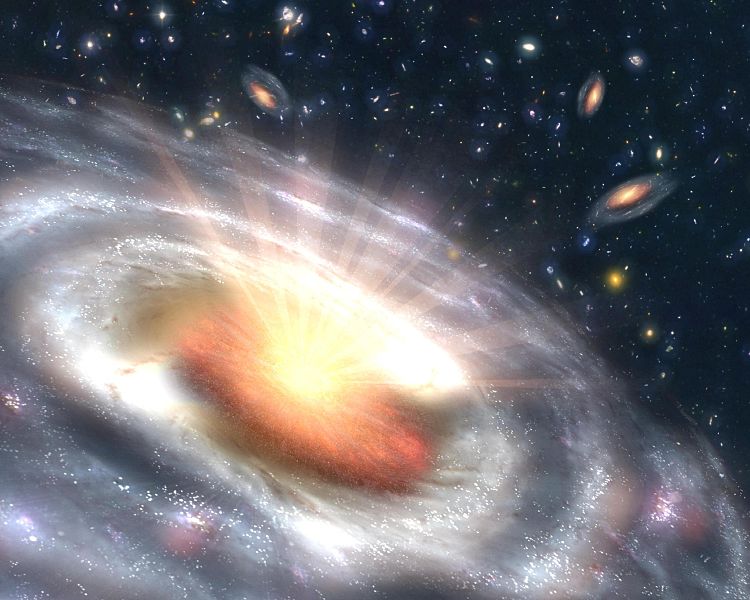
A black hole quasar (Jet Propulsion Laboratory, NASA, public domain)
Allan Sandage discovered the first quasar, calculated the value of Hubble’s constant, and made the first plausible determination of the age of the universe. He also lived just a few blocks from the house in which I grew up — something that I learned only a few weeks before he died. How I wish that I had known!
The current issue of Scientific American contains a really nice summary article by the British astrophysicist and cosmologist Martin Rees, Baron Rees of Ludlow, entitled “How Astronomers Revolutionized Our View of the Cosmos: The universe turns out to be much bigger and weirder than anyone thought” (Scientific American 323/3 [September 2020, 323/3]: 58-64) about the history of modern cosmology. Martin Rees has been the Astronomer Royal since 1995. From 2004 until 2012, he also served as the master of Trinity College, Cambridge, and from 2005 to 2010, he was the president of the Royal Society.
The article is very clearly and approachably written, and I commend it as a good overview for those who want to learn about the topic or to refresh their memories. I’m pleased, too, that Rees seems to have very specifically tried to credit some of the previously unsung women who made pioneering contributions to the field.
The piece describes how scientists determined that stars are made of the same basic elements that we know on earth, rather than the quintessence or “fifth essence” (beyond earth, water, air, and fire) postulated by pre-modern thinkers., and how they are powered. Among others, the Anglo-American astronomer Cecilia Payne-Gaposchkin (1900-1979) contributed to this work. The Russian-American astronomer Otto Struve (1897-1963) is said to have described her doctoral dissertation as “the most brilliant Ph.D. thesis ever written in astronomy.”
The article also tells about the famous 1920 “great debate” between Harlow Shapley and Heber Curtis about whether the Milky Way represented the entirety of the visible universe (Shapley’s position) or whether the fuzzy nebulae that had been observed were beyond our local galaxy (Curtis’s view). In 1924, Edwin Hubble resolved the question in favor of Curtis’s view on the basis of observational data, interpreted on the basis of techniques partially developed by Henrietta Swan Leavitt (1868-1921), who was the subject of George Johnson’s enjoyable biography Miss Leavitt’s Stars.
In 1933, Fritz Zwicky detected what we now know as “dark matter,” the existence of which was confirmed in the 1970s by, among others, the American astronomer Vera Rubin (1928-2016). And yet, Martin Rees comments, “we are hardly closer than we were in the 1930s to figuring out what it is” (61).
Rees goes on to discuss Albert Einstein’s work on gravity in his general theory of relativity, and the related phenomena of neutron stars, pulsars (mentioning the relevant work of the Irish astrophysicist Jocelyn Bell Burnell [b. 1943]), black holes, and quasars.
(Probably to be continued.)
Next Post

August 25, 2020 Revision 4.7 "The Qur’an on the Last Days"
Browse Our Archives
Select a Category Uncategorized
Select a Month October 2026 September 2026 August 2026 July 2026 June 2026 May 2026 April 2026 March 2026 February 2026 January 2026 December 2025 November 2025 October 2025 September 2025 August 2025 July 2025 June 2025 May 2025 April 2025 March 2025 February 2025 January 2025 December 2024 November 2024 October 2024 September 2024 August 2024 July 2024 June 2024 May 2024 April 2024 March 2024 February 2024 January 2024 December 2023 November 2023 October 2023 September 2023 August 2023 July 2023 June 2023 May 2023 April 2023 March 2023 February 2023 January 2023 December 2022 November 2022 October 2022 September 2022 August 2022 July 2022 June 2022 May 2022 April 2022 March 2022 February 2022 January 2022 December 2021 November 2021 October 2021 September 2021 August 2021 July 2021 June 2021 May 2021 April 2021 March 2021 February 2021 January 2021 December 2020 November 2020 October 2020 September 2020 August 2020 July 2020 June 2020 May 2020 April 2020 March 2020 February 2020 January 2020 December 2019 November 2019 October 2019 September 2019 August 2019 July 2019 June 2019 May 2019 April 2019 March 2019 February 2019 January 2019 December 2018 November 2018 October 2018 September 2018 August 2018 July 2018 June 2018 May 2018 April 2018 March 2018 February 2018 January 2018 December 2017 November 2017 October 2017 September 2017 August 2017 July 2017 June 2017 May 2017 April 2017 March 2017 February 2017 January 2017 December 2016 November 2016 October 2016 September 2016 August 2016 July 2016 June 2016 May 2016 April 2016 March 2016 February 2016 January 2016 December 2015 November 2015 October 2015 September 2015 August 2015 July 2015 June 2015 May 2015 April 2015 March 2015 February 2015 January 2015 December 2014 November 2014 March 2014 August 2013 February 2012
Follow Us!
TAKE THE
Religious Wisdom Quiz
For God so loved the world that he gave his one and only Son, that whoever believes in him shall not ____ but have eternal life.
Select your answer to see how you score.
Fail Fall Suffer Perish
Related posts from Sic et Non

Created or Discovered? (Part Two)
Created or Discovered? (Part One)

Multiple Degrees within the Kingdoms
TRENDING AT PATHEOS Latter-day Saint

'Super Scam Me' Exposes AI Jon Bon Jovi...
Leslie Pickett believed she was in a relationship with Jon Bon Jovi....

The Brazilian Remake of Kendricks' 'Flywheel' Opens in...
“Flywheel,” the story that launched the Kendrick Brothers’ filmmaking career is getting...

The Dangers of Gradual Accommodation (Winking at Sin)
Recently, the “law of gradualness” resurfaced during the opening of a weeklong,...

The Iron Gates and the Lion of the...
Yesterday, I didn't finish my report about, well, yesterday. So I'll...

The Image: On the Horror of Capitalism and...
The Image Then went the Pharisees, and took counsel how they might...

We are approaching the date of our new American national holiday: October...
view all Latter-day Saint blogs
Ad-Free & Subscriber Log-In Subscription Support
- About Us
- 2026 Calendar
- Videos
- Podcasts
- Library of World Religions
- Faith In Media Tracker
- Advertise With Us
- Write for Us
- Privacy Policy
- Terms of Service
- Do Not Sell My Data
- Contact Us
- Radiant Digital
- Manage Newsletter Subscriptions
- Unsubscribe From Notifications
- Sitemap
Copyright 2008-2026, Patheos. All rights reserved.
Subscription Support Ad-Free & Subscriber Log-In
Follow Patheos