
BuddhistCatholicContemplativeEvangelicalGeneral ChristianHinduJewishLatter-day SaintMuslimNew VisionsProgressive Christian
Beliefs
- Buddhist
- Catholic
- Contemplative
- Evangelical
- General Christian
- Hindu
- Jewish
- Latter-day Saint
- More Voices
- Muslim
- New Visions
- Pagan
- Progressive Christian
Topics
- Religion News
- Food and Religion
- Sports and Religion
- Religious Art
- Religious Music and Entertainment
- Religious Events
- History and Religion
- Style and Religion
- Politics and Religion
- Women in Religion
- Recreation Outdoors and Religion
- Business Finance and Religion
- Careers Workplace and Religion
- Education and Religion
- Family Parenting and Religion
- Health Fitness and Religion
- Home and Religion
- Relationships and Religion
- Technology and Religion
- Travel and Religion
Columnists
- Buddhist Columnists
- Business Finance and Religion Columnists
- Careers Workplace and Religion Columnists
- Catholic Columnists
- Contemplative Columnists
- Education and Religion Columnists
- Evangelists Columnists
- Family Parenting and Religion Columnists
- General Christian Columnists
- Health Fitness and Religion Columnists
- Hindu Columnists
- History and Religion Columnists
- Home and Religion Columnists
- Jewish Columnists
- More Voices Columnists
- Latter Day Columnists
- Muslim Columnists
- New Visions Columnists
- Nonreligious Columnists
- Pagan Columnists
- Politics and Religion Columnists
- Progressive Columnists
- Recreation Outdoors and Religion Columnists
- Relationships and Religion Columnists
- Religion News Columnists
- Religious Art Columnists
- Religious Events Columnists
- Religious Music and Entertainment Columnists
- Sports and Religion Columnists
- Style and Religion Columnists
- Technology and Religion Columnists
- Travel and Religion Columnists
- Women in Religion Columnists
Resource Library
- 2026 Calendar
- Library of World Religions
- The 100 Most Holy Places on Earth
- Patheos Answers
- Podcasts
- Videos
- Faith Leaders Database
- Anglican Episcopalian
- Bahai
- Baptist
- Buddhism
- Christianity
- Confucianism
- Eastern Orthodoxy
- Hinduism
- Holiness and Pentecostal
- ISKCON
- Islam
- Judaism
- Lutheran
- Methodist
- The Church of Jesus Christ of Latter-day Saints
- New Age
- Paganism
- Presbytarian and Reformed
- Protestantism
- Religion Behind the Scenes
- Roman Catholic
- Scientology
- Shia Islam
- Sikhism
- Sufism
- Sunni Islam
- Taoism
- Zen
- See all religions
Research Tools
 Ad-Free & Subscriber Log-In Subscription Support
Ad-Free & Subscriber Log-In Subscription Support
Follow Patheos 

- Trending:
- Forgiveness
- |
- Marriage
- |
- Consciousness
- |
- Death Penalty
- |
- Election
- |
- Halloween

- Home
- Latter-day Saint
- “How Astronomers Revolutionized Our View of the Cosmos,” Revisited
“How Astronomers Revolutionized Our View of the Cosmos,” Revisited
Last updated on: August 27, 2020 at 12:29 am by Dan Peterson
“How Astronomers Revolutionized Our View of the Cosmos,” Revisited 2020-08-27T00:29:05-06:00 Dan Peterson
Patheos Explore the world's faith through different perspectives on religion and spirituality! Patheos has the views of the prevalent religions and spiritualities of the world.
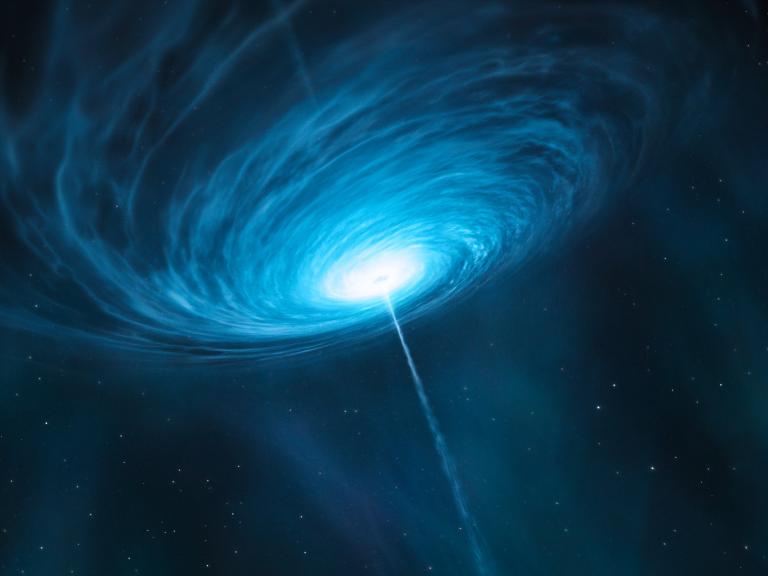
An artist’s impression of Quasar (quasi-stellar object) 3C 279.
(NASA public domain image)
The current issue of Scientific American contains a clear and approachable summary article by the British astrophysicist and cosmologist Martin Rees, Baron Rees of Ludlow, entitled “How Astronomers Revolutionized Our View of the Cosmos: The universe turns out to be much bigger and weirder than anyone thought” (Scientific American 323/3 [September 2020, 323/3]: 58-64) about the history of modern cosmology. Martin Rees has been the Astronomer Royal since 1995. From 2004 until 2012, he also served as the master of Trinity College, Cambridge, and from 2005 to 2010, he was the president of the Royal Society.
I’m continuing my notes from yesterday’s entry.
Dr. Rees offers a brief account of the serendipitous 1965 discovery, by Arno Penzias and Robert Wilson, of the cosmic microwave background radiation, ancient “light” left over from roughly 300,000 years after the birth of the universe. Now, he says, “we understand, at least in outline, 99.998 percent of cosmic history” (62)
That’s on a huge scale. But, on the far opposite end of the scale, “A series of discoveries has also revealed the history of the elemental building blocks that make up stars, planets and even our own bodies” (62). He spends some time on a famous paper in Reviews of Modern Physics that set forth the way in which most of the atoms of the periodic table are created within stars, by “stellar nucleosynthesis.” Commonly called BBFH after its four co-authors — the great British astrophysicist Sir Fred Hoyle, the married Anglo-American astronomers Margaret Burbidge (1919-2020; she died on 5 April of this year, after a fall, at nearly 101 years of age) and Geoffrey Burbidge (1925-2010), and the American nuclear physicist William Fowler — the paper, says Martin Rees,
calculated why oxygen and carbon, for instance, are common, whereas gold and uranium are rare. Our galaxy, it turns out, is a huge ecological system where gas is being recycled through successive generations of stars. Each of us contains atoms forged in dozens of different stars spread across the Milky Way that lived and died more than 4.5 billion years ago (63).
The process by which gold is forged, by the way, was not determined until much more recently, and in a quite unexpected way. The finding of gravitational waves, expected as an implication of Einstein’s general theory of relativity but not previously observed, by the Laser Interferometer Gravitational-wave Observatory (LIGO), suggested that gold was created during the mergers of pulsar stars.
The article also gives a helpful summation of the remarkable recent progress in discovering exoplanets — none of which were known when I was young. (Granted that telescopes were yet to be invented, still . . .)
More than twenty years ago, Dr. Rees confesses, he predicted that we would understand the nature of dark matter by now. However, we don’t. He still believes that we’ll have the explanation reasonably soon.
The situation is very different with “dark energy,” which became a “thing” in 1998. It’s the mysterious force that seems to be powering the accelerating (!) expansion of the universe. “I am not expecting answers anytime soon,” says Dr. Rees (64). On a brighter note, though, “I expect evidence of a biosphere on an exoplanet within 20 years” (46). (He’s plainly unafraid of going out on a limb.)
I close my notes here with a funny anecdote involving, among others, the prominent cosmologist Andrei Linde, followed by a nice bit of angst-inducing gloom:
About 10 years ago I was on a panel at Stanford University where we were asked by someone in the audience how much we would bet on the multiverse concept. I said that on a scale of betting my goldfish, my dog or my life, I was nearly at the dog level. Andrei Linde, who had spent 25 years promoting [a cosmological theory called] eternal inflation, said he would almost bet his life. Later, on being told this, physicist Steven Weinberg said he would happily bet my dog and Linde’s life (64).
And what will happen to this universe — or multiverse — of ours? Long-range forecasts are seldom reliable, but the best and most conservative bet is that we have almost an eternity ahead with an ever colder and ever emptier cosmos. Galaxies will accelerate away and disappear. All that will be left from our vantage point will be the remnants of the Milky Way, Andromeda and smaller neighbors. Protons may decay, dark matter particles may be annihilated, there may be occasional flashes when black holes evaporate — and then silence. (64)
It almost makes you want to go back to bed, doesn’t it?
Previous Post

August 25, 2020
Revision 4.7 "The Qur’an on the Last Days"
Next Post
August 25, 2020 "Scholarly Support for the Book of Abraham"
Browse Our Archives
Select a Category Uncategorized
Select a Month October 2026 September 2026 August 2026 July 2026 June 2026 May 2026 April 2026 March 2026 February 2026 January 2026 December 2025 November 2025 October 2025 September 2025 August 2025 July 2025 June 2025 May 2025 April 2025 March 2025 February 2025 January 2025 December 2024 November 2024 October 2024 September 2024 August 2024 July 2024 June 2024 May 2024 April 2024 March 2024 February 2024 January 2024 December 2023 November 2023 October 2023 September 2023 August 2023 July 2023 June 2023 May 2023 April 2023 March 2023 February 2023 January 2023 December 2022 November 2022 October 2022 September 2022 August 2022 July 2022 June 2022 May 2022 April 2022 March 2022 February 2022 January 2022 December 2021 November 2021 October 2021 September 2021 August 2021 July 2021 June 2021 May 2021 April 2021 March 2021 February 2021 January 2021 December 2020 November 2020 October 2020 September 2020 August 2020 July 2020 June 2020 May 2020 April 2020 March 2020 February 2020 January 2020 December 2019 November 2019 October 2019 September 2019 August 2019 July 2019 June 2019 May 2019 April 2019 March 2019 February 2019 January 2019 December 2018 November 2018 October 2018 September 2018 August 2018 July 2018 June 2018 May 2018 April 2018 March 2018 February 2018 January 2018 December 2017 November 2017 October 2017 September 2017 August 2017 July 2017 June 2017 May 2017 April 2017 March 2017 February 2017 January 2017 December 2016 November 2016 October 2016 September 2016 August 2016 July 2016 June 2016 May 2016 April 2016 March 2016 February 2016 January 2016 December 2015 November 2015 October 2015 September 2015 August 2015 July 2015 June 2015 May 2015 April 2015 March 2015 February 2015 January 2015 December 2014 November 2014 March 2014 August 2013 February 2012
Follow Us!
TAKE THE
Religious Wisdom Quiz
Who was Isaac's wife?
Select your answer to see how you score.
Sarah Rebekah Rachel Leah
Related posts from Sic et Non

"The Physicality of the Small Plates"

Created or Discovered? (Part Two)

Created or Discovered? (Part One)

Multiple Degrees within the Kingdoms
TRENDING AT PATHEOS Latter-day Saint

How to Make a Decision When You Can't...
Main point: It’s much more valuable to stay close to God so...

Archdiocese Hosts Military Marriage Retreat in Germany
RASTATT, Germany — The transient military lifestyle, with its frequent deployments and...

Nearly every morning, I make the drive to Detroit with my high-school-age...

The Real AI Story Is Adoption Without Trust
Artificial intelligence has crossed a political threshold. It is no longer a...

A new article, written by Jeff Lindsay and Gale L. Pooley,...

Swimfan: Forgotten Aughts Pleasures
This is a recovery effort. In 2002, My Big Fat Greek Wedding...
view all Latter-day Saint blogs
Ad-Free & Subscriber Log-In Subscription Support
- About Us
- 2026 Calendar
- Videos
- Podcasts
- Library of World Religions
- Faith In Media Tracker
- Advertise With Us
- Write for Us
- Privacy Policy
- Terms of Service
- Do Not Sell My Data
- Contact Us
- Radiant Digital
- Manage Newsletter Subscriptions
- Unsubscribe From Notifications
- Sitemap
Copyright 2008-2026, Patheos. All rights reserved.
Subscription Support Ad-Free & Subscriber Log-In
Follow Patheos