
BuddhistCatholicContemplativeEvangelicalGeneral ChristianHinduJewishLatter-day SaintMuslimNew VisionsProgressive Christian
Beliefs
- Buddhist
- Catholic
- Contemplative
- Evangelical
- General Christian
- Hindu
- Jewish
- Latter-day Saint
- More Voices
- Muslim
- New Visions
- Pagan
- Progressive Christian
Topics
- Religion News
- Food and Religion
- Sports and Religion
- Religious Art
- Religious Music and Entertainment
- Religious Events
- History and Religion
- Style and Religion
- Politics and Religion
- Women in Religion
- Recreation Outdoors and Religion
- Business Finance and Religion
- Careers Workplace and Religion
- Education and Religion
- Family Parenting and Religion
- Health Fitness and Religion
- Home and Religion
- Relationships and Religion
- Technology and Religion
- Travel and Religion
Columnists
- Buddhist Columnists
- Business Finance and Religion Columnists
- Careers Workplace and Religion Columnists
- Catholic Columnists
- Contemplative Columnists
- Education and Religion Columnists
- Evangelists Columnists
- Family Parenting and Religion Columnists
- General Christian Columnists
- Health Fitness and Religion Columnists
- Hindu Columnists
- History and Religion Columnists
- Home and Religion Columnists
- Jewish Columnists
- More Voices Columnists
- Latter Day Columnists
- Muslim Columnists
- New Visions Columnists
- Nonreligious Columnists
- Pagan Columnists
- Politics and Religion Columnists
- Progressive Columnists
- Recreation Outdoors and Religion Columnists
- Relationships and Religion Columnists
- Religion News Columnists
- Religious Art Columnists
- Religious Events Columnists
- Religious Music and Entertainment Columnists
- Sports and Religion Columnists
- Style and Religion Columnists
- Technology and Religion Columnists
- Travel and Religion Columnists
- Women in Religion Columnists
Resource Library
- 2026 Calendar
- Library of World Religions
- The 100 Most Holy Places on Earth
- Patheos Answers
- Podcasts
- Videos
- Faith Leaders Database
- Anglican Episcopalian
- Bahai
- Baptist
- Buddhism
- Christianity
- Confucianism
- Eastern Orthodoxy
- Hinduism
- Holiness and Pentecostal
- ISKCON
- Islam
- Judaism
- Lutheran
- Methodist
- The Church of Jesus Christ of Latter-day Saints
- New Age
- Paganism
- Presbytarian and Reformed
- Protestantism
- Religion Behind the Scenes
- Roman Catholic
- Scientology
- Shia Islam
- Sikhism
- Sufism
- Sunni Islam
- Taoism
- Zen
- See all religions
Research Tools
 Ad-Free & Subscriber Log-In Subscription Support
Ad-Free & Subscriber Log-In Subscription Support
Follow Patheos 

- Trending:
- Forgiveness
- |
- Marriage
- |
- Consciousness
- |
- Death Penalty
- |
- Election
- |
- Halloween

- Home
- Latter-day Saint
- “Sacred Time, Sacred Space, & Sacred Meaning”
“Sacred Time, Sacred Space, & Sacred Meaning”
Last updated on: July 25, 2020 at 8:56 pm by Dan Peterson
“Sacred Time, Sacred Space, & Sacred Meaning” 2020-07-25T20:56:56-06:00 Dan Peterson
Patheos Explore the world's faith through different perspectives on religion and spirituality! Patheos has the views of the prevalent religions and spiritualities of the world.
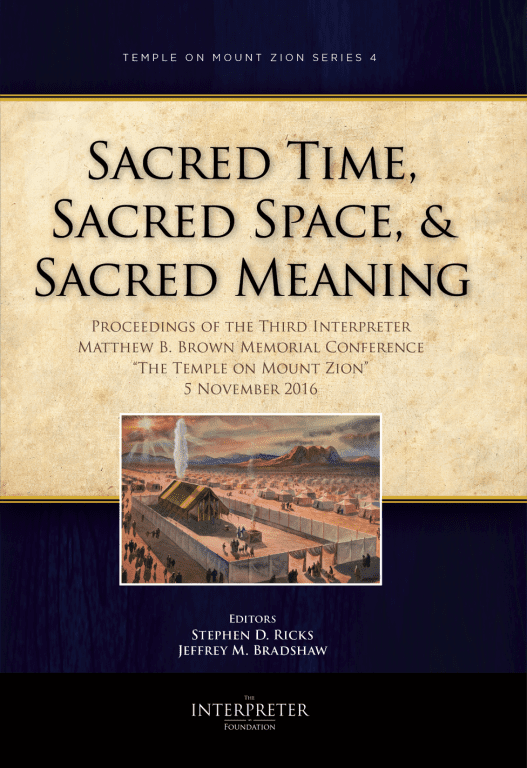
The cover of the fourth volume in the Temple on Mount Zion series, new from the Interpreter Foundation
I’m. pleased to announce the appearance of a new book from the Interpreter Foundation, edited by Stephen D. Ricks and Jeffrey Mark Bradshaw and featuring articles by Matthew L. Bowen, Jeffrey M. Bradshaw, David Calabro, and Camille Fronk Olson:
And here’s something that you might also enjoy:
Book of Moses Insights #013: Enoch’s Teaching Mission: Imprisonment of the Gibborim (Moses 7:38)
***
On a quite distinct issue: Some have suggested that the authors of the four gospels not only weren’t writing actual history, but didn’t even imagine themselves to be doing so. Historical accuracy, it is said, meant little or nothing to them. Is this valid? Here are some notes on the question:
From the outset, the Gospels present themselves as being truthful accounts of actual history. For example, Luke states the purpose of his Gospel clearly at the very beginning. He wrote it so that his readers might know “certainty concerning the things you have been taught” related to the life of Jesus (1:4). John makes a similar assertion at the end of his work, emphasizing that he testified “about these things” and wrote “these things, and we know that his testimony is true” (John 21:24). (Nathan Busenitz, Reasons We Believe: 50 Lines of Evidence That Confirm the Christian Faith [Wheaton, IL: Crossway Books, 2008], 126)
Consider the way the Gospels are written — in a sober and responsible fashion, with accurate incidental details, with obvious care and exactitude. You don’t find the outlandish flourishes and blatant mythologizing that you see in a lot of other ancient writings. . . . The goal of the Gospel writers was to attempt to record what had actually happened. (Craig Blomberg, cited by Lee Strobel, The Case for Christ [Grand Rapids, MI: Zondervan, 1998], 40)
For example, consider the twenty-one allusions to historical events, geographical places, and political positions in Luke 3:1-2:
In the fifteenth year (1) of the reign of Tiberius Caesar (2), Pontius Pilate (3) being governor (4) of Judea (5), and Herod (6) being tetrarch (7) of Galilee (8), and his brother Philip (9) tetrarch (10) of the region of Ituraea (11) and Trachonitis (12), and Lysanias (13) tetrarch (14) of Abilene (15), during the high priesthood (16) of Annas (17) and Caiaphas (18), the word of God came to John (19) the son of Zechariah (20) in the wilderness (21).
In just two verses, it becomes clear that Luke’s goal was to convey that which was tied to historical fact. This is in keeping with his stated purpose for writing (Luke 1:4). (Busenitz, Reasons We Believe, 127)
The evangelists certainly claim to be writing history. True, they write as passionate exponents of a certain interpretation of that history, and they select and arrange their facts accordingly. But . . . there is no reason to think a person must be a bad historian because he or she is a strong partisan. (D. A. Carson, Douglas J. Moo, and Leon Morris, An Introduction to the New Testament [Grand Rapids, MI: Zondervan, 1992], 52)
Posted from Breckenridge, Colorado
Previous Post

July 25, 2020
Revision 2.8 "Shanfara of Azd, and friends"
Next Post
July 25, 2020 "Death is nothing more than a doorway, something you walk through."
Browse Our Archives
Select a Category Uncategorized
Select a Month October 2026 September 2026 August 2026 July 2026 June 2026 May 2026 April 2026 March 2026 February 2026 January 2026 December 2025 November 2025 October 2025 September 2025 August 2025 July 2025 June 2025 May 2025 April 2025 March 2025 February 2025 January 2025 December 2024 November 2024 October 2024 September 2024 August 2024 July 2024 June 2024 May 2024 April 2024 March 2024 February 2024 January 2024 December 2023 November 2023 October 2023 September 2023 August 2023 July 2023 June 2023 May 2023 April 2023 March 2023 February 2023 January 2023 December 2022 November 2022 October 2022 September 2022 August 2022 July 2022 June 2022 May 2022 April 2022 March 2022 February 2022 January 2022 December 2021 November 2021 October 2021 September 2021 August 2021 July 2021 June 2021 May 2021 April 2021 March 2021 February 2021 January 2021 December 2020 November 2020 October 2020 September 2020 August 2020 July 2020 June 2020 May 2020 April 2020 March 2020 February 2020 January 2020 December 2019 November 2019 October 2019 September 2019 August 2019 July 2019 June 2019 May 2019 April 2019 March 2019 February 2019 January 2019 December 2018 November 2018 October 2018 September 2018 August 2018 July 2018 June 2018 May 2018 April 2018 March 2018 February 2018 January 2018 December 2017 November 2017 October 2017 September 2017 August 2017 July 2017 June 2017 May 2017 April 2017 March 2017 February 2017 January 2017 December 2016 November 2016 October 2016 September 2016 August 2016 July 2016 June 2016 May 2016 April 2016 March 2016 February 2016 January 2016 December 2015 November 2015 October 2015 September 2015 August 2015 July 2015 June 2015 May 2015 April 2015 March 2015 February 2015 January 2015 December 2014 November 2014 March 2014 August 2013 February 2012
Follow Us!
TAKE THE
Religious Wisdom Quiz
In the Parable of the Pearl of Great Price, what does the merchant do?
Select your answer to see how you score.
Finds a lost coin Sells all to buy the pearl Buys many pearls Builds a bigger barn
Related posts from Sic et Non

Notes on Women, Priesthood, and General Conference

"The Book of Moses as a Temple Text"


TRENDING AT PATHEOS Latter-day Saint

Letters on Living the Faith by C.S. Lewis
Most of us met C.S. Lewis as a public intellectual. Mere Christianity....

When Halloween Unmasks Married Hearts
Written by Dr. David K. Ewen from Eternal Truth Bible College Behind...

Aristotle. He’s been called the father of logic, the father of the...

Methodist Central Hall and Westminster Abbey
Situated on the same square is Methodist Central Hall and Westminster Abbey. ...

57th Dove Awards Honor Dolly Parton, Crown New...
On gospel music’s biggest night, the 57th annual GMA Dove Awards honored...

The First Eucharistic Controversy: Christ’s Real Presence
For Catholics, the Eucharist is the source and summit of the Christian...
view all Latter-day Saint blogs
Ad-Free & Subscriber Log-In Subscription Support
- About Us
- 2026 Calendar
- Videos
- Podcasts
- Library of World Religions
- Faith In Media Tracker
- Advertise With Us
- Write for Us
- Privacy Policy
- Terms of Service
- Do Not Sell My Data
- Contact Us
- Radiant Digital
- Manage Newsletter Subscriptions
- Unsubscribe From Notifications
- Sitemap
Copyright 2008-2026, Patheos. All rights reserved.
Subscription Support Ad-Free & Subscriber Log-In
Follow Patheos