
BuddhistCatholicContemplativeEvangelicalGeneral ChristianHinduJewishLatter-day SaintMuslimNew VisionsProgressive Christian
Beliefs
- Buddhist
- Catholic
- Contemplative
- Evangelical
- General Christian
- Hindu
- Jewish
- Latter-day Saint
- More Voices
- Muslim
- New Visions
- Pagan
- Progressive Christian
Topics
- Religion News
- Food and Religion
- Sports and Religion
- Religious Art
- Religious Music and Entertainment
- Religious Events
- History and Religion
- Style and Religion
- Politics and Religion
- Women in Religion
- Recreation Outdoors and Religion
- Business Finance and Religion
- Careers Workplace and Religion
- Education and Religion
- Family Parenting and Religion
- Health Fitness and Religion
- Home and Religion
- Relationships and Religion
- Technology and Religion
- Travel and Religion
Columnists
- Buddhist Columnists
- Business Finance and Religion Columnists
- Careers Workplace and Religion Columnists
- Catholic Columnists
- Contemplative Columnists
- Education and Religion Columnists
- Evangelists Columnists
- Family Parenting and Religion Columnists
- General Christian Columnists
- Health Fitness and Religion Columnists
- Hindu Columnists
- History and Religion Columnists
- Home and Religion Columnists
- Jewish Columnists
- More Voices Columnists
- Latter Day Columnists
- Muslim Columnists
- New Visions Columnists
- Nonreligious Columnists
- Pagan Columnists
- Politics and Religion Columnists
- Progressive Columnists
- Recreation Outdoors and Religion Columnists
- Relationships and Religion Columnists
- Religion News Columnists
- Religious Art Columnists
- Religious Events Columnists
- Religious Music and Entertainment Columnists
- Sports and Religion Columnists
- Style and Religion Columnists
- Technology and Religion Columnists
- Travel and Religion Columnists
- Women in Religion Columnists
Resource Library
- 2026 Calendar
- Library of World Religions
- The 100 Most Holy Places on Earth
- Patheos Answers
- Podcasts
- Videos
- Faith Leaders Database
- Anglican Episcopalian
- Bahai
- Baptist
- Buddhism
- Christianity
- Confucianism
- Eastern Orthodoxy
- Hinduism
- Holiness and Pentecostal
- ISKCON
- Islam
- Judaism
- Lutheran
- Methodist
- The Church of Jesus Christ of Latter-day Saints
- New Age
- Paganism
- Presbytarian and Reformed
- Protestantism
- Religion Behind the Scenes
- Roman Catholic
- Scientology
- Shia Islam
- Sikhism
- Sufism
- Sunni Islam
- Taoism
- Zen
- See all religions
Research Tools
 Ad-Free & Subscriber Log-In Subscription Support
Ad-Free & Subscriber Log-In Subscription Support
Follow Patheos 

- Trending:
- Forgiveness
- |
- Marriage
- |
- Consciousness
- |
- Death Penalty
- |
- Election
- |
- Halloween

- Home
- Latter-day Saint
- Revision 2.8 “Shanfara of Azd, and friends”
Revision 2.8 “Shanfara of Azd, and friends”
Last updated on: July 25, 2020 at 8:47 pm by Dan Peterson
Revision 2.8 “Shanfara of Azd, and friends” 2020-07-25T20:47:58-06:00 Dan Peterson
Patheos Explore the world's faith through different perspectives on religion and spirituality! Patheos has the views of the prevalent religions and spiritualities of the world.
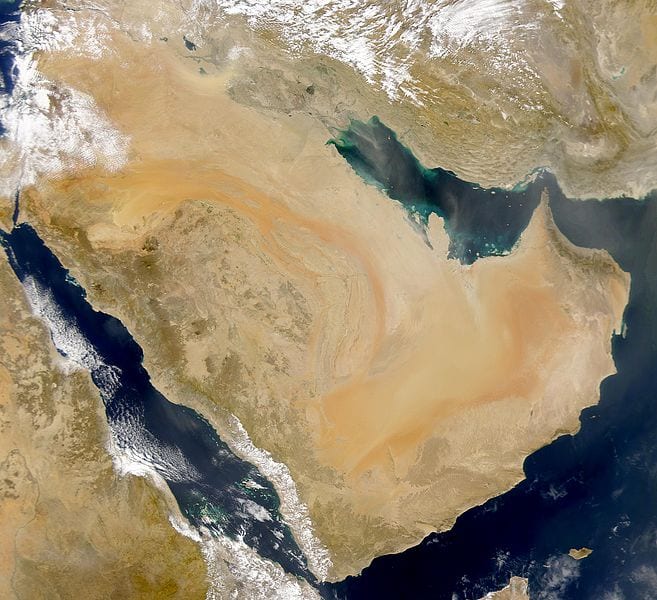
I doubt that many people today would describe the Arabian Peninsula as a “savannah.” Yet that’s what it once was.
(NASA public domain photograph)
In my previous installment, I wrote about the pre-Islamic Arabian value of revenge, rather than charitable forgiveness. So we continue:
The story of Shanfara, a poet and outlaw of the tribe of Azd, will also illustrate something of the ideal Arabian hero. The story is told that when he was just a young child, he was kidnapped by another tribe, known as the Banu Salaman. (Banu, here, means “sons [of].”) He was brought up among them and for many years had no idea that he was not actually one of them. However, when he grew up and learned the truth he vowed that he would avenge the injury done to him and his tribe by killing a hundred warriors of the Banu Salaman. Preparing his revenge, he left the Banu Salaman and went back to his real kinfolk, the Banu Azd. Over the next several years, he did indeed manage to kill ninety-eight of the Banu Salaman, but then they contrived to ambush him, and it looked as if he would fail to fulfill his vow. However, when, in the fierce fight of the ambush, one of his hands was chopped off by the stroke of a sword. Shanfara grabbed the amputated hand with his other and threw it as hard as he could in the face of one of his attackers, killing him. Furious, the ambushers then overpowered Shanfara and hacked him to death, leaving his body to rot on the desert sand. The total of the Banu Salaman that he’d slain came to ninety-nine, one short of fulfilling his vow. He’d failed, or so one might have thought. However, many days after Shanfara’s death, one of the Banu Salaman was passing by and paused to look at the bones of their late enemy as they lay there, bleaching in the intense desert sun. To show his contempt, the man gave a powerful kick to Shanfara’s skull, sending it bouncing across the sand. But a splinter of bone from the skull pierced his foot. The wound festered, and the man died. Shanfara, in other words, had actually fulfilled his vow. And his persistence in revenge—a persistence that endured beyond his death—made him a great hero of pre-Islamic Arabia.
Honor was another pre-Islamic Arabian virtue. A couple of stories will illustrate something of what it meant to the early inhabitants of the Peninsula.
The first, and the shortest, is connected with a famous pre-Islamic poet by the name of Tarafa. Tarafa had a problem—and perhaps not an unexpected one, considering that he made his living by words: He couldn’t keep his mouth shut. Specifically, he showed great impertinence toward Amr ibn Hind, who reigned as king of Hira between 554 and 568 A.D. On one occasion, for instance, finding himself seated opposite the king’s beautiful sister at a banquet, he exclaimed:
Behold, she has come back to me,
My fair gazelle whose ear-rings shine;
Had not the king been sitting here,
I would have pressed her lips to mine!
This wasn’t the kind of outburst that was likely to win favor with the princess’s royal brother. But the impertinence was nothing compared to the insult that Tarafa had earlier directed at the king himself:
Would that we had instead of Amr
A milch-ewe bleating round our tent!
Fed up with such behavior from a mere poet, Amr sent Tarafa and a friend (who must have been similarly offensive) to Bahrayn, carrying sealed letters to that island’s governor. En route, however, the friend began to grow suspicious and opened his letter. Sure enough, he found that it contained orders to bury him alive. He threw his letter into the stream and advised Tarafa to do likewise. Tarafa, however, refused. He felt himself honor-bound to carry his letter to Bahrayn and to deliver it unopened, as he had promised to do. When he arrived in Bahrayn, he was executed. According to some sources, he wasn’t yet twenty years old.
The next story relates to the pre-Islamic Arabian Jew Samawal, whom we’ve already briefly met. He lived in a castle some distance to the north of an oasis called Yathrib, a place that will take on considerable importance in the next chapter. One day, the great pre-Islamic poet Imru al-Qays is said to have taken refuge with Samawal when fleeing from some of his enemies (of whom he had many) in the direction of Syria. Before the poet departed from the castle, he left five coats of mail armor with Samawal for safe-keeping, items that had been handed down from generation to generation as heirlooms within his family. Imru al-Qays then continued on his journey toward Syria. Eventually, he went on to Constantinople, where he sought help from the Byzantine emperor in regaining his kingdom, which had been stolen from him. The appeal found sympathy, but Imru al-Qays died on his way home.
Meanwhile, though, his enemy, the king of Hira, sent an army against Samawal, demanding the five coats of mail that Imru al-Qays had deposited with him. But Samawal had given a solemn promise to take care of the armor, and he refused to yield it up. So the army of Hira besieged his castle. The siege went on and on, and Samawal was unbending. Finally, the besiegers were able to capture Samawal’s son, who had gone out to hunt.
“Do you know this boy?” the commander of the besieging forces asked.
“Yes,” replied Samawal. “He is my son.”
“Then will you deliver up the things you have in your possession, or should I kill him?”
“Do with him as you will,” replied Samawal. “I will never break my oath, nor will I give up the property of my guest.”
The general then drew his sword and killed the boy before the very eyes of his father, Samawal. Immediately afterwards, the army of Hira raised the siege and went home, knowing now that Samawal would never yield up what they wanted.
Posted from Estes Park, Colorado
Previous Post

July 24, 2020
"Galileo: Science vs. religion or truth vs. fiction?"
Next Post
July 25, 2020 "Sacred Time, Sacred Space, & Sacred Meaning"
Browse Our Archives
Select a Category Uncategorized
Select a Month October 2026 September 2026 August 2026 July 2026 June 2026 May 2026 April 2026 March 2026 February 2026 January 2026 December 2025 November 2025 October 2025 September 2025 August 2025 July 2025 June 2025 May 2025 April 2025 March 2025 February 2025 January 2025 December 2024 November 2024 October 2024 September 2024 August 2024 July 2024 June 2024 May 2024 April 2024 March 2024 February 2024 January 2024 December 2023 November 2023 October 2023 September 2023 August 2023 July 2023 June 2023 May 2023 April 2023 March 2023 February 2023 January 2023 December 2022 November 2022 October 2022 September 2022 August 2022 July 2022 June 2022 May 2022 April 2022 March 2022 February 2022 January 2022 December 2021 November 2021 October 2021 September 2021 August 2021 July 2021 June 2021 May 2021 April 2021 March 2021 February 2021 January 2021 December 2020 November 2020 October 2020 September 2020 August 2020 July 2020 June 2020 May 2020 April 2020 March 2020 February 2020 January 2020 December 2019 November 2019 October 2019 September 2019 August 2019 July 2019 June 2019 May 2019 April 2019 March 2019 February 2019 January 2019 December 2018 November 2018 October 2018 September 2018 August 2018 July 2018 June 2018 May 2018 April 2018 March 2018 February 2018 January 2018 December 2017 November 2017 October 2017 September 2017 August 2017 July 2017 June 2017 May 2017 April 2017 March 2017 February 2017 January 2017 December 2016 November 2016 October 2016 September 2016 August 2016 July 2016 June 2016 May 2016 April 2016 March 2016 February 2016 January 2016 December 2015 November 2015 October 2015 September 2015 August 2015 July 2015 June 2015 May 2015 April 2015 March 2015 February 2015 January 2015 December 2014 November 2014 March 2014 August 2013 February 2012
Follow Us!
TAKE THE
Religious Wisdom Quiz
What sign marked the houses to be spared during Passover?
Select your answer to see how you score.
A red ribbon A dove symbol A lit candle Blood on doorposts
Related posts from Sic et Non
"Anchoring Nephi’s Account in the Real World"

"Shall We Not Go On in So Great...

"Alma" as a Semitic Name, and Reaching Irreantum

"Nephi’s Eight Years in the 'Wilderness'"
TRENDING AT PATHEOS Latter-day Saint

The First Eucharistic Controversy: Christ’s Real Presence
For Catholics, the Eucharist is the source and summit of the Christian...

What a Stop Sign Can Teach Us About...
How to Make a Decision When You Can't Hear God Main point:...

Archdiocese Hosts Military Marriage Retreat in Germany
RASTATT, Germany — The transient military lifestyle, with its frequent deployments and...

Nearly every morning, I make the drive to Detroit with my high-school-age...

The Real AI Story Is Adoption Without Trust
Artificial intelligence has crossed a political threshold. It is no longer a...

A new article, written by Jeff Lindsay and Gale L. Pooley,...
view all Latter-day Saint blogs
Ad-Free & Subscriber Log-In Subscription Support
- About Us
- 2026 Calendar
- Videos
- Podcasts
- Library of World Religions
- Faith In Media Tracker
- Advertise With Us
- Write for Us
- Privacy Policy
- Terms of Service
- Do Not Sell My Data
- Contact Us
- Radiant Digital
- Manage Newsletter Subscriptions
- Unsubscribe From Notifications
- Sitemap
Copyright 2008-2026, Patheos. All rights reserved.
Subscription Support Ad-Free & Subscriber Log-In
Follow Patheos