
BuddhistCatholicContemplativeEvangelicalGeneral ChristianHinduJewishLatter-day SaintMuslimNew VisionsProgressive Christian
Beliefs
- Buddhist
- Catholic
- Contemplative
- Evangelical
- General Christian
- Hindu
- Jewish
- Latter-day Saint
- More Voices
- Muslim
- New Visions
- Pagan
- Progressive Christian
Topics
- Religion News
- Food and Religion
- Sports and Religion
- Religious Art
- Religious Music and Entertainment
- Religious Events
- History and Religion
- Style and Religion
- Politics and Religion
- Women in Religion
- Recreation Outdoors and Religion
- Business Finance and Religion
- Careers Workplace and Religion
- Education and Religion
- Family Parenting and Religion
- Health Fitness and Religion
- Home and Religion
- Relationships and Religion
- Technology and Religion
- Travel and Religion
Columnists
- Buddhist Columnists
- Business Finance and Religion Columnists
- Careers Workplace and Religion Columnists
- Catholic Columnists
- Contemplative Columnists
- Education and Religion Columnists
- Evangelists Columnists
- Family Parenting and Religion Columnists
- General Christian Columnists
- Health Fitness and Religion Columnists
- Hindu Columnists
- History and Religion Columnists
- Home and Religion Columnists
- Jewish Columnists
- More Voices Columnists
- Latter Day Columnists
- Muslim Columnists
- New Visions Columnists
- Nonreligious Columnists
- Pagan Columnists
- Politics and Religion Columnists
- Progressive Columnists
- Recreation Outdoors and Religion Columnists
- Relationships and Religion Columnists
- Religion News Columnists
- Religious Art Columnists
- Religious Events Columnists
- Religious Music and Entertainment Columnists
- Sports and Religion Columnists
- Style and Religion Columnists
- Technology and Religion Columnists
- Travel and Religion Columnists
- Women in Religion Columnists
Resource Library
- 2026 Calendar
- Library of World Religions
- The 100 Most Holy Places on Earth
- Patheos Answers
- Podcasts
- Videos
- Faith Leaders Database
- Anglican Episcopalian
- Bahai
- Baptist
- Buddhism
- Christianity
- Confucianism
- Eastern Orthodoxy
- Hinduism
- Holiness and Pentecostal
- ISKCON
- Islam
- Judaism
- Lutheran
- Methodist
- The Church of Jesus Christ of Latter-day Saints
- New Age
- Paganism
- Presbytarian and Reformed
- Protestantism
- Religion Behind the Scenes
- Roman Catholic
- Scientology
- Shia Islam
- Sikhism
- Sufism
- Sunni Islam
- Taoism
- Zen
- See all religions
Research Tools
 Ad-Free & Subscriber Log-In Subscription Support
Ad-Free & Subscriber Log-In Subscription Support
Follow Patheos 

- Trending:
- Forgiveness
- |
- Marriage
- |
- Consciousness
- |
- Death Penalty
- |
- Election
- |
- Halloween

- Home
- Latter-day Saint
- Revision 2.7 “Life Among the Pre-Islamic Bedouin”
Revision 2.7 “Life Among the Pre-Islamic Bedouin”
Last updated on: July 25, 2020 at 8:30 pm by Dan Peterson
Revision 2.7 “Life Among the Pre-Islamic Bedouin” 2020-07-25T20:30:35-06:00 Dan Peterson
Patheos Explore the world's faith through different perspectives on religion and spirituality! Patheos has the views of the prevalent religions and spiritualities of the world.

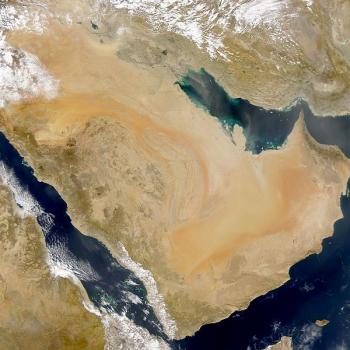
“Abstract in Sand and Sky” (Peter Dowley); Wikimedia Commons public domain image
Nomadic life breeds hardiness, frugality, eagerness for material things, fortitude, and hospitality. Such qualities are essential to survival. Furthermore, the nomad was and is an individualist, impatient of discipline, reluctant to submit to restraint or authority. (In early Islam, it was always wondered whether the bedouins could ever be real Muslims.) This trait had interesting consequences. With a few exceptions where they came in contact with the Romans or the Persians, or in Yemen to the far south, no authoritarian political forms developed among the pre-Islamic Arabs. In fact, no political institutions arose at all, in the sense in which we generally view such things. Bedouin culture has always been much less stratified, less divided into classes, less complex (in a way) than societies based on agriculture. There were transient concentrations of wealth, perhaps, but there was little lasting class stratification among the Arabs before Islam. In a sense, life was very democratic. Indeed, it was virtually anarchic. (Quite the opposite of, say, the neighboring Sasanian Persians and their “king of kings.”) Society was based on individual prowess and prestige, as well as on close lineage and group loyalties. The chief had no authority to coerce. Herdsmen or nomads couldn’t be exploited like peasants, who were tied to their fields and, thus, “rooted” in place. They had pride. Every man was free to depart with his dependents. (Late in the 1970s, I encountered a group of bedouins in the Sinai. That area had recently reverted from Israeli to Egyptian control, and I asked one of them if he were happy to be back under the rule of fellow Arabs. He looked at me as if I were crazy. “We are bedouins,” he said. What did it matter to him who ran the government?)
At this point, some readers will no doubt wonder how the tribes held together at all, if individual Arabs and their families were constantly setting out on their own. How can a society exist without some controls? It’s a good question. In fact, while there was a certain freedom to depart, there were also constraints that would make people want to stay with their tribes and work things out. I’ve said that there were no political institutions throughout most of pre-Islamic Arabia. That’s true, but the practice of the “blood feud” maintained a certain intertribal peace. I realize that blood feuds don’t sound very promising, at first glance, as a peacemaking tool. However, they maintained the peace in the same way that the threat of war maintains a fragile peace in today’s international relations. The process worked more or less as follows: If someone from Tribe A killed someone from Tribe B, Tribe B would feel itself justified in killing someone from Tribe A. If the actual perpetrator of the original murder could be caught and punished, that would be wonderful. But if not, just about anybody from Tribe A would do—provided that he or she were of the same social status. If not, Tribe A would feel itself victimized and would set out to get somebody else from Tribe B. And so on and on, much like the famous Hatfields and McCoys. Sometimes a feud would continue for so long that nobody could quite remember the original offense, only that they had gotten the short end of the stick on the last exchange and that the other tribe was going to have to pay before things were over. This may, as I said above, not seem a very promising way to keep the peace, but it was. Blood feuds were costly. So if Tribe A found that it had a member who was likely to get the tribe into trouble, they would often find a way to deal with him on their own before he acted out his violent intentions or inclinations. And it was in the interest of every individual Arab to maintain his links to a tribe because, without such tribal affiliation, he was vulnerable to anybody who wanted his horse or didn’t like his face. There was no government to protect him. If a tribe did find itself involved in a dispute, it would try long and hard to buy its way out of the situation or, in some other manner, to find a peaceful solution.
Virtue, to the ancient Arab, was muruwwa, or “manliness.” (This isn’t far different from the original meaning of our own English word virtue: Vir, in Latin, is the equivalent of English man. Related to this is the term werewolf, for a creature that is supposedly half-wolf and half-human.)[1] This “manliness” expressed itself in a number of ways that we would perhaps not find admirable, although “manly” bravery and honor certainly have something to be said for them. The general spirit of the pre-Islamic Arabian ideal is that of Tennyson’s hero: “To strive, to seek, to find, and not to yield.”[2]
That spirit wasn’t precisely Christian. Revenge, for instance, was considered a virtue, indeed a duty, among the Arabians of the century or so prior to Islam. “When wrong befalls me,” exclaimed a pre-Islamic Arabian Jew by the name of Samawal ibn Adiya, expressing a widely felt idea, “I endure not tamely.”[3] There was, of course, some good reason for this: To fail to avenge an injury was to invite another one, either to yourself or to your kinfolk. There was no government, no police force, to prevent such injuries. It was up to you. Thus, we have preserved the lament of an Arab whose kin refused to help him against a group of raiders who had stolen his camels. In the final line of the lament, we can almost hear the poet’s disgusted astonishment at the weakness of his relatives:
For all their numbers, they are good for naught,
My people, against harm however light:
They pardon wrong by evildoers wrought,
Malice with loving kindness they requite.[4]
[1] I once gave this explanation to a Gospel Doctrine class about Mark 5:30 and parallel passages (in which Jesus perceives that “virtue” or “power” has gone out of him) and then carelessly left the words virtue and werewolf on the blackboard. I was told later that the Relief Society of another ward, meeting in the same classroom afterward, had a vigorous discussion trying to determine what my lesson had been about
[2] This is the last line of Tennyson’s “Ulysses”—written, appropriately enough, about a Homeric hero.
[3] Nicholson, A Literary History of the Arabs, 88.
[4] Nicholson, A Literary History of the Arabs, 92.
Posted from Estes Park, Colorado
Previous Post

July 23, 2020
Goodness from the Heartland
Next Post
July 24, 2020 "Moses 1 and the Apocalypse of Abraham: Twin Sons of Different Mothers?"
Browse Our Archives
Select a Category Uncategorized
Select a Month October 2026 September 2026 August 2026 July 2026 June 2026 May 2026 April 2026 March 2026 February 2026 January 2026 December 2025 November 2025 October 2025 September 2025 August 2025 July 2025 June 2025 May 2025 April 2025 March 2025 February 2025 January 2025 December 2024 November 2024 October 2024 September 2024 August 2024 July 2024 June 2024 May 2024 April 2024 March 2024 February 2024 January 2024 December 2023 November 2023 October 2023 September 2023 August 2023 July 2023 June 2023 May 2023 April 2023 March 2023 February 2023 January 2023 December 2022 November 2022 October 2022 September 2022 August 2022 July 2022 June 2022 May 2022 April 2022 March 2022 February 2022 January 2022 December 2021 November 2021 October 2021 September 2021 August 2021 July 2021 June 2021 May 2021 April 2021 March 2021 February 2021 January 2021 December 2020 November 2020 October 2020 September 2020 August 2020 July 2020 June 2020 May 2020 April 2020 March 2020 February 2020 January 2020 December 2019 November 2019 October 2019 September 2019 August 2019 July 2019 June 2019 May 2019 April 2019 March 2019 February 2019 January 2019 December 2018 November 2018 October 2018 September 2018 August 2018 July 2018 June 2018 May 2018 April 2018 March 2018 February 2018 January 2018 December 2017 November 2017 October 2017 September 2017 August 2017 July 2017 June 2017 May 2017 April 2017 March 2017 February 2017 January 2017 December 2016 November 2016 October 2016 September 2016 August 2016 July 2016 June 2016 May 2016 April 2016 March 2016 February 2016 January 2016 December 2015 November 2015 October 2015 September 2015 August 2015 July 2015 June 2015 May 2015 April 2015 March 2015 February 2015 January 2015 December 2014 November 2014 March 2014 August 2013 February 2012
Follow Us!
TAKE THE
Religious Wisdom Quiz
True or False: James states that the tongue is a fire, a world of iniquity.
Select your answer to see how you score.
FALSE TRUE
Related posts from Sic et Non
"Anchoring Nephi’s Account in the Real World"

"Shall We Not Go On in So Great...

"Alma" as a Semitic Name, and Reaching Irreantum

"Nephi’s Eight Years in the 'Wilderness'"
TRENDING AT PATHEOS Latter-day Saint

Nearly every morning, I make the drive to Detroit with my high-school-age...

The Real AI Story Is Adoption Without Trust
Artificial intelligence has crossed a political threshold. It is no longer a...

A new article, written by Jeff Lindsay and Gale L. Pooley,...

Swimfan: Forgotten Aughts Pleasures
This is a recovery effort. In 2002, My Big Fat Greek Wedding...

Top Three Anti-Catholic Lies About Catholicism
This is my initial transcript for the video, "THE 3 WORST...

Pope Leo Celebrates Mass for Nurses & Docs...
I don't have any idea how he did it, but Pope Leo...
view all Latter-day Saint blogs
Ad-Free & Subscriber Log-In Subscription Support
- About Us
- 2026 Calendar
- Videos
- Podcasts
- Library of World Religions
- Faith In Media Tracker
- Advertise With Us
- Write for Us
- Privacy Policy
- Terms of Service
- Do Not Sell My Data
- Contact Us
- Radiant Digital
- Manage Newsletter Subscriptions
- Unsubscribe From Notifications
- Sitemap
Copyright 2008-2026, Patheos. All rights reserved.
Subscription Support Ad-Free & Subscriber Log-In
Follow Patheos