
BuddhistCatholicContemplativeEvangelicalGeneral ChristianHinduJewishLatter-day SaintMuslimNew VisionsProgressive Christian
Beliefs
- Buddhist
- Catholic
- Contemplative
- Evangelical
- General Christian
- Hindu
- Jewish
- Latter-day Saint
- More Voices
- Muslim
- New Visions
- Pagan
- Progressive Christian
Topics
- Religion News
- Food and Religion
- Sports and Religion
- Religious Art
- Religious Music and Entertainment
- Religious Events
- History and Religion
- Style and Religion
- Politics and Religion
- Women in Religion
- Recreation Outdoors and Religion
- Business Finance and Religion
- Careers Workplace and Religion
- Education and Religion
- Family Parenting and Religion
- Health Fitness and Religion
- Home and Religion
- Relationships and Religion
- Technology and Religion
- Travel and Religion
Columnists
- Buddhist Columnists
- Business Finance and Religion Columnists
- Careers Workplace and Religion Columnists
- Catholic Columnists
- Contemplative Columnists
- Education and Religion Columnists
- Evangelists Columnists
- Family Parenting and Religion Columnists
- General Christian Columnists
- Health Fitness and Religion Columnists
- Hindu Columnists
- History and Religion Columnists
- Home and Religion Columnists
- Jewish Columnists
- More Voices Columnists
- Latter Day Columnists
- Muslim Columnists
- New Visions Columnists
- Nonreligious Columnists
- Pagan Columnists
- Politics and Religion Columnists
- Progressive Columnists
- Recreation Outdoors and Religion Columnists
- Relationships and Religion Columnists
- Religion News Columnists
- Religious Art Columnists
- Religious Events Columnists
- Religious Music and Entertainment Columnists
- Sports and Religion Columnists
- Style and Religion Columnists
- Technology and Religion Columnists
- Travel and Religion Columnists
- Women in Religion Columnists
Resource Library
- 2026 Calendar
- Library of World Religions
- The 100 Most Holy Places on Earth
- Patheos Answers
- Podcasts
- Videos
- Faith Leaders Database
- Anglican Episcopalian
- Bahai
- Baptist
- Buddhism
- Christianity
- Confucianism
- Eastern Orthodoxy
- Hinduism
- Holiness and Pentecostal
- ISKCON
- Islam
- Judaism
- Lutheran
- Methodist
- The Church of Jesus Christ of Latter-day Saints
- New Age
- Paganism
- Presbytarian and Reformed
- Protestantism
- Religion Behind the Scenes
- Roman Catholic
- Scientology
- Shia Islam
- Sikhism
- Sufism
- Sunni Islam
- Taoism
- Zen
- See all religions
Research Tools
 Ad-Free & Subscriber Log-In Subscription Support
Ad-Free & Subscriber Log-In Subscription Support
Follow Patheos 

- Trending:
- Forgiveness
- |
- Marriage
- |
- Consciousness
- |
- Death Penalty
- |
- Election
- |
- Halloween

- Home
- Latter-day Saint
- Revision 2.5 “Arab nomadism and the scriptures”
Revision 2.5 “Arab nomadism and the scriptures”
Last updated on: July 23, 2020 at 1:03 am by Dan Peterson
Revision 2.5 “Arab nomadism and the scriptures” 2020-07-23T01:03:46-06:00 Dan Peterson
Patheos Explore the world's faith through different perspectives on religion and spirituality! Patheos has the views of the prevalent religions and spiritualities of the world.

The original “Three Tenors” join in a chorus from Verdi’s “Aîda”
(Wikimedia Commons public domain image)
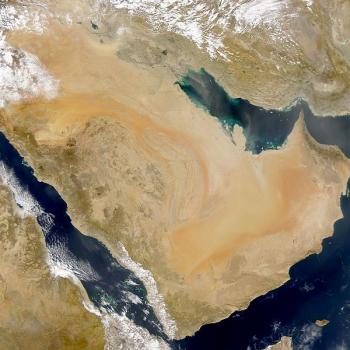
From the earliest times, the people of Arabia, though dominantly nomadic, have also included semi-nomadic and even fully settled groups. Sedentary life was overwhelmingly concentrated in the south, with the inhabitants of north and central Arabia being largely nomadic. The two classes of Arabs seldom got along with one another. Arabic literature is full of references to the contempt felt by nomads for settled folk and to the scorn of the people of the settlements for the nomads of the desert.[1] Such desert nomads, or bedouins, roam the Arabian wastelands in units known as tribes. These tribes are really just large extended families, although they also function rather like a government, in that they preserve order, take care of the poor and the orphans and widows, and even occasionally negotiate with one another in much the same way as modern nation-states. Each group possesses, for instance, a recognized pastureland in which to wander. (They don’t just wander anywhere.) But, especially in premodern times, the boundary lines were fluid and were changed constantly by intertribal conflict. Each tribe was sovereign—again, in much the same way that a nation is sovereign—and was led by a chief, or shaykh, who was chosen partly on the basis of descent and partly on the basis of proven valor and wisdom.[2] In theory, at least, tribes were made up of blood relatives and were named after a common ancestor—either real or fictional. Thus, the tribe known as the Banu Hawazin — the “sons” or “children of Hawazin” — would believe themselves to be descended from a progenitor called Hawazin.
The nomads’ seasonal migrations are dictated by the necessities of water and pasturage. They’re obliged to go where the water and the grass are. In this harsh land, the camel is far and away the most important animal, and the Bible often connects it with the Arabs.[3] The head of David’s camel keepers, for instance, was an Ishmaelite.[4] Indeed, even in modern times the camel continues to be the main beast of burden and the principal means of transport for these nomadic tribes. But sheep and goats were also important to ancient Arabs.[5] And the horse, which isn’t nearly so well suited to life in the desert as the camel, was a highly-esteemed luxury.[6] The most common nomadic dwelling—useful because it’s mobile—was and is a tent. (When Nephi, in the shortest verse in the Book of Mormon, records that his father “dwelt in a tent,” he tells us volumes, I think, about the lifestyle that he and his family had adopted while in the desert en route to the land of promise.[7] Tents are a prominent part of the first chapters of 1 Nephi.) Pictorial representations of these tents on ancient Assyrian monuments show them to have been much the same in ancient times as they are today. Modern bedouin women, like their ancient counterparts, do the domestic work around the tent, of which half is considered “women’s quarters.” They tend to the small animals, prepare food, and weave. The males, on the other hand, take care of the camels and the horses, hunt, and, of course, raid. Judges 8:21-26 mentions a style of ornamentation of men and camels that remains common today. And the nose ring and bracelets given to Rebekah are still the ornaments given to a bedouin girl.[8]
The “sons of Heth” from whom Abraham bought a burial ground for his family in Hebron, and among whom Esau found wives, seem to have been Arabs.[9] And, intriguingly, the “ravens” who fed Elijah “by the brook Cherith” in the wilderness may well have been the bedouin Arabs of the region. According to this view, which remains rather speculative, 1 Kings 17:4 should read “I have commanded the Arabs to feed thee there.” (The Hebrew equivalents for English raven and Arab are quite similar and could easily have been confused with one another over the many centuries of the transmission of the biblical text.)[10] If such an interpretation is true, we see an early instance of Arabians as agents of God, receiving revelation or inspiration from him.
The Midianites are an Arabian group of bedouins who play an important role in the scriptures. They were Ishmaelite traders who took caravans to Egypt, as mentioned in the story of Joseph.[11] The prophet Isaiah speaks of their “multitude of dromedaries [camels]” and of their great wealth in gold and incense, brought up from Sheba in South Arabia.[12] In the story of Gideon, “the Midianites came up, and the Amalekites, and the children of the east . . . with their cattle and their tents, and they came as grasshoppers for multitude; for both they and their camels were without number” (Judges 6:3, 5).
Some Midianites, at least, seem to have been a pastoral people, a people of shepherds. It was among them that Moses found his wife after he had fled from before the pharaoh, and it was to them that he led the children of Israel after their exodus from Egypt.[13] In at least one case, a Midianite appears to have served as an authorized agent of the Lord: According to Doctrine and Covenants 84:6-7, Jethro, the Midianite chief, held the priesthood and conferred it upon Moses. This goes considerably beyond what the Bible says about him. But it may receive some support from Arabic tradition, which seems to know Jethro under the name of Shu’ayb, whom it views as a great prophet and preacher who spoke with authority from God.[14]
[1] This is not altogether unlike the relationship between Nephites and Lamanites in much of the Book of Mormon. Some writers on the claims of the Restoration have argued that, in the friction depicted between urban Nephites and wandering Lamanites, the Book of Mormon reflects early American feeling for the “yeoman farmer.” But, in arguing this, these writers only reveal their lack of acquaintance with ancient history and the Near East. The dispute between “ranchers” and “farmers” is not merely American. It goes back to Cain and Abel.
[2] The work *shaykh—*sometimes spelled sheik and sheikh, and often mispronounced as if it were the French word chic—means “elder.” Someday, when Latter-day Saint missionaries take the gospel to the Arabs, we may have missionary shaykhs. Shaykh is also often used by Arab newspapers to translate the title senator, since that English word too was originally connected with the idea of age. (Think of senile!)
[3] As in Genesis 37:25; Judges 6:5; 7:12; 8:26; 1 Samuel 15:3; 30:17; 1 Kings 10:2; 1 Chronicles 5:21; 27:30; 2 Chronicles 9:1; Jeremiah 49:29, 32.
[4] 1 Chronicles 27:30.
[5] Ezekiel 27:21.
[6] See the admiring words of Job 39:19-25. A. J. Arberry, Aspects of Islamic Civilization (Ann Arbor: University of Michigan Press, 1967), 19-31, furnishes specimens of pre- Islamic Arabic poetry in excellent translation. Several passages are in praise of the nomads’ horses and camels.
[7] 1 Nephi 2:15. The tents of the ancient Arabs, sometimes associated with camels, are mentioned in the Bible at places like Judges 8:11; Psalms 83:6; 120:5; Jeremiah 49:29, 31 32; Ezekiel 38:11.
[8] Genesis 24:22, 47.
[9] Genesis 26:34; 27:46; 36:2. They were almost certainly not the same people as the more famous “Hittites” of Anatolia, whose Indo-European language, like modern Persian, is (very) distantly related to English.
[10] 1 Kings 17:4, 6. See A. Jeffery, “Arabians,” in Buttrick, et al., eds., The Interpreter’s Dictionary of the Bible, 1:182; John Gray, I and II Kings: A Commentary (Philadelphia: The Westminster Press, 1963), 338-39.
[11] Genesis 37:24-36. Judges 8:22-27 also links the Midianites with Ishmael (and with camels).
[12] Isaiah 60:6.
[13] Exodus 2-3, 17.
[14] See, in the Qur’an, 7:85-93.
Posted from Estes Park, Colorado
Previous Post

July 22, 2020
The Great Middle Initial Scandal
Next Post
July 22, 2020 Living longer and better through religious involvement? A summation
Browse Our Archives
Select a Category Uncategorized
Select a Month October 2026 September 2026 August 2026 July 2026 June 2026 May 2026 April 2026 March 2026 February 2026 January 2026 December 2025 November 2025 October 2025 September 2025 August 2025 July 2025 June 2025 May 2025 April 2025 March 2025 February 2025 January 2025 December 2024 November 2024 October 2024 September 2024 August 2024 July 2024 June 2024 May 2024 April 2024 March 2024 February 2024 January 2024 December 2023 November 2023 October 2023 September 2023 August 2023 July 2023 June 2023 May 2023 April 2023 March 2023 February 2023 January 2023 December 2022 November 2022 October 2022 September 2022 August 2022 July 2022 June 2022 May 2022 April 2022 March 2022 February 2022 January 2022 December 2021 November 2021 October 2021 September 2021 August 2021 July 2021 June 2021 May 2021 April 2021 March 2021 February 2021 January 2021 December 2020 November 2020 October 2020 September 2020 August 2020 July 2020 June 2020 May 2020 April 2020 March 2020 February 2020 January 2020 December 2019 November 2019 October 2019 September 2019 August 2019 July 2019 June 2019 May 2019 April 2019 March 2019 February 2019 January 2019 December 2018 November 2018 October 2018 September 2018 August 2018 July 2018 June 2018 May 2018 April 2018 March 2018 February 2018 January 2018 December 2017 November 2017 October 2017 September 2017 August 2017 July 2017 June 2017 May 2017 April 2017 March 2017 February 2017 January 2017 December 2016 November 2016 October 2016 September 2016 August 2016 July 2016 June 2016 May 2016 April 2016 March 2016 February 2016 January 2016 December 2015 November 2015 October 2015 September 2015 August 2015 July 2015 June 2015 May 2015 April 2015 March 2015 February 2015 January 2015 December 2014 November 2014 March 2014 August 2013 February 2012
Follow Us!
TAKE THE
Religious Wisdom Quiz
What animal is mentioned in Proverbs as having little strength but great wisdom?
Select your answer to see how you score.
Ant Ox Bear Lion
Related posts from Sic et Non
"Anchoring Nephi’s Account in the Real World"

"Shall We Not Go On in So Great...

"Alma" as a Semitic Name, and Reaching Irreantum

Something that Christians don't need to believe
TRENDING AT PATHEOS Latter-day Saint

Nearly every morning, I make the drive to Detroit with my high-school-age...

The Real AI Story Is Adoption Without Trust
Artificial intelligence has crossed a political threshold. It is no longer a...

A new article, written by Jeff Lindsay and Gale L. Pooley,...

Swimfan: Forgotten Aughts Pleasures
This is a recovery effort. In 2002, My Big Fat Greek Wedding...

Top Three Anti-Catholic Lies About Catholicism
This is my initial transcript for the video, "THE 3 WORST...

Pope Leo Celebrates Mass for Nurses & Docs...
I don't have any idea how he did it, but Pope Leo...
view all Latter-day Saint blogs
Ad-Free & Subscriber Log-In Subscription Support
- About Us
- 2026 Calendar
- Videos
- Podcasts
- Library of World Religions
- Faith In Media Tracker
- Advertise With Us
- Write for Us
- Privacy Policy
- Terms of Service
- Do Not Sell My Data
- Contact Us
- Radiant Digital
- Manage Newsletter Subscriptions
- Unsubscribe From Notifications
- Sitemap
Copyright 2008-2026, Patheos. All rights reserved.
Subscription Support Ad-Free & Subscriber Log-In
Follow Patheos