
BuddhistCatholicContemplativeEvangelicalGeneral ChristianHinduJewishLatter-day SaintMuslimNew VisionsProgressive Christian
Beliefs
- Buddhist
- Catholic
- Contemplative
- Evangelical
- General Christian
- Hindu
- Jewish
- Latter-day Saint
- More Voices
- Muslim
- New Visions
- Pagan
- Progressive Christian
Topics
- Religion News
- Food and Religion
- Sports and Religion
- Religious Art
- Religious Music and Entertainment
- Religious Events
- History and Religion
- Style and Religion
- Politics and Religion
- Women in Religion
- Recreation Outdoors and Religion
- Business Finance and Religion
- Careers Workplace and Religion
- Education and Religion
- Family Parenting and Religion
- Health Fitness and Religion
- Home and Religion
- Relationships and Religion
- Technology and Religion
- Travel and Religion
Columnists
- Buddhist Columnists
- Business Finance and Religion Columnists
- Careers Workplace and Religion Columnists
- Catholic Columnists
- Contemplative Columnists
- Education and Religion Columnists
- Evangelists Columnists
- Family Parenting and Religion Columnists
- General Christian Columnists
- Health Fitness and Religion Columnists
- Hindu Columnists
- History and Religion Columnists
- Home and Religion Columnists
- Jewish Columnists
- More Voices Columnists
- Latter Day Columnists
- Muslim Columnists
- New Visions Columnists
- Nonreligious Columnists
- Pagan Columnists
- Politics and Religion Columnists
- Progressive Columnists
- Recreation Outdoors and Religion Columnists
- Relationships and Religion Columnists
- Religion News Columnists
- Religious Art Columnists
- Religious Events Columnists
- Religious Music and Entertainment Columnists
- Sports and Religion Columnists
- Style and Religion Columnists
- Technology and Religion Columnists
- Travel and Religion Columnists
- Women in Religion Columnists
Resource Library
- 2026 Calendar
- Library of World Religions
- The 100 Most Holy Places on Earth
- Patheos Answers
- Podcasts
- Videos
- Faith Leaders Database
- Anglican Episcopalian
- Bahai
- Baptist
- Buddhism
- Christianity
- Confucianism
- Eastern Orthodoxy
- Hinduism
- Holiness and Pentecostal
- ISKCON
- Islam
- Judaism
- Lutheran
- Methodist
- The Church of Jesus Christ of Latter-day Saints
- New Age
- Paganism
- Presbytarian and Reformed
- Protestantism
- Religion Behind the Scenes
- Roman Catholic
- Scientology
- Shia Islam
- Sikhism
- Sufism
- Sunni Islam
- Taoism
- Zen
- See all religions
Research Tools
 Ad-Free & Subscriber Log-In Subscription Support
Ad-Free & Subscriber Log-In Subscription Support
Follow Patheos 

- Trending:
- Forgiveness
- |
- Marriage
- |
- Consciousness
- |
- Death Penalty
- |
- Election
- |
- Halloween

- Home
- Latter-day Saint
- Revision 2.4.”The Earliest Arabs and Lehi’s Trail”
Revision 2.4.”The Earliest Arabs and Lehi’s Trail”
Last updated on: July 24, 2020 at 2:53 pm by Dan Peterson
Revision 2.4.”The Earliest Arabs and Lehi’s Trail” 2020-07-24T14:53:30-06:00 Dan Peterson
Patheos Explore the world's faith through different perspectives on religion and spirituality! Patheos has the views of the prevalent religions and spiritualities of the world.
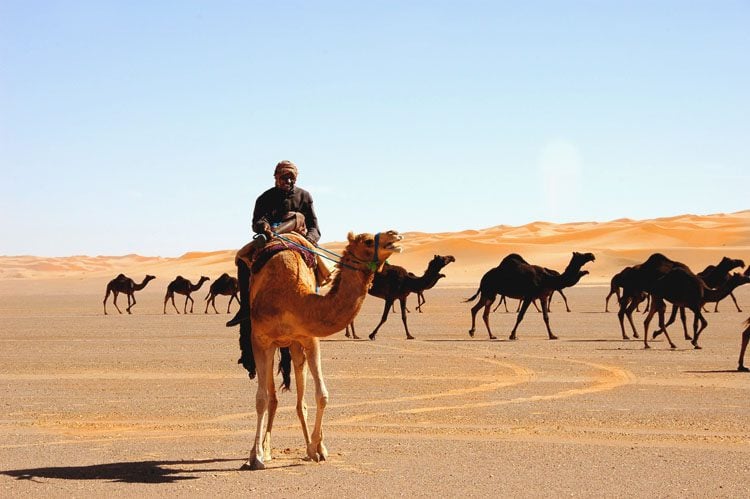
In the Arabian Peninsula, with camels
(Wikimedia Commons photo by Mohammad Nowfal)
It was at Nahom, incidentally, that Lehi and his party abruptly turned due east after their long period of travel along the coast of Arabia in a southeasterly direction. A glance at the map shows that by doing so, they missed the area of what has long been known as Yemen. Instead, they moved along behind the mountains that form the natural division between Yemen and the rest of the Arabian peninsula. (Most of Yemen is mountainous. The tallest measured peak is 12,336 feet high.) This may or may not have been deliberate. But I suspect that it was, and for several reasons. First of all, whether they knew it yet or not, they needed to find a place in which they could find shipbuilding materials. Few such places exist, so the direction of their travel had to be quite deliberately chosen. (Whether it was chosen by the travelers themselves or by the Lord, for them, is immaterial.) But Lehi may well also have wanted to avoid the relatively civilized area of Yemen, the ancient Sheba. For one thing, it would have constituted a real temptation to his sons Laman and Lemuel, for whom he still had some faint hope. For another, Yemen represented the Arabian end of the major frankincense trail. There could well have been Jewish merchants there, and, if Hugh Nibley is correct in asserting that Lehi himself came from a merchant background, there might have been people in the towns of Yemen who would actually have known him.[1] Given the circumstances of his escape from Palestine, including the death of Laban, it might have been unwise to have met such people. Even Lehi’s vision of the Tree of Life may suggest something of the image that wealthy, mercantile Yemen could well have had in his mind. The “great and spacious building,” standing “as it were in the air, high above the earth” and “filled with people . . . [whose] manner of dress was exceedingly fine,” seems very like the ancient “skyscraper” architecture of Yemen. These multi-story Yemeni buildings, many of which still stand, have no windows on the ground floor, so as to be less vulnerable to thieves and robbers. At night, or in the “mist of darkness” reported by the prophet, it would indeed seem that the people who leaned out of the windows “in the attitude of mocking and pointing their fingers” were in a building that floated “as it were in the air, high above the earth.”[2]
Thus, Arabia and the Arabs play an important role in the early portion of the Book of Mormon. They figure prominently in the other scriptures as well. Some of the mountains of northwest Arabia, for example, are volcanoes that are now reckoned to be extinct (although eruptions are recorded into medieval times). Some scholars have seen in the smoke and fire and earthquake of Mount Sinai a description of a volcanic eruption (Exodus 19:18) and have argued that Moses’ reception of the stone tablets of the law actually took place in what is today Saudi Arabia, rather than at the traditional site in the Sinai Peninsula.[3]
It isn’t certain just when the Arabian peoples first appear in history. As early as 854 B.C., an inscription of Shalmaneser III mentions “Gindibu the Arabian,” who had assembled a camel corps to oppose the Assyrians. In the very south of the Arabian Peninsula, an advanced civilization seems to have developed as early as 1200 B.C., although we’re only now beginning to have some idea about it. The island of Bahrayn, off the eastern coast of Arabia in the Persian Gulf, may be the ancient Sumerian Dilmun. The genealogical tables in the Old Testament include recognizably Arabian groups among the children of Cush, Aram, and Eber, as well as among the children of Abraham by Keturah and by Hagar.[4] The complexity of the situation is increased by Arabian peoples being known throughout the Old Testament by a number of different (and occasionally puzzling) names, including, most prominently, Ishmaelites, Midianites, Dedanites, and Sabeans. It isn’t easy in the present state of our knowledge to reconcile all of these accounts, but we know that they contain truth because many of the names can be plausibly related to known peoples and places in Arabia.
The Hebrew word Arab properly means “nomad,” which tells us a great deal about these early people.[5] The description of Ishmael, in Genesis 16:12, as “a wild man,” whose “hand will be against every man, and every man’s hand against him,” well describes the life of the nomad, who has been famous from the beginning of history for his raids against settled folk.[6] It was a group of Sabeans—listed above as an Arabian people—who raided Job’s lands, killing his herdsmen and riding off with his cattle as booty.[7] This is the kind of life (though possibly without the thievery) that Ishmael seems to have led, wandering the desert and dwelling in a tent. “And God was with the lad; and he grew, and dwelt in the wilderness.”[8]
[1] In the period just prior to the rise of Islam, a Jewish kingdom was actually established for a brief time in southern Arabia. And persecuted Jews often fled to Arabia even at that relatively late time. See Shmuel Safrai, in Ben-Sasson, A History of the Jewish People, 358-359, 380. [Insert Nibley reference.]
[2] 1 Nephi 8:23, 26-27.
[3] Galatians 4:25 places Mount Sinai in “Arabia.” But, since even the traditional Sinai falls within the biblical definition of that term, this probably means nothing.
[4] Genesis 10:7, 23, 25-30; 25:1-4, 13-16.
[5] Later, in the Arabic language itself, the Qur’an contrasts the settled peoples of the oases with the nomads, whom it terms “Arabs.”
[6] The Amalekite raid on Ziklag recorded in 1 Samuel 30 is a good example of this, as is the Arabian raid that carried off Jehoram’s family and possessions, mentioned in 2 Chronicles 21:16-17, 22:1. (In Psalm 83, the Ishmaelites and the Hagarenes are depicted as the hereditary enemies of Israel.) Such raiding provoked pursuit, and the oracle of Isaiah 21:13-17 seems to be addressed to a group of fleeing Arabs.
[7] Job 1:15.
[8] Genesis 21:20.
Church of Jesus Christ of Latter-day Saints
Previous Post

July 20, 2020
A note on Joseph Smith, death, and out-of-body experiences
Next Post
July 21, 2020 Before he found Tokyo
Browse Our Archives
Select a Category Uncategorized
Select a Month October 2026 September 2026 August 2026 July 2026 June 2026 May 2026 April 2026 March 2026 February 2026 January 2026 December 2025 November 2025 October 2025 September 2025 August 2025 July 2025 June 2025 May 2025 April 2025 March 2025 February 2025 January 2025 December 2024 November 2024 October 2024 September 2024 August 2024 July 2024 June 2024 May 2024 April 2024 March 2024 February 2024 January 2024 December 2023 November 2023 October 2023 September 2023 August 2023 July 2023 June 2023 May 2023 April 2023 March 2023 February 2023 January 2023 December 2022 November 2022 October 2022 September 2022 August 2022 July 2022 June 2022 May 2022 April 2022 March 2022 February 2022 January 2022 December 2021 November 2021 October 2021 September 2021 August 2021 July 2021 June 2021 May 2021 April 2021 March 2021 February 2021 January 2021 December 2020 November 2020 October 2020 September 2020 August 2020 July 2020 June 2020 May 2020 April 2020 March 2020 February 2020 January 2020 December 2019 November 2019 October 2019 September 2019 August 2019 July 2019 June 2019 May 2019 April 2019 March 2019 February 2019 January 2019 December 2018 November 2018 October 2018 September 2018 August 2018 July 2018 June 2018 May 2018 April 2018 March 2018 February 2018 January 2018 December 2017 November 2017 October 2017 September 2017 August 2017 July 2017 June 2017 May 2017 April 2017 March 2017 February 2017 January 2017 December 2016 November 2016 October 2016 September 2016 August 2016 July 2016 June 2016 May 2016 April 2016 March 2016 February 2016 January 2016 December 2015 November 2015 October 2015 September 2015 August 2015 July 2015 June 2015 May 2015 April 2015 March 2015 February 2015 January 2015 December 2014 November 2014 March 2014 August 2013 February 2012
Follow Us!
TAKE THE
Religious Wisdom Quiz
Who interpreted dreams for a Persian king about goats and rams?
Select your answer to see how you score.
Daniel Obadiah Hosea Joel
Related posts from Sic et Non


Notes on Women, Priesthood, and General Conference

"The Book of Moses as a Temple Text"

TRENDING AT PATHEOS Latter-day Saint

In "Irreplaceable," our book on vocation and technology, Trevor Sutton and I...

I was strolling through the top floor of the brand new Parthenon...

What Does Gêvâh Mean For Kimberley Guifoyle &...
This week, a lot of the news is focused on Kimberly Guilfoyle....

INNER CIRCLE: Profound Mystery (Of Christ In All...
Ephesians 5:31-32 “For this reason, a man will leave his father and...

Do Not Rejoice When Your Enemy Falls: The...
Turning an execution into a public spectacle is a disturbing expression of...

'The Chosen' S6 Trailer: The Passion Gets Very...
Not many watching 'The Chosen' worry about spoilers, but just because they...
view all Latter-day Saint blogs
Ad-Free & Subscriber Log-In Subscription Support
- About Us
- 2026 Calendar
- Videos
- Podcasts
- Library of World Religions
- Faith In Media Tracker
- Advertise With Us
- Write for Us
- Privacy Policy
- Terms of Service
- Do Not Sell My Data
- Contact Us
- Radiant Digital
- Manage Newsletter Subscriptions
- Unsubscribe From Notifications
- Sitemap
Copyright 2008-2026, Patheos. All rights reserved.
Subscription Support Ad-Free & Subscriber Log-In
Follow Patheos