
BuddhistCatholicContemplativeEvangelicalGeneral ChristianHinduJewishLatter-day SaintMuslimNew VisionsProgressive Christian
Beliefs
- Buddhist
- Catholic
- Contemplative
- Evangelical
- General Christian
- Hindu
- Jewish
- Latter-day Saint
- More Voices
- Muslim
- New Visions
- Pagan
- Progressive Christian
Topics
- Religion News
- Food and Religion
- Sports and Religion
- Religious Art
- Religious Music and Entertainment
- Religious Events
- History and Religion
- Style and Religion
- Politics and Religion
- Women in Religion
- Recreation Outdoors and Religion
- Business Finance and Religion
- Careers Workplace and Religion
- Education and Religion
- Family Parenting and Religion
- Health Fitness and Religion
- Home and Religion
- Relationships and Religion
- Technology and Religion
- Travel and Religion
Columnists
- Buddhist Columnists
- Business Finance and Religion Columnists
- Careers Workplace and Religion Columnists
- Catholic Columnists
- Contemplative Columnists
- Education and Religion Columnists
- Evangelists Columnists
- Family Parenting and Religion Columnists
- General Christian Columnists
- Health Fitness and Religion Columnists
- Hindu Columnists
- History and Religion Columnists
- Home and Religion Columnists
- Jewish Columnists
- More Voices Columnists
- Latter Day Columnists
- Muslim Columnists
- New Visions Columnists
- Nonreligious Columnists
- Pagan Columnists
- Politics and Religion Columnists
- Progressive Columnists
- Recreation Outdoors and Religion Columnists
- Relationships and Religion Columnists
- Religion News Columnists
- Religious Art Columnists
- Religious Events Columnists
- Religious Music and Entertainment Columnists
- Sports and Religion Columnists
- Style and Religion Columnists
- Technology and Religion Columnists
- Travel and Religion Columnists
- Women in Religion Columnists
Resource Library
- 2026 Calendar
- Library of World Religions
- The 100 Most Holy Places on Earth
- Patheos Answers
- Podcasts
- Videos
- Faith Leaders Database
- Anglican Episcopalian
- Bahai
- Baptist
- Buddhism
- Christianity
- Confucianism
- Eastern Orthodoxy
- Hinduism
- Holiness and Pentecostal
- ISKCON
- Islam
- Judaism
- Lutheran
- Methodist
- The Church of Jesus Christ of Latter-day Saints
- New Age
- Paganism
- Presbytarian and Reformed
- Protestantism
- Religion Behind the Scenes
- Roman Catholic
- Scientology
- Shia Islam
- Sikhism
- Sufism
- Sunni Islam
- Taoism
- Zen
- See all religions
Research Tools
 Ad-Free & Subscriber Log-In Subscription Support
Ad-Free & Subscriber Log-In Subscription Support
Follow Patheos 

- Trending:
- Forgiveness
- |
- Marriage
- |
- Consciousness
- |
- Death Penalty
- |
- Election
- |
- Halloween

- Home
- Latter-day Saint
- Revision 2.11 “Poetry and Poets”
Revision 2.11 “Poetry and Poets”
Last updated on: July 28, 2020 at 10:10 pm by Dan Peterson
Revision 2.11 “Poetry and Poets” 2020-07-28T22:10:19-06:00 Dan Peterson
Patheos Explore the world's faith through different perspectives on religion and spirituality! Patheos has the views of the prevalent religions and spiritualities of the world.
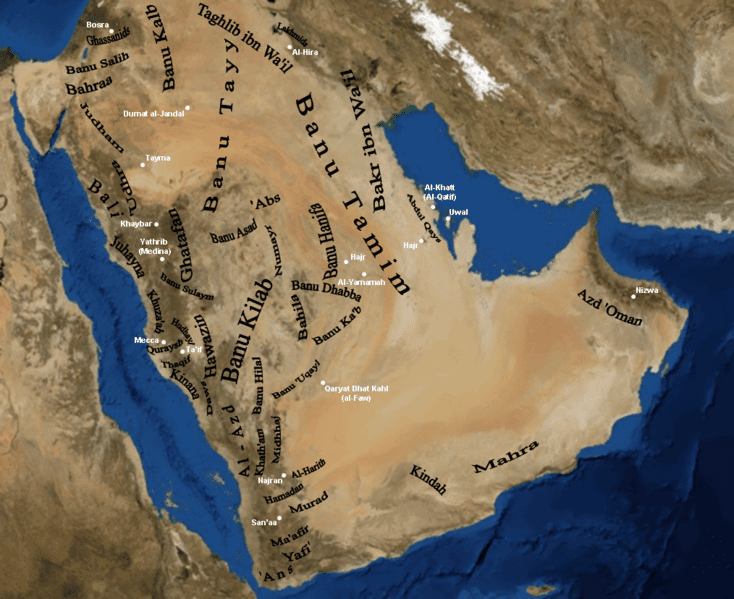
Tribes of Arabia on the eve of the rise of Islam
(Wikimedia Commons public domain image)
Poetry was the sole medium of literary expression in pre-Islamic Arabia. In a real sense, it was the only form of art. This is related at least partially to the high Semitic reverence for the word that we’ve already mentioned. It’s also undoubtedly related to the fact that nomads, constantly on the brink of starvation and always on the move, are hardly likely to produce great architecture or monumental sculpture. They need to be able to carry their art, such as it is, with them. So women’s dresses and camel bags come in for some attention. But the lightest-weight form of art anywhere is the memorized word.
The oldest Arabic poems and proverbs that we still possess date back only to about a century before the rise of Islam–that is, to about 500 AD. However, the Arabs were known even in biblical times for their poetry and for what the scholars sometimes call “gnomic wisdom.”[1] In 1 Kings 44:30, Solomon’s wisdom is said to have been so great that it surpassed that of “all the children of the east country” (i.e., the Arabs). And Job’s wise friends, it’s clear, come from north Arabian groups.[2] (Indeed, the book of Job as a whole has been argued by some commentators to have an Arabian origin.)
It’s perhaps hard for us in the English-speaking world to picture a society in which poetry wasn’t just for the cultured élite, but for everyone. Nevertheless, this is the picture we get of early Arabia. Poetry was a matter of passionate interest, in much the way, perhaps, that sports captures the attention of many modern men. It was one of the few things that unified the Arabs. Throughout the peninsula, the same Arabic dialect was used for poetry, and the same rules of composition were followed. This made poetry a powerful public relations tool. (We’ve seen to what lengths Hatim of Tayyi was willing to go in order to get three famous poets to praise his family) In fact, the poet’s usual job was to praise his tribe and to vilify the tribes of others. If he was good at his job, if he composed memorable lines, his praise (or his satire) could stick for years and even for generations. As one ancient Arab writer put it, already looking back on the pre-Islamic period,
When there appeared a poet in a family of the Arabs, the other tribes round about would gather together to that family and wish them joy of their good luck. Feasts would be got ready, the women of the tribe would join together in bands, playing upon lutes, as they were wont to do at bridals, and the men and boys would congratulate one another; for a poet was a defence to the honour of them all, a weapon to ward off insult from their good name, and a means of perpetuating their glorious deeds and of establishing their fame for ever. And they used not to wish one another joy but for three things—the birth of a boy, the coming to light of a poet, and the foaling of a noble mare.[3]
[1] From the Greek word gnosis, or “knowledge,” from which we also get the terms gnosticism and gnostic—to say nothing of the common word agnostic for someone who does not know.
[2] A. Jeffery. “Arabians.” In George Arthur Buttrick, et al. eds. The Interpreter’s Dictionary of the Bible. 1:184.
[3] Ibn Rashiq, cited in the translation of Sir Charles Lyall, by Nicholson, 71.
Posted from Breckenridge, Colorado
Previous Post

July 27, 2020
Rocks, terrestrial and Martian, and some wild animals
Next Post
July 28, 2020 Prophets, as it were, without honor in their own country
Browse Our Archives
Select a Category Uncategorized
Select a Month October 2026 September 2026 August 2026 July 2026 June 2026 May 2026 April 2026 March 2026 February 2026 January 2026 December 2025 November 2025 October 2025 September 2025 August 2025 July 2025 June 2025 May 2025 April 2025 March 2025 February 2025 January 2025 December 2024 November 2024 October 2024 September 2024 August 2024 July 2024 June 2024 May 2024 April 2024 March 2024 February 2024 January 2024 December 2023 November 2023 October 2023 September 2023 August 2023 July 2023 June 2023 May 2023 April 2023 March 2023 February 2023 January 2023 December 2022 November 2022 October 2022 September 2022 August 2022 July 2022 June 2022 May 2022 April 2022 March 2022 February 2022 January 2022 December 2021 November 2021 October 2021 September 2021 August 2021 July 2021 June 2021 May 2021 April 2021 March 2021 February 2021 January 2021 December 2020 November 2020 October 2020 September 2020 August 2020 July 2020 June 2020 May 2020 April 2020 March 2020 February 2020 January 2020 December 2019 November 2019 October 2019 September 2019 August 2019 July 2019 June 2019 May 2019 April 2019 March 2019 February 2019 January 2019 December 2018 November 2018 October 2018 September 2018 August 2018 July 2018 June 2018 May 2018 April 2018 March 2018 February 2018 January 2018 December 2017 November 2017 October 2017 September 2017 August 2017 July 2017 June 2017 May 2017 April 2017 March 2017 February 2017 January 2017 December 2016 November 2016 October 2016 September 2016 August 2016 July 2016 June 2016 May 2016 April 2016 March 2016 February 2016 January 2016 December 2015 November 2015 October 2015 September 2015 August 2015 July 2015 June 2015 May 2015 April 2015 March 2015 February 2015 January 2015 December 2014 November 2014 March 2014 August 2013 February 2012
Follow Us!
TAKE THE
Religious Wisdom Quiz
Which Christian principle is highlighted in the parable of the Good Samaritan?
Select your answer to see how you score.
Ignore strangers Compassion for all Only help friends Seek praise
Related posts from Sic et Non

"Anchoring Nephi’s Account in the Real World"

"Shall We Not Go On in So Great...

"Alma" as a Semitic Name, and Reaching Irreantum

"Nephi’s Eight Years in the 'Wilderness'"
TRENDING AT PATHEOS Latter-day Saint

In "Irreplaceable," our book on vocation and technology, Trevor Sutton and I...

I was strolling through the top floor of the brand new Parthenon...

What Does Gêvâh Mean For Kimberley Guifoyle &...
This week, a lot of the news is focused on Kimberly Guilfoyle....

INNER CIRCLE: Profound Mystery (Of Christ In All...
Ephesians 5:31-32 “For this reason, a man will leave his father and...

Do Not Rejoice When Your Enemy Falls: The...
Turning an execution into a public spectacle is a disturbing expression of...

'The Chosen' S6 Trailer: The Passion Gets Very...
Not many watching 'The Chosen' worry about spoilers, but just because they...
view all Latter-day Saint blogs
Ad-Free & Subscriber Log-In Subscription Support
- About Us
- 2026 Calendar
- Videos
- Podcasts
- Library of World Religions
- Faith In Media Tracker
- Advertise With Us
- Write for Us
- Privacy Policy
- Terms of Service
- Do Not Sell My Data
- Contact Us
- Radiant Digital
- Manage Newsletter Subscriptions
- Unsubscribe From Notifications
- Sitemap
Copyright 2008-2026, Patheos. All rights reserved.
Subscription Support Ad-Free & Subscriber Log-In
Follow Patheos