
BuddhistCatholicContemplativeEvangelicalGeneral ChristianHinduJewishLatter-day SaintMuslimNew VisionsProgressive Christian
Beliefs
- Buddhist
- Catholic
- Contemplative
- Evangelical
- General Christian
- Hindu
- Jewish
- Latter-day Saint
- More Voices
- Muslim
- New Visions
- Pagan
- Progressive Christian
Topics
- Religion News
- Food and Religion
- Sports and Religion
- Religious Art
- Religious Music and Entertainment
- Religious Events
- History and Religion
- Style and Religion
- Politics and Religion
- Women in Religion
- Recreation Outdoors and Religion
- Business Finance and Religion
- Careers Workplace and Religion
- Education and Religion
- Family Parenting and Religion
- Health Fitness and Religion
- Home and Religion
- Relationships and Religion
- Technology and Religion
- Travel and Religion
Columnists
- Buddhist Columnists
- Business Finance and Religion Columnists
- Careers Workplace and Religion Columnists
- Catholic Columnists
- Contemplative Columnists
- Education and Religion Columnists
- Evangelists Columnists
- Family Parenting and Religion Columnists
- General Christian Columnists
- Health Fitness and Religion Columnists
- Hindu Columnists
- History and Religion Columnists
- Home and Religion Columnists
- Jewish Columnists
- More Voices Columnists
- Latter Day Columnists
- Muslim Columnists
- New Visions Columnists
- Nonreligious Columnists
- Pagan Columnists
- Politics and Religion Columnists
- Progressive Columnists
- Recreation Outdoors and Religion Columnists
- Relationships and Religion Columnists
- Religion News Columnists
- Religious Art Columnists
- Religious Events Columnists
- Religious Music and Entertainment Columnists
- Sports and Religion Columnists
- Style and Religion Columnists
- Technology and Religion Columnists
- Travel and Religion Columnists
- Women in Religion Columnists
Resource Library
- 2026 Calendar
- Library of World Religions
- The 100 Most Holy Places on Earth
- Patheos Answers
- Podcasts
- Videos
- Faith Leaders Database
- Anglican Episcopalian
- Bahai
- Baptist
- Buddhism
- Christianity
- Confucianism
- Eastern Orthodoxy
- Hinduism
- Holiness and Pentecostal
- ISKCON
- Islam
- Judaism
- Lutheran
- Methodist
- The Church of Jesus Christ of Latter-day Saints
- New Age
- Paganism
- Presbytarian and Reformed
- Protestantism
- Religion Behind the Scenes
- Roman Catholic
- Scientology
- Shia Islam
- Sikhism
- Sufism
- Sunni Islam
- Taoism
- Zen
- See all religions
Research Tools
 Ad-Free & Subscriber Log-In Subscription Support
Ad-Free & Subscriber Log-In Subscription Support
Follow Patheos 

- Trending:
- Forgiveness
- |
- Marriage
- |
- Consciousness
- |
- Death Penalty
- |
- Election
- |
- Halloween

- Home
- Latter-day Saint
- Revision 2.1 “The Arabs before Islam”
Revision 2.1 “The Arabs before Islam”
Last updated on: July 24, 2020 at 12:05 am by Dan Peterson
Revision 2.1 “The Arabs before Islam” 2020-07-24T00:05:24-06:00 Dan Peterson
Patheos Explore the world's faith through different perspectives on religion and spirituality! Patheos has the views of the prevalent religions and spiritualities of the world.
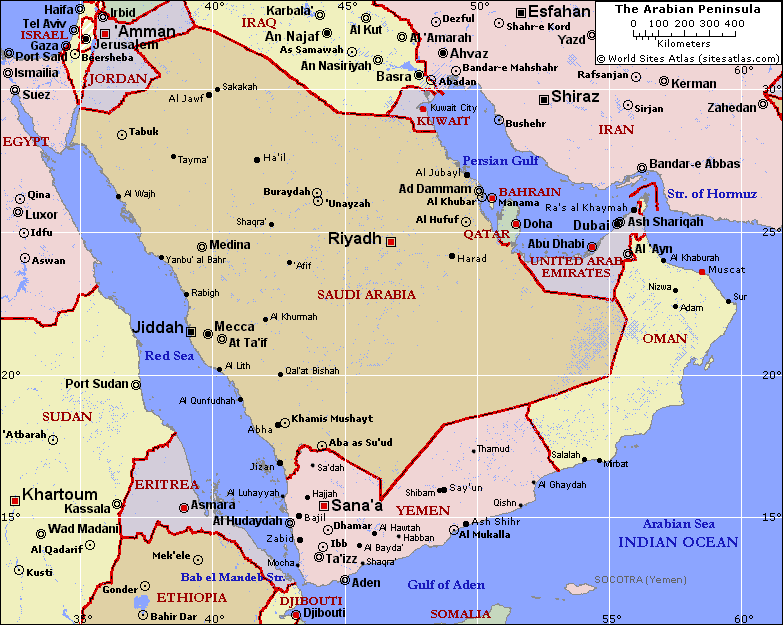
A political map of the modern Arabian Peninsula (Wikimedia Commons)
The first question that comes up when we begin to discuss “the Arabs” is what, exactly, we mean by the term Arab. As the word is used today, it refers to people whose primary language is Arabic. This Semitic language, a relative of Hebrew, is the native language of at least three hundred million people and is the official tongue of countries from Iraq in the east to Morocco in the west. The largest Arabic-speaking country is Egypt. Even in Israel, Arabic, along with Hebrew, is one of the official national languages. This linguistic definition means that many Arabs are Christians. There’s no religious requirement, no necessity of being a Muslim, in order to be an Arab. It also means that most of the world’s Muslims are not Arabs. The Persians, for instance, who are better known to us today as Iranians, are overwhelmingly more or less devout Muslims but are not Arabs in any sense. In fact, their language is distantly related to English. (The Persian synonym for the English word bad, for instance, is bad, which seems rather closely related. The Persian equivalent of English father is padar; the equivalent of English mother is madar; and brother, in Persian, is biradhar.)[1] The Turks are Muslims but aren’t Arabs. Neither are the large Muslim populations of Pakistan, China, Nigeria, Kenya, India, Malaysia, the former Soviet Union, and many other nations. The largest Muslim country in the world is Indonesia, which isn’t Arab at all.
The important thing to note here is that calling someone an “Arab” today doesn’t necessarily say a great deal about his or her lineage. The Arabs of northwest Africa, presumably, have a far different genealogy than do the Arabs of Yemen or of Syria, fully a continent away. The notion that there might be no genealogical significance at all to the term Arab may come as something of a shock to many Latter-day Saints, who’ve been raised on the notion that the Arabs are the descendants of Abraham’s son Ishmael. But to say that there’s no genealogical aspect to “Arabness” wouldn’t be quite accurate, either. There is a connection between the Arabs and Ishmael. But we must be precise in the way we talk about it.
The Egyptians, as I’ve already noted, represent the largest national population of Arabs in the world. Yet the Egyptians of today are virtually all direct descendants of the ancient people who built the pyramids and the great temples at Luxor and Karnak, and those people weren’t Arabs. How we account for this fact will help to explain what I mean when I say that the Arabs’ descent from Ishmael must be carefully qualified. The original home of the Arabs is the area known as the Arabian Peninsula, occupied today by such states as Saudi Arabia, Yemen, the United Arab Emirates, and Oman. While the Arabs were confined within their original homeland, the Egyptians remained clearly non-Arab, as did the populations of Iraq and Morocco. It was only when the Arabs, inspired by the call of Islam, poured out of the peninsula, across North Africa, and up into Mesopotamia, when they occupied those lands and began to intermarry with the local populations, and when their Arabic began to be the language of everyday speech in the conquered territories that those areas beyond the peninsula came to be “Arab” in the modern sense.
A useful way of distinguishing between the original more-or-less pure Arabs of the peninsula and the Arabs of today is to call the former peoples “Arabian.” These are the people who actually lived in the Arabian Peninsula. The subsequent conquests and intermingling, which we’ll discuss more fully hereafter, mean that “Arabian blood” is to be found throughout the Arab world. But it also means that, for many areas, and especially for the outlying ones, the lineage of Ishmael is probably not the dominant bloodline in the general population.
Arabia is the largest peninsula in the world, covering almost a million square miles, which makes it roughly one third the size of the continental United States. It’s a rectangle, bound on the west by the Red Sea, on the south by the Gulf of Aden and the Indian Ocean, and on the east by the Gulf of Oman and the Persian Gulf (to which the Arabs generally refer as the Arabian Gulf). On the north, the geographical boundary is less decisive, merely the Euphrates River, and there Arabia meets the modern states of Jordan, Syria, and Iraq. Since it’s bound on three sides by seas and on the north by a river, the peninsula is known to the Arabs themselves as jazirat al-‘Arab, “the Island of the Arabs.”[2]
Talk of an island should not, of course, mislead anybody into thinking that Arabia is moist or green. The area in the southern portion of the peninsula known as “the empty quarter” is the largest continuous area of sand in the world. Parts of it receive rain only once every ten years. To the north is another great sandy desert, the Nufud, which some readers will remember from the movie Lawrence of Arabia. When we say that most of Arabia is desert, we mean that it’s truly and absolutely desert. The dry areas of the United States sometimes look almost like tropical rain forests by comparison. This astonishing desolation, coupled with the area’s remoteness—which is still pretty much the case today, as America and its allies learned in the difficult process of trying to get men and material into Saudi Arabia in connection with two wars in the Persian Gulf—meant that the Arabs had the peninsula essentially to themselves. Occasionally, outsiders would try to take control of a part of the area, but they were virtually never successful. A Roman expedition, for example, met with disaster in Arabia under the command of Aelius Gallus in 25 B.C.
But why would anybody want to take over so inhospitable a place? An understanding of the area is necessary before the answer is clear.
[1]. On the other hand, the Persian equivalent of English sister is khwahar. We’re talking about a foreign language, after all.
[2]. Hence the name of the Al Jazeera Media Network, which is based in Doha, Qatar.
Posted from Park City, Utah
Previous Post

July 18, 2020
For the weekend
Next Post
July 19, 2020 Revision 2.2 "Arabia"
Browse Our Archives
Select a Category Uncategorized
Select a Month October 2026 September 2026 August 2026 July 2026 June 2026 May 2026 April 2026 March 2026 February 2026 January 2026 December 2025 November 2025 October 2025 September 2025 August 2025 July 2025 June 2025 May 2025 April 2025 March 2025 February 2025 January 2025 December 2024 November 2024 October 2024 September 2024 August 2024 July 2024 June 2024 May 2024 April 2024 March 2024 February 2024 January 2024 December 2023 November 2023 October 2023 September 2023 August 2023 July 2023 June 2023 May 2023 April 2023 March 2023 February 2023 January 2023 December 2022 November 2022 October 2022 September 2022 August 2022 July 2022 June 2022 May 2022 April 2022 March 2022 February 2022 January 2022 December 2021 November 2021 October 2021 September 2021 August 2021 July 2021 June 2021 May 2021 April 2021 March 2021 February 2021 January 2021 December 2020 November 2020 October 2020 September 2020 August 2020 July 2020 June 2020 May 2020 April 2020 March 2020 February 2020 January 2020 December 2019 November 2019 October 2019 September 2019 August 2019 July 2019 June 2019 May 2019 April 2019 March 2019 February 2019 January 2019 December 2018 November 2018 October 2018 September 2018 August 2018 July 2018 June 2018 May 2018 April 2018 March 2018 February 2018 January 2018 December 2017 November 2017 October 2017 September 2017 August 2017 July 2017 June 2017 May 2017 April 2017 March 2017 February 2017 January 2017 December 2016 November 2016 October 2016 September 2016 August 2016 July 2016 June 2016 May 2016 April 2016 March 2016 February 2016 January 2016 December 2015 November 2015 October 2015 September 2015 August 2015 July 2015 June 2015 May 2015 April 2015 March 2015 February 2015 January 2015 December 2014 November 2014 March 2014 August 2013 February 2012
Follow Us!
TAKE THE
Religious Wisdom Quiz
What book tells about the beginning of the world?
Select your answer to see how you score.
Genesis Matthew Psalms Acts
Related posts from Sic et Non

Islam in America or Islam versus America?

A basic working chronology of Islamic-era Iran

Actual Data and Actual Crusades

TRENDING AT PATHEOS Latter-day Saint

Methodist Central Hall and Westminster Abbey
Situated on the same square is Methodist Central Hall and Westminster Abbey. ...

57th Dove Awards Honor Dolly Parton, Crown New...
On gospel music’s biggest night, the 57th annual GMA Dove Awards honored...

The First Eucharistic Controversy: Christ’s Real Presence
For Catholics, the Eucharist is the source and summit of the Christian...

What a Stop Sign Can Teach Us About...
How to Make a Decision When You Can't Hear God Main point:...

Archdiocese Hosts Military Marriage Retreat in Germany
RASTATT, Germany — The transient military lifestyle, with its frequent deployments and...

Nearly every morning, I make the drive to Detroit with my high-school-age...
view all Latter-day Saint blogs
Ad-Free & Subscriber Log-In Subscription Support
- About Us
- 2026 Calendar
- Videos
- Podcasts
- Library of World Religions
- Faith In Media Tracker
- Advertise With Us
- Write for Us
- Privacy Policy
- Terms of Service
- Do Not Sell My Data
- Contact Us
- Radiant Digital
- Manage Newsletter Subscriptions
- Unsubscribe From Notifications
- Sitemap
Copyright 2008-2026, Patheos. All rights reserved.
Subscription Support Ad-Free & Subscriber Log-In
Follow Patheos