
BuddhistCatholicContemplativeEvangelicalGeneral ChristianHinduJewishLatter-day SaintMuslimNew VisionsProgressive Christian
Beliefs
- Buddhist
- Catholic
- Contemplative
- Evangelical
- General Christian
- Hindu
- Jewish
- Latter-day Saint
- More Voices
- Muslim
- New Visions
- Pagan
- Progressive Christian
Topics
- Religion News
- Food and Religion
- Sports and Religion
- Religious Art
- Religious Music and Entertainment
- Religious Events
- History and Religion
- Style and Religion
- Politics and Religion
- Women in Religion
- Recreation Outdoors and Religion
- Business Finance and Religion
- Careers Workplace and Religion
- Education and Religion
- Family Parenting and Religion
- Health Fitness and Religion
- Home and Religion
- Relationships and Religion
- Technology and Religion
- Travel and Religion
Columnists
- Buddhist Columnists
- Business Finance and Religion Columnists
- Careers Workplace and Religion Columnists
- Catholic Columnists
- Contemplative Columnists
- Education and Religion Columnists
- Evangelists Columnists
- Family Parenting and Religion Columnists
- General Christian Columnists
- Health Fitness and Religion Columnists
- Hindu Columnists
- History and Religion Columnists
- Home and Religion Columnists
- Jewish Columnists
- More Voices Columnists
- Latter Day Columnists
- Muslim Columnists
- New Visions Columnists
- Nonreligious Columnists
- Pagan Columnists
- Politics and Religion Columnists
- Progressive Columnists
- Recreation Outdoors and Religion Columnists
- Relationships and Religion Columnists
- Religion News Columnists
- Religious Art Columnists
- Religious Events Columnists
- Religious Music and Entertainment Columnists
- Sports and Religion Columnists
- Style and Religion Columnists
- Technology and Religion Columnists
- Travel and Religion Columnists
- Women in Religion Columnists
Resource Library
- 2026 Calendar
- Library of World Religions
- The 100 Most Holy Places on Earth
- Patheos Answers
- Podcasts
- Videos
- Faith Leaders Database
- Anglican Episcopalian
- Bahai
- Baptist
- Buddhism
- Christianity
- Confucianism
- Eastern Orthodoxy
- Hinduism
- Holiness and Pentecostal
- ISKCON
- Islam
- Judaism
- Lutheran
- Methodist
- The Church of Jesus Christ of Latter-day Saints
- New Age
- Paganism
- Presbytarian and Reformed
- Protestantism
- Religion Behind the Scenes
- Roman Catholic
- Scientology
- Shia Islam
- Sikhism
- Sufism
- Sunni Islam
- Taoism
- Zen
- See all religions
Research Tools
 Ad-Free & Subscriber Log-In Subscription Support
Ad-Free & Subscriber Log-In Subscription Support
Follow Patheos 

- Trending:
- Forgiveness
- |
- Marriage
- |
- Consciousness
- |
- Death Penalty
- |
- Election
- |
- Halloween

- Home
- Latter-day Saint
- Revision 1.9 “Judaism survived, despite the odds”
Revision 1.9 “Judaism survived, despite the odds”
Last updated on: July 15, 2020 at 6:19 pm by Dan Peterson
Revision 1.9 “Judaism survived, despite the odds” 2020-07-15T18:19:38-06:00 Dan Peterson
Patheos Explore the world's faith through different perspectives on religion and spirituality! Patheos has the views of the prevalent religions and spiritualities of the world.
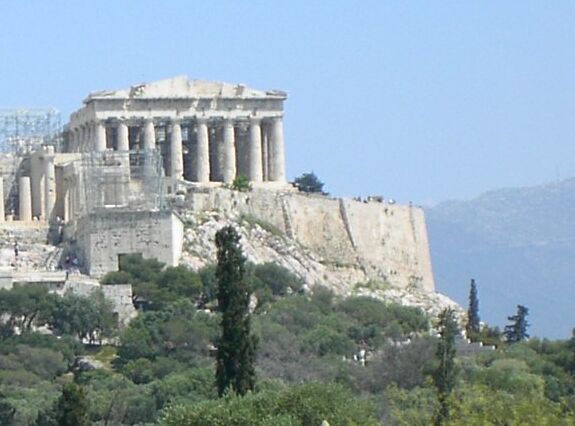
The Parthenon, on the Athenian Acropolis. (Wikimedia Commons public domain)
Paul Johnson well summarizes the catastrophic changes in the fortunes of world Jewry:
In the short-term perspective of the second century AD, the Jews appeared to have been a powerful national and religious group which had courted ruin, and achieved it. During most of the first century, the Jews not only constituted a tenth of the empire, and a much higher proportion in certain big cities, but were expanding. They had the transcendent new idea of the age: ethical monotheism. They were almost all literate. They had the only welfare system that existed. They made converts in all social groups, including the highest. One or more of the Flavian emperors might easily have become a Jew, just as Constantine was to become a Christian 250 years later. Josephus was entitled to boast: “There is not one city, Greek or barbarian, nor a single nation where the custom of the seventh day, on which we rest from all work, and the fasts and the lighting of the candles, are not observed . . . and as God permeates the universe, so the Law has found its way into the hearts of all men.” A century later, the whole process had been reversed. Jerusalem was no longer a Jewish city at all. Alexandria, once 40 percent Jewish, lost its Jewish voice completely. The huge casualty figures cited by such authors as Josephus, Tacitus and Dio for the two revolts (Tacitus said 1,197,000 Jews were killed or sold as slaves in the 66-70 struggle alone) may be exaggerated but it is clear that the Jewish population of Palestine fell rapidly at this time. In the diaspora, the expanding Christian communities not only purloined the best Jewish theological and social ideas, and so the role of “light to the gentiles,” but made increasing inroads into the Jewish masses themselves, diaspora Jews forming one of the chief sources of Christian converts.[1]
It would have seemed, with the temple gone, with all the old priesthood organizations destroyed and the rituals now impossible to perform, with the people scattered and leaderless, that Judaism was finished. Other religions, after all, had vanished from the face of the earth before. Nobody worshipped Babylonian Marduk any more. The gods of ancient Egypt were dead or dying. So, too, were the gods of ancient Greece. And, truly, this was a traumatic period. A vacuum appeared at the center of Judaism. There can be no doubt that Jews everywhere were depressed and demoralized. The zeal of the first revolt and the messianic fervor of Bar Kokhba’s rebellion were succeeded by doubt and despair. Gloom, as we can well understand, was pervasive, and the next five centuries would be a time of agonized adjustment to the new and harsh reality of exile. But Judaism was different. It survived.
One of the forms in which it survived is scarcely noticed by us today, so familiar are we with it. In the midst of all of the political agitation and instability, amid the wars and the massacres and the exiles, a movement had arisen that would prove far more important than any of the political revolutionaries and their plots. A man by the name of Jesus of Nazareth had taught for a few years in Palestine and had then been put to death by the Romans. This was done at the request of the Jewish leadership, ostensibly because they feared that he was preparing yet another rebellion against Rome, but more precisely because his teachings undercut their own authority among their people. The trouble, of course, was that Jesus didn’t stay dead. His followers, energized by their conviction of his triumph over the grave as well as by the outpouring of the Holy Ghost upon them, began to spread his teachings with more vigor than ever. The worst fear of the chief priests and Pharisees had come horribly true: Please, they had begged Pilate, please assign a guard to Jesus’ tomb, “lest his disciples come by night, and steal him away, and say unto the people, He is risen from the dead: so the last error shall be worse than the first.”[2]
New believers flocked to the standard of Christianity, including a diaspora Jew by the name of Saul of Tarsus who was transformed from persecutor to convert by a direct appearance of the risen Christ. Saul’s family was originally from Galilee, and although he had been raised in Cilicia, in what is today Turkey, he had returned to Palestine to study under the great rabbi Gamaliel the Elder. Convinced by his vision of the divinity of Christ, Saul devoted his life to preaching the gospel to the Jews of the diaspora and even to the Gentiles. It was a mission for which he was perfectly suited. He was fully Jewish. As he himself said, he was “circumcised the eighth day, of the stock of Israel, of the tribe of Benjamin, an Hebrew of the Hebrews; as touching the law, a Pharisee.”[3] Yet he also had a good secular education, including a command of Greek and of gentile culture. He could quote their own poets to the Athenians on Mars Hill, trying to convince them to listen to his message.[4] Furthermore, Saul held Roman citizenship, something that was comparatively rare out in the provinces, and he used it and its privileges on more than one occasion to further his mission.[5] In fact, he soon began to go by his Roman name, Paul, rather than by his Jewish name.
[1] P. Johnson, History of the Jews, 147-48.
[2] Matthew 27:64.
[3] Philippians 3:5.
[4] Acts 17:28 features references to at least two Greek philosopher-poets. Epimenides of Cnossos, who wrote in the sixth century B.C., used language very much like Paul’s “in him we live, and move, and exist.” The statement “We are all his children” is a direct quotation from the Phainomena of Aratus, a third-century pagan poet from Saul’s own native Cilicia.
[5] In Acts 22:24-30, he used his citizenship to avoid a scourging. It may also have helped him to escape a lynch mob, according to Acts 23:27. Faithful to the command given him at Acts 23:11 to go and preach the gospel at Rome, Paul managed, by appealing to Caesar (Acts 25:9-12), to get the Roman government to pay his mission expenses. It is a bit reminiscent of Parley P. Pratt’s experience while a missionary in western Ohio. He was arrested on a baseless charge and hauled off to court, where he preached and sang to the judge. Such behavior did not amuse the court officials, and Brother Pratt spent the night in jail. However, on the next morning he was in the mood to continue his missionary labors and had no interest in further imprisonment. So, at a certain point while standing in the public square, he turned to his jailor, a Mr. Peabody, and said, among other things, “You have given me an opportunity to preach, sing, and have also entertained me with lodging and breakfast. I must now go on my journey. . . . I thank you for all your kindness—good day, sir.” At which, he escaped by running into the nearby forest, which is a hilarious story in its own right. See Autobiography of Parley Parker Pratt, edited by Parley P. Pratt, Jr., 6th ed. (Salt Lake City: Deseret Book, 1966), 48-51. Amusingly, an annual Parley P. Pratt Freedom Run is now held: https://www.facebook.com/pppfreedomrun/.
Previous Post

July 10, 2020
Revision 1.8. "Masada and Its Sequel"
Browse Our Archives
Select a Category Uncategorized
Select a Month October 2026 September 2026 August 2026 July 2026 June 2026 May 2026 April 2026 March 2026 February 2026 January 2026 December 2025 November 2025 October 2025 September 2025 August 2025 July 2025 June 2025 May 2025 April 2025 March 2025 February 2025 January 2025 December 2024 November 2024 October 2024 September 2024 August 2024 July 2024 June 2024 May 2024 April 2024 March 2024 February 2024 January 2024 December 2023 November 2023 October 2023 September 2023 August 2023 July 2023 June 2023 May 2023 April 2023 March 2023 February 2023 January 2023 December 2022 November 2022 October 2022 September 2022 August 2022 July 2022 June 2022 May 2022 April 2022 March 2022 February 2022 January 2022 December 2021 November 2021 October 2021 September 2021 August 2021 July 2021 June 2021 May 2021 April 2021 March 2021 February 2021 January 2021 December 2020 November 2020 October 2020 September 2020 August 2020 July 2020 June 2020 May 2020 April 2020 March 2020 February 2020 January 2020 December 2019 November 2019 October 2019 September 2019 August 2019 July 2019 June 2019 May 2019 April 2019 March 2019 February 2019 January 2019 December 2018 November 2018 October 2018 September 2018 August 2018 July 2018 June 2018 May 2018 April 2018 March 2018 February 2018 January 2018 December 2017 November 2017 October 2017 September 2017 August 2017 July 2017 June 2017 May 2017 April 2017 March 2017 February 2017 January 2017 December 2016 November 2016 October 2016 September 2016 August 2016 July 2016 June 2016 May 2016 April 2016 March 2016 February 2016 January 2016 December 2015 November 2015 October 2015 September 2015 August 2015 July 2015 June 2015 May 2015 April 2015 March 2015 February 2015 January 2015 December 2014 November 2014 March 2014 August 2013 February 2012
Follow Us!
TAKE THE
Religious Wisdom Quiz
Do not conform to the pattern of this world, but be transformed by the renewing of your ____.
Select your answer to see how you score.
Mind Actions Spirit Heart
Related posts from Sic et Non

Notes on Women, Priesthood, and General Conference

"The Book of Moses as a Temple Text"

A case of twin near-death experiences?

TRENDING AT PATHEOS Latter-day Saint

57th Dove Awards Honor Dolly Parton, Crown New...
On gospel music’s biggest night, the 57th annual GMA Dove Awards honored...

The First Eucharistic Controversy: Christ’s Real Presence
For Catholics, the Eucharist is the source and summit of the Christian...

What a Stop Sign Can Teach Us About...
How to Make a Decision When You Can't Hear God Main point:...

Archdiocese Hosts Military Marriage Retreat in Germany
RASTATT, Germany — The transient military lifestyle, with its frequent deployments and...

Nearly every morning, I make the drive to Detroit with my high-school-age...

The Real AI Story Is Adoption Without Trust
Artificial intelligence has crossed a political threshold. It is no longer a...
view all Latter-day Saint blogs
Ad-Free & Subscriber Log-In Subscription Support
- About Us
- 2026 Calendar
- Videos
- Podcasts
- Library of World Religions
- Faith In Media Tracker
- Advertise With Us
- Write for Us
- Privacy Policy
- Terms of Service
- Do Not Sell My Data
- Contact Us
- Radiant Digital
- Manage Newsletter Subscriptions
- Unsubscribe From Notifications
- Sitemap
Copyright 2008-2026, Patheos. All rights reserved.
Subscription Support Ad-Free & Subscriber Log-In
Follow Patheos