
BuddhistCatholicContemplativeEvangelicalGeneral ChristianHinduJewishLatter-day SaintMuslimNew VisionsProgressive Christian
Beliefs
- Buddhist
- Catholic
- Contemplative
- Evangelical
- General Christian
- Hindu
- Jewish
- Latter-day Saint
- More Voices
- Muslim
- New Visions
- Pagan
- Progressive Christian
Topics
- Religion News
- Food and Religion
- Sports and Religion
- Religious Art
- Religious Music and Entertainment
- Religious Events
- History and Religion
- Style and Religion
- Politics and Religion
- Women in Religion
- Recreation Outdoors and Religion
- Business Finance and Religion
- Careers Workplace and Religion
- Education and Religion
- Family Parenting and Religion
- Health Fitness and Religion
- Home and Religion
- Relationships and Religion
- Technology and Religion
- Travel and Religion
Columnists
- Buddhist Columnists
- Business Finance and Religion Columnists
- Careers Workplace and Religion Columnists
- Catholic Columnists
- Contemplative Columnists
- Education and Religion Columnists
- Evangelists Columnists
- Family Parenting and Religion Columnists
- General Christian Columnists
- Health Fitness and Religion Columnists
- Hindu Columnists
- History and Religion Columnists
- Home and Religion Columnists
- Jewish Columnists
- More Voices Columnists
- Latter Day Columnists
- Muslim Columnists
- New Visions Columnists
- Nonreligious Columnists
- Pagan Columnists
- Politics and Religion Columnists
- Progressive Columnists
- Recreation Outdoors and Religion Columnists
- Relationships and Religion Columnists
- Religion News Columnists
- Religious Art Columnists
- Religious Events Columnists
- Religious Music and Entertainment Columnists
- Sports and Religion Columnists
- Style and Religion Columnists
- Technology and Religion Columnists
- Travel and Religion Columnists
- Women in Religion Columnists
Resource Library
- 2026 Calendar
- Library of World Religions
- The 100 Most Holy Places on Earth
- Patheos Answers
- Podcasts
- Videos
- Faith Leaders Database
- Anglican Episcopalian
- Bahai
- Baptist
- Buddhism
- Christianity
- Confucianism
- Eastern Orthodoxy
- Hinduism
- Holiness and Pentecostal
- ISKCON
- Islam
- Judaism
- Lutheran
- Methodist
- The Church of Jesus Christ of Latter-day Saints
- New Age
- Paganism
- Presbytarian and Reformed
- Protestantism
- Religion Behind the Scenes
- Roman Catholic
- Scientology
- Shia Islam
- Sikhism
- Sufism
- Sunni Islam
- Taoism
- Zen
- See all religions
Research Tools
 Ad-Free & Subscriber Log-In Subscription Support
Ad-Free & Subscriber Log-In Subscription Support
Follow Patheos 

- Trending:
- Forgiveness
- |
- Marriage
- |
- Consciousness
- |
- Death Penalty
- |
- Election
- |
- Halloween

- Home
- Latter-day Saint
- Revision 1.8. “Masada and Its Sequel”
Revision 1.8. “Masada and Its Sequel”
Last updated on: July 15, 2020 at 6:17 pm by Dan Peterson
Revision 1.8. “Masada and Its Sequel” 2020-07-15T18:17:10-06:00 Dan Peterson
Patheos Explore the world's faith through different perspectives on religion and spirituality! Patheos has the views of the prevalent religions and spiritualities of the world.
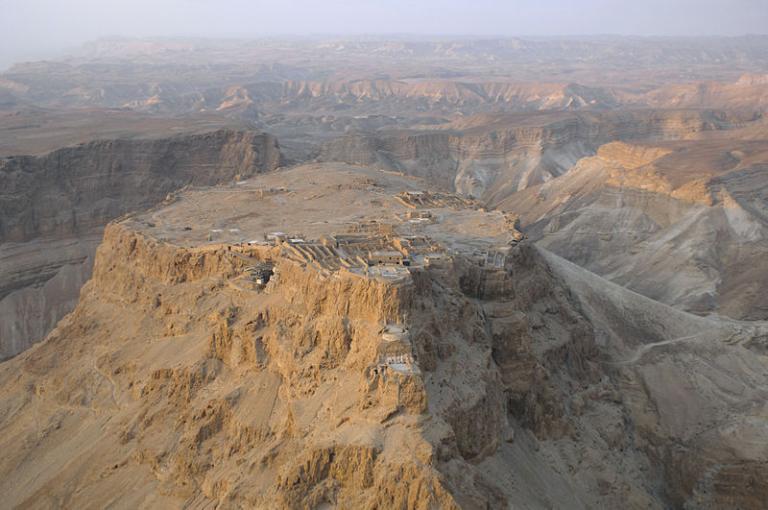
Masada from the north, with the ruins of the palace of Herod the Great cascading down the cliff in the foreground. It’s the site where — according to Flavius Josephus — a large group of Jewish Zealots committed suicide in AD 73 rather than be enslaved by the Romans.
(Wikimedia Commons public domain image)
The last Jewish stronghold was the spectacular mountain fortress-palace of Masada, 1300 feet above the barren wilderness of the Dead Sea. It’s still possible today to stand upon Masada and see the outlines of the siege walls left behind by Flavius Silva and his Tenth Legion in the arid, hot soil. The Romans must have wondered just who was besieging whom. (Occasionally, the Jewish garrison on Masada would open up one of the cisterns of the fortress and let a cascade of water run down the side of the massive rock. This showed their enemies that they were comfortable and well supplied.) Still, while the Jews survived for a while and even thumbed their noses for a season at the Roman soldiers, time was again on Rome’s side.
The siege of Masada called for exactly the kind of military engineering at which the Romans were expert. With the forced assistance of thousands of Jewish prisoners of war, they built an immense ramp to the top of Masada that is still there today. The defenders of the fortress, unable to stop the ramp—and reluctant to fire upon their captive countrymen, who were building it—knew that the end was near. So, in a final act of defiance, they committed suicide. Nearly a thousand Jewish rebels died, including, perhaps, the last residents of the Essene community at Qumran. The Essenes had evidently sealed up their sacred records in the caves there and had retreated southward for a final stand against the Romans at Masada. Nearly two thousand years later, their documents would be discovered and become known to the world as the “Dead Sea Scrolls.” (The Nephite practice of sealing up important documents during periods of impending military disaster in the hope that they’ll come forth again at a later time—a practice much ridiculed when Joseph Smith revealed it to the modern world—now seems authentically ancient and Near Eastern.)
At the end of the revolt, the land was in ruins. Villages and cities were destroyed. Vast numbers of Jews were dead. Palestinian agriculture had suffered severely. The orchards of the hills and plains had been laid waste, sometimes by deliberate Roman policy and sometimes by the Jews themselves. Palestine’s persimmon groves, the only such groves in the world, were uprooted by Jewish rebels to prevent them from falling into the hands of the Romans.
However, this cataclysmic revolt that left Jerusalem destroyed and the holy temple in ruins—just as Jesus had said it would soon be—wasn’t the last Jewish rebellion against Rome. A revolt in Egypt lasted from 115 to 117 A.D. and crippled the Jewish community there. Jews were never again to be an important element in the life of the great ancient city of Alexandria. But Palestine, too, would see one more revolt: Astonishingly, the economy and the population of the Holy Land were able to bounce back by the end of the first century, so much so that the Jews were soon able to launch yet another suicidal war against the Roman Empire. This revolt broke out around 132 A.D. under the leadership of a guerrilla leader generally known as Simon bar Kokhba.[1] He enjoyed considerable early success. Simon drafted the local population into his army and gained control of the whole province of Judea, including Jerusalem. He even managed to secure much of the rest of the Holy Land. One entire Roman legion–the 22nd, based in and sent from Egypt–was annihilated. But, once again, the revolt’s ultimate fate was never really in question. Rome summoned its legions from as far away as Britain and the Danube frontier and concentrated them around Judea. As in the earlier rebellion, the Romans—eventually there were a full twelve legions of them, three times as many as Vespasian and Titus had commanded—proceeded slowly, methodically, through the countryside, destroying outlying points of resistance, dividing and conquering, using siege warfare to starve holdouts into submission. Galilee was lost to the Jews early on. From that point, the destruction and ruin of war were concentrated almost entirely on Judea itself. Some Jewish rebels attempted to hold Jerusalem, but it was hardly defensible because its walls had not been rebuilt since the last insurrection against Rome. Gradually, although they inflicted heavy losses upon their adversaries, the Jewish rebels were pushed back into the town of Betar in the Judean hills southwest of Jerusalem, where they fell to Roman forces in the summer of 135 A.D.
The Romans were much harsher this time than they had been in the Great Revolt of 66-70 A.D. Simon was killed in the siege of Betar, and the great Rabbi Akiva ben Joseph, the most illustrious scholar of his time, was tortured to death. (Rabbinic lore indicates that Akiva had not only supported Simon’s revolt but had pronounced Simon to be the Messiah.) Ancient sources speak of Jewish deaths numbering well above half a million, of nearly a thousand towns and villages being utterly destroyed. Unnumbered Jews were sold into slavery, and nearly all of Judea was left a wasteland. But the Romans’ losses had been heavy too, and when the emperor Hadrian reported to the Senate, he omitted the customary introductory phrase, “I trust you and your children are well; I and my troops are well.”[2]
In fact, Hadrian was furious. Personally hostile to Judaism because he found practices like circumcision disgusting and barbaric, he ordered the transformation of Jerusalem into a Greek-style pagan city, or polis. He used the debris of the old city to fill up the hollows and ravines of the site and to create a level platform upon which to build his new creation, which he named not Jerusalem but Aelia Capitolina, after his own family name and the name of the tutelary god of Rome. Hadrian transferred a population of Greek-speakers into the new city and forbade Jews to enter it on pain of death. The old official name of Judea was abolished and was replaced by the new name Syria-Palestina.[3] Thus ended what was definitively the last Jewish revolt against Rome.[4]
[1] There is some dispute about Simon’s name, but Bar Kokhba is the title by which he is most widely known. It means “Son of the Star” and is related to the words Kokob and Kokaubeam occurring in Abraham 3:13. Ancient Christian sources thought the title was given to Simon for its alleged messianic implications.
[2] Dio Cassius, Roman History, 59.
[3] This new name represented a lingering memory of the ancient Philistines and may have been especially (and intentionally) galling to the Jews.
[4] In 1961, the great Israeli archaeologist Yigael Yadin found a land deed connected with the Bar Kokhba revolt in a place not far from the Dead Sea called the Cave of Letters. See Yigael Yadin, Bar-Kokhba (New York: Random House, 1971), 176. This document is of considerable interest for Latter-day Saints, since it was signed by one “Alma the son of Judah.” The Nephite masculine name Alma has occasioned much ignorant laughter among anti-Mormons, but it is now known to be authentically ancient and authentically Jewish. How, though, could Joseph Smith have known that? See Hugh Nibley, The Prophetic Book of Mormon, Volume 8 in the Collected Works of Hugh Nibley (Salt Lake City and Provo: Deseret Book and the Foundation for Ancient Research and Mormon Studies, 1989), 281-82. Nibley offers a discussion of Bar Kokhba at pp. 274-88 of the same volume in a book review that originally appeared in Brigham Young University Studies 14 (Autumn 1973), 115-26.
Next Post

July 11, 2020 Revision 1.9 "Judaism survived, despite the odds"
Browse Our Archives
Select a Category Uncategorized
Select a Month October 2026 September 2026 August 2026 July 2026 June 2026 May 2026 April 2026 March 2026 February 2026 January 2026 December 2025 November 2025 October 2025 September 2025 August 2025 July 2025 June 2025 May 2025 April 2025 March 2025 February 2025 January 2025 December 2024 November 2024 October 2024 September 2024 August 2024 July 2024 June 2024 May 2024 April 2024 March 2024 February 2024 January 2024 December 2023 November 2023 October 2023 September 2023 August 2023 July 2023 June 2023 May 2023 April 2023 March 2023 February 2023 January 2023 December 2022 November 2022 October 2022 September 2022 August 2022 July 2022 June 2022 May 2022 April 2022 March 2022 February 2022 January 2022 December 2021 November 2021 October 2021 September 2021 August 2021 July 2021 June 2021 May 2021 April 2021 March 2021 February 2021 January 2021 December 2020 November 2020 October 2020 September 2020 August 2020 July 2020 June 2020 May 2020 April 2020 March 2020 February 2020 January 2020 December 2019 November 2019 October 2019 September 2019 August 2019 July 2019 June 2019 May 2019 April 2019 March 2019 February 2019 January 2019 December 2018 November 2018 October 2018 September 2018 August 2018 July 2018 June 2018 May 2018 April 2018 March 2018 February 2018 January 2018 December 2017 November 2017 October 2017 September 2017 August 2017 July 2017 June 2017 May 2017 April 2017 March 2017 February 2017 January 2017 December 2016 November 2016 October 2016 September 2016 August 2016 July 2016 June 2016 May 2016 April 2016 March 2016 February 2016 January 2016 December 2015 November 2015 October 2015 September 2015 August 2015 July 2015 June 2015 May 2015 April 2015 March 2015 February 2015 January 2015 December 2014 November 2014 March 2014 August 2013 February 2012
Follow Us!
TAKE THE
Religious Wisdom Quiz
What does "Hosanna" mean?
Select your answer to see how you score.
Praise Hurry Save us Rejoice
Related posts from Sic et Non

Notes on Women, Priesthood, and General Conference

"The Book of Moses as a Temple Text"

TRENDING AT PATHEOS Latter-day Saint

57th Dove Awards Honor Dolly Parton, Crown New...
On gospel music’s biggest night, the 57th annual GMA Dove Awards honored...

The First Eucharistic Controversy: Christ’s Real Presence
For Catholics, the Eucharist is the source and summit of the Christian...

What a Stop Sign Can Teach Us About...
How to Make a Decision When You Can't Hear God Main point:...

Archdiocese Hosts Military Marriage Retreat in Germany
RASTATT, Germany — The transient military lifestyle, with its frequent deployments and...

Nearly every morning, I make the drive to Detroit with my high-school-age...

The Real AI Story Is Adoption Without Trust
Artificial intelligence has crossed a political threshold. It is no longer a...
view all Latter-day Saint blogs
Ad-Free & Subscriber Log-In Subscription Support
- About Us
- 2026 Calendar
- Videos
- Podcasts
- Library of World Religions
- Faith In Media Tracker
- Advertise With Us
- Write for Us
- Privacy Policy
- Terms of Service
- Do Not Sell My Data
- Contact Us
- Radiant Digital
- Manage Newsletter Subscriptions
- Unsubscribe From Notifications
- Sitemap
Copyright 2008-2026, Patheos. All rights reserved.
Subscription Support Ad-Free & Subscriber Log-In
Follow Patheos