
BuddhistCatholicContemplativeEvangelicalGeneral ChristianHinduJewishLatter-day SaintMuslimNew VisionsProgressive Christian
Beliefs
- Buddhist
- Catholic
- Contemplative
- Evangelical
- General Christian
- Hindu
- Jewish
- Latter-day Saint
- More Voices
- Muslim
- New Visions
- Pagan
- Progressive Christian
Topics
- Religion News
- Food and Religion
- Sports and Religion
- Religious Art
- Religious Music and Entertainment
- Religious Events
- History and Religion
- Style and Religion
- Politics and Religion
- Women in Religion
- Recreation Outdoors and Religion
- Business Finance and Religion
- Careers Workplace and Religion
- Education and Religion
- Family Parenting and Religion
- Health Fitness and Religion
- Home and Religion
- Relationships and Religion
- Technology and Religion
- Travel and Religion
Columnists
- Buddhist Columnists
- Business Finance and Religion Columnists
- Careers Workplace and Religion Columnists
- Catholic Columnists
- Contemplative Columnists
- Education and Religion Columnists
- Evangelists Columnists
- Family Parenting and Religion Columnists
- General Christian Columnists
- Health Fitness and Religion Columnists
- Hindu Columnists
- History and Religion Columnists
- Home and Religion Columnists
- Jewish Columnists
- More Voices Columnists
- Latter Day Columnists
- Muslim Columnists
- New Visions Columnists
- Nonreligious Columnists
- Pagan Columnists
- Politics and Religion Columnists
- Progressive Columnists
- Recreation Outdoors and Religion Columnists
- Relationships and Religion Columnists
- Religion News Columnists
- Religious Art Columnists
- Religious Events Columnists
- Religious Music and Entertainment Columnists
- Sports and Religion Columnists
- Style and Religion Columnists
- Technology and Religion Columnists
- Travel and Religion Columnists
- Women in Religion Columnists
Resource Library
- 2026 Calendar
- Library of World Religions
- The 100 Most Holy Places on Earth
- Patheos Answers
- Podcasts
- Videos
- Faith Leaders Database
- Anglican Episcopalian
- Bahai
- Baptist
- Buddhism
- Christianity
- Confucianism
- Eastern Orthodoxy
- Hinduism
- Holiness and Pentecostal
- ISKCON
- Islam
- Judaism
- Lutheran
- Methodist
- The Church of Jesus Christ of Latter-day Saints
- New Age
- Paganism
- Presbytarian and Reformed
- Protestantism
- Religion Behind the Scenes
- Roman Catholic
- Scientology
- Shia Islam
- Sikhism
- Sufism
- Sunni Islam
- Taoism
- Zen
- See all religions
Research Tools
 Ad-Free & Subscriber Log-In Subscription Support
Ad-Free & Subscriber Log-In Subscription Support
Follow Patheos 

- Trending:
- Forgiveness
- |
- Marriage
- |
- Consciousness
- |
- Death Penalty
- |
- Election
- |
- Halloween

- Home
- Latter-day Saint
- Revision 1.6 “Herod the Great”
Revision 1.6 “Herod the Great”
Last updated on: July 10, 2020 at 9:01 pm by Dan Peterson
Revision 1.6 “Herod the Great” 2020-07-10T21:01:53-06:00 Dan Peterson
Patheos Explore the world's faith through different perspectives on religion and spirituality! Patheos has the views of the prevalent religions and spiritualities of the world.
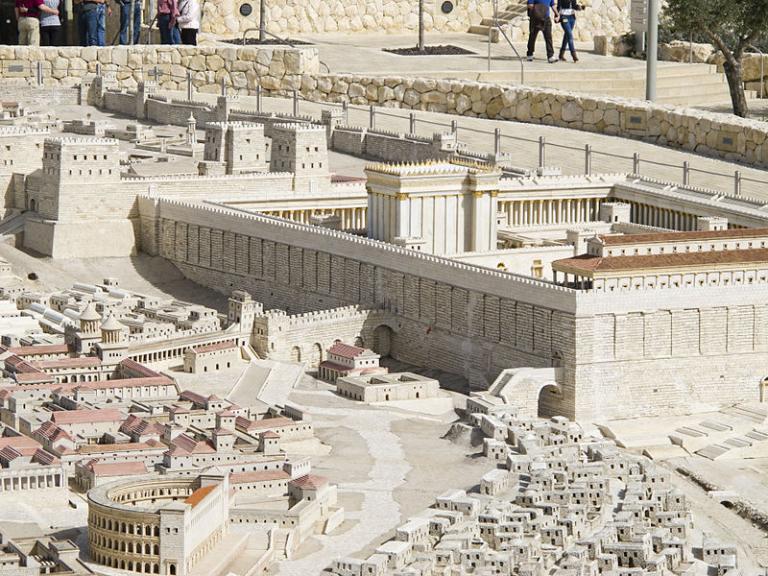
The temple of Jerusalem as it appeared in 66 AD, about three and a half decades after the crucifixion of Jesus and just prior to the Roman destruction of temple and city during the First Jewish Revolt. This wonderful outdoor model of late Second Temple Jerusalem stands on the grounds of the Israel Museum.
(Wikimedia Commons public domain photograph)
In 63 B.C., Judea became a client-state of the new superpower, Rome. Thus, as the Christian era dawned, the vast majority of the Jewish population—in Palestine and in other centers such as Alexandria—lived in areas under Roman control. At first, the Romans didn’t rule Palestine directly. They preferred rule through locals, such as the infamous Herod.
Herod saw himself as something of a reformer, dragging a backward people kicking and screaming into the modern age. He sought to weaken the power of rigorist Judaism by separating “church” and state. One of his first acts upon coming to power in 37 B.C. was to execute forty-six leading members of the Sanhedrin, whose chief sin was seeking to uphold the law of Moses in secular matters. Largely for reasons of personal interest, he wanted the Sanhedrin to be a religious court only. Herod did not seek to become high priest, but he made it an appointed post to which he could name virtually anybody he liked, any time he liked. He favored the Jews of the diaspora—that is, those who lived abroad, or were “dispersed”—and he was their greatest patron, endowing charities, synagogues, and libraries in Alexandria, Rome, Babylon, and throughout the world, wherever Jews were to be found. But his sense of Jewish destiny also allowed him to rebuild the temple of Apollo at Rhodes and to single-handedly save the cash-strapped but explicitly pagan Olympic games, which earned him great popularity beyond the Jewish community. On the coast, he created the new port city of Caesarea, in honor of his patron, Augustus. In Jerusalem, after he’d established a firm grip on power, he founded both a theatre and an amphitheatre— among the most Greek of institutions. He thought diaspora Jews were more sophisticated, more open, than the benighted inhabitants of Judea, so he brought them in to fill many of the municipal offices in Jerusalem and throughout the area. He even favored diaspora Jews for the office of high priest. The construction of a massive new temple was part of his modernizing plan to make Jerusalem not merely the provincial capital of Judea but the capital of Jews worldwide. The temple was to be—and indeed was—a spectacle famous the world over, one that made his name and the name of Jerusalem itself well known.
Herod’s temple became a repository of riches. Even Gentiles and foreigners offered gifts and sacrifices. Kings such as Artaxerxes and Augustus donated golden vessels to it, which were stored in its treasuries. And Jews throughout the world were hardly behind in their generosity. Josephus says the temple became “the general treasury of all Jewish wealth.”[1]
We know a great deal about the temple of Herod. Its platform covered thirty-five acres and was a mile in circumference. Those who have been to Jerusalem and have had the opportunity to stand beneath the platform are often struck by its height, but it was actually twice as high then as it is now, since 2,000 years of rubbish have covered up many of the lower courses of stone. It was an immense structure, and it was clearly designed to impress. Gates and decorations were covered in gold and silver. An unusually white stone was used for its walls, which gleamed for miles in the bright Palestinian sun. Very little money was spent on the actual interior of the temple, which was relatively plain. After all, Herod was not from a priestly family and thus could not even enter the inner court. So why spend valuable resources on it? And, anyway, the chief aim of the building was to impress mortal human beings, and the overwhelming majority of those who were to be impressed also could not enter the most sacred sanctuaries. (This says much of Herod’s motives.)
However, if buildings, even impressive ones, do not last forever—and we all know that the temple of Herod did not last through even the first century after Christ—their builders certainly do not live forever. Just before his death, Herod ordered a great golden eagle to be placed above the entrance to the temple. Pious Jews at Jerusalem were outraged, and a group of Torah students managed to climb up and smash the eagle to pieces. Sick as he was, Herod responded with his typical cruelty. According to most modern scholars, he passed to his eternal reward in the spring of the year 4 B.C., shortly after having the students burned to death. (It was a typical action for the man who, according to the gospel of Matthew, had killed all of the infant children in Bethlehem and surrounding areas just a short while before.)
[1] 1 Maccabees 14:41 (Jerusalem Bible translation).
Previous Post

July 8, 2020
"I stood with the Prophet Joseph Smith in the presence of the angel"
Browse Our Archives
Select a Category Uncategorized
Select a Month October 2026 September 2026 August 2026 July 2026 June 2026 May 2026 April 2026 March 2026 February 2026 January 2026 December 2025 November 2025 October 2025 September 2025 August 2025 July 2025 June 2025 May 2025 April 2025 March 2025 February 2025 January 2025 December 2024 November 2024 October 2024 September 2024 August 2024 July 2024 June 2024 May 2024 April 2024 March 2024 February 2024 January 2024 December 2023 November 2023 October 2023 September 2023 August 2023 July 2023 June 2023 May 2023 April 2023 March 2023 February 2023 January 2023 December 2022 November 2022 October 2022 September 2022 August 2022 July 2022 June 2022 May 2022 April 2022 March 2022 February 2022 January 2022 December 2021 November 2021 October 2021 September 2021 August 2021 July 2021 June 2021 May 2021 April 2021 March 2021 February 2021 January 2021 December 2020 November 2020 October 2020 September 2020 August 2020 July 2020 June 2020 May 2020 April 2020 March 2020 February 2020 January 2020 December 2019 November 2019 October 2019 September 2019 August 2019 July 2019 June 2019 May 2019 April 2019 March 2019 February 2019 January 2019 December 2018 November 2018 October 2018 September 2018 August 2018 July 2018 June 2018 May 2018 April 2018 March 2018 February 2018 January 2018 December 2017 November 2017 October 2017 September 2017 August 2017 July 2017 June 2017 May 2017 April 2017 March 2017 February 2017 January 2017 December 2016 November 2016 October 2016 September 2016 August 2016 July 2016 June 2016 May 2016 April 2016 March 2016 February 2016 January 2016 December 2015 November 2015 October 2015 September 2015 August 2015 July 2015 June 2015 May 2015 April 2015 March 2015 February 2015 January 2015 December 2014 November 2014 March 2014 August 2013 February 2012
Follow Us!
TAKE THE
Religious Wisdom Quiz
What does "Judas" mean in Greek?
Select your answer to see how you score.
Betrayer Deceiver Strong Praise
Related posts from Sic et Non

Notes on Women, Priesthood, and General Conference

"The Book of Moses as a Temple Text"

TRENDING AT PATHEOS Latter-day Saint

The Real AI Story Is Adoption Without Trust
Artificial intelligence has crossed a political threshold. It is no longer a...

A new article, written by Jeff Lindsay and Gale L. Pooley,...

Swimfan: Forgotten Aughts Pleasures
This is a recovery effort. In 2002, My Big Fat Greek Wedding...

Top Three Anti-Catholic Lies About Catholicism
This is my initial transcript for the video, "THE 3 WORST...

Pope Leo Celebrates Mass for Nurses & Docs...
I don't have any idea how he did it, but Pope Leo...

The Sermon on the Mount, Part I: Matthew...
The Sermon on the Mount, Part I (Matthew 4:12-5:12) St. Matthew moves...
view all Latter-day Saint blogs
Ad-Free & Subscriber Log-In Subscription Support
- About Us
- 2026 Calendar
- Videos
- Podcasts
- Library of World Religions
- Faith In Media Tracker
- Advertise With Us
- Write for Us
- Privacy Policy
- Terms of Service
- Do Not Sell My Data
- Contact Us
- Radiant Digital
- Manage Newsletter Subscriptions
- Unsubscribe From Notifications
- Sitemap
Copyright 2008-2026, Patheos. All rights reserved.
Subscription Support Ad-Free & Subscriber Log-In
Follow Patheos