
BuddhistCatholicContemplativeEvangelicalGeneral ChristianHinduJewishLatter-day SaintMuslimNew VisionsProgressive Christian
Beliefs
- Buddhist
- Catholic
- Contemplative
- Evangelical
- General Christian
- Hindu
- Jewish
- Latter-day Saint
- More Voices
- Muslim
- New Visions
- Pagan
- Progressive Christian
Topics
- Religion News
- Food and Religion
- Sports and Religion
- Religious Art
- Religious Music and Entertainment
- Religious Events
- History and Religion
- Style and Religion
- Politics and Religion
- Women in Religion
- Recreation Outdoors and Religion
- Business Finance and Religion
- Careers Workplace and Religion
- Education and Religion
- Family Parenting and Religion
- Health Fitness and Religion
- Home and Religion
- Relationships and Religion
- Technology and Religion
- Travel and Religion
Columnists
- Buddhist Columnists
- Business Finance and Religion Columnists
- Careers Workplace and Religion Columnists
- Catholic Columnists
- Contemplative Columnists
- Education and Religion Columnists
- Evangelists Columnists
- Family Parenting and Religion Columnists
- General Christian Columnists
- Health Fitness and Religion Columnists
- Hindu Columnists
- History and Religion Columnists
- Home and Religion Columnists
- Jewish Columnists
- More Voices Columnists
- Latter Day Columnists
- Muslim Columnists
- New Visions Columnists
- Nonreligious Columnists
- Pagan Columnists
- Politics and Religion Columnists
- Progressive Columnists
- Recreation Outdoors and Religion Columnists
- Relationships and Religion Columnists
- Religion News Columnists
- Religious Art Columnists
- Religious Events Columnists
- Religious Music and Entertainment Columnists
- Sports and Religion Columnists
- Style and Religion Columnists
- Technology and Religion Columnists
- Travel and Religion Columnists
- Women in Religion Columnists
Resource Library
- 2026 Calendar
- Library of World Religions
- The 100 Most Holy Places on Earth
- Patheos Answers
- Podcasts
- Videos
- Faith Leaders Database
- Anglican Episcopalian
- Bahai
- Baptist
- Buddhism
- Christianity
- Confucianism
- Eastern Orthodoxy
- Hinduism
- Holiness and Pentecostal
- ISKCON
- Islam
- Judaism
- Lutheran
- Methodist
- The Church of Jesus Christ of Latter-day Saints
- New Age
- Paganism
- Presbytarian and Reformed
- Protestantism
- Religion Behind the Scenes
- Roman Catholic
- Scientology
- Shia Islam
- Sikhism
- Sufism
- Sunni Islam
- Taoism
- Zen
- See all religions
Research Tools
 Ad-Free & Subscriber Log-In Subscription Support
Ad-Free & Subscriber Log-In Subscription Support
Follow Patheos 

- Trending:
- Forgiveness
- |
- Marriage
- |
- Consciousness
- |
- Death Penalty
- |
- Election
- |
- Halloween

- Home
- Latter-day Saint
- Revision 1.4 Hellenism
Revision 1.4 Hellenism
Last updated on: July 6, 2020 at 10:48 am by Dan Peterson
Revision 1.4 Hellenism 2020-07-06T10:48:24-06:00 Dan Peterson
Patheos Explore the world's faith through different perspectives on religion and spirituality! Patheos has the views of the prevalent religions and spiritualities of the world.
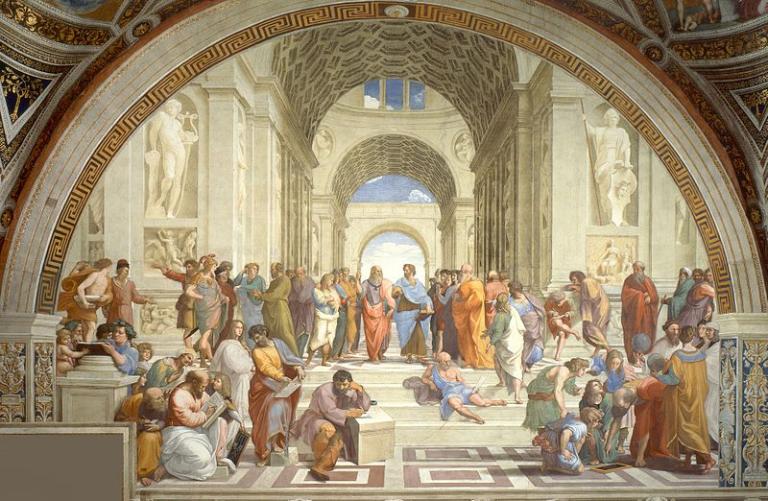
Raphael, “The School of Athens” (1505)
In this painting, located in the Vatican Apartments, Plato (the older bearded man, shown gesturing upwards) walks with his younger student, Aristotle (who motions downward, suggesting how his philosophical approach would come to differ from his master’s). In the foreground, Michelangelo sits, looking downward, resting his head on his fist. Over toward the right border of the painting, the very young Raphael himself, wearing a black beret-like hat, looks directly at the viewer.
(Wikimedia Commons public domain image)
The records that the Hebrews had so laboriously created would eventually prove to be of great worth to their descendants, helping them understand their own uniqueness and their special covenant relationship with God.[1] New challenges were arising, and these records became invaluable. In the late fourth century B.C., the landscape of the Near East was dramatically changed by the invasion of Alexander the Great. Alexander, descendant of a royal family in the relatively uncultured area of Macedonia, north of Greece, was a pupil of the great philosopher Aristotle and, with all the fervor of a convert, brought a form of Greek civilization with him wherever he went.[2] His armies pushed into Asia and Africa, establishing Greek colonies such as Alexandria in Egypt. After a few years of what has come to be known as the Hellenistic Age, much of the eastern Mediterranean world was tied together in an unprecedented way by links of culture, common learning, and shared knowledge of the Greek language.[3] People were able to move around now. A new international society was created in which Jews could, and did, spread out across much of the eastern Mediterranean. Large Jewish colonies were established in many areas, most notably in the new city of Alexandria. (This diaspora or “dispersion” merely continued a process of dispersal which had begun with the Babylonian captivity. Many Jews, having grown wealthy and comfortable, had simply stayed in Babylonia when the captivity came to an end.)
Alexander’s successors—he died at a very young age—were his generals, who carved out empires for themselves. Noteworthy among these were Ptolemy in Egypt, and Seleucus in Syria and Mesopotamia (modern Iraq). The Jews who remained in Palestine were ruled first by the Ptolemies and then, after 200 B.C., by the Seleucids. These new Hellenistic rulers brought Greek institutions with them. The most prominent of these institutions was the gymnasium, whose functions were far broader than the name suggests to modern hearers. It was not only an athletic center where, to the horror of pious Jews, men and sometimes women competed in the nude, but a community center. Furthermore, it was the main educational institution of Greek culture.
That culture held tremendous attraction. People who wanted to be sophisticated—people such as Philip of Macedon, who hired Aristotle to tutor his son Alexander—were eager to learn from the Greeks. Moreover, they were often eager to be Greeks. Or, at least, they tried to imitate them to the extent of their ability. The best science and philosophy of the period were Greek. The most prosperous people of the new period were either Greeks or imitators of Greeks. They were phenomenal traders and merchants, with networks across the Mediterranean world. Owing to such trade and learning, the eastern Mediterranean coast was soon heavily Hellenized. And the Greek cities of the coast established satellite towns in the interior. Soon, the mountainous regions of Judea and Samaria seemed rustic and backward by contrast.
But adaptation to the world comes at a price. At the least, it presents considerable risks. Greek culture was the passport to sophistication, to social advancement. Those who rejected it were likely to be mocked by their more up-to-date neighbors.[4] Some Jews, therefore, and especially the upper classes, the rich, and the chief priests, wanted to be like their Hellenized overlords. If their Jewishness got in the way, well, they were prepared to abandon it, or better yet, to redefine it so that it was no longer an obstacle. A number even wanted to push the pace of Hellenization—some for selfish, materialistic interests and others because they were genuinely attracted to Hellenistic ideas (which were, it must constantly be stressed, genuinely attractive). Consequently, there was, among many Jews of the period, a distinctly secularizing and materialistic tendency.
Reactions varied. Many Jews, probably the majority, resisted. Some withdrew into an ever more rigorous adherence to the old traditions. The Essene community at Qumran, from whom we’ve received the Dead Sea Scrolls, seems to have originated in the third century B.C. as a reaction to what it perceived as the “corruption” brought in by the Greeks. Other pious Jews sought to adapt to the new world without giving up their principles. They learned Greek, they lived in Hellenized cities (many in Alexandria), and they translated their scriptures into Greek, giving us the famous Septuagint, the Greek version of the Old Testament that is still an important document to this day. (The New Testament figure of Apollos is a good illustration of this middle tendency to neither withdraw from the “modern” world nor totally surrender to it. We are told of him that he was a Jew and that he was “mighty in the scriptures” even before his conversion to Christianity. Yet he was “born at Alexandria,” and there can hardly be a more perfectly Greek name than Apollos.)[5]
But the resources available to Judaism for resistance and adaptation were fairly limited by now. By 200 B.C., the idea of a Jewish canon was beginning to take shape. This had the effect of discouraging additions. Prophecy was discouraged and began to die out. Even the Jews themselves realized that something was missing. The First Book of Maccabees, for example, was written in the century before Christ. Speaking of one difficult period for the Jews, it declares that “there had been nothing like it since the disappearance of prophecy among them.”[6] Later on, during another period of stress and confusion, “the Jews and the priests . . . agreed that Simon [Maccabeus] should be their perpetual leader and high priest until a trustworthy prophet should arise.”[7] Clearly, although a new living prophet was sorely needed, no prophet was found.
[1] See 1 Nephi 5:21. The Book of Mormon furnishes a splendid example, in the Mulekites, of a people who lacked such records and who consequently lost their identity and even their language. See Omni 1:17. This situation, which comports so well with what scholars know today about linguistic evolution and the development of cultures, seems to me utterly beyond the capacity of an uneducated 1820s New York farm boy to have made up on his own.
[2] Aristotle, in his turn, had studied under Plato, who had been a disciple of Socrates. There is probably no more distinguished lineage of teachers and students anywhere in the history of education.
[3] Words like Hellenistic and Hellene come from the Greeks’ word for their own homeland, Hellas.
[4] See 1 Nephi 8:26-28.
[5] Acts 18:24-25. Apollos became a very important missionary ally of Paul’s. See 1 Corinthians 1:12; 3:4-6, 22; 16:12; Titus 3:13.
[6] 1 Maccabees 9:27 (Jerusalem Bible translation).
[7] 1 Maccabees 14:41 (Jerusalem Bible translation).
Previous Post

July 5, 2020
A Prolegomenon to "Getting to Know Elder Boyd K. Packer"
Next Post
July 6, 2020 Getting to Know Elder Boyd K. Packer (Conclusion)
Browse Our Archives
Select a Category Uncategorized
Select a Month October 2026 September 2026 August 2026 July 2026 June 2026 May 2026 April 2026 March 2026 February 2026 January 2026 December 2025 November 2025 October 2025 September 2025 August 2025 July 2025 June 2025 May 2025 April 2025 March 2025 February 2025 January 2025 December 2024 November 2024 October 2024 September 2024 August 2024 July 2024 June 2024 May 2024 April 2024 March 2024 February 2024 January 2024 December 2023 November 2023 October 2023 September 2023 August 2023 July 2023 June 2023 May 2023 April 2023 March 2023 February 2023 January 2023 December 2022 November 2022 October 2022 September 2022 August 2022 July 2022 June 2022 May 2022 April 2022 March 2022 February 2022 January 2022 December 2021 November 2021 October 2021 September 2021 August 2021 July 2021 June 2021 May 2021 April 2021 March 2021 February 2021 January 2021 December 2020 November 2020 October 2020 September 2020 August 2020 July 2020 June 2020 May 2020 April 2020 March 2020 February 2020 January 2020 December 2019 November 2019 October 2019 September 2019 August 2019 July 2019 June 2019 May 2019 April 2019 March 2019 February 2019 January 2019 December 2018 November 2018 October 2018 September 2018 August 2018 July 2018 June 2018 May 2018 April 2018 March 2018 February 2018 January 2018 December 2017 November 2017 October 2017 September 2017 August 2017 July 2017 June 2017 May 2017 April 2017 March 2017 February 2017 January 2017 December 2016 November 2016 October 2016 September 2016 August 2016 July 2016 June 2016 May 2016 April 2016 March 2016 February 2016 January 2016 December 2015 November 2015 October 2015 September 2015 August 2015 July 2015 June 2015 May 2015 April 2015 March 2015 February 2015 January 2015 December 2014 November 2014 March 2014 August 2013 February 2012
Follow Us!
TAKE THE
Religious Wisdom Quiz
Who gave birth to Isaac at a very old age?
Select your answer to see how you score.
Rachel Rebekah Sarah Leah
Related posts from Sic et Non


Coming on Friday, 4 March 2022

A Christmas gift recommendation and a book notice
TRENDING AT PATHEOS Latter-day Saint

The Image: On the Horror of Capitalism and...
The Image Then went the Pharisees, and took counsel how they might...

We are approaching the date of our new American national holiday: October...

Letters on Living the Faith by C.S. Lewis
Most of us met C.S. Lewis as a public intellectual. Mere Christianity....

When Halloween Unmasks Married Hearts
Written by Dr. David K. Ewen from Eternal Truth Bible College Behind...

Aristotle. He’s been called the father of logic, the father of the...

Methodist Central Hall and Westminster Abbey
Situated on the same square is Methodist Central Hall and Westminster Abbey. ...
view all Latter-day Saint blogs
Ad-Free & Subscriber Log-In Subscription Support
- About Us
- 2026 Calendar
- Videos
- Podcasts
- Library of World Religions
- Faith In Media Tracker
- Advertise With Us
- Write for Us
- Privacy Policy
- Terms of Service
- Do Not Sell My Data
- Contact Us
- Radiant Digital
- Manage Newsletter Subscriptions
- Unsubscribe From Notifications
- Sitemap
Copyright 2008-2026, Patheos. All rights reserved.
Subscription Support Ad-Free & Subscriber Log-In
Follow Patheos