
BuddhistCatholicContemplativeEvangelicalGeneral ChristianHinduJewishLatter-day SaintMuslimNew VisionsProgressive Christian
Beliefs
- Buddhist
- Catholic
- Contemplative
- Evangelical
- General Christian
- Hindu
- Jewish
- Latter-day Saint
- More Voices
- Muslim
- New Visions
- Pagan
- Progressive Christian
Topics
- Religion News
- Food and Religion
- Sports and Religion
- Religious Art
- Religious Music and Entertainment
- Religious Events
- History and Religion
- Style and Religion
- Politics and Religion
- Women in Religion
- Recreation Outdoors and Religion
- Business Finance and Religion
- Careers Workplace and Religion
- Education and Religion
- Family Parenting and Religion
- Health Fitness and Religion
- Home and Religion
- Relationships and Religion
- Technology and Religion
- Travel and Religion
Columnists
- Buddhist Columnists
- Business Finance and Religion Columnists
- Careers Workplace and Religion Columnists
- Catholic Columnists
- Contemplative Columnists
- Education and Religion Columnists
- Evangelists Columnists
- Family Parenting and Religion Columnists
- General Christian Columnists
- Health Fitness and Religion Columnists
- Hindu Columnists
- History and Religion Columnists
- Home and Religion Columnists
- Jewish Columnists
- More Voices Columnists
- Latter Day Columnists
- Muslim Columnists
- New Visions Columnists
- Nonreligious Columnists
- Pagan Columnists
- Politics and Religion Columnists
- Progressive Columnists
- Recreation Outdoors and Religion Columnists
- Relationships and Religion Columnists
- Religion News Columnists
- Religious Art Columnists
- Religious Events Columnists
- Religious Music and Entertainment Columnists
- Sports and Religion Columnists
- Style and Religion Columnists
- Technology and Religion Columnists
- Travel and Religion Columnists
- Women in Religion Columnists
Resource Library
- 2026 Calendar
- Library of World Religions
- The 100 Most Holy Places on Earth
- Patheos Answers
- Podcasts
- Videos
- Faith Leaders Database
- Anglican Episcopalian
- Bahai
- Baptist
- Buddhism
- Christianity
- Confucianism
- Eastern Orthodoxy
- Hinduism
- Holiness and Pentecostal
- ISKCON
- Islam
- Judaism
- Lutheran
- Methodist
- The Church of Jesus Christ of Latter-day Saints
- New Age
- Paganism
- Presbytarian and Reformed
- Protestantism
- Religion Behind the Scenes
- Roman Catholic
- Scientology
- Shia Islam
- Sikhism
- Sufism
- Sunni Islam
- Taoism
- Zen
- See all religions
Research Tools
 Ad-Free & Subscriber Log-In Subscription Support
Ad-Free & Subscriber Log-In Subscription Support
Follow Patheos 

- Trending:
- Forgiveness
- |
- Marriage
- |
- Consciousness
- |
- Death Penalty
- |
- Election
- |
- Halloween

- Home
- Latter-day Saint
- Revision 1.3 “Post-Biblical Judaism” B
Revision 1.3 “Post-Biblical Judaism” B
Last updated on: July 6, 2020 at 10:35 am by Dan Peterson
Revision 1.3 “Post-Biblical Judaism” B 2020-07-06T10:35:40-06:00 Dan Peterson
Patheos Explore the world's faith through different perspectives on religion and spirituality! Patheos has the views of the prevalent religions and spiritualities of the world.
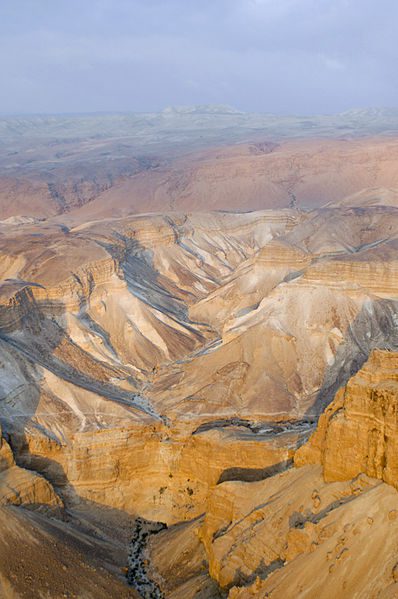
An aerial view of the Judean wilderness (near Masada), by Andrew Shiva
(Wikimedia Commons public domain photo)
For all the talk of a land “flowing with milk and honey,” Palestine is a relatively difficult place to eke out a living. Tahiti might have been nice, with fruit just waiting to be picked. Switzerland is far prettier. Even in the Near East, there are places where it would have been much easier to live a peaceful life. Take Egypt, for instance. With a regular and predictable river running gently through it, separated from would-be enemies by harsh deserts but itself enjoying the lushness of the Nile Valley, Egypt, by the standards of the ancient Near East, was a wonderful place. Palestine, on the other hand, was the highway that nearly every Near Eastern conqueror took to get to his next trophy. President Gordon B. Hinckley once called it, quite accurately, “the bloody doormat of the eastern world.”[1] Why did God put his people there? I think that it may be connected with the development of character. The German poet Goethe noted that, while talent is developed in stillness and quiet, character is developed in the stream, or torrent, of everyday events.* Today the Lord asks us to be in the world, while not of it—to be actively involved in making a living, in raising a family, in marriage—and doesn’t allow us the sometimes tempting alternative of withdrawal to a nice, quiet monastery. So did the Lord plant his people in Palestine, rather than in some more peaceful and pleasant land. We humans seem to need some discomfort to prod us to great achievements; dissatisfaction motivates us to do and to think, to pray and to strive.
God’s concern with the literal soil of Palestine was also reflected in his attention to the way the people behaved on it and in regard to it. It strengthened the passion of the Israelite prophets for proper behavior, for righteousness. Judaism was to be a religion interested in this life, not just in the next. Unlike Buddhism and Hinduism, which encourage us to escape the attachments of earth and mortality, Judaism teaches that this world is—or, at least, can be—sanctified. “And God saw every thing that he had made, and, behold, it was very good.”[2] Righteousness could dwell upon this earth; a sanctified society could be built here. It would be a literal place, with physical structures of brick and stone, not merely a spiritual abstraction.[3] Someday, the Messiah would purify Israel and glorify Jerusalem. The prophets sought, not escape, but the blessing of the Lord upon them and their people in this world as well as in the next. Far from seeking a timeless Nirvana, the Hebrew scriptures pronounced time to be holy. “And God blessed the seventh day, and sanctified it.”[4] Their very positive attitude toward the world, and toward time, almost guaranteed that the Hebrews would take history seriously. God, they were convinced, revealed himself in this world and acted in this earthly time. And it was their religious duty to record those revelations and mighty acts. As Paul Johnson points out, the Jews
were the first to create consequential, substantial and interpretative history . . . [T]hey were fascinated by their past from very early times. They knew they were a special people who had not simply evolved from an unrecorded past but had been brought into existence, for certain definite purposes, by a specific series of divine acts. They saw it as their collective business to determine, record, comment and reflect upon these acts. No other people has ever shown, particularly at that remote time, so strong a compulsion to explore their origins. The Bible gives constant examples of the probing historical spirit: why, for instance, was there a heap of stones before the city gate at Ai? What was the meaning of the twelve stones at Gilgal? This passion for aetiology, the quest for explanations, broadened into a more general habit of seeing the present and future in terms of the past. The Jews wanted to know about themselves and their destiny. They wanted to know about God and his intentions and wishes. Since God, in their theology, was the sole cause of all events—as Amos put it, ‘Does evil befall a city unless Yahweh wills it?’—and thus the author of history, and since they were the chosen actors in his vast dramas, the record and study of historical events were the keys to the understanding of both God and man. Hence the Jews were above all historians, and the Bible is essentially a historical work from start to finish.[5]
The people of Israel were not great craftsmen, or painters, or architects. But writing was their national habit, almost their obsession. They probably produced, in sheer quantity, the greatest literature of antiquity, of which the Old Testament is only a small fragment. . . . [They] saw literature as a didactic activity, with a collective purpose. It was not an act of personal self-indulgence.[6]
* Es bildet ein Talent sich in der Stille, Sich ein Charakter in dem Strom der Welt. (Goethe, Torquato Tasso, I.ii.66)
1] Cited by Truman G. Madsen, in his foreword to Baldridge, Grafting In, i.
[2] Genesis 1:31. It is beyond the scope of this book, but I would like to suggest, even if I cannot develop the thought here, that Latter-day Saints share this positive evaluation of the world. We do not dream of “escaping the body,” and we are not inclined to asceticism. There are no Latter-day Saint monks. See Daniel C. Peterson and Huston Smith, “Purpose of Earth Life: Comparative Perspective” in Daniel H. Ludlow, ed., Encyclopedia of Mormonism (New York: Macmillan, 1992), 3:1181-83.
[3] Latter-day Saints, too, have their attachment to a land. There is Utah, “sacred home of the prophets of God” in the words of the hymn. Even more, there is the New Jerusalem, someday literally to be built of actual brick, steel, glass, boards, and stone. It is not a mere spiritual abstraction. And if Zion means “the pure in heart,” as it does (Doctrine and Covenants 97:21), it also signifies a literal place. Interestingly, some nineteenth- century critics of the Church thought it too concerned with fields and barns and fences to be truly “spiritual.” Nowadays, one occasionally hears the criticism from liberal Protestant and Catholic theologians and from secularizing critics that the doctrines of the Restoration are too concerned with the next life; such critics, having often themselves abandoned their belief in transcendent matters such as life after death, now focus on religion as a tool for social reform. Amidst the fashions of the world, however, the Church goes on its way. It sanctifies the world of work and everyday life, teaching that cleaning one’s yard or digging irrigation canals in pioneer Deseret can be an act of worship, while at the same time it regards the life to come as a literal reality. Like their predecessors, modern prophets teach a balance between this life and the next. The two are, after all, not so very different.
[4] Genesis 2:3.
[5] P. Johnson, History of the Jews, 91-92.
[6] P. Johnson, History of the Jews, 88.
Previous Post

July 4, 2020
Revision 1.2 "Post-Biblical Judaism"
Next Post
July 5, 2020 Getting to Know Elder Boyd K. Packer
Browse Our Archives
Select a Category Uncategorized
Select a Month October 2026 September 2026 August 2026 July 2026 June 2026 May 2026 April 2026 March 2026 February 2026 January 2026 December 2025 November 2025 October 2025 September 2025 August 2025 July 2025 June 2025 May 2025 April 2025 March 2025 February 2025 January 2025 December 2024 November 2024 October 2024 September 2024 August 2024 July 2024 June 2024 May 2024 April 2024 March 2024 February 2024 January 2024 December 2023 November 2023 October 2023 September 2023 August 2023 July 2023 June 2023 May 2023 April 2023 March 2023 February 2023 January 2023 December 2022 November 2022 October 2022 September 2022 August 2022 July 2022 June 2022 May 2022 April 2022 March 2022 February 2022 January 2022 December 2021 November 2021 October 2021 September 2021 August 2021 July 2021 June 2021 May 2021 April 2021 March 2021 February 2021 January 2021 December 2020 November 2020 October 2020 September 2020 August 2020 July 2020 June 2020 May 2020 April 2020 March 2020 February 2020 January 2020 December 2019 November 2019 October 2019 September 2019 August 2019 July 2019 June 2019 May 2019 April 2019 March 2019 February 2019 January 2019 December 2018 November 2018 October 2018 September 2018 August 2018 July 2018 June 2018 May 2018 April 2018 March 2018 February 2018 January 2018 December 2017 November 2017 October 2017 September 2017 August 2017 July 2017 June 2017 May 2017 April 2017 March 2017 February 2017 January 2017 December 2016 November 2016 October 2016 September 2016 August 2016 July 2016 June 2016 May 2016 April 2016 March 2016 February 2016 January 2016 December 2015 November 2015 October 2015 September 2015 August 2015 July 2015 June 2015 May 2015 April 2015 March 2015 February 2015 January 2015 December 2014 November 2014 March 2014 August 2013 February 2012
Follow Us!
TAKE THE
Religious Wisdom Quiz
What did King Nebuchadnezzar order everyone to worship?
Select your answer to see how you score.
A lion A golden statue The sun His crown
Related posts from Sic et Non

The Book of Mormon on the composition of...
On Adam Clarke, the Book of Mormon, and...
TRENDING AT PATHEOS Latter-day Saint

A new article, written by Jeff Lindsay and Gale L. Pooley,...

Swimfan: Forgotten Aughts Pleasures
This is a recovery effort. In 2002, My Big Fat Greek Wedding...

Top Three Anti-Catholic Lies About Catholicism
This is my initial transcript for the video, "THE 3 WORST...

Pope Leo Celebrates Mass for Nurses & Docs...
I don't have any idea how he did it, but Pope Leo...

The Sermon on the Mount, Part I: Matthew...
The Sermon on the Mount, Part I (Matthew 4:12-5:12) St. Matthew moves...

What's up from Crossway: Reviewing some of their latest A few weeks...
view all Latter-day Saint blogs
Ad-Free & Subscriber Log-In Subscription Support
- About Us
- 2026 Calendar
- Videos
- Podcasts
- Library of World Religions
- Faith In Media Tracker
- Advertise With Us
- Write for Us
- Privacy Policy
- Terms of Service
- Do Not Sell My Data
- Contact Us
- Radiant Digital
- Manage Newsletter Subscriptions
- Unsubscribe From Notifications
- Sitemap
Copyright 2008-2026, Patheos. All rights reserved.
Subscription Support Ad-Free & Subscriber Log-In
Follow Patheos