
BuddhistCatholicContemplativeEvangelicalGeneral ChristianHinduJewishLatter-day SaintMuslimNew VisionsProgressive Christian
Beliefs
- Buddhist
- Catholic
- Contemplative
- Evangelical
- General Christian
- Hindu
- Jewish
- Latter-day Saint
- More Voices
- Muslim
- New Visions
- Pagan
- Progressive Christian
Topics
- Religion News
- Food and Religion
- Sports and Religion
- Religious Art
- Religious Music and Entertainment
- Religious Events
- History and Religion
- Style and Religion
- Politics and Religion
- Women in Religion
- Recreation Outdoors and Religion
- Business Finance and Religion
- Careers Workplace and Religion
- Education and Religion
- Family Parenting and Religion
- Health Fitness and Religion
- Home and Religion
- Relationships and Religion
- Technology and Religion
- Travel and Religion
Columnists
- Buddhist Columnists
- Business Finance and Religion Columnists
- Careers Workplace and Religion Columnists
- Catholic Columnists
- Contemplative Columnists
- Education and Religion Columnists
- Evangelists Columnists
- Family Parenting and Religion Columnists
- General Christian Columnists
- Health Fitness and Religion Columnists
- Hindu Columnists
- History and Religion Columnists
- Home and Religion Columnists
- Jewish Columnists
- More Voices Columnists
- Latter Day Columnists
- Muslim Columnists
- New Visions Columnists
- Nonreligious Columnists
- Pagan Columnists
- Politics and Religion Columnists
- Progressive Columnists
- Recreation Outdoors and Religion Columnists
- Relationships and Religion Columnists
- Religion News Columnists
- Religious Art Columnists
- Religious Events Columnists
- Religious Music and Entertainment Columnists
- Sports and Religion Columnists
- Style and Religion Columnists
- Technology and Religion Columnists
- Travel and Religion Columnists
- Women in Religion Columnists
Resource Library
- 2026 Calendar
- Library of World Religions
- The 100 Most Holy Places on Earth
- Patheos Answers
- Podcasts
- Videos
- Faith Leaders Database
- Anglican Episcopalian
- Bahai
- Baptist
- Buddhism
- Christianity
- Confucianism
- Eastern Orthodoxy
- Hinduism
- Holiness and Pentecostal
- ISKCON
- Islam
- Judaism
- Lutheran
- Methodist
- The Church of Jesus Christ of Latter-day Saints
- New Age
- Paganism
- Presbytarian and Reformed
- Protestantism
- Religion Behind the Scenes
- Roman Catholic
- Scientology
- Shia Islam
- Sikhism
- Sufism
- Sunni Islam
- Taoism
- Zen
- See all religions
Research Tools
 Ad-Free & Subscriber Log-In Subscription Support
Ad-Free & Subscriber Log-In Subscription Support
Follow Patheos 

- Trending:
- Forgiveness
- |
- Marriage
- |
- Consciousness
- |
- Death Penalty
- |
- Election
- |
- Halloween

- Home
- Latter-day Saint
- Revision 1.2 “Post-Biblical Judaism”
Revision 1.2 “Post-Biblical Judaism”
Last updated on: July 5, 2020 at 9:46 pm by Dan Peterson
Revision 1.2 “Post-Biblical Judaism” 2020-07-05T21:46:37-06:00 Dan Peterson
Patheos Explore the world's faith through different perspectives on religion and spirituality! Patheos has the views of the prevalent religions and spiritualities of the world.
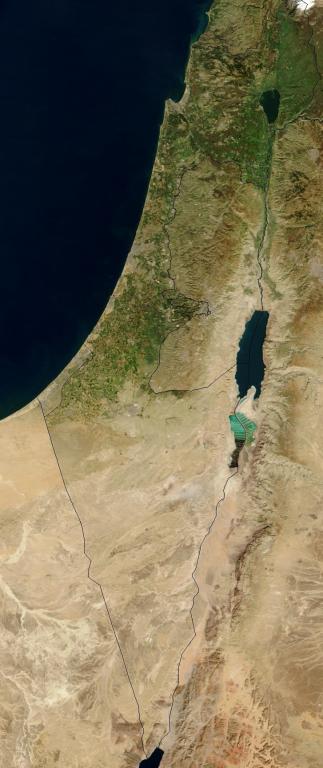
A satellite image of Israel/Palestine, showing the Sea of Galilee toward the top, connected by the Jordan River to the Dead Sea further southward, and the top of the Gulf of Aqabah (or Eilat) at the lower end of the photo. The Mediterranean Sea, of course, is on the left.
(Wikimedia Commons public domain)
In the previous passage from my forthcoming book, I wrote briefly about the scandal of what we in the West have often called “world history.” Now I focus a bit more:
Post-Biblical Judaism
There is a similar gap—not scandalous, but still more than a bit unfortunate—in our knowledge of the history of religion. For most Latter-day Saints, and for most Christians generally, the history of Israel ends with Malachi. He is followed by a blank space of a few centuries, and then the New Testament opens. But the New Testament covers the events of only a few decades. In it, the Sadducees and Pharisees strut briefly on the stage, then are gone. This poses a problem. The Bible and the other standard works of the Church contain enough material to guide us on the path to salvation, which is obviously the most important information we could possibly desire, but if we want to understand the world of today, neither the Bible nor any other book of scripture is enough by itself. And this is true even in the area of religion. Surely Latter-day Saints, of all people, will see that it’s impossible to fully understand modern Christianity on the basis of the Bible alone. Too much change has occurred—much of it of the kind that we would recognize as part of the “great apostasy.” By the same token, the Bible doesn’t account for Judaism as it exists today. Yet few of us know much about Judaism beyond the Old Testament, the Sadducees, and the Pharisees. Still, if we want to understand the Judaism of today, we have to learn something of its development during the twenty centuries between the crucifixion of Christ and our own time. And, as will become clear, we especially need to learn something about the six centuries between the death of Jesus and the coming of Islam.
The most striking fact about Judaism during the past twenty centuries is its survival. By all reasonable expectations, Judaism should have disappeared long ago, as many other ancient religions have done. Sometimes I think that a powerful argument for the existence of God could be constructed solely on the basis of the fact that Judaism exists to this day, and, perhaps even more impressively, on the fact that, two thousand years after the Roman destruction of Jerusalem and the scattering of the Jews, a Hebrew-speaking Jewish state has been reestablished in the Near East. (The mighty Roman Empire, by contrast, is long gone, and Latin, its rich official language, is thoroughly and completely dead.) “The Jews,” writes the brilliant British historian Paul Johnson with considerable reason, “are the most tenacious people in history.”[1]
Most of us know something of the history of Israel—which, of course, originally included more tribes than merely Judah, or the Jews—from the Old Testament. Even so, it’s important to remember two central ideas from ancient Hebrew teachings because they continue to be fundamental to Judaism in the centuries after the close of the Bible. These ideas, which have their origins in Abraham himself, are the covenant with God and the attachment to the Land of Israel. The covenant suggests a special relationship between God and those with whom he has made the covenant. It doesn’t mean that they’re necessarily better than others, nor that their souls are worth more than the souls of the Father’s other children. It does, however, mean that they are called to be “a chosen generation, a royal priesthood, an holy nation, a peculiar people; that [they] should shew forth the praises of him who hath called [them] out of darkness into his marvellous light.”[2] Just before the revelation of the Ten Commandments, the Lord told Moses to inform the people that they were to be “a kingdom of priests, and an holy nation.”[3] Even earlier, God spoke to Abraham, saying, “I will make of thee a great nation, and I will bless thee, and make thy name great; and thou shalt be a blessing . . . and in thee shall all families of the earth be blessed.”[4] The prophets of Israel liked to compare the covenant between Jehovah and his people to the marriage contract between a husband and his wife. The people’s unfaithfulness was like a wife’s adultery. The unfortunate prophet Hosea, for instance, was directed by the Lord to make his own family life a symbol of the relationship between God and Israel: “Go, take unto thee a wife of whoredoms and children of whoredoms: for the land hath committed great whoredom, departing from the Lord.”[5] As Hosea’s wife strayed, so too did Israel stray from its promise of faithfulness. The Savior himself denounced “an evil and adulterous generation [that] seeketh after a sign.”[6] Through Isaiah, God announced that, if there was going to be a divorce, it would come because of Israel’s transgressions, not his.[7] But in the last days, Isaiah declared, the Lord would take his “wife” back, and her tent would be so full of children that its stakes would have to be moved further out and the tent expanded just to hold them.[8]
Second, the covenant implies a demand for better behavior. It requires not just accurate notions about God and not just “faith without works.” It requires action, a certain kind of conduct. If other nations are not holy, still Israel is to be holy. If most of us in modern Israel are not quite saints, still we are called “Saints” and are called to become such in full reality. “For,” says the Lord, “of him unto whom much is given much is required.”[9]
The second principle is just as essential to understanding Judaism. From its earliest days, Israel has felt itself linked to a particular piece of land. This is important for many reasons. For one thing, much of the story of Israel recounts its efforts to acquire the land in the first place, along with the warnings of the prophets about losing it and the dream, after one exile or another, of returning to it. Many of the messages of the prophets deal with Israel’s worthiness or lack of worthiness to possess the land, as well as with the future of the land—whether that future was darkened in the short term by the wickedness of the people or glorious in the long term because of the mercy and power of Jehovah. This relationship between land and people helped to form Israel in many ways. I think it important, too, to notice which land it was that God appointed for his covenant people. He could have given them a nicer place.
[1] Paul Johnson, A History of the Jews (New York: Harper and Row, 1987), 3.
[2] 1 Peter 2:9.
[3] Exodus 19:6.
[4] Genesis 12:2-3; compare Abraham 2:8-11.
[5] Hosea 1:2.
[6] Matthew 12:39.
[7] Isaiah 50:1; compare Doctrine and Covenants 82:10.
[8] Isaiah 54:1-10. It is this image of the bedouin tent—or, more precisely, of the tabernacle in the wilderness, which was a special kind of bedouin tent—that gives us our modern word stake for an administrative unit of the Church. The “center stake of Zion” is the pole that holds the tent up in the center.
[9] Doctrine and Covenants 82:3.
Previous Post

July 4, 2020
Some all-too-hasty thoughts for American Independence Day 2020
Next Post
July 5, 2020 Revision 1.3 "Post-Biblical Judaism" B
Browse Our Archives
Select a Category Uncategorized
Select a Month October 2026 September 2026 August 2026 July 2026 June 2026 May 2026 April 2026 March 2026 February 2026 January 2026 December 2025 November 2025 October 2025 September 2025 August 2025 July 2025 June 2025 May 2025 April 2025 March 2025 February 2025 January 2025 December 2024 November 2024 October 2024 September 2024 August 2024 July 2024 June 2024 May 2024 April 2024 March 2024 February 2024 January 2024 December 2023 November 2023 October 2023 September 2023 August 2023 July 2023 June 2023 May 2023 April 2023 March 2023 February 2023 January 2023 December 2022 November 2022 October 2022 September 2022 August 2022 July 2022 June 2022 May 2022 April 2022 March 2022 February 2022 January 2022 December 2021 November 2021 October 2021 September 2021 August 2021 July 2021 June 2021 May 2021 April 2021 March 2021 February 2021 January 2021 December 2020 November 2020 October 2020 September 2020 August 2020 July 2020 June 2020 May 2020 April 2020 March 2020 February 2020 January 2020 December 2019 November 2019 October 2019 September 2019 August 2019 July 2019 June 2019 May 2019 April 2019 March 2019 February 2019 January 2019 December 2018 November 2018 October 2018 September 2018 August 2018 July 2018 June 2018 May 2018 April 2018 March 2018 February 2018 January 2018 December 2017 November 2017 October 2017 September 2017 August 2017 July 2017 June 2017 May 2017 April 2017 March 2017 February 2017 January 2017 December 2016 November 2016 October 2016 September 2016 August 2016 July 2016 June 2016 May 2016 April 2016 March 2016 February 2016 January 2016 December 2015 November 2015 October 2015 September 2015 August 2015 July 2015 June 2015 May 2015 April 2015 March 2015 February 2015 January 2015 December 2014 November 2014 March 2014 August 2013 February 2012
Follow Us!
TAKE THE
Religious Wisdom Quiz
What is the largest predominantly Catholic country in South America?
Select your answer to see how you score.
Brazil Argentina Mexico Peru
Related posts from Sic et Non
On Adam Clarke, the Book of Mormon, and...
TRENDING AT PATHEOS Latter-day Saint

Swimfan: Forgotten Aughts Pleasures
This is a recovery effort. In 2002, My Big Fat Greek Wedding...

Top Three Anti-Catholic Lies About Catholicism
This is my initial transcript for the video, "THE 3 WORST...

Pope Leo Celebrates Mass for Nurses & Docs...
I don't have any idea how he did it, but Pope Leo...

The Sermon on the Mount, Part I: Matthew...
The Sermon on the Mount, Part I (Matthew 4:12-5:12) St. Matthew moves...

What's up from Crossway: Reviewing some of their latest A few weeks...

Janie Learns the Way of the Cross: A...
Teaching children about Jesus' Passion can be challenging. Many parents and educators...
view all Latter-day Saint blogs
Ad-Free & Subscriber Log-In Subscription Support
- About Us
- 2026 Calendar
- Videos
- Podcasts
- Library of World Religions
- Faith In Media Tracker
- Advertise With Us
- Write for Us
- Privacy Policy
- Terms of Service
- Do Not Sell My Data
- Contact Us
- Radiant Digital
- Manage Newsletter Subscriptions
- Unsubscribe From Notifications
- Sitemap
Copyright 2008-2026, Patheos. All rights reserved.
Subscription Support Ad-Free & Subscriber Log-In
Follow Patheos