
BuddhistCatholicContemplativeEvangelicalGeneral ChristianHinduJewishLatter-day SaintMuslimNew VisionsProgressive Christian
Beliefs
- Buddhist
- Catholic
- Contemplative
- Evangelical
- General Christian
- Hindu
- Jewish
- Latter-day Saint
- More Voices
- Muslim
- New Visions
- Pagan
- Progressive Christian
Topics
- Religion News
- Food and Religion
- Sports and Religion
- Religious Art
- Religious Music and Entertainment
- Religious Events
- History and Religion
- Style and Religion
- Politics and Religion
- Women in Religion
- Recreation Outdoors and Religion
- Business Finance and Religion
- Careers Workplace and Religion
- Education and Religion
- Family Parenting and Religion
- Health Fitness and Religion
- Home and Religion
- Relationships and Religion
- Technology and Religion
- Travel and Religion
Columnists
- Buddhist Columnists
- Business Finance and Religion Columnists
- Careers Workplace and Religion Columnists
- Catholic Columnists
- Contemplative Columnists
- Education and Religion Columnists
- Evangelists Columnists
- Family Parenting and Religion Columnists
- General Christian Columnists
- Health Fitness and Religion Columnists
- Hindu Columnists
- History and Religion Columnists
- Home and Religion Columnists
- Jewish Columnists
- More Voices Columnists
- Latter Day Columnists
- Muslim Columnists
- New Visions Columnists
- Nonreligious Columnists
- Pagan Columnists
- Politics and Religion Columnists
- Progressive Columnists
- Recreation Outdoors and Religion Columnists
- Relationships and Religion Columnists
- Religion News Columnists
- Religious Art Columnists
- Religious Events Columnists
- Religious Music and Entertainment Columnists
- Sports and Religion Columnists
- Style and Religion Columnists
- Technology and Religion Columnists
- Travel and Religion Columnists
- Women in Religion Columnists
Resource Library
- 2026 Calendar
- Library of World Religions
- The 100 Most Holy Places on Earth
- Patheos Answers
- Podcasts
- Videos
- Faith Leaders Database
- Anglican Episcopalian
- Bahai
- Baptist
- Buddhism
- Christianity
- Confucianism
- Eastern Orthodoxy
- Hinduism
- Holiness and Pentecostal
- ISKCON
- Islam
- Judaism
- Lutheran
- Methodist
- The Church of Jesus Christ of Latter-day Saints
- New Age
- Paganism
- Presbytarian and Reformed
- Protestantism
- Religion Behind the Scenes
- Roman Catholic
- Scientology
- Shia Islam
- Sikhism
- Sufism
- Sunni Islam
- Taoism
- Zen
- See all religions
Research Tools
 Ad-Free & Subscriber Log-In Subscription Support
Ad-Free & Subscriber Log-In Subscription Support
Follow Patheos 

- Trending:
- Forgiveness
- |
- Marriage
- |
- Consciousness
- |
- Death Penalty
- |
- Election
- |
- Halloween

- Home
- Latter-day Saint
- “Please Keep the Name ‘Redskins'”
“Please Keep the Name ‘Redskins'”
Last updated on: July 5, 2020 at 9:56 pm by Dan Peterson
“Please Keep the Name ‘Redskins'” 2020-07-05T21:56:30-06:00 Dan Peterson
Patheos Explore the world's faith through different perspectives on religion and spirituality! Patheos has the views of the prevalent religions and spiritualities of the world.
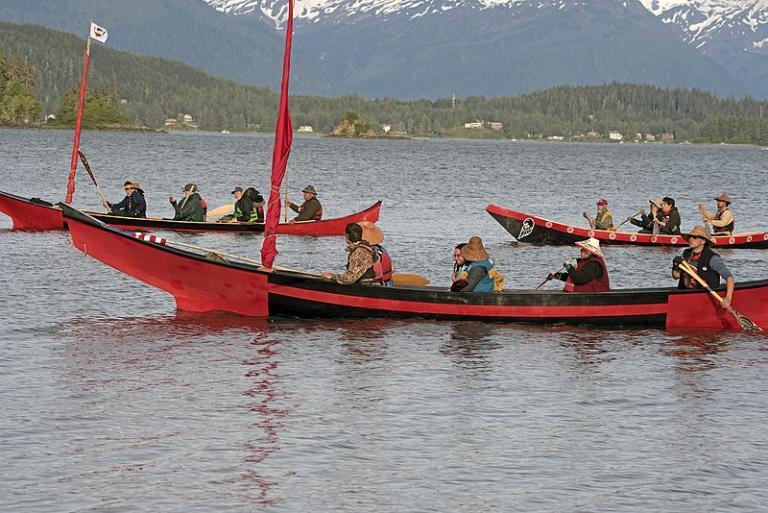
Tlingit canoes head into the Auk Village Celebration, Juneau, in southeastern Alaska, from the North, via the Inside Passage.
(Wikimedia Commons public domain image)
With his permission, I again share a thought-provoking Facebook entry posted by a friend, neighbor, and fellow Interpreter Foundation volunteer:
“Please Keep the Name Redskins” by Tom Pittman
I am Native American. I am a member of the Tlingit tribe of Southeast Alaska. I am of the Raven moiety, and of the T’akdeintaan (Sea Pigeon) clan. My Tlingit name is Koohook. My mother raised me in the ways of our people: I harvested herring eggs, fished, hunted, wore regalia, danced, sang, ate Tlingit foods, and learned what my mom called “Native values”.
One of those values is integrity.
Contrary to the narrative people keep repeating, the word “redskins” was NOT coined as a derogatory reference to Native Americans.
According to Smithsonian historian Ives Goddard, it is a documented historical fact that the word “redskins” was originally coined by Native Americans as a SELF-IDENTIFIER to differentiate between the many groups of First Americans, and the groups of newly arrived, light-skinned colonists.
=> Obviously, Native Americans did not find the word they made up to refer to themselves as offensive.
In pre-Columbian America, indigenous Americans didn’t think of themselves as all one race as many do today. They saw themselves as different peoples with different languages, foods, customs, etc. Some tribes even warred with each other over things like territory.
It wasn’t until European colonists showed up that the need arose for a word to refer to all the indigenous tribes, without also referring to the newly arrived groups of lighter skinned people, hence the birth of the word “redskins”.
Goddard writes that the word was not used by white people until James Fenimore Cooper used it in his 1823 novel “The Pioneers”. In the book, Cooper has a dying Indian character lament, “There will soon be no red-skin in the country.”
Until then, white Americans called Indigenous Americans “Indians,” which when you think about it is by far the more offensive word.
In fact, if we Natives want to be indignant about something, and demand that someone change the name of something, it should be that the government rename agencies such as the “Bureau of Indian Affairs” and the “Indian Health Service”.
After all, everyone has known for over 500 years that American “Indians” were never from India, yet the word continues to be used and it is demeaning to both real Indians, and Indigenous Americans.
Of course, that’s not to say that some white people haven’t used the word “redskins” in a derogatory way, but then again some people have used the words “millennial” and “boomer” in derogatory ways as well.
Even the word “genius” is often used to demean someone as an idiot, but that doesn’t mean the word itself was ever intended to be offensive.
In the mid 1800s, when team owners (White Americans) began using the word “redskins” (and other Native American references) to name sports teams, they chose the words because they were widely seen positively, not as insults.
Just THINK about it: no one pays money to cheer for losers, so no team owner would ever name a team after something the public saw as negative.
In the 1800s, the term “redskin” carried the connotation “from THIS land” and “as American as American can be”.
So naming a sports team after a Native American reference was an expression of PATRIOTISM — of breaking from their European roots and coming together as Americans now.
Native American references in sports has always been intended as a tribute and a compliment. Team owners wanted their athletes to be regarded as highly as Native Americans were.
Of course, America also has a sad history of anti-Native American bigotry as well.
In 1915, a shockingly racist book was released called “Redskin Rimes” by Earl Emmons. Its introduction mocked people who had positive impressions of Natives, then the book went on to present “a series of poems, songs and speeches, each more offensive than the last” according to NPR’s Lakshmi Gandhi.
In addition to books, Native American racism was perpetuated by the fledgling movie industry.
Many films blatantly engaged in the appalling stereotyping of “Indians” including a 1932 Tom and Jerry cartoon called “Redskin Blues” wherein the duo was saved from blood-thirsty savages by the US army.
In short, while books and movies perpetuated racism in America, the sports world held Native Americans up in a positive light.
Wouldn’t it be a shame if the sports world was now punished for that?
Thanks to professional sports, millions of people look up to and cheer Native American symbols now!
As a final point to think about, please consider the life and legacy of one of my heroes, Jim Thorpe.
Jim Thorpe was a member of the Sac and Fox Nation, born during this very time period, in May of 1887.
As you probably know, Jim Thorpe was the first Native American to win a gold medal for the United States, winning 2 gold medals in the 1912 Olympics (decathlon and pentathlon).
At the time Thorpe won his gold medals, it was unclear if Native Americans were even recognized as U.S. citizens.
When Jim Thorpe was qualifying for the US Olympic team, The New York Times ran an article on April 28, 1912 with the headline “Indian Thorpe in Olympiad; Redskin from Carlisle Will Strive for Place on American Team”.
Note the positive use of the term “Redskin” in the headline from the most influential news publication of its time, the national “newspaper of record”.
The following year, in 1913, Jim Thorpe signed with the New York Giants and played 6 seasons of Major League Baseball.
Thorpe then switched sports and won 3 championships as a professional football player!
While playing professional football, Jim Thorpe organized a team and called it the “Oorang Indians” (from LaRue, Ohio).
Thorpe also organized a professional basketball team he called “the World Famous Indians of LaRue”.
Native American hero, Jim Thorpe, *TWICE* named professional sports teams after Native American references.
You can bet this was NOT done because he wanted to demean Native Americans!
PLEASE THINK ABOUT THIS:
=> At the very height of bigotry against Native Americans in the United States, with books and movies openly and intensely engaging in racial slurs and stereotypes, the world’s most famous Native American deliberately pushed against the hate by naming his professional sports teams after Native American references so that White Americans could see us in a positive light.
I would HATE to see Jim Thorpe’s superlative legacy unraveled by misinformed outrage.
The word “redskins” exists because we Native Americans made it up to refer to ourselves.
While some in history used the word as a racial slur, today millions of sports fans look to Native American symbols with enthusiastic support. And it’s our culture they are cheering!
Someone please take the footguns away from those Natives who are trying to unravel Jim Thorpe’s legacy!
To be clear, I personally am not fond of the team name “Redskins”.
But I’m not offended by it either, because I understand its origins and history.
=> What concerns me is that changing the name of the Washington Redskins will trigger a PURGING of Native American references in sports altogether, and that would be TRAGIC.
So if the Washington Redskins do change their name, I *REALLY* hope they will choose another Native American reference for the team’s name.
For instance, the University of Utah pays a royalty to the Ute tribe for their use of the “Runnin’ Utes”. We can have more win/wins like this.
My name is Koohook. My mother raised me in the ways of our people.
And I want my grandchildren living in a world that sees Native Americans in a positive light — in part because I think it will help them see themselves positively as well.
Thanks for listening.
Gunalchéesh
References:
Just to put this in perspective:
Although I’m not opposed to watching part of an occasional football game, I’m far and away not much of a serious football enthusiast and I’m definitely not a particular fan of the NFL. In other words, the names of NFL teams aren’t high on my list of issues. I don’t really have a dog in this fight. But I like accurate history and reasoned positions, and I think that Tom’s perspective is worth hearing.
It seems pretty unlikely to me that owners of professional sports teams have chosen to give them names that they themselves considered demeaning. There are, so far as I’m aware, no professional athletic organizations bearing names like the Winnipeg Wimps, the Los Angeles Losers, the Seattle Sob Sisters, the Pittsburg Pansies, the Detroit Defeated, the Toledo Trodden-Upon, or the Cleveland Cowards Instead, names like Vikings, Hawks, Bengals, Lions, Raiders, Hornets, Falcons, Titans, Timberwolves, Grizzlies, Steelers, Cavaliers, Braves, Redskins, Panthers, Rams, Pirates, Indians, Yankees, Eagles, Athletics, Buccaneers, Chiefs, Raptors, Reds, Chargers, Tigers, Giants, Warriors, and Rangers are intended to suggest rugged strength, defiance, fierce competitiveness, and so forth. There is admiration in them. Pride. Certainly not contempt.
Previous Post

July 4, 2020
"A faithful testimony"
Next Post
July 4, 2020 On some proposed psychological explanations for near-death experiences
Browse Our Archives
Select a Category Uncategorized
Select a Month October 2026 September 2026 August 2026 July 2026 June 2026 May 2026 April 2026 March 2026 February 2026 January 2026 December 2025 November 2025 October 2025 September 2025 August 2025 July 2025 June 2025 May 2025 April 2025 March 2025 February 2025 January 2025 December 2024 November 2024 October 2024 September 2024 August 2024 July 2024 June 2024 May 2024 April 2024 March 2024 February 2024 January 2024 December 2023 November 2023 October 2023 September 2023 August 2023 July 2023 June 2023 May 2023 April 2023 March 2023 February 2023 January 2023 December 2022 November 2022 October 2022 September 2022 August 2022 July 2022 June 2022 May 2022 April 2022 March 2022 February 2022 January 2022 December 2021 November 2021 October 2021 September 2021 August 2021 July 2021 June 2021 May 2021 April 2021 March 2021 February 2021 January 2021 December 2020 November 2020 October 2020 September 2020 August 2020 July 2020 June 2020 May 2020 April 2020 March 2020 February 2020 January 2020 December 2019 November 2019 October 2019 September 2019 August 2019 July 2019 June 2019 May 2019 April 2019 March 2019 February 2019 January 2019 December 2018 November 2018 October 2018 September 2018 August 2018 July 2018 June 2018 May 2018 April 2018 March 2018 February 2018 January 2018 December 2017 November 2017 October 2017 September 2017 August 2017 July 2017 June 2017 May 2017 April 2017 March 2017 February 2017 January 2017 December 2016 November 2016 October 2016 September 2016 August 2016 July 2016 June 2016 May 2016 April 2016 March 2016 February 2016 January 2016 December 2015 November 2015 October 2015 September 2015 August 2015 July 2015 June 2015 May 2015 April 2015 March 2015 February 2015 January 2015 December 2014 November 2014 March 2014 August 2013 February 2012
Follow Us!
TAKE THE
Religious Wisdom Quiz
Which is the only book that does not mention "God"?
Select your answer to see how you score.
Esther Song of Solomon Lamentations Ezra
Related posts from Sic et Non
Native Americans, Musk Oxen, and More

A monument to the transience of power (and...

Native Americans and Latter-day Saints in Early Utah

"Protecting the Symbols of Christ’s Church"
TRENDING AT PATHEOS Latter-day Saint

Letters on Living the Faith by C.S. Lewis
Most of us met C.S. Lewis as a public intellectual. Mere Christianity....

When Halloween Unmasks Married Hearts
Written by Dr. David K. Ewen from Eternal Truth Bible College Behind...

Aristotle. He’s been called the father of logic, the father of the...

Methodist Central Hall and Westminster Abbey
Situated on the same square is Methodist Central Hall and Westminster Abbey. ...

57th Dove Awards Honor Dolly Parton, Crown New...
On gospel music’s biggest night, the 57th annual GMA Dove Awards honored...

The First Eucharistic Controversy: Christ’s Real Presence
For Catholics, the Eucharist is the source and summit of the Christian...
view all Latter-day Saint blogs
Ad-Free & Subscriber Log-In Subscription Support
- About Us
- 2026 Calendar
- Videos
- Podcasts
- Library of World Religions
- Faith In Media Tracker
- Advertise With Us
- Write for Us
- Privacy Policy
- Terms of Service
- Do Not Sell My Data
- Contact Us
- Radiant Digital
- Manage Newsletter Subscriptions
- Unsubscribe From Notifications
- Sitemap
Copyright 2008-2026, Patheos. All rights reserved.
Subscription Support Ad-Free & Subscriber Log-In
Follow Patheos