
BuddhistCatholicContemplativeEvangelicalGeneral ChristianHinduJewishLatter-day SaintMuslimNew VisionsProgressive Christian
Beliefs
- Buddhist
- Catholic
- Contemplative
- Evangelical
- General Christian
- Hindu
- Jewish
- Latter-day Saint
- More Voices
- Muslim
- New Visions
- Pagan
- Progressive Christian
Topics
- Religion News
- Food and Religion
- Sports and Religion
- Religious Art
- Religious Music and Entertainment
- Religious Events
- History and Religion
- Style and Religion
- Politics and Religion
- Women in Religion
- Recreation Outdoors and Religion
- Business Finance and Religion
- Careers Workplace and Religion
- Education and Religion
- Family Parenting and Religion
- Health Fitness and Religion
- Home and Religion
- Relationships and Religion
- Technology and Religion
- Travel and Religion
Columnists
- Buddhist Columnists
- Business Finance and Religion Columnists
- Careers Workplace and Religion Columnists
- Catholic Columnists
- Contemplative Columnists
- Education and Religion Columnists
- Evangelists Columnists
- Family Parenting and Religion Columnists
- General Christian Columnists
- Health Fitness and Religion Columnists
- Hindu Columnists
- History and Religion Columnists
- Home and Religion Columnists
- Jewish Columnists
- More Voices Columnists
- Latter Day Columnists
- Muslim Columnists
- New Visions Columnists
- Nonreligious Columnists
- Pagan Columnists
- Politics and Religion Columnists
- Progressive Columnists
- Recreation Outdoors and Religion Columnists
- Relationships and Religion Columnists
- Religion News Columnists
- Religious Art Columnists
- Religious Events Columnists
- Religious Music and Entertainment Columnists
- Sports and Religion Columnists
- Style and Religion Columnists
- Technology and Religion Columnists
- Travel and Religion Columnists
- Women in Religion Columnists
Resource Library
- 2026 Calendar
- Library of World Religions
- The 100 Most Holy Places on Earth
- Patheos Answers
- Podcasts
- Videos
- Faith Leaders Database
- Anglican Episcopalian
- Bahai
- Baptist
- Buddhism
- Christianity
- Confucianism
- Eastern Orthodoxy
- Hinduism
- Holiness and Pentecostal
- ISKCON
- Islam
- Judaism
- Lutheran
- Methodist
- The Church of Jesus Christ of Latter-day Saints
- New Age
- Paganism
- Presbytarian and Reformed
- Protestantism
- Religion Behind the Scenes
- Roman Catholic
- Scientology
- Shia Islam
- Sikhism
- Sufism
- Sunni Islam
- Taoism
- Zen
- See all religions
Research Tools
 Ad-Free & Subscriber Log-In Subscription Support
Ad-Free & Subscriber Log-In Subscription Support
Follow Patheos 

- Trending:
- Forgiveness
- |
- Marriage
- |
- Consciousness
- |
- Death Penalty
- |
- Election
- |
- Halloween

- Home
- Latter-day Saint
- Uto-Aztecan languages and a very eccentric Interpreter donor
Uto-Aztecan languages and a very eccentric Interpreter donor
Last updated on: June 14, 2020 at 3:02 pm by Dan Peterson
Uto-Aztecan languages and a very eccentric Interpreter donor 2020-06-14T15:02:57-06:00 Dan Peterson
Patheos Explore the world's faith through different perspectives on religion and spirituality! Patheos has the views of the prevalent religions and spiritualities of the world.
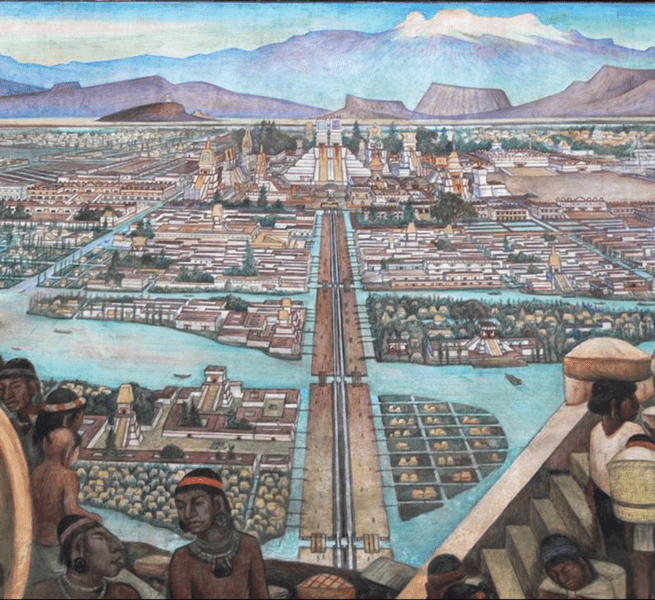
The Aztec capital city of Tenochtitlan, where the principal language was Nahuatl
(Wikimedia Commons public domain image)
Brian Stubbs is a Latter-day Saint who specializes in the linguistics and particularly the vocabulary of the Uto-Aztecan family of Amerindian languages — a family that, as I understand it, includes such tongues as Shoshoni, Comanche, Hopi, Paiute, Nahuatl, and Tarahumara. He also has advanced graduate training in Semitic languages. Notably, he is the author of Uto-Aztecan: A Comparative Vocabulary (2011).
In 2015, he published a potentially revolutionary book entitled Exploring the Explanatory Power of Semitic and Egyptian in Uto-Aztecan, which he then followed up the next year (2016) with a more accessible, popularized account under the title of Changes in Languages from Nephi to Now. The latter book has just appeared in a revised second edition (that is apparently not yet available via Amazon.com).
Here’s a column of mine on the subject that appeared in the Deseret News for 1 June 2017:
Critics of the Book of Mormon often argue that no evidence exists for contact between the ancient Near East and the Americas. Accordingly, proof of such contact would demolish a principal objection to Joseph Smith’s prophetic claims.
If the thesis of Brian Stubbs’ “Exploring the Explanatory Power of Semitic and Egyptian in Uto-Aztecan” is correct, he has furnished precisely that proof.
I’ll draw here from two reviews of his difficult, complex book. The first was published in BYU Studies by Dirk Elzinga, who teaches linguistics at Brigham Young University and is online at byustudies.byu.edu. Holder of a doctorate from the University of Arizona, his research focuses on Uto-Aztecan languages (specifically, Shoshone, Goshute, Paiute and Ute). The second, written by John Robertson, professor of linguistics emeritus at Brigham Young University, appeared in Interpreter: A Journal of Mormon Scripture and online at mormoninterpreter.com. Equipped with a Ph.D. from Harvard, Robertson’s scholarly career has concentrated on language change, the reconstruction of proto-Mayan, and the grammar and sound system of Mayan hieroglyphs.
More than 30 years ago, Stubbs told Robertson he had found “a significant number of cognates that would link a New World language family (Uto-Aztecan) to an Old World language family (pre-exilic Hebrew and later others).” “Two words are cognate,” Elzinga explains, “if it can be demonstrated that they both have a common historical source and that their sound (and meaning) differences are due to normally occurring linguistic change.”
Robertson admits he was initially “suspicious” of “a wild claim.” After all, “the scholarly consensus was and is that among the thousands of languages spoken in the New World prior to European contact” none had Old World connections. (“It is something of a parlor trick among linguists,” observes Elzinga, “to find false cognates between any two arbitrarily chosen languages; it is surprisingly easy.”)
Since then, though, based on such works as his massive 2011 book “Uto-Aztecan: A Comparative Vocabulary,” Stubbs has become “a well-respected linguist” (Elzinga) and “one of the leading Uto-Aztecanists worldwide” (Robertson).
And now he’s published “his crowning work” (Robertson), “his magnum opus, a compendium of lexical, phonological, and grammatical data that provides evidence for infusions of ancient Near Eastern languages in Uto-Aztecan grammar and lexicon” (Elzinga).
“Of course,” Robertson points out, “it would not be difficult to dismiss the whole of his argument out of hand.” For one thing, “all previous attempts to connect any New World language to European or Middle Eastern languages have been amateurish, even laughable by credible linguistic standards,” and, for another, “because Stubbs is a Mormon, his scholarship would naturally be tainted and therefore untrustworthy.”
However, “It is an impressive follow-up to his earlier UA work,” writes Robertson. “His 2015 publication deserves the same assessment of the data that has been given to his earlier 2011 publication — even in the face of his unusual claim.”
“At first glance,” writes Elzinga, the book seems to belong to “linguistic crackpottery.” It’s “dense, self-published, and in sore need of careful editing — none of which immediately commends it to the serious reader.” But Stubbs “has … the training and experience, together with extensive accurate data, to back up his extraordinary claim.”
“As a practitioner of the comparative historical method for 40-plus years,” Robertson concludes, “I believe I can say what Stubbs’s scholarship does and does not deserve: It does not deserve aprioristic dismissal given the extensive data he presents. It does deserve authoritative consideration because, from my point of view, I cannot find an easy way to challenge the breadth and depth of the data.”
“The scholarship throughout is sound,” Elzinga declares. “Stubbs has a good track record of academic publication in Uto-Aztecan studies, and he is just as careful with his treatment of the present material as he is in his more traditional Uto-Aztecan work. … It is definitely worth the trouble to work through this book.”
So, has Stubbs proved the Book of Mormon true? No. But, as Elzinga perceptively observes, his data suggest that speakers of both Egyptian and a Semitic language came into contact with Uto-Aztecan speakers at roughly the same time, and that a distinct Semitic infusion occurred at a different point.
“To Latter-day Saints, a scenario immediately presents itself to explain two separate Semitic infusions, but Stubbs is careful to avoid this sort of speculation and to let the data speak for itself,” Elzinga writes.
Helpfully, Stubbs has also published a shorter, simpler and expressly Mormon-oriented version of his longer work, titled “Changes in Languages: From Nephi to Now.”
Unsurprisingly, there has been some criticism of Brian Stubbs’s rather earth-shattering argument. A few days ago, a reader of this blog wrote to ask if Brother Stubbs was ever intending to respond to that criticism. I replied that he should watch the pages of Interpreter: A Journal of Latter-day Saint Faith and Scholarship.
At that, a critic of the Church who calls himself “Charles” and who reads my blog posted a prediction that Brian Stubbs would never publish a response in Interpreter. I responded that he and others should watch the journal and see.
He answered that he had “personally confirmed” that no response from Brian Stubbs would appear in Interpreter. I got a kick out of that, because I have connections in the Interpreter Foundation. I know stuff.
Still, Charles remained and remains adamant. Five days ago, he proposed “a friendly wager”:
If this alleged forthcoming article is a response from Brian Stubbs I will personally donate $500 to the Interpreter Foundation. If this alleged forthcoming article is not a response from Brian Stubbs you . . . will donate $500 to [a toxic ex-Mormon message board on which I have been a major target for daily defamation and character assassination over the past decade and a half] for [its] maintenance, updating and server fees.
I accepted the wager. (I’m taking absolutely zero risk. As I say, I know stuff.)
Today, Wednesday, Charles has reiterated his claim:
[A]s of this morning (around 10:37 am) Brian Stubbs was completely unaware that he was supposed to be writing a response for the Interpreter.
And he has asked that I post a blog entry alerting everybody to our wager. So, say I, why not? I find the whole thing exceptionally weird, but I’m more than happy to inform people of Charles’s very strange bet. And, assuming that he’ll actually fulfill it, I’ll be more than happy to deposit his check.
Please stay tuned.
Previous Post

June 3, 2020
The Latest from the Interpreter Foundation (Part Two)
Next Post
June 4, 2020 About this coming 3 November
Browse Our Archives
Select a Category Uncategorized
Select a Month October 2026 September 2026 August 2026 July 2026 June 2026 May 2026 April 2026 March 2026 February 2026 January 2026 December 2025 November 2025 October 2025 September 2025 August 2025 July 2025 June 2025 May 2025 April 2025 March 2025 February 2025 January 2025 December 2024 November 2024 October 2024 September 2024 August 2024 July 2024 June 2024 May 2024 April 2024 March 2024 February 2024 January 2024 December 2023 November 2023 October 2023 September 2023 August 2023 July 2023 June 2023 May 2023 April 2023 March 2023 February 2023 January 2023 December 2022 November 2022 October 2022 September 2022 August 2022 July 2022 June 2022 May 2022 April 2022 March 2022 February 2022 January 2022 December 2021 November 2021 October 2021 September 2021 August 2021 July 2021 June 2021 May 2021 April 2021 March 2021 February 2021 January 2021 December 2020 November 2020 October 2020 September 2020 August 2020 July 2020 June 2020 May 2020 April 2020 March 2020 February 2020 January 2020 December 2019 November 2019 October 2019 September 2019 August 2019 July 2019 June 2019 May 2019 April 2019 March 2019 February 2019 January 2019 December 2018 November 2018 October 2018 September 2018 August 2018 July 2018 June 2018 May 2018 April 2018 March 2018 February 2018 January 2018 December 2017 November 2017 October 2017 September 2017 August 2017 July 2017 June 2017 May 2017 April 2017 March 2017 February 2017 January 2017 December 2016 November 2016 October 2016 September 2016 August 2016 July 2016 June 2016 May 2016 April 2016 March 2016 February 2016 January 2016 December 2015 November 2015 October 2015 September 2015 August 2015 July 2015 June 2015 May 2015 April 2015 March 2015 February 2015 January 2015 December 2014 November 2014 March 2014 August 2013 February 2012
Follow Us!
TAKE THE
Religious Wisdom Quiz
Where did Elisha perform many miracles?
Select your answer to see how you score.
Bethel Samaria Jericho Shunem
Related posts from Sic et Non


Some notes on the archaeology of the Bible


TRENDING AT PATHEOS Latter-day Saint

Nearly every morning, I make the drive to Detroit with my high-school-age...

The Real AI Story Is Adoption Without Trust
Artificial intelligence has crossed a political threshold. It is no longer a...

A new article, written by Jeff Lindsay and Gale L. Pooley,...

Swimfan: Forgotten Aughts Pleasures
This is a recovery effort. In 2002, My Big Fat Greek Wedding...

Top Three Anti-Catholic Lies About Catholicism
This is my initial transcript for the video, "THE 3 WORST...

Pope Leo Celebrates Mass for Nurses & Docs...
I don't have any idea how he did it, but Pope Leo...
view all Latter-day Saint blogs
Ad-Free & Subscriber Log-In Subscription Support
- About Us
- 2026 Calendar
- Videos
- Podcasts
- Library of World Religions
- Faith In Media Tracker
- Advertise With Us
- Write for Us
- Privacy Policy
- Terms of Service
- Do Not Sell My Data
- Contact Us
- Radiant Digital
- Manage Newsletter Subscriptions
- Unsubscribe From Notifications
- Sitemap
Copyright 2008-2026, Patheos. All rights reserved.
Subscription Support Ad-Free & Subscriber Log-In
Follow Patheos