
BuddhistCatholicContemplativeEvangelicalGeneral ChristianHinduJewishLatter-day SaintMuslimNew VisionsProgressive Christian
Beliefs
- Buddhist
- Catholic
- Contemplative
- Evangelical
- General Christian
- Hindu
- Jewish
- Latter-day Saint
- More Voices
- Muslim
- New Visions
- Pagan
- Progressive Christian
Topics
- Religion News
- Food and Religion
- Sports and Religion
- Religious Art
- Religious Music and Entertainment
- Religious Events
- History and Religion
- Style and Religion
- Politics and Religion
- Women in Religion
- Recreation Outdoors and Religion
- Business Finance and Religion
- Careers Workplace and Religion
- Education and Religion
- Family Parenting and Religion
- Health Fitness and Religion
- Home and Religion
- Relationships and Religion
- Technology and Religion
- Travel and Religion
Columnists
- Buddhist Columnists
- Business Finance and Religion Columnists
- Careers Workplace and Religion Columnists
- Catholic Columnists
- Contemplative Columnists
- Education and Religion Columnists
- Evangelists Columnists
- Family Parenting and Religion Columnists
- General Christian Columnists
- Health Fitness and Religion Columnists
- Hindu Columnists
- History and Religion Columnists
- Home and Religion Columnists
- Jewish Columnists
- More Voices Columnists
- Latter Day Columnists
- Muslim Columnists
- New Visions Columnists
- Nonreligious Columnists
- Pagan Columnists
- Politics and Religion Columnists
- Progressive Columnists
- Recreation Outdoors and Religion Columnists
- Relationships and Religion Columnists
- Religion News Columnists
- Religious Art Columnists
- Religious Events Columnists
- Religious Music and Entertainment Columnists
- Sports and Religion Columnists
- Style and Religion Columnists
- Technology and Religion Columnists
- Travel and Religion Columnists
- Women in Religion Columnists
Resource Library
- 2026 Calendar
- Library of World Religions
- The 100 Most Holy Places on Earth
- Patheos Answers
- Podcasts
- Videos
- Faith Leaders Database
- Anglican Episcopalian
- Bahai
- Baptist
- Buddhism
- Christianity
- Confucianism
- Eastern Orthodoxy
- Hinduism
- Holiness and Pentecostal
- ISKCON
- Islam
- Judaism
- Lutheran
- Methodist
- The Church of Jesus Christ of Latter-day Saints
- New Age
- Paganism
- Presbytarian and Reformed
- Protestantism
- Religion Behind the Scenes
- Roman Catholic
- Scientology
- Shia Islam
- Sikhism
- Sufism
- Sunni Islam
- Taoism
- Zen
- See all religions
Research Tools
 Ad-Free & Subscriber Log-In Subscription Support
Ad-Free & Subscriber Log-In Subscription Support
Follow Patheos 

- Trending:
- Forgiveness
- |
- Marriage
- |
- Consciousness
- |
- Death Penalty
- |
- Election
- |
- Halloween

- Home
- Latter-day Saint
- “Spelling in the Manuscripts and Editions”
“Spelling in the Manuscripts and Editions”
Last updated on: July 2, 2020 at 10:27 pm by Dan Peterson
“Spelling in the Manuscripts and Editions” 2020-07-02T22:27:32-06:00 Dan Peterson
Patheos Explore the world's faith through different perspectives on religion and spirituality! Patheos has the views of the prevalent religions and spiritualities of the world.
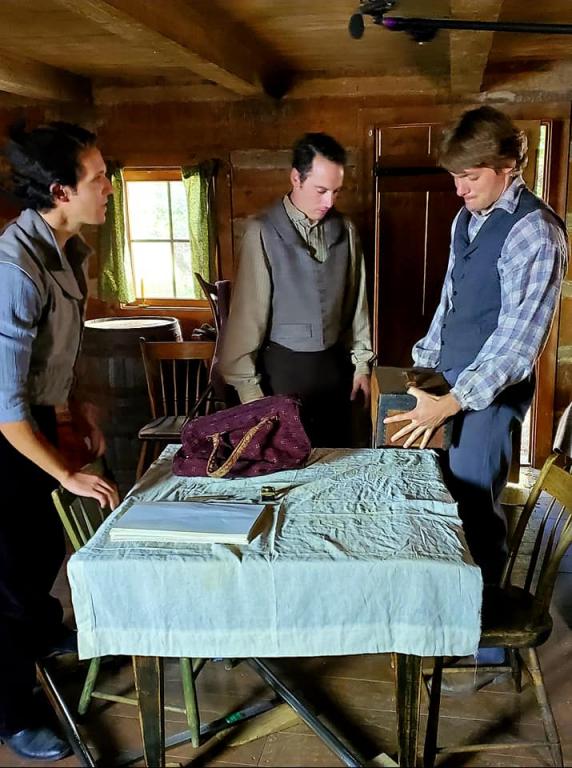
From left to right, in a still photo by James Jordan from the set of the Interpreter Foundation “Witnesses” film project, currently under production: Oliver Cowdery, David Whitmer, and Joseph Smith, who has the plates of the Book of Mormon in a box. Do they seem very young? They should. They were.
Below is a four-page statement that Royal Skousen has shared with me regarding the publication last week of part 6 of volume 3 of the critical text, Spelling in the Manuscripts and Editions. It should soon be available from BYU Studies at $49.95, if it isn’t already available. In posting it here, I’ve unfortunately (and, so far as I can tell, pretty much unavoidably) ruined much of his formatting. But the content remains unimpaired. And I expect that a properly-formatted version of this statement will appear reasonably soon on the website of the Interpreter Foundation.
Summary of Spelling in the Manuscripts and Editions, part 6 of volume 3, The History of the Text of the Book of Mormon, by Royal Skousen
For part 6 of volume 3 of the Book of Mormon critical text project, we take up what may
seem like a mundane subject, namely, misspellings in the manuscripts and in the printed editions.
This brief summary of the book will introduce the reader to three important questions regarding
scribal misspellings in the manuscripts:
First, did the 1830 typesetter adopt Oliver Cowdery’s misspellings in the manuscript
when he set the text for the 1830 edition of the Book of Mormon?
Second, just how good were the Book of Mormon scribes in doing their copywork?
And third, can the misspellings tell us anything important about the Book of Mormon
text, or are they just innocuous errors?
The answers to all three of these questions turn out to be crucial in doing critical text work on
the Book of Mormon.
The first chapter in part 6 is entitled “Misunderstanding Spelling Variation in the Book of
Mormon”, and it deals with an article that has had an inordinate influence for the past 36 years
on how Latter-day Saints have understood misspellings in the Book of Mormon manuscripts and
in the 1830 edition of the Book of Mormon, namely, George Horton’s “Understanding Textual
Changes in the Book of Mormon”, published in the LDS Church’s Ensign in December, 1983.
Despite Horton’s implicit claim in the title of his article that he will undertake to explain
“textual changes”, he virtually ignores the subject of substantive changes in the text of the Book
of Mormon and instead devotes most of the article to the less important question of spelling
variation in the early text of the Book of Mormon. In this regard, I evaluate several provocative
statements of Horton’s in the first chapter of part 6 and find them false in virtually every aspect:
(1) “The spelling in the first edition was Oliver Cowdery’s.”
(2) “Consider, too, that the two distinct words strait and straight would sound exactly
the same as Joseph dictated it. But Oliver spelled both words straight every time.”
(3) “American English spelling in 1829 was not yet standardized.”
(4) “As late as 1828, American lexicographer Noah Webster noted that five dictionaries
were available to him. Examples from four of those dictionaries show the variations in
spellings commonly accepted at the time Oliver was taking dictation from the Prophet.”
(5) “It is not surprising, then, that many words in the Book of Mormon would need to be
corrected as American English spelling became more uniform later in the nineteenth
century.”
Not only can we prove these statements false, but we can also find the sources that Horton
apparently misread or misunderstood and thus led him to make these unsupportable conclusions
about the manuscripts and the early editions of the Book of Mormon.
In the second chapter of part 6, entitled “The Manuscripts and Their Scribes”, I turn to the
question of good and bad scribes in the manuscripts. For the extant 28 percent of the original
manuscript (O) of the Book of Mormon text, we have the handwriting of four scribes: Oliver
Cowdery, John Whitmer, Christian Whitmer, and Joseph Smith himself. Oliver was the main
scribe, and his hand is found on virtually every extant leaf and fragment except for 23 pages
in 1 Nephi. For that part of the text, the two Whitmers each took down Joseph’s dictation for
about a dozen pages each. And finally, Joseph Smith himself wrote down the text for 28 words
in Alma 45:22.
The printer’s manuscript (P), the copy of O, is fully extant except for one and a half lines
at the bottom of page 1 and also the same amount at the bottom of page 2 (the verso of page 1).
Here in P we have the handwriting for three scribes: again, Oliver Cowdery is the main scribe,
and he accounts for 83.0 percent of the text; then Martin Harris for 16.4 percent (who twice
takes over for Oliver, in Mosiah 25 – Alma 13 and in 3 Nephi 19 – Mormon 9); and finally
Hyrum Smith for only 0.6 percent (who takes over for Martin for five short intervals in
Mosiah 28 – Alma 5). The identification of scribes 2 and 3 of O as John and Christian Whitmer,
and scribe 2 of P as Martin Harris are recent and tentative, to varying degrees of probability:
“very likely”, for John Whitmer; “possibly”, for Christian Whitmer; and “probably”, for Martin
Harris. In part 7 of volume 3, I will provide the evidence that supports these identifications.
In evaluating the abilities of these scribes, we consider four different types of errors:
TYPE OF ERROR TYPICAL EXAMPLES
misspelling cept [kept], excede, apparrel, weopon, citties, truely
spelling slips concening, ome [one], woice, Nindred, Nepi
word slips “in my shall they called” (missing name and be) [Mosiah 26:18]
“the number Number of the slain” (a dittography) [Alma 3:l]
“partakers of the spirit of the tree of life” (error for fruit) [Alma 5:62]
textual changes “I cried > did cry unto the Lord [1 Nephi 2:16]
“to be cast with sorrow > NULL into a watery grave” [1 Nephi 18:18]
“being nursed > nourished by the Gentiles” [1 Nephi 22:8]
In the second chapter of part 6, in comparing the abilities of the different scribes, we count only
the first three of these error types. Although the fourth type definitely includes scribal errors,
we can be sure of an error only because the copytext, the original manuscript, still exists. In this
second chapter, we wish to determine the scribes’ ability to correctly copy the text, but for much
of the scribes’ work we do not have a copytext that will allow us to accurately do this. This
automatically holds for any scribe of O that wrote down Joseph Smith’s words as he dictated
them to the scribe. To be sure, an obvious error in O can be detected, such as “ishmael and also
his hole hole” (in 1 Nephi 7:5) and “therefore my Sons see that ye are merciful unto your
Brethren” (in Alma 41:14), where Alma is speaking only to one son, Corianton. But there is no
record of what words Joseph saw in his instrument or what he actually said when he dictated
those words. We have only what the scribe copied down. Similarly, if a scribe copied a portion
of O into P but that portion of O is no longer extant, we can still determine the scribe’s
misspellings, spelling slips, and word slips, but not the substantive textual changes unless they
are obvious errors. For this reason, we will exclude the fourth error type in measuring a scribe’s
ability since we want to compare the scribes against each other – and also against themselves (in
order to determine if their scribal ability may have changed over time). Ultimately, we will not
ignore these substantive textual changes: they will be considered in depth in part 7 of volume 3
when we determine the transmission of the text from the manuscripts through the editions.
There is one other kind of spelling that we ignore in determining scribal errors, namely,
acceptable variant spellings that occurred in printed matter in the early 1800s, spelling variants
such as centre, enquire, journied, sayeth, saviour, and sea shore. It turns out that Oliver Cowdery
used these spelling variants quite often, and some of these variants are still acceptable in America
or in Britain.
We therefore apply the first three errors types to the known Book of Mormon scribes,
and we end up with two measures: (1) misspellings, and (2) obvious scribal slips. The latter
measures the overall sloppiness of the scribe and combines spelling slips and obvious word slips.
We exclude Joseph Smith from the list because his 28 words in O form too small a sampling to
make any effective analysis of his scribal work in the Book of Mormon manuscripts (there are
no slips and only one misspelling, citty). We list eight samplings of Oliver Cowdery’s scribal
work (one sampling from O and seven from P). For the other scribes we consider all their
scribal work. Martin Harris’s scribal work is divided into four parts. And for the sake of
comparison, we include the 1830 typesetter John Gilbert’s error rates. We end up with the
following conclusions:
(1) Martin Harris was a relatively good speller, but his rate of scribal slips was fairly high.
(2) Oliver Cowdery’s spelling improved over time. This is probably because he was the one
proofing the 1830 typeset sheets against the manuscript.
(3) Oliver Cowdery’s scribal slips were consistently low, and much better than any of the
other scribes. This is one reason why Oliver was the preferred scribe.
(4) There are two really bad scribes, Christian Whitmer and Hyrum Smith. Both their rates of
misspelling and scribal error are very high.
The final chapter of part 6 is an extensive 455-page analysis of all the misspellings in the
manuscripts as well as the spelling variants in the printed editions of the Book of Mormon. Most
of the sections in this chapter are organized according to phonemes (that is, sounds). At the end,
there are a few sections dealing with the spelling of certain graphemes (that is, letters), such as
silent e and the letter x. And to conclude this entire analysis, there is an eight-page index of all
the words in the analysis, organized according to their standard spellings.
Given all this analysis of the misspellings, one may reasonably ask: “Can there any good
thing come out of misspellings?” One purpose of part 6, dedicated entirely to the spellings in the
manuscripts and the editions, is to show the numerous ways in which spelling issues have had an
important impact in the critical text project of the Book of Mormon. Here are some of the things
that spellings errors can tell us:
(1) Joseph Smith’s pronunciation of names such as Amalickiah, Melchizedek, and Mosiah
(2) various dialectal pronunciations for the scribes: wage as written wedge (Oliver Cowdery),
scroll as scrawl (Martin Harris), Nazareth as nathareth (Christian Whitmer), and spacious
as specious (for both Christian and John Whitmer)
(3) a word’s pronunciation sometimes led to a scribal error: scourge was pronounced as if it
were scorge, leading to the replacement of scorched in Mosiah 17:13 with scourged (“they
took him and bound him and scorched > scourged his skin with fagots”)
(4) the written form in O was misread by Oliver Cowdery when he copied it into P, especially
when the scribe in O was not Oliver: Christian Whitmer’s pr. sing > Oliver Cowdery’s
feeling, in 1 Nephi 8:31 (“and he also saw other multitudes pressing > feeling their way
towards that great and spacious building”)
(5) errors made by the 1830 typesetter, misreading a spelling in either O or P: claped in P >
clasped in the 1830 edition, in Alma 19:30 (“she clapped > clasped her hands”)
(6) a name was misinterpreted because of priming from preceding words in the text: shilum
in P > shiblum in the 1830 edition, in Alma 11:16 (“a shiblon is half of a senum / therefore
a shiblon for a half a measure of barley / and a shilum > shiblum is a half of a shiblon”)
(7) difficulty in interpreting the correct wording (especially for homophones): rights or rites, in
Alma 43:45 (“they were fighting … for their rights ~ rites of worship”)
(8) archaic spellings can make understanding difficult: the weapon scimitar was consistently
spelled cimeter in the 1830 edition and still is in the standard Book of Mormon text, yet
many readers wonder what this cimeter is but will not find it in their collegiate dictionary
(9) detecting forgeries, especially in the University of Chicago acquisition (Alma 3-5), dating
from the early 1980s and intending to be in Oliver Cowdery’s hand, with its unique spellings
that the scribes never otherwise used: forheads, thruout, Morman, and gilt [guilt]
(10) the spelling out of Book of Mormon names in O: Oliver Cowdery initially writing a name
phonetically, then immediately revising that spelling, apparently the result of Joseph Smith
spelling out that name for him: Zenock > Zenoch (in Alma 33:15), Amelickiah > Amalickiah
(in Alma 47:4), and Coriantummer > Coriantumr (in Helaman 1:15)
(11) the possible spelling out of common words of English: Christian Whitmer miswrote his first
instance of genealogy as jenealeja (in 1 Nephi 5:14), but then he spelled his subsequent
instances of the word correctly
(12) names that Oliver Cowdery, for no apparent reason, changed the spelling of when he copied
the text from O into P: Gaddianton (O) > Gadianton (P), Kishcumen (O) > Kishkumen (P),
and Morionton (O) > Morianton (P)
Posted from Garden City, Utah
Church of Jesus Christ of Latter-day Saints
Previous Post

June 28, 2020
A testimony from John Taylor
Next Post
June 29, 2020 "You simply couldn't help but like him"
Browse Our Archives
Select a Category Uncategorized
Select a Month October 2026 September 2026 August 2026 July 2026 June 2026 May 2026 April 2026 March 2026 February 2026 January 2026 December 2025 November 2025 October 2025 September 2025 August 2025 July 2025 June 2025 May 2025 April 2025 March 2025 February 2025 January 2025 December 2024 November 2024 October 2024 September 2024 August 2024 July 2024 June 2024 May 2024 April 2024 March 2024 February 2024 January 2024 December 2023 November 2023 October 2023 September 2023 August 2023 July 2023 June 2023 May 2023 April 2023 March 2023 February 2023 January 2023 December 2022 November 2022 October 2022 September 2022 August 2022 July 2022 June 2022 May 2022 April 2022 March 2022 February 2022 January 2022 December 2021 November 2021 October 2021 September 2021 August 2021 July 2021 June 2021 May 2021 April 2021 March 2021 February 2021 January 2021 December 2020 November 2020 October 2020 September 2020 August 2020 July 2020 June 2020 May 2020 April 2020 March 2020 February 2020 January 2020 December 2019 November 2019 October 2019 September 2019 August 2019 July 2019 June 2019 May 2019 April 2019 March 2019 February 2019 January 2019 December 2018 November 2018 October 2018 September 2018 August 2018 July 2018 June 2018 May 2018 April 2018 March 2018 February 2018 January 2018 December 2017 November 2017 October 2017 September 2017 August 2017 July 2017 June 2017 May 2017 April 2017 March 2017 February 2017 January 2017 December 2016 November 2016 October 2016 September 2016 August 2016 July 2016 June 2016 May 2016 April 2016 March 2016 February 2016 January 2016 December 2015 November 2015 October 2015 September 2015 August 2015 July 2015 June 2015 May 2015 April 2015 March 2015 February 2015 January 2015 December 2014 November 2014 March 2014 August 2013 February 2012
Follow Us!
TAKE THE
Religious Wisdom Quiz
Who interpreted dreams for a Persian king about goats and rams?
Select your answer to see how you score.
Daniel Obadiah Hosea Joel
Related posts from Sic et Non


Notes on Women, Priesthood, and General Conference

"The Book of Moses as a Temple Text"

TRENDING AT PATHEOS Latter-day Saint

In "Irreplaceable," our book on vocation and technology, Trevor Sutton and I...

I was strolling through the top floor of the brand new Parthenon...

What Does Gêvâh Mean For Kimberley Guifoyle &...
This week, a lot of the news is focused on Kimberly Guilfoyle....

INNER CIRCLE: Profound Mystery (Of Christ In All...
Ephesians 5:31-32 “For this reason, a man will leave his father and...

Do Not Rejoice When Your Enemy Falls: The...
Turning an execution into a public spectacle is a disturbing expression of...

'The Chosen' S6 Trailer: The Passion Gets Very...
Not many watching 'The Chosen' worry about spoilers, but just because they...
view all Latter-day Saint blogs
Ad-Free & Subscriber Log-In Subscription Support
- About Us
- 2026 Calendar
- Videos
- Podcasts
- Library of World Religions
- Faith In Media Tracker
- Advertise With Us
- Write for Us
- Privacy Policy
- Terms of Service
- Do Not Sell My Data
- Contact Us
- Radiant Digital
- Manage Newsletter Subscriptions
- Unsubscribe From Notifications
- Sitemap
Copyright 2008-2026, Patheos. All rights reserved.
Subscription Support Ad-Free & Subscriber Log-In
Follow Patheos