
BuddhistCatholicContemplativeEvangelicalGeneral ChristianHinduJewishLatter-day SaintMuslimNew VisionsProgressive Christian
Beliefs
- Buddhist
- Catholic
- Contemplative
- Evangelical
- General Christian
- Hindu
- Jewish
- Latter-day Saint
- More Voices
- Muslim
- New Visions
- Pagan
- Progressive Christian
Topics
- Religion News
- Food and Religion
- Sports and Religion
- Religious Art
- Religious Music and Entertainment
- Religious Events
- History and Religion
- Style and Religion
- Politics and Religion
- Women in Religion
- Recreation Outdoors and Religion
- Business Finance and Religion
- Careers Workplace and Religion
- Education and Religion
- Family Parenting and Religion
- Health Fitness and Religion
- Home and Religion
- Relationships and Religion
- Technology and Religion
- Travel and Religion
Columnists
- Buddhist Columnists
- Business Finance and Religion Columnists
- Careers Workplace and Religion Columnists
- Catholic Columnists
- Contemplative Columnists
- Education and Religion Columnists
- Evangelists Columnists
- Family Parenting and Religion Columnists
- General Christian Columnists
- Health Fitness and Religion Columnists
- Hindu Columnists
- History and Religion Columnists
- Home and Religion Columnists
- Jewish Columnists
- More Voices Columnists
- Latter Day Columnists
- Muslim Columnists
- New Visions Columnists
- Nonreligious Columnists
- Pagan Columnists
- Politics and Religion Columnists
- Progressive Columnists
- Recreation Outdoors and Religion Columnists
- Relationships and Religion Columnists
- Religion News Columnists
- Religious Art Columnists
- Religious Events Columnists
- Religious Music and Entertainment Columnists
- Sports and Religion Columnists
- Style and Religion Columnists
- Technology and Religion Columnists
- Travel and Religion Columnists
- Women in Religion Columnists
Resource Library
- 2026 Calendar
- Library of World Religions
- The 100 Most Holy Places on Earth
- Patheos Answers
- Podcasts
- Videos
- Faith Leaders Database
- Anglican Episcopalian
- Bahai
- Baptist
- Buddhism
- Christianity
- Confucianism
- Eastern Orthodoxy
- Hinduism
- Holiness and Pentecostal
- ISKCON
- Islam
- Judaism
- Lutheran
- Methodist
- The Church of Jesus Christ of Latter-day Saints
- New Age
- Paganism
- Presbytarian and Reformed
- Protestantism
- Religion Behind the Scenes
- Roman Catholic
- Scientology
- Shia Islam
- Sikhism
- Sufism
- Sunni Islam
- Taoism
- Zen
- See all religions
Research Tools
 Ad-Free & Subscriber Log-In Subscription Support
Ad-Free & Subscriber Log-In Subscription Support
Follow Patheos 

- Trending:
- Forgiveness
- |
- Marriage
- |
- Consciousness
- |
- Death Penalty
- |
- Election
- |
- Halloween

- Home
- Latter-day Saint
- Infighting in Acts 6
Infighting in Acts 6
Last updated on: June 14, 2020 at 3:10 pm by Dan Peterson
Infighting in Acts 6 2020-06-14T15:10:09-06:00 Dan Peterson
Patheos Explore the world's faith through different perspectives on religion and spirituality! Patheos has the views of the prevalent religions and spiritualities of the world.
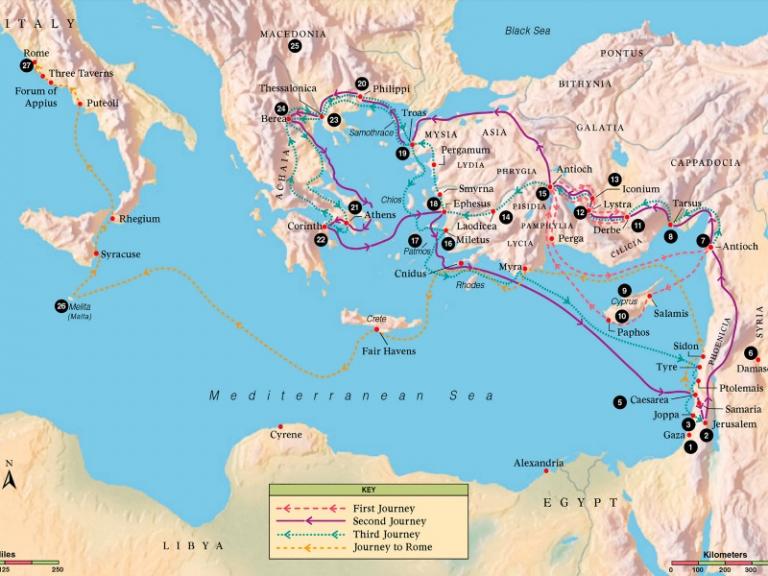
A map of the Mediterranean in the time of the apostle Paul (LDS Media Library)
In what has become, without any really conscious intent, my weekly Saturday commentary on a chapter of Acts — I may, in a short while and for nefarious purposes of my own, take a detour to look carefully at part of a chapter in 1 Corinthians and then at part of a chapter in Romans — I come today to Acts 6. This is a very brief chapter, and my comments here will largely deviate from my focus heretofore, which has been on the remarkable and early witness of the apostles to the resurrection of Christ. I find it difficult if not impossible to explain that very early witness absent a firm conviction, on their part, of Christ’s triumph over death. Acts 6 raises a quite different and much more mundane point, social division. As always in these little commentaries, I quote from the English Standard Version (ESV), unless otherwise indicated:
6 Now in these days when the disciples were increasing in number, a complaint by the Hellenists arose against the Hebrews because their widows were being neglected in the daily distribution.
- In this context, the “Hellenists” (Ἑλληνιστῶν) are presumably Greek-speaking Jews, which means that they originated outside of Palestine. The “Hebrews” (Ἑβραίους) are also Jews, of course. But they are Palestinian Jews, whose first language is Hebrew or, more properly at this period, Aramaic.
- The “Hellenists” feel that, because of language and cultural differences, their widows — that is, their needy — are being neglected by the predominantly “Hebrew” membership (and entirely “Hebrew” apostolic leadership) of the Church.
2 And the twelve summoned the full number of the disciples and said, “It is not right that we should give up preaching the word of God to serve tables. 3 Therefore, brothers, pick out from among you seven men of good repute, full of the Spirit and of wisdom, whom we will appoint to this duty. 4 But we will devote ourselves to prayer and to the ministry of the word.”
- It is impossible not to detect a certain exasperation on the part of the Twelve that they are being distracted from the preaching of the Gospel — that is, of the Resurrection — by such temporal matters as the distribution of foodstuffs. (The phrase to serve tables accurately and literally represents the Greek διακονεῖν τραπέζαις.)
- The word ἀδελφοί in 6:3, which the ESV translates as brothers, could also be read as brothers and sisters, since, in ancient Greek, masculine terms were typically regarded as including the feminine, although feminine nouns and pronouns referred specifically to feminine persons. (Sorry, ladies. It’s not my sexism!) If it’s read this way, then women were also involved in the matter. Not inappropriately if, as Acts 6:1 says, the dispute principally involved the treatment of widows (αἱ χῆραι).
5 And what they said pleased the whole gathering, and they chose Stephen, a man full of faith and of the Holy Spirit, and Philip, and Prochorus, and Nicanor, and Timon, and Parmenas, and Nicolaus, a proselyte of Antioch. 6 These they set before the apostles, and they prayed and laid their hands on them.
- It is significant to note that every single one of these names — Stephen, Philip, Prochorus, Nicanor, Timon, Parmenas, and Nicolaus — is plainly Greek. In other words, in order to avoid discrimination against Greek-speaking Jewish converts, the Church membership proposes a committee entirely composed of Greek-speaking Jewish converts, and the apostles ratify the proposal.
7 And the word of God continued to increase, and the number of the disciples multiplied greatly in Jerusalem, and a great many of the priests became obedient to the faith.
- “Priests” (ἱερεῖς) — Jews of Levitical/Aaronic descent (presumably residents of the city, if they are associated with the liturgy of the temple [ἱερόν) — are also joining the Church, not merely Greek-speaking Jews.
The rapid growth of the Church in Jerusalem (difficult to explain if, after his very public and very shameful execution, Jesus’ body were widely known to be still present in his tomb there) soon begins to attract powerful displeasure. The events narrated in the rest of this chapter and in Acts 7 are typically thought to have occurred somewhere between AD 34 and AD 36, which puts it within three or four years of the death of Jesus, however that is dated:
8 And Stephen, full of grace and power, was doing great wonders and signs among the people. 9 Then some of those who belonged to the synagogue of the Freedmen (as it was called), and of the Cyrenians, and of the Alexandrians, and of those from Cilicia and Asia, rose up and disputed with Stephen.
- These verses reflect the same “ethnic” (or cultural or linguistic) divisions among the Jews at Jerusalem that we have already just seen within the Christian community more specifically. There is at least one separate synagogue for (presumably Greek-speaking) Jews from Cyrene, Alexandria, Cilicia, and Asia. Perhaps more. (Commentators are divided on how to read this passage.)
- Cyrene was a city on the Mediterranean coast of Libya. It is just slightly to the left of center in the bottom half of the map above.
- Alexandria is a city on the northern Egyptian coast, to the right or east of Cyrene on the map.
- Cilicia was a region on the southern coast of Anatolia (modern-day Turkey). It is in the upper right-hand quadrant of the map above.
- Asia, to the ancient Greeks and Romans, wasn’t Japan or China or Thailand or Korea. It was essentially the western coastal region of Anatolia (or modern Turkey). Again, it is in the upper right-hand quadrant of the above map.
- The King James Bible, literally reflecting the underlying Greek (Λιβερτίνων), calls the ESV’s “synagogue of the Freedmen” “the synagogue of the Libertines.” Don’t be misled by that. These people weren’t necessarily immoral or licentious or dissolute. They or their ancestors had been “liberated.” That is, they were, or were descended from, former slaves. Thus, they were “freemen” or “freedmen,” perhaps descendants of the Jews who had been enslaved by the Roman general Pompey after his conquest of Judea in BC 63.
10 But they could not withstand the wisdom and the Spirit with which he was speaking. 11 Then they secretly instigated men who said, “We have heard him speak blasphemous words against Moses and God.” 12 And they stirred up the people and the elders and the scribes, and they came upon him and seized him and brought him before the council, 13 and they set up false witnesses who said, “This man never ceases to speak words against this holy place and the law, 14 for we have heard him say that this Jesus of Nazareth will destroy this place and will change the customs that Moses delivered to us.”
- The witness testimonies aren’t accurate, but they’re distortions of actual Christian teaching — consciously or unconsciously “spun” to make them more shocking.
15 And gazing at him, all who sat in the council saw that his face was like the face of an angel.
- It’s not exactly clear what it means that “his face was like the face of an angel” (τὸ πρόσωπον αὐτοῦ ὡσεὶ πρόσωπον ἀγγέλου), and no further explanation is forthcoming. There are numerous reports of Joseph Smith’s face seeming transparent, or appearing to glow, during the reception of revelations. Perhaps it is something of that sort.
Previous Post

June 6, 2020
The "Acme Universe Making Machine"
Next Post
June 6, 2020 We're headed for an upsurge in deaths, and there's no valid reason for it
Browse Our Archives
Select a Category Uncategorized
Select a Month October 2026 September 2026 August 2026 July 2026 June 2026 May 2026 April 2026 March 2026 February 2026 January 2026 December 2025 November 2025 October 2025 September 2025 August 2025 July 2025 June 2025 May 2025 April 2025 March 2025 February 2025 January 2025 December 2024 November 2024 October 2024 September 2024 August 2024 July 2024 June 2024 May 2024 April 2024 March 2024 February 2024 January 2024 December 2023 November 2023 October 2023 September 2023 August 2023 July 2023 June 2023 May 2023 April 2023 March 2023 February 2023 January 2023 December 2022 November 2022 October 2022 September 2022 August 2022 July 2022 June 2022 May 2022 April 2022 March 2022 February 2022 January 2022 December 2021 November 2021 October 2021 September 2021 August 2021 July 2021 June 2021 May 2021 April 2021 March 2021 February 2021 January 2021 December 2020 November 2020 October 2020 September 2020 August 2020 July 2020 June 2020 May 2020 April 2020 March 2020 February 2020 January 2020 December 2019 November 2019 October 2019 September 2019 August 2019 July 2019 June 2019 May 2019 April 2019 March 2019 February 2019 January 2019 December 2018 November 2018 October 2018 September 2018 August 2018 July 2018 June 2018 May 2018 April 2018 March 2018 February 2018 January 2018 December 2017 November 2017 October 2017 September 2017 August 2017 July 2017 June 2017 May 2017 April 2017 March 2017 February 2017 January 2017 December 2016 November 2016 October 2016 September 2016 August 2016 July 2016 June 2016 May 2016 April 2016 March 2016 February 2016 January 2016 December 2015 November 2015 October 2015 September 2015 August 2015 July 2015 June 2015 May 2015 April 2015 March 2015 February 2015 January 2015 December 2014 November 2014 March 2014 August 2013 February 2012
Follow Us!
TAKE THE
Religious Wisdom Quiz
Though you sit among the coals lamenting, you must remember that_________. What does Lamentations say will not cease?
Select your answer to see how you score.
His covenant His compassions His presence His love
Related posts from Sic et Non
A Testimony: Χριστὸς ἀνέστη! Ἀληθῶς ἀνέστη!
TRENDING AT PATHEOS Latter-day Saint

When Halloween Unmasks Married Hearts
Written by Dr. David K. Ewen from Eternal Truth Bible College Behind...

Aristotle. He’s been called the father of logic, the father of the...

Methodist Central Hall and Westminster Abbey
Situated on the same square is Methodist Central Hall and Westminster Abbey. ...

57th Dove Awards Honor Dolly Parton, Crown New...
On gospel music’s biggest night, the 57th annual GMA Dove Awards honored...

The First Eucharistic Controversy: Christ’s Real Presence
For Catholics, the Eucharist is the source and summit of the Christian...

What a Stop Sign Can Teach Us About...
How to Make a Decision When You Can't Hear God Main point:...
view all Latter-day Saint blogs
Ad-Free & Subscriber Log-In Subscription Support
- About Us
- 2026 Calendar
- Videos
- Podcasts
- Library of World Religions
- Faith In Media Tracker
- Advertise With Us
- Write for Us
- Privacy Policy
- Terms of Service
- Do Not Sell My Data
- Contact Us
- Radiant Digital
- Manage Newsletter Subscriptions
- Unsubscribe From Notifications
- Sitemap
Copyright 2008-2026, Patheos. All rights reserved.
Subscription Support Ad-Free & Subscriber Log-In
Follow Patheos