
BuddhistCatholicContemplativeEvangelicalGeneral ChristianHinduJewishLatter-day SaintMuslimNew VisionsProgressive Christian
Beliefs
- Buddhist
- Catholic
- Contemplative
- Evangelical
- General Christian
- Hindu
- Jewish
- Latter-day Saint
- More Voices
- Muslim
- New Visions
- Pagan
- Progressive Christian
Topics
- Religion News
- Food and Religion
- Sports and Religion
- Religious Art
- Religious Music and Entertainment
- Religious Events
- History and Religion
- Style and Religion
- Politics and Religion
- Women in Religion
- Recreation Outdoors and Religion
- Business Finance and Religion
- Careers Workplace and Religion
- Education and Religion
- Family Parenting and Religion
- Health Fitness and Religion
- Home and Religion
- Relationships and Religion
- Technology and Religion
- Travel and Religion
Columnists
- Buddhist Columnists
- Business Finance and Religion Columnists
- Careers Workplace and Religion Columnists
- Catholic Columnists
- Contemplative Columnists
- Education and Religion Columnists
- Evangelists Columnists
- Family Parenting and Religion Columnists
- General Christian Columnists
- Health Fitness and Religion Columnists
- Hindu Columnists
- History and Religion Columnists
- Home and Religion Columnists
- Jewish Columnists
- More Voices Columnists
- Latter Day Columnists
- Muslim Columnists
- New Visions Columnists
- Nonreligious Columnists
- Pagan Columnists
- Politics and Religion Columnists
- Progressive Columnists
- Recreation Outdoors and Religion Columnists
- Relationships and Religion Columnists
- Religion News Columnists
- Religious Art Columnists
- Religious Events Columnists
- Religious Music and Entertainment Columnists
- Sports and Religion Columnists
- Style and Religion Columnists
- Technology and Religion Columnists
- Travel and Religion Columnists
- Women in Religion Columnists
Resource Library
- 2026 Calendar
- Library of World Religions
- The 100 Most Holy Places on Earth
- Patheos Answers
- Podcasts
- Videos
- Faith Leaders Database
- Anglican Episcopalian
- Bahai
- Baptist
- Buddhism
- Christianity
- Confucianism
- Eastern Orthodoxy
- Hinduism
- Holiness and Pentecostal
- ISKCON
- Islam
- Judaism
- Lutheran
- Methodist
- The Church of Jesus Christ of Latter-day Saints
- New Age
- Paganism
- Presbytarian and Reformed
- Protestantism
- Religion Behind the Scenes
- Roman Catholic
- Scientology
- Shia Islam
- Sikhism
- Sufism
- Sunni Islam
- Taoism
- Zen
- See all religions
Research Tools
 Ad-Free & Subscriber Log-In Subscription Support
Ad-Free & Subscriber Log-In Subscription Support
Follow Patheos 

- Trending:
- Forgiveness
- |
- Marriage
- |
- Consciousness
- |
- Death Penalty
- |
- Election
- |
- Halloween

- Home
- Latter-day Saint
- Half full, or half empty? More similar, or more different?
Half full, or half empty? More similar, or more different?
Last updated on: June 3, 2020 at 12:08 am by Dan Peterson
Half full, or half empty? More similar, or more different? 2020-06-03T00:08:16-06:00 Dan Peterson
Patheos Explore the world's faith through different perspectives on religion and spirituality! Patheos has the views of the prevalent religions and spiritualities of the world.
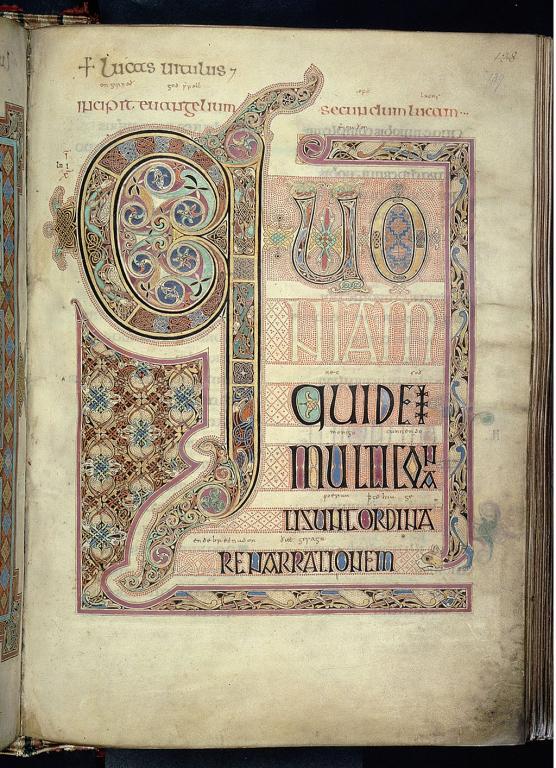
The beginning of the New Testament book of Luke in the Lindisfarne Gospels
(Wikimedia Commons public domain photo)
I offer here a summary passage from Mark D. Roberts, Can We Trust the Gospels?: Investigating the Reliability of Matthew, Mark, Luke, and John (Wheaton, IL: Crossway Books, 2007). Roberts, who, at the time his book was published, was senior pastor at Irvine Presbyterian Church in southern California, earned a Ph.D. in New Testament studies from Harvard University. In the quotation that I cite below, Rev. Roberts refers to Q (which stands for German Quelle, meaning “source”), a hypothesized written collection of logia or sayings of Jesus, purportedly drawn from the oral tradition of the early Christian movement. Q is conceived as part of the material common to both the Gospels of Matthew and Luke but not found in the Gospel of Mark:
In my first New Testament class in college, I learned about a relatively new scholarly discipline called redaction criticism (from the German term Redaktionsgeschichte, meaning “the history of editing” of the Gospels). Redaction critics, assuming that Matthew and Luke used Mark and Q as sources, studied the editorial changes made by Matthew and Luke. These changes revealed the distinctive theologies of their Gospels. I say “distinctive.” What I heard in class, however, was “distinctive and contradictory.” In that religion class, and throughout my graduate studies in New Testament, it was popular to emphasize the unique perspectives of Matthew, Mark, Luke, and John, and to minimize what they had in common, or even to deny that they had much in common at all. I heard plenty about the “contradictions” between the Gospels as my professors engaged in redaction criticism.
Some conservative scholars reacted negatively to redaction criticism, even suggesting that the discipline itself was inconsistent with biblical authority. But most evangelical scholars have come to see both the good and the bad in redaction criticism. The good has been identifying the distinctive efforts of the Gospel writers, who didn’t merely collect material and paste it together, but who carefully wove that material into a coherent and creative narrative. Redaction criticism has raised the respect given to Matthew, Mark, Luke, and John as creative, careful writers, and not mere collectors of traditions.
The bad part of redaction criticism has been the tendency of many who use this methodology to exaggerate the differences among the Gospels. Nobody doubts that there are such differences and that they are significant. But sometimes in focusing so much on the different trees one loses sight of the common forest. Think for a moment. If you were to sit down and read Mark, and then Matthew, do you think you would come away thinking, Now there are two unique, virtually incompatible pictures of Jesus? Hardly! In fact, I think you would be more inclined to say, after reading Matthew, Well, he adds some more fascinating material (like the visit of the Magi or the Sermon on the Mount) but that’s mostly the same story as I found in Mark. It was rather redundant in parts, actually. (96-97, italics in original)
Previous Post

June 1, 2020
Scientific reductionism and common sense
Next Post
June 1, 2020 A note from the president of the Church of Jesus Christ of Latter-day Saints
Browse Our Archives
Select a Category Uncategorized
Select a Month October 2026 September 2026 August 2026 July 2026 June 2026 May 2026 April 2026 March 2026 February 2026 January 2026 December 2025 November 2025 October 2025 September 2025 August 2025 July 2025 June 2025 May 2025 April 2025 March 2025 February 2025 January 2025 December 2024 November 2024 October 2024 September 2024 August 2024 July 2024 June 2024 May 2024 April 2024 March 2024 February 2024 January 2024 December 2023 November 2023 October 2023 September 2023 August 2023 July 2023 June 2023 May 2023 April 2023 March 2023 February 2023 January 2023 December 2022 November 2022 October 2022 September 2022 August 2022 July 2022 June 2022 May 2022 April 2022 March 2022 February 2022 January 2022 December 2021 November 2021 October 2021 September 2021 August 2021 July 2021 June 2021 May 2021 April 2021 March 2021 February 2021 January 2021 December 2020 November 2020 October 2020 September 2020 August 2020 July 2020 June 2020 May 2020 April 2020 March 2020 February 2020 January 2020 December 2019 November 2019 October 2019 September 2019 August 2019 July 2019 June 2019 May 2019 April 2019 March 2019 February 2019 January 2019 December 2018 November 2018 October 2018 September 2018 August 2018 July 2018 June 2018 May 2018 April 2018 March 2018 February 2018 January 2018 December 2017 November 2017 October 2017 September 2017 August 2017 July 2017 June 2017 May 2017 April 2017 March 2017 February 2017 January 2017 December 2016 November 2016 October 2016 September 2016 August 2016 July 2016 June 2016 May 2016 April 2016 March 2016 February 2016 January 2016 December 2015 November 2015 October 2015 September 2015 August 2015 July 2015 June 2015 May 2015 April 2015 March 2015 February 2015 January 2015 December 2014 November 2014 March 2014 August 2013 February 2012
Follow Us!
TAKE THE
Religious Wisdom Quiz
Where did Elisha perform many miracles?
Select your answer to see how you score.
Bethel Samaria Jericho Shunem
Related posts from Sic et Non
Some notes on the resurrection of Jesus
Setting the Record Straight, Though Without Much Real...


Christmas, the Israelite Tabernacle, and the Gospel of...
TRENDING AT PATHEOS Latter-day Saint

Nearly every morning, I make the drive to Detroit with my high-school-age...

The Real AI Story Is Adoption Without Trust
Artificial intelligence has crossed a political threshold. It is no longer a...

A new article, written by Jeff Lindsay and Gale L. Pooley,...

Swimfan: Forgotten Aughts Pleasures
This is a recovery effort. In 2002, My Big Fat Greek Wedding...

Top Three Anti-Catholic Lies About Catholicism
This is my initial transcript for the video, "THE 3 WORST...

Pope Leo Celebrates Mass for Nurses & Docs...
I don't have any idea how he did it, but Pope Leo...
view all Latter-day Saint blogs
Ad-Free & Subscriber Log-In Subscription Support
- About Us
- 2026 Calendar
- Videos
- Podcasts
- Library of World Religions
- Faith In Media Tracker
- Advertise With Us
- Write for Us
- Privacy Policy
- Terms of Service
- Do Not Sell My Data
- Contact Us
- Radiant Digital
- Manage Newsletter Subscriptions
- Unsubscribe From Notifications
- Sitemap
Copyright 2008-2026, Patheos. All rights reserved.
Subscription Support Ad-Free & Subscriber Log-In
Follow Patheos