
BuddhistCatholicContemplativeEvangelicalGeneral ChristianHinduJewishLatter-day SaintMuslimNew VisionsProgressive Christian
Beliefs
- Buddhist
- Catholic
- Contemplative
- Evangelical
- General Christian
- Hindu
- Jewish
- Latter-day Saint
- More Voices
- Muslim
- New Visions
- Pagan
- Progressive Christian
Topics
- Religion News
- Food and Religion
- Sports and Religion
- Religious Art
- Religious Music and Entertainment
- Religious Events
- History and Religion
- Style and Religion
- Politics and Religion
- Women in Religion
- Recreation Outdoors and Religion
- Business Finance and Religion
- Careers Workplace and Religion
- Education and Religion
- Family Parenting and Religion
- Health Fitness and Religion
- Home and Religion
- Relationships and Religion
- Technology and Religion
- Travel and Religion
Columnists
- Buddhist Columnists
- Business Finance and Religion Columnists
- Careers Workplace and Religion Columnists
- Catholic Columnists
- Contemplative Columnists
- Education and Religion Columnists
- Evangelists Columnists
- Family Parenting and Religion Columnists
- General Christian Columnists
- Health Fitness and Religion Columnists
- Hindu Columnists
- History and Religion Columnists
- Home and Religion Columnists
- Jewish Columnists
- More Voices Columnists
- Latter Day Columnists
- Muslim Columnists
- New Visions Columnists
- Nonreligious Columnists
- Pagan Columnists
- Politics and Religion Columnists
- Progressive Columnists
- Recreation Outdoors and Religion Columnists
- Relationships and Religion Columnists
- Religion News Columnists
- Religious Art Columnists
- Religious Events Columnists
- Religious Music and Entertainment Columnists
- Sports and Religion Columnists
- Style and Religion Columnists
- Technology and Religion Columnists
- Travel and Religion Columnists
- Women in Religion Columnists
Resource Library
- 2026 Calendar
- Library of World Religions
- The 100 Most Holy Places on Earth
- Patheos Answers
- Podcasts
- Videos
- Faith Leaders Database
- Anglican Episcopalian
- Bahai
- Baptist
- Buddhism
- Christianity
- Confucianism
- Eastern Orthodoxy
- Hinduism
- Holiness and Pentecostal
- ISKCON
- Islam
- Judaism
- Lutheran
- Methodist
- The Church of Jesus Christ of Latter-day Saints
- New Age
- Paganism
- Presbytarian and Reformed
- Protestantism
- Religion Behind the Scenes
- Roman Catholic
- Scientology
- Shia Islam
- Sikhism
- Sufism
- Sunni Islam
- Taoism
- Zen
- See all religions
Research Tools
 Ad-Free & Subscriber Log-In Subscription Support
Ad-Free & Subscriber Log-In Subscription Support
Follow Patheos 

- Trending:
- Forgiveness
- |
- Marriage
- |
- Consciousness
- |
- Death Penalty
- |
- Election
- |
- Halloween

- Home
- Latter-day Saint
- For My Father (1913-2003)
For My Father (1913-2003)
Last updated on: July 2, 2020 at 10:52 pm by Dan Peterson
For My Father (1913-2003) 2020-07-02T22:52:23-06:00 Dan Peterson
Patheos Explore the world's faith through different perspectives on religion and spirituality! Patheos has the views of the prevalent religions and spiritualities of the world.
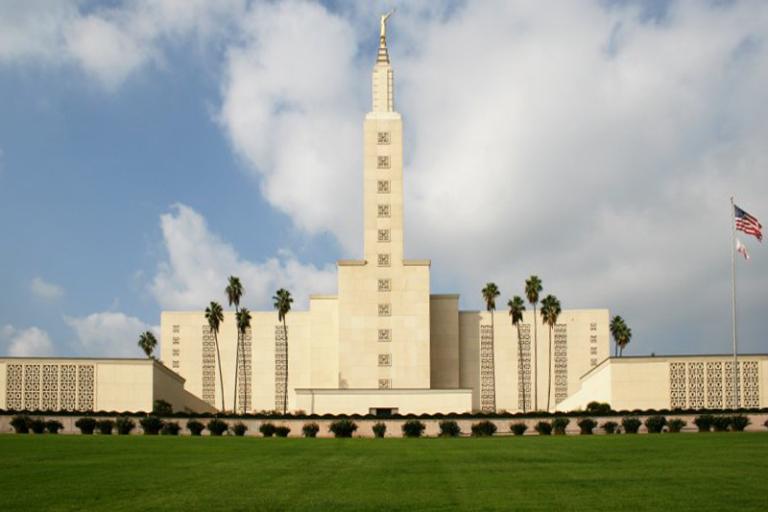
While I was growing up in the greater Los Angeles area, this was “my” temple. And this is where, finally, my parents were sealed together for time and all eternity, and where my brother and I were sealed to them. I’m profoundly grateful for that.
(Public domain image from Wikimedia Commons)
My father died seventeen years ago today.
I still miss him very much. I think about him every day. Certain sights always, invariably, remind me of him. There are many things that I would like to tell him, many questions that I would like to ask of him.
Virtually all, if not absolutely all, of the people I knew and loved when I was young, the people who formed me and to whom I looked up, are now gone. The collection of my friends and family on the other side is very large now. Of the nuclear family in which I grew up, I’ve been — for more than eight years now — the only one left .
As has become my little tradition, each year (if I don’t forget what day it is), I post tributes (often what I wrote for their funerals) to my father, my mother, my brother, and my granddaughter. They’re not adequate, and there’s no reason why anybody else should care about them or find them anything other than wearisome, but I want to do something to memorialize people that I loved and to remember them*.* So here’s what I delivered just slightly less than seventeen years ago, haltingly and through very uncharacteristic tears:
For Dad
Written 30 June 2003
Delivered 3 July 2003 (Rose Hills Cemetery, Whittier, California)
First of all, I want to thank all those who have helped Mom and Dad through these last, difficult, years. The ward. Their home teacher, Gary Walburger. Mom’s visiting teacher, Lou Ann Hatch. Particularly Angelina, Virginia, Blanca, Gus, my aunt Mary, and—most especially—my brother, Kenneth.
I’ve written my remarks out, hoping that I might have a better chance of getting through this. (My initial practice run was not encouraging.) I wrote almost all of these notes while sitting with Dad in the hospital over the weekend, while he dozed—and when it became inescapably obvious to me that his earthly stay could not (and should not) continue much longer.
A totally unexpected stroke left Dad blind six years ago, and deprived him of almost everything he liked to do. He had already been obliged to give up hunting and fishing and golf. Now he couldn’t read. He couldn’t work in his beautiful yard. He couldn’t follow the stock market or research family history. He couldn’t even watch Dodger baseball games or play cards or practice tricks on his pool table. For obvious reasons, he became very fond of a famous old Protestant hymn written by John Newton:
Amazing grace! (how sweet the sound)
That sav’d a wretch like me!
I once was lost, but now am found,
Was blind, but now I see.
At first, he talked a great deal about getting his sight back. With the passing of the long dark years, though, he mentioned that possibility more seldom, and, gradually, his muscles atrophied and his mind lost its sharpness and he spent more and more of his life immobile, a prisoner of his rocking chair. But he never entirely gave up hope. With touching determination, he hurled his fading memory at stacks of Spanish instructional tapes—over and over and over again. As recently as last Friday, he asked me whether he would ever be able to see again. I told him Yes. What I didn’t tell him was that I expected it to be only in the next life. And now, after his long night of darkness, he can see again. “Someday we’ll understand all of this,” he said to me several times over the past few months. Now the mental fog that increasingly gathered about him and so frustrated him has been burned away by warm, brilliant, loving light. All is clear. In the words of a beloved Mormon hymn, “The morning breaks, the shadows flee!”
John Newton’s “Amazing Grace” contains another verse, far less known than the one I’ve already quoted. Dad was probably unfamiliar with it. But it describes perfectly what has happened to him this week:
Yes, when this flesh and heart shall fail,
And mortal life shall cease;
I shall possess, within the veil,
A life of joy and peace.
More and more, as Dad sat there in darkness, his mind journeyed back to earlier days, to (among other things) life on the family farm in North Dakota. Several times, he told me of the prayer he prayed as a little boy, part ready-made and part personalized:
Now I lay me down to sleep.
I pray the Lord my soul to keep.
If I should die before I wake,
I pray the Lord my soul to take.
God bless Papa and Mama, Nellie, George, Alvina, Clarence, Ernest, and Selmer.
For the past several years, Dad has been the last of that little Scandinavian farm family. All had gone on before him. As I visited with him this past weekend, I found myself unable to pray for his recovery. I could only tell him how much we loved him, and pray that he would be received on the other side by those who loved him at least as much.
I do not believe that he was alone when that time came, when, as he had prayed as a child, the Lord finally did take his soul. I expect that Papa and Mama, Nellie, George, Alvina, Clarence, Ernest, and Selmer were there to welcome him home, in a wonderful reunion with those whom he had “loved long since, and lost a while.”
As I’ve mentioned, I was able to spend much of last weekend—his last weekend—with Dad, something for which I’ll always be grateful. Perhaps because of his medications, Dad was “confused”—that was his word—about many things in his final three or four days. But the quality of his character was as clear as ever. Perhaps even clearer, because, as his conversation grew repetitive, he repeated the things that really mattered to him. At the end, his concerns were about whether he had led a good life, whether he had contributed anything, done some good, whether we had a good relationship, whether we were all close as a family. I told him Yes, on all counts.
Over his last few days, this veteran of the Eleventh Armored Division, of Patton’s Third Army, didn’t remember military experiences in the Ardennes Forest of Belgium. He didn’t remember the blackout over London, the V-1 and V-2 rocket attacks that he had told me about so often. He didn’t remember his unit’s role in the liberation of the Nazi death camp at Mauthausen, in Austria, which had been such a pivotal experience of his earlier life.
He didn’t remember, until I reminded him, his studies at forestry school in North Dakota, or his stint in Roosevelt’s Civilian Conservation Corps, or his pre-war enlistment in the horse cavalry down by El Centro. The old sense of humor was still there, though, when memories came back to him. He thought that his stay in the cavalry would be a short one. But then came Pearl Harbor, and a note from the president telling him that his military career had been extended “for the duration.” Lying on his bed last Saturday, he chuckled at the letter’s cheery opening word: “Greetings!” said President Roosevelt. “That was nice of him!” remembered Dad. And when the physical therapist asked him, on Sunday, what the main problem was, he replied, “I’m getting awfully damned old! That’s the problem!”
Several years ago, Brigham Young University hosted a conference on the “liberators,” the now-aging soldiers who had put an end to Hitler’s concentration camps and freed their few nearly starved survivors. Dad didn’t want to come. But he surrendered to pressure and pleas, and he did. And when, at a concluding luncheon for the conference, the conference organizers asked the veterans to rise, receive a standing ovation, and be given a plaque, he broke down and sobbed. Only once before in my life had I seen him weep so.
Last weekend, as Dad lay pathetically in his hospital bed, he looked all too much like the concentration camp inmates that he had helped to free nearly six decades earlier. The liberator, one of the dwindling number of what has justly been called “the greatest generation,” now himself needed liberation from a body that was, simply, worn out.
A couple of Fridays ago, I spoke with him on the telephone. As I always did, I asked him how he was. “Dan,” he answered in an exceptionally strong and clear voice, “I can’t do anything.” As if he were preparing me for what was soon to follow, he told me that he was ready to go, and that I shouldn’t be sad when he did.
A radio advertisement has been playing in Utah recently, for a performance of the Requiem by Gabriel Fauré. In it, Fauré is quoted as responding to critics who thought his Requiem wasn’t gloomy enough. It was, they said, a kind of “lullaby to death.” Fauré cheerfully conceded that that was indeed exactly what it was. Death, he said, comes as a deliverer. It opens the path to a better place. Certainly, it did so for Dad.
At the end, Dad didn’t really remember E. C. Construction Company, the many factories and streets and neighborhoods that he and his colleagues had helped to build. He didn’t remember his service as a counselor in the bishopric of the San Gabriel Ward or his assisting in the family history library, or his work with the Boy Scouts. He didn’t remember that he had helped to build the chapel that I attended when I was growing up, and that, for years, even though he wasn’t a member of the Church, some members jokingly called him “bishop,” honoring him for his willingness to help.
As we talked about some of the many good things he had done, and the places he had seen, he remarked, “I’m learning a lot of new things. I’ll bet you are, too.” I wasn’t, of course. These were the things I had seen in and learned from my Dad. But when he finally said, with some relief, “I guess it wasn’t too bad a life. Maybe I did a few good things,” I was happy and proud to be able to answer him, “Yes, Dad, you did.”
I believe that my father is one of those to whom the Savior will say—perhaps already has said—in the words of the New Testament parable of the talents, “Well done, thou good and faithful servant: thou hast been faithful over a few things, I will make thee ruler over many things: enter thou into the joy of thy lord.” (Matthew 25:21.)
A modest and shy person, Dad would never have seen himself as a great man. Yet he was. In all the truly important things, he was. He loved my mother, and, to his very last day, worried about whether she was receiving adequate care. He was my first and only missionary convert. I was privileged to baptize him—and Kenneth to confirm him a member—on the night I was set apart as a missionary. Kenneth and I could have had no better father. When, just after his stroke, I was about to publish a book, it suddenly came to me with a flash almost of revelation that I had to dedicate it to my father, and how that dedication should read: Quoting Jesus’ description of Nathanael, I dedicated it “To my father, Carl P. Peterson—an Israelite indeed, in whom there is no guile.” (John 1:47.) Dad worried about that dedication. He was afraid that I was calling him “perfect.” I wasn’t, of course. But Dad was entirely without guile or deceit. He was a loving, gentle, patient man. Humble, self-effacing. Kind.
Of such is the Kingdom of Heaven.
I loved him, and I continue to love him, more than I have words to express.
Posted from Bountiful, Utah
Previous Post

June 30, 2020
Living longer, but committing fewer crimes
Next Post
June 30, 2020 Considering retirement locations
Browse Our Archives
Select a Category Uncategorized
Select a Month October 2026 September 2026 August 2026 July 2026 June 2026 May 2026 April 2026 March 2026 February 2026 January 2026 December 2025 November 2025 October 2025 September 2025 August 2025 July 2025 June 2025 May 2025 April 2025 March 2025 February 2025 January 2025 December 2024 November 2024 October 2024 September 2024 August 2024 July 2024 June 2024 May 2024 April 2024 March 2024 February 2024 January 2024 December 2023 November 2023 October 2023 September 2023 August 2023 July 2023 June 2023 May 2023 April 2023 March 2023 February 2023 January 2023 December 2022 November 2022 October 2022 September 2022 August 2022 July 2022 June 2022 May 2022 April 2022 March 2022 February 2022 January 2022 December 2021 November 2021 October 2021 September 2021 August 2021 July 2021 June 2021 May 2021 April 2021 March 2021 February 2021 January 2021 December 2020 November 2020 October 2020 September 2020 August 2020 July 2020 June 2020 May 2020 April 2020 March 2020 February 2020 January 2020 December 2019 November 2019 October 2019 September 2019 August 2019 July 2019 June 2019 May 2019 April 2019 March 2019 February 2019 January 2019 December 2018 November 2018 October 2018 September 2018 August 2018 July 2018 June 2018 May 2018 April 2018 March 2018 February 2018 January 2018 December 2017 November 2017 October 2017 September 2017 August 2017 July 2017 June 2017 May 2017 April 2017 March 2017 February 2017 January 2017 December 2016 November 2016 October 2016 September 2016 August 2016 July 2016 June 2016 May 2016 April 2016 March 2016 February 2016 January 2016 December 2015 November 2015 October 2015 September 2015 August 2015 July 2015 June 2015 May 2015 April 2015 March 2015 February 2015 January 2015 December 2014 November 2014 March 2014 August 2013 February 2012
Follow Us!
TAKE THE
Religious Wisdom Quiz
What queen visited Solomon to test his wisdom?
Select your answer to see how you score.
Queen of Tyre Queen of Sheba Queen of Egypt Queen Esther
Related posts from Sic et Non



Panel Perspectives on the Book of Abraham, and...
TRENDING AT PATHEOS Latter-day Saint

Janie Learns the Way of the Cross: A...
Teaching children about Jesus' Passion can be challenging. Many parents and educators...

Looking For Good Catholic Writing - October 2026
He alone extends the heavens, and he walks upon the waves of...

In "Irreplaceable," our book on vocation and technology, Trevor Sutton and I...

I was strolling through the top floor of the brand new Parthenon...

What Does Gêvâh Mean For Kimberley Guifoyle &...
This week, a lot of the news is focused on Kimberly Guilfoyle....

INNER CIRCLE: Profound Mystery (Of Christ In All...
Ephesians 5:31-32 “For this reason, a man will leave his father and...
view all Latter-day Saint blogs
Ad-Free & Subscriber Log-In Subscription Support
- About Us
- 2026 Calendar
- Videos
- Podcasts
- Library of World Religions
- Faith In Media Tracker
- Advertise With Us
- Write for Us
- Privacy Policy
- Terms of Service
- Do Not Sell My Data
- Contact Us
- Radiant Digital
- Manage Newsletter Subscriptions
- Unsubscribe From Notifications
- Sitemap
Copyright 2008-2026, Patheos. All rights reserved.
Subscription Support Ad-Free & Subscriber Log-In
Follow Patheos