
BuddhistCatholicContemplativeEvangelicalGeneral ChristianHinduJewishLatter-day SaintMuslimNew VisionsProgressive Christian
Beliefs
- Buddhist
- Catholic
- Contemplative
- Evangelical
- General Christian
- Hindu
- Jewish
- Latter-day Saint
- More Voices
- Muslim
- New Visions
- Pagan
- Progressive Christian
Topics
- Religion News
- Food and Religion
- Sports and Religion
- Religious Art
- Religious Music and Entertainment
- Religious Events
- History and Religion
- Style and Religion
- Politics and Religion
- Women in Religion
- Recreation Outdoors and Religion
- Business Finance and Religion
- Careers Workplace and Religion
- Education and Religion
- Family Parenting and Religion
- Health Fitness and Religion
- Home and Religion
- Relationships and Religion
- Technology and Religion
- Travel and Religion
Columnists
- Buddhist Columnists
- Business Finance and Religion Columnists
- Careers Workplace and Religion Columnists
- Catholic Columnists
- Contemplative Columnists
- Education and Religion Columnists
- Evangelists Columnists
- Family Parenting and Religion Columnists
- General Christian Columnists
- Health Fitness and Religion Columnists
- Hindu Columnists
- History and Religion Columnists
- Home and Religion Columnists
- Jewish Columnists
- More Voices Columnists
- Latter Day Columnists
- Muslim Columnists
- New Visions Columnists
- Nonreligious Columnists
- Pagan Columnists
- Politics and Religion Columnists
- Progressive Columnists
- Recreation Outdoors and Religion Columnists
- Relationships and Religion Columnists
- Religion News Columnists
- Religious Art Columnists
- Religious Events Columnists
- Religious Music and Entertainment Columnists
- Sports and Religion Columnists
- Style and Religion Columnists
- Technology and Religion Columnists
- Travel and Religion Columnists
- Women in Religion Columnists
Resource Library
- 2026 Calendar
- Library of World Religions
- The 100 Most Holy Places on Earth
- Patheos Answers
- Podcasts
- Videos
- Faith Leaders Database
- Anglican Episcopalian
- Bahai
- Baptist
- Buddhism
- Christianity
- Confucianism
- Eastern Orthodoxy
- Hinduism
- Holiness and Pentecostal
- ISKCON
- Islam
- Judaism
- Lutheran
- Methodist
- The Church of Jesus Christ of Latter-day Saints
- New Age
- Paganism
- Presbytarian and Reformed
- Protestantism
- Religion Behind the Scenes
- Roman Catholic
- Scientology
- Shia Islam
- Sikhism
- Sufism
- Sunni Islam
- Taoism
- Zen
- See all religions
Research Tools
 Ad-Free & Subscriber Log-In Subscription Support
Ad-Free & Subscriber Log-In Subscription Support
Follow Patheos 

- Trending:
- Forgiveness
- |
- Marriage
- |
- Consciousness
- |
- Death Penalty
- |
- Election
- |
- Halloween

- Home
- Latter-day Saint
- Einstein’s “greatest blunder”
Einstein’s “greatest blunder”
Last updated on: June 27, 2020 at 12:51 am by Dan Peterson
Einstein’s “greatest blunder” 2020-06-27T00:51:04-06:00 Dan Peterson
Patheos Explore the world's faith through different perspectives on religion and spirituality! Patheos has the views of the prevalent religions and spiritualities of the world.
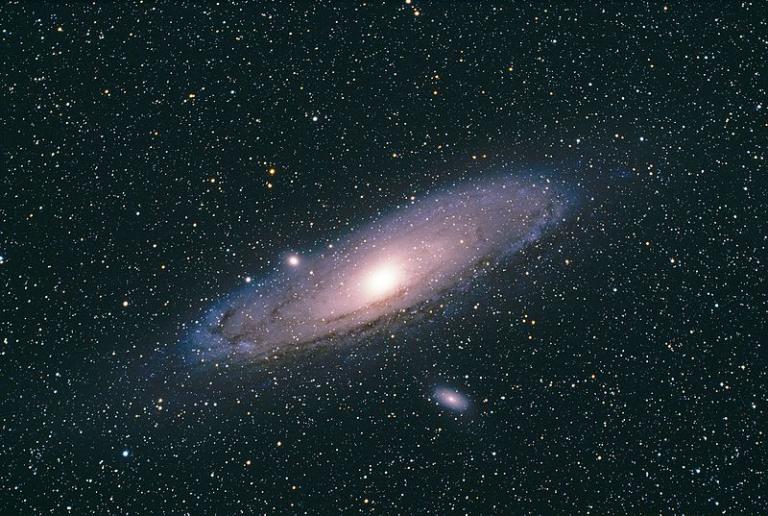
The Andromeda Galaxy, our nearest galactic neighbor
(Wikimedia Commons public domain image)
Some passages that I marked in Alister E. McGrath, A Fine-Tuned Universe: The Quest for God in Science and Theology (Louisville, KY: Westminster John Knox Press, 2009).
First, an obvious but extremely important point:
An empirical scientific method will always seek to inquire about natural causes; only a nonempirical metaphysical naturalism will insist that they can always be found. (112)
Next, two passages about history that I will myself need to relate, and to get correct, in something that I’m writing:
The twentieth century saw dramatic changes in our understanding of the origins and development of the universe. The first two decades were dominated by the assumption that the universe was static. This led Albert Einstein to make what he later came to regard as one of the greatest blunders of his life. In 1915, Einstein published his ten coupled, nonlinear, partial differential equations, now known as the “Einstein field equations,” which set out some fundamental features of his theory of general relativity. The solution of his equations indicated that the universe was not static, but expanding. Alarmed by an apparent inconsistency with the prevailing model of a static universe, Einstein brought his theories into line with it by adding an artificial term — now known as the cosmological constant — to his field equations, stabilizing his model of the universe against expansion or contraction. Yet if Einstein had possessed sufficient confidence in his original equations, on the basis of his theory he would have predicted that the universe was expanding or contracting, long before there was any observational evidence for any such expansion.
During the 1920s, evidence began to emerge suggesting that the universe was indeed expanding. Up to this point, it had been generally (though not universally) assumed that the nebulae observed in the night sky — such as M31 in Andromeda or M42 in Orion — were part of the Milky Way, the galaxy within which our solar system is located. On the basis of observations at the newly constructed 100-inch telescope on Mount Wilson (California), Edwin Hubble (1883-1953) proposed that these objects were galaxies in their own right, lying far beyond our own. Developing work on the spectral redshifts of these galaxies, Hubble was able to propose that the greater the distance between any two galaxies, the greater their relative speed of separation. The universe was expanding, with increasing speed and apparently irreversibly. (112-113)
Other ways of thinking were certainly possible. In 1948, Fred Hoyle and others developed a “steady state” theory of the universe, which held that the universe, although expanding, could not be said to have had a beginning. Matter was continuously created in order to fill in the voids arising from cosmic expansion. (113)
Previous Post

June 25, 2020
Philo-Semitism, Vicarious Baptisms, and Me: A Retrospective
Next Post
June 25, 2020 "Strictly upright"
Browse Our Archives
Select a Category Uncategorized
Select a Month October 2026 September 2026 August 2026 July 2026 June 2026 May 2026 April 2026 March 2026 February 2026 January 2026 December 2025 November 2025 October 2025 September 2025 August 2025 July 2025 June 2025 May 2025 April 2025 March 2025 February 2025 January 2025 December 2024 November 2024 October 2024 September 2024 August 2024 July 2024 June 2024 May 2024 April 2024 March 2024 February 2024 January 2024 December 2023 November 2023 October 2023 September 2023 August 2023 July 2023 June 2023 May 2023 April 2023 March 2023 February 2023 January 2023 December 2022 November 2022 October 2022 September 2022 August 2022 July 2022 June 2022 May 2022 April 2022 March 2022 February 2022 January 2022 December 2021 November 2021 October 2021 September 2021 August 2021 July 2021 June 2021 May 2021 April 2021 March 2021 February 2021 January 2021 December 2020 November 2020 October 2020 September 2020 August 2020 July 2020 June 2020 May 2020 April 2020 March 2020 February 2020 January 2020 December 2019 November 2019 October 2019 September 2019 August 2019 July 2019 June 2019 May 2019 April 2019 March 2019 February 2019 January 2019 December 2018 November 2018 October 2018 September 2018 August 2018 July 2018 June 2018 May 2018 April 2018 March 2018 February 2018 January 2018 December 2017 November 2017 October 2017 September 2017 August 2017 July 2017 June 2017 May 2017 April 2017 March 2017 February 2017 January 2017 December 2016 November 2016 October 2016 September 2016 August 2016 July 2016 June 2016 May 2016 April 2016 March 2016 February 2016 January 2016 December 2015 November 2015 October 2015 September 2015 August 2015 July 2015 June 2015 May 2015 April 2015 March 2015 February 2015 January 2015 December 2014 November 2014 March 2014 August 2013 February 2012
Follow Us!
TAKE THE
Religious Wisdom Quiz
Who fasted and prayed after reading the prophecy of Jeremiah's 70 years?
Select your answer to see how you score.
Joel Daniel Hosea Micah
Related posts from Sic et Non
It's older (and far bigger) than we can...
Some Notes on "Fine-Tuning" and the Multiverse
“Although the seal is hidden, the wax stamped...

TRENDING AT PATHEOS Latter-day Saint

Pope Leo Celebrates Mass for Nurses & Docs...
I don't have any idea how he did it, but Pope Leo...

The Sermon on the Mount, Part I: Matthew...
The Sermon on the Mount, Part I (Matthew 4:12-5:12) St. Matthew moves...

What's up from Crossway: Reviewing some of their latest A few weeks...

Janie Learns the Way of the Cross: A...
Teaching children about Jesus' Passion can be challenging. Many parents and educators...

Looking For Good Catholic Writing - October 2026
He alone extends the heavens, and he walks upon the waves of...

In "Irreplaceable," our book on vocation and technology, Trevor Sutton and I...
view all Latter-day Saint blogs
Ad-Free & Subscriber Log-In Subscription Support
- About Us
- 2026 Calendar
- Videos
- Podcasts
- Library of World Religions
- Faith In Media Tracker
- Advertise With Us
- Write for Us
- Privacy Policy
- Terms of Service
- Do Not Sell My Data
- Contact Us
- Radiant Digital
- Manage Newsletter Subscriptions
- Unsubscribe From Notifications
- Sitemap
Copyright 2008-2026, Patheos. All rights reserved.
Subscription Support Ad-Free & Subscriber Log-In
Follow Patheos