
BuddhistCatholicContemplativeEvangelicalGeneral ChristianHinduJewishLatter-day SaintMuslimNew VisionsProgressive Christian
Beliefs
- Buddhist
- Catholic
- Contemplative
- Evangelical
- General Christian
- Hindu
- Jewish
- Latter-day Saint
- More Voices
- Muslim
- New Visions
- Pagan
- Progressive Christian
Topics
- Religion News
- Food and Religion
- Sports and Religion
- Religious Art
- Religious Music and Entertainment
- Religious Events
- History and Religion
- Style and Religion
- Politics and Religion
- Women in Religion
- Recreation Outdoors and Religion
- Business Finance and Religion
- Careers Workplace and Religion
- Education and Religion
- Family Parenting and Religion
- Health Fitness and Religion
- Home and Religion
- Relationships and Religion
- Technology and Religion
- Travel and Religion
Columnists
- Buddhist Columnists
- Business Finance and Religion Columnists
- Careers Workplace and Religion Columnists
- Catholic Columnists
- Contemplative Columnists
- Education and Religion Columnists
- Evangelists Columnists
- Family Parenting and Religion Columnists
- General Christian Columnists
- Health Fitness and Religion Columnists
- Hindu Columnists
- History and Religion Columnists
- Home and Religion Columnists
- Jewish Columnists
- More Voices Columnists
- Latter Day Columnists
- Muslim Columnists
- New Visions Columnists
- Nonreligious Columnists
- Pagan Columnists
- Politics and Religion Columnists
- Progressive Columnists
- Recreation Outdoors and Religion Columnists
- Relationships and Religion Columnists
- Religion News Columnists
- Religious Art Columnists
- Religious Events Columnists
- Religious Music and Entertainment Columnists
- Sports and Religion Columnists
- Style and Religion Columnists
- Technology and Religion Columnists
- Travel and Religion Columnists
- Women in Religion Columnists
Resource Library
- 2026 Calendar
- Library of World Religions
- The 100 Most Holy Places on Earth
- Patheos Answers
- Podcasts
- Videos
- Faith Leaders Database
- Anglican Episcopalian
- Bahai
- Baptist
- Buddhism
- Christianity
- Confucianism
- Eastern Orthodoxy
- Hinduism
- Holiness and Pentecostal
- ISKCON
- Islam
- Judaism
- Lutheran
- Methodist
- The Church of Jesus Christ of Latter-day Saints
- New Age
- Paganism
- Presbytarian and Reformed
- Protestantism
- Religion Behind the Scenes
- Roman Catholic
- Scientology
- Shia Islam
- Sikhism
- Sufism
- Sunni Islam
- Taoism
- Zen
- See all religions
Research Tools
 Ad-Free & Subscriber Log-In Subscription Support
Ad-Free & Subscriber Log-In Subscription Support
Follow Patheos 

- Trending:
- Forgiveness
- |
- Marriage
- |
- Consciousness
- |
- Death Penalty
- |
- Election
- |
- Halloween

- Home
- Latter-day Saint
- “A Planet is Born”
“A Planet is Born”
Last updated on: June 10, 2020 at 2:03 pm by Dan Peterson
“A Planet is Born” 2020-06-10T14:03:38-06:00 Dan Peterson
Patheos Explore the world's faith through different perspectives on religion and spirituality! Patheos has the views of the prevalent religions and spiritualities of the world.
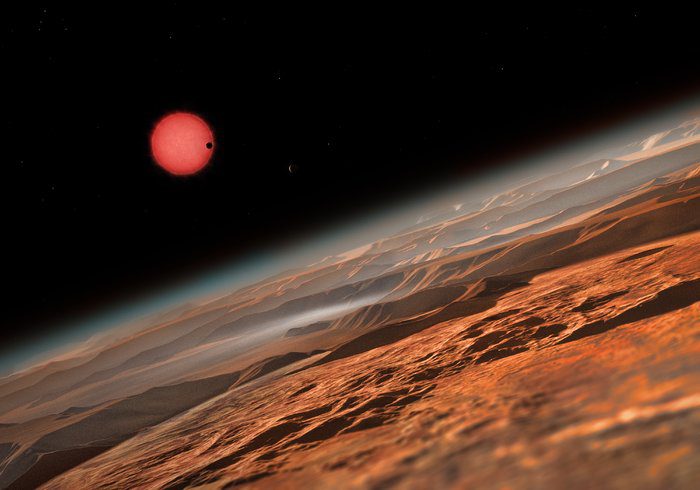
This public domain artist’s impression shows an imagined view from close to one of the three planets orbiting a dwarf star just 40 light-years from Earth that were discovered using the TRAPPIST telescope at the European Southern Observatory’s facility at La Silla, Chile. These worlds have sizes and temperatures similar to those of Venus and Earth and may be the best candidates found thus in the search for life outside our solar system. They are the first planets ever discovered around such a tiny and dim star. In this view, one of the inner planets is seen in transit across the disc of its tiny and dim parent star.
I enjoyed an article in the current issue of Scientific American about “circumstellar disks.” It’s by a professor at the University of Colorado at Boulder who is reporting on work carried out at the Atacama Large Millimeter/submillimeter Array (ALMA) telescope high up in the Atacama Desert of Chile: Meredith A. MacGregor, “Astronomers Watch as Planets Are Born: High-resolution images of the debris disks around stars are revealing how solar systems form,” Scientific American (June 2020): 54-61. (The title and subtitle are somewhat different in the print edition, which seems needlessly confusing.) Here are some passages that struck me:
Professor MacGregor first explains that stars are formed from molecular clouds, which are composed of dust and gas. Whereas “empty” space typically has a density of about one atom per cubic centimeter, molecular clouds “can reach densities 10,000 to one million times this norm” (56). And, when they do so, their gravity causes them to collapse and, eventually, to turn into stars. As they rotate, though, remaining dust and gas collects around them to form what are called “circumstellar disks.” They might also be called “protoplanetary disks,” because planets form from them:
Rock, metal and ice condense out of the disk to form planetary seeds. As seeds start to collide and stick together, they grow larger and larger until they have enough gravity to start attracting more material through a process known as accretion. The baby protoplanets orbit within the disk and continue accumulating material, carving out gaps in the disk in a game of planetary Pac-Man. Nearly all stars that are younger than a few million years are surrounded by disks that most likely harbor a zoo of new planetary systems. (57)
How common are such phenomena? How common are planets?
By using infrared telescopes to search for such bright spots, astronomers have confirmed that at least 20 to 25 percent of stars are surrounded by debris disks. Given our picture of how planetary systems form, one might logically conclude that all stars should be surrounded by remnant material—after all, statistics from the Kepler mission tell us that every star in the galaxy has at least one orbiting exoplanet. In fact, debris disks are probably more common than we know. (57)
Telescope missions such as Kepler and TESS (the Transiting Exoplanet Survey Satellite) and many ground-based surveys have so far detected thousands of exoplanets. Yet most of these planets are more massive or are closer to their host star than the planets in our solar system are. These types of planets are not necessarily more common, though; they are simply easier for us to find. (59)
In other words, there may be an inconceivably large number of exoplanets out there. And how early do protoplanetary disks form?
In one of its first blockbuster disk images, taken in 2014, ALMA imaged HL Tau, a young system probably less than 100,000 years old. The photograph revealed that what had been assumed to be a continuous disk was carved into multiple rings and gaps. Given the young age of the system, if these gaps are actually sculpted by baby planets, planet formation must start earlier than originally thought. In another notable discovery, in 2018, the DSHARP (Disk Substructures at High Angular Resolution Project) survey looked at 20 protoplanetary disks with high resolution and found that every one of them had rings and gaps, and some even showed spiral structure. Apparently such features are not unique to HL Tau but are instead ubiquitous to young circumstellar disks. (59)
And worlds without number have I created; and I also created them for mine own purpose; and by the Son I created them, which is mine Only Begotten. (Moses 1:33)
Next Post

June 8, 2020 "Understanding Ritual Hand Gestures of the Ancient World"
Browse Our Archives
Select a Category Uncategorized
Select a Month October 2026 September 2026 August 2026 July 2026 June 2026 May 2026 April 2026 March 2026 February 2026 January 2026 December 2025 November 2025 October 2025 September 2025 August 2025 July 2025 June 2025 May 2025 April 2025 March 2025 February 2025 January 2025 December 2024 November 2024 October 2024 September 2024 August 2024 July 2024 June 2024 May 2024 April 2024 March 2024 February 2024 January 2024 December 2023 November 2023 October 2023 September 2023 August 2023 July 2023 June 2023 May 2023 April 2023 March 2023 February 2023 January 2023 December 2022 November 2022 October 2022 September 2022 August 2022 July 2022 June 2022 May 2022 April 2022 March 2022 February 2022 January 2022 December 2021 November 2021 October 2021 September 2021 August 2021 July 2021 June 2021 May 2021 April 2021 March 2021 February 2021 January 2021 December 2020 November 2020 October 2020 September 2020 August 2020 July 2020 June 2020 May 2020 April 2020 March 2020 February 2020 January 2020 December 2019 November 2019 October 2019 September 2019 August 2019 July 2019 June 2019 May 2019 April 2019 March 2019 February 2019 January 2019 December 2018 November 2018 October 2018 September 2018 August 2018 July 2018 June 2018 May 2018 April 2018 March 2018 February 2018 January 2018 December 2017 November 2017 October 2017 September 2017 August 2017 July 2017 June 2017 May 2017 April 2017 March 2017 February 2017 January 2017 December 2016 November 2016 October 2016 September 2016 August 2016 July 2016 June 2016 May 2016 April 2016 March 2016 February 2016 January 2016 December 2015 November 2015 October 2015 September 2015 August 2015 July 2015 June 2015 May 2015 April 2015 March 2015 February 2015 January 2015 December 2014 November 2014 March 2014 August 2013 February 2012
Follow Us!
TAKE THE
Religious Wisdom Quiz
Who preached the first Christian sermon on Pentecost in Acts?
Select your answer to see how you score.
Philip Peter Paul James
Related posts from Sic et Non

"Unmasking Halloween: Its Origins and Meaning"

A Note on the Miller-Urey Experiment
TRENDING AT PATHEOS Latter-day Saint

Nearly every morning, I make the drive to Detroit with my high-school-age...

The Real AI Story Is Adoption Without Trust
Artificial intelligence has crossed a political threshold. It is no longer a...

A new article, written by Jeff Lindsay and Gale L. Pooley,...

Swimfan: Forgotten Aughts Pleasures
This is a recovery effort. In 2002, My Big Fat Greek Wedding...

Top Three Anti-Catholic Lies About Catholicism
This is my initial transcript for the video, "THE 3 WORST...

Pope Leo Celebrates Mass for Nurses & Docs...
I don't have any idea how he did it, but Pope Leo...
view all Latter-day Saint blogs
Ad-Free & Subscriber Log-In Subscription Support
- About Us
- 2026 Calendar
- Videos
- Podcasts
- Library of World Religions
- Faith In Media Tracker
- Advertise With Us
- Write for Us
- Privacy Policy
- Terms of Service
- Do Not Sell My Data
- Contact Us
- Radiant Digital
- Manage Newsletter Subscriptions
- Unsubscribe From Notifications
- Sitemap
Copyright 2008-2026, Patheos. All rights reserved.
Subscription Support Ad-Free & Subscriber Log-In
Follow Patheos