
BuddhistCatholicContemplativeEvangelicalGeneral ChristianHinduJewishLatter-day SaintMuslimNew VisionsProgressive Christian
Beliefs
- Buddhist
- Catholic
- Contemplative
- Evangelical
- General Christian
- Hindu
- Jewish
- Latter-day Saint
- More Voices
- Muslim
- New Visions
- Pagan
- Progressive Christian
Topics
- Religion News
- Food and Religion
- Sports and Religion
- Religious Art
- Religious Music and Entertainment
- Religious Events
- History and Religion
- Style and Religion
- Politics and Religion
- Women in Religion
- Recreation Outdoors and Religion
- Business Finance and Religion
- Careers Workplace and Religion
- Education and Religion
- Family Parenting and Religion
- Health Fitness and Religion
- Home and Religion
- Relationships and Religion
- Technology and Religion
- Travel and Religion
Columnists
- Buddhist Columnists
- Business Finance and Religion Columnists
- Careers Workplace and Religion Columnists
- Catholic Columnists
- Contemplative Columnists
- Education and Religion Columnists
- Evangelists Columnists
- Family Parenting and Religion Columnists
- General Christian Columnists
- Health Fitness and Religion Columnists
- Hindu Columnists
- History and Religion Columnists
- Home and Religion Columnists
- Jewish Columnists
- More Voices Columnists
- Latter Day Columnists
- Muslim Columnists
- New Visions Columnists
- Nonreligious Columnists
- Pagan Columnists
- Politics and Religion Columnists
- Progressive Columnists
- Recreation Outdoors and Religion Columnists
- Relationships and Religion Columnists
- Religion News Columnists
- Religious Art Columnists
- Religious Events Columnists
- Religious Music and Entertainment Columnists
- Sports and Religion Columnists
- Style and Religion Columnists
- Technology and Religion Columnists
- Travel and Religion Columnists
- Women in Religion Columnists
Resource Library
- 2026 Calendar
- Library of World Religions
- The 100 Most Holy Places on Earth
- Patheos Answers
- Podcasts
- Videos
- Faith Leaders Database
- Anglican Episcopalian
- Bahai
- Baptist
- Buddhism
- Christianity
- Confucianism
- Eastern Orthodoxy
- Hinduism
- Holiness and Pentecostal
- ISKCON
- Islam
- Judaism
- Lutheran
- Methodist
- The Church of Jesus Christ of Latter-day Saints
- New Age
- Paganism
- Presbytarian and Reformed
- Protestantism
- Religion Behind the Scenes
- Roman Catholic
- Scientology
- Shia Islam
- Sikhism
- Sufism
- Sunni Islam
- Taoism
- Zen
- See all religions
Research Tools
 Ad-Free & Subscriber Log-In Subscription Support
Ad-Free & Subscriber Log-In Subscription Support
Follow Patheos 

- Trending:
- Forgiveness
- |
- Marriage
- |
- Consciousness
- |
- Death Penalty
- |
- Election
- |
- Halloween

- Home
- Latter-day Saint
- “To this we are witnesses”: A note on Acts 3
“To this we are witnesses”: A note on Acts 3
Last updated on: May 16, 2020 at 11:15 pm by Dan Peterson
“To this we are witnesses”: A note on Acts 3 2020-05-16T23:15:44-06:00 Dan Peterson
Patheos Explore the world's faith through different perspectives on religion and spirituality! Patheos has the views of the prevalent religions and spiritualities of the world.
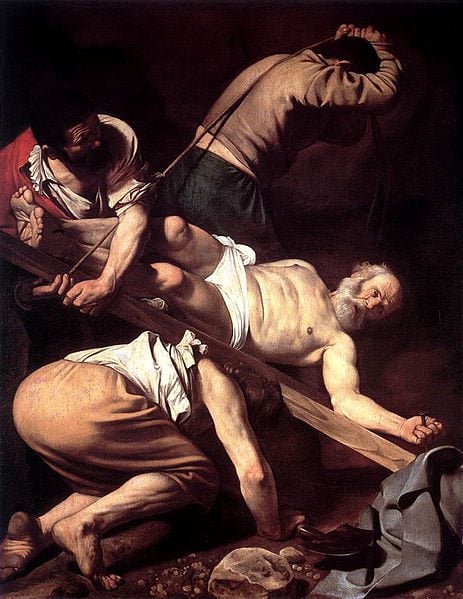
“The Crucifixion of St. Peter” (Caravaggio)
Regarding Acts 3, I simply want to point to three stunning verses from Peter’s impromptu speech to the crowd in the temple at Jerusalem. Their contrast with the scene of the dispirited apostles hiding out on the Saturday between Friday’s Crucifixion and the events of the Resurrection that commenced sometime on Sunday morning could not possibly be any more clear. Something must have happened! Anyway, here they are, in the ESV or English Standard Version:
The God of Abraham, the God of Isaac, and the God of Jacob, the God of our fathers, glorified his servant Jesus, whom you delivered over and denied in the presence of Pilate, when he had decided to release him. 14 But you denied the Holy and Righteous One, and asked for a murderer to be granted to you, 15 and you killed the Author of life, whom God raised from the dead. To this we are witnesses [μάρτυρές]. (3:13-15)
- 3:13 — “The God of Abraham, the God of Isaac, and the God of Jacob, the God of our fathers” — Here, Peter very deliberately invokes the great patriarchs of the Israelite tradition in order to make as strong as possible his accusation, which follows closely hereafter, that, in rejecting Jesus, the Jews had rejected their God and his servant.
- At the conclusion of his speech, at 3:22-25, Peter will likewise invoke the prophets of the Old Testament, and then link them with the patriarchs — and with Jesus. And he will, again, suggest that, in rejecting Jesus, the people of Jerusalem have rejected God’s plan for them and, accordingly, need to repent: “Moses said, ‘The Lord God will raise up for you a prophet like me from your brothers. You shall listen to him in whatever he tells you. And it shall be that every soul who does not listen to that prophet shall be destroyed from the people.’ And all the prophets who have spoken, from Samuel and those who came after him, also proclaimed these days. You are the sons of the prophets and of the covenant that God made with your fathers, saying to Abraham, ‘And in your offspring shall all the families of the earth be blessed.’”
- 3:13 — “his servant Jesus” — I don’t see how anybody reading this phrase can fail to see a distinction between Jesus and “God.” This is not a classical-trinitarian verse.
- 3:13 — “his servant Jesus, whom you delivered over” — Again, Peter boldly casts in the face of his temple-attending Jewish audience the fact that, in rejecting Jesus, they have opposed the God whom they purport to worship. Please note, too, that Peter more or less lets Pilate off the hook, saying that, while the Roman governor “had decided to release [Jesus],” he was persuaded to crucify Christ by the Jews of Jerusalem.
- 3:14 — “you denied the Holy and Righteous One, and asked for a murderer to be granted to you” — Could Peter’s words possibly be any more damning or accusatory? You might think not. But then comes the next verse:
- 3:15 — “you killed the Author of life, whom God raised from the dead” — To have “killed the Author of life” must surely be about the worst sin of which anyone could be accused. And then Peter points to the astonishing divine rebuke, directly on point, that followed that act of life-denying deicide: “God raised [him] from the dead.” They opposed God’s plan, but God defeated their opposition.
- 3:15 — “To this we are witnesses [μάρτυρές].” — Peter takes personal responsibility for the charges that he is making, and includes his companion, John, and perhaps the other apostles as well, in the lodging of the accusation. It’s a bit like the American Founding Fathers putting their signatures to the Declaration of Independence. I can’t help but think of John Hancock’s large and flamboyant signature on the Declaration: A later, apocryphal story has it that Hancock signed his name so largely and clearly with the explanation that he hoped that King George would be able to read it without his spectacles. That story may not be true, but it rather fits Peter’s boldly defiant statement here in Acts 3:15. Something — the Resurrection, perhaps? — has absolutely transformed the cowering apostles of the Saturday before Easter.
- 3:15 — Again, “To this we are witnesses [μάρτυρές].” — The Greek word behind the ESV’s witnesses is martyres. That is, perhaps, not without meaning.
One final observation on the setting of Acts 3:
Now Peter and John were going up to the temple at the hour of prayer, the ninth hour. (3:1)
- This occurs at 3 PM — the count of the hours begins at sunrise, around 6 AM — at the time of the afternoon prayer.
- The fact that Peter and John were attending afternoon prayers in the temple is highly significant: Plainly, the early post-Resurrection Christian movement had not utterly rejected the temple, as some modern Christians maintain.
Previous Post

May 15, 2020
Two (or three) very different conquests of Jerusalem
Next Post
May 16, 2020 Majoring in a Minor
Browse Our Archives
Select a Category Uncategorized
Select a Month October 2026 September 2026 August 2026 July 2026 June 2026 May 2026 April 2026 March 2026 February 2026 January 2026 December 2025 November 2025 October 2025 September 2025 August 2025 July 2025 June 2025 May 2025 April 2025 March 2025 February 2025 January 2025 December 2024 November 2024 October 2024 September 2024 August 2024 July 2024 June 2024 May 2024 April 2024 March 2024 February 2024 January 2024 December 2023 November 2023 October 2023 September 2023 August 2023 July 2023 June 2023 May 2023 April 2023 March 2023 February 2023 January 2023 December 2022 November 2022 October 2022 September 2022 August 2022 July 2022 June 2022 May 2022 April 2022 March 2022 February 2022 January 2022 December 2021 November 2021 October 2021 September 2021 August 2021 July 2021 June 2021 May 2021 April 2021 March 2021 February 2021 January 2021 December 2020 November 2020 October 2020 September 2020 August 2020 July 2020 June 2020 May 2020 April 2020 March 2020 February 2020 January 2020 December 2019 November 2019 October 2019 September 2019 August 2019 July 2019 June 2019 May 2019 April 2019 March 2019 February 2019 January 2019 December 2018 November 2018 October 2018 September 2018 August 2018 July 2018 June 2018 May 2018 April 2018 March 2018 February 2018 January 2018 December 2017 November 2017 October 2017 September 2017 August 2017 July 2017 June 2017 May 2017 April 2017 March 2017 February 2017 January 2017 December 2016 November 2016 October 2016 September 2016 August 2016 July 2016 June 2016 May 2016 April 2016 March 2016 February 2016 January 2016 December 2015 November 2015 October 2015 September 2015 August 2015 July 2015 June 2015 May 2015 April 2015 March 2015 February 2015 January 2015 December 2014 November 2014 March 2014 August 2013 February 2012
Follow Us!
TAKE THE
Religious Wisdom Quiz
Which Psalm opens with "Blessed is the man"?
Select your answer to see how you score.
Psalm 119 Psalm 23 Psalm 1 Psalm 51
Related posts from Sic et Non

Notes on Women, Priesthood, and General Conference

"The Book of Moses as a Temple Text"

An action movie and some vacuous theology

TRENDING AT PATHEOS Latter-day Saint

The Dangers of Gradual Accommodation (Winking at Sin)
Recently, the “law of gradualness” resurfaced during the opening of a weeklong,...

The Iron Gates and the Lion of the...
Yesterday, I didn't finish my report about, well, yesterday. So I'll...

Dolly Parton’s Last Song Wins Dove Award with...
Bluegrass band The Grascals, speaking on the red carpet at the 57th...

The Image: On the Horror of Capitalism and...
The Image Then went the Pharisees, and took counsel how they might...

We are approaching the date of our new American national holiday: October...

Letters on Living the Faith by C.S. Lewis
Most of us met C.S. Lewis as a public intellectual. Mere Christianity....
view all Latter-day Saint blogs
Ad-Free & Subscriber Log-In Subscription Support
- About Us
- 2026 Calendar
- Videos
- Podcasts
- Library of World Religions
- Faith In Media Tracker
- Advertise With Us
- Write for Us
- Privacy Policy
- Terms of Service
- Do Not Sell My Data
- Contact Us
- Radiant Digital
- Manage Newsletter Subscriptions
- Unsubscribe From Notifications
- Sitemap
Copyright 2008-2026, Patheos. All rights reserved.
Subscription Support Ad-Free & Subscriber Log-In
Follow Patheos