
BuddhistCatholicContemplativeEvangelicalGeneral ChristianHinduJewishLatter-day SaintMuslimNew VisionsProgressive Christian
Beliefs
- Buddhist
- Catholic
- Contemplative
- Evangelical
- General Christian
- Hindu
- Jewish
- Latter-day Saint
- More Voices
- Muslim
- New Visions
- Pagan
- Progressive Christian
Topics
- Religion News
- Food and Religion
- Sports and Religion
- Religious Art
- Religious Music and Entertainment
- Religious Events
- History and Religion
- Style and Religion
- Politics and Religion
- Women in Religion
- Recreation Outdoors and Religion
- Business Finance and Religion
- Careers Workplace and Religion
- Education and Religion
- Family Parenting and Religion
- Health Fitness and Religion
- Home and Religion
- Relationships and Religion
- Technology and Religion
- Travel and Religion
Columnists
- Buddhist Columnists
- Business Finance and Religion Columnists
- Careers Workplace and Religion Columnists
- Catholic Columnists
- Contemplative Columnists
- Education and Religion Columnists
- Evangelists Columnists
- Family Parenting and Religion Columnists
- General Christian Columnists
- Health Fitness and Religion Columnists
- Hindu Columnists
- History and Religion Columnists
- Home and Religion Columnists
- Jewish Columnists
- More Voices Columnists
- Latter Day Columnists
- Muslim Columnists
- New Visions Columnists
- Nonreligious Columnists
- Pagan Columnists
- Politics and Religion Columnists
- Progressive Columnists
- Recreation Outdoors and Religion Columnists
- Relationships and Religion Columnists
- Religion News Columnists
- Religious Art Columnists
- Religious Events Columnists
- Religious Music and Entertainment Columnists
- Sports and Religion Columnists
- Style and Religion Columnists
- Technology and Religion Columnists
- Travel and Religion Columnists
- Women in Religion Columnists
Resource Library
- 2026 Calendar
- Library of World Religions
- The 100 Most Holy Places on Earth
- Patheos Answers
- Podcasts
- Videos
- Faith Leaders Database
- Anglican Episcopalian
- Bahai
- Baptist
- Buddhism
- Christianity
- Confucianism
- Eastern Orthodoxy
- Hinduism
- Holiness and Pentecostal
- ISKCON
- Islam
- Judaism
- Lutheran
- Methodist
- The Church of Jesus Christ of Latter-day Saints
- New Age
- Paganism
- Presbytarian and Reformed
- Protestantism
- Religion Behind the Scenes
- Roman Catholic
- Scientology
- Shia Islam
- Sikhism
- Sufism
- Sunni Islam
- Taoism
- Zen
- See all religions
Research Tools
 Ad-Free & Subscriber Log-In Subscription Support
Ad-Free & Subscriber Log-In Subscription Support
Follow Patheos 

- Trending:
- Forgiveness
- |
- Marriage
- |
- Consciousness
- |
- Death Penalty
- |
- Election
- |
- Halloween

- Home
- Latter-day Saint
- The Sacrament of the Lord’s Supper as Evidence for the Resurrection of Jesus
The Sacrament of the Lord’s Supper as Evidence for the Resurrection of Jesus
Last updated on: May 26, 2020 at 9:48 am by Dan Peterson
The Sacrament of the Lord’s Supper as Evidence for the Resurrection of Jesus 2020-05-26T09:48:56-06:00 Dan Peterson
Patheos Explore the world's faith through different perspectives on religion and spirituality! Patheos has the views of the prevalent religions and spiritualities of the world.
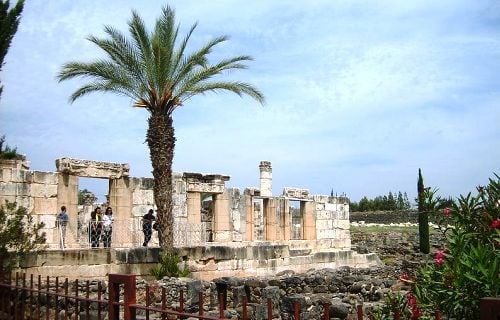
This ruined synagogue in Capernaum — surprisingly grand for such a tiny village — is much too late to be the one Jesus knew, but it likely sits on the same spot.
(Wikimedia Commons public domain photograph)
I want to flesh out here an argument that I heard very briefly mentioned the other day in a recorded discussion. It seems to me, while not a “slam dunk,” to be quite an interesting line of reasoning. All biblical citations are from the English Standard Version or ESV.
According to John 6:53-58, Jesus said something very jarring while he was teaching in the synagogue at Capernaum:
53 So Jesus said to them, “Truly, truly, I say to you, unless you eat the flesh of the Son of Man and drink his blood, you have no life in you. 54 Whoever feeds on my flesh and drinks my blood has eternal life, and I will raise him up on the last day. 55 For my flesh is true food, and my blood is true drink. 56 Whoever feeds on my flesh and drinks my blood abides in me, and I in him. 57 As the living Father sent me, and I live because of the Father, so whoever feeds on me, he also will live because of me. 58 This is the bread that came down from heaven, not like the bread the fathers ate, and died. Whoever feeds on this bread will live forever.”
John 6 goes on to record that these words, which almost seem to speak of cannibalism, so shocked their hearers that they caused a crisis among them:
60 When many of his disciples heard it, they said, “This is a hard saying; who can listen to it?”61 But Jesus, knowing in himself that his disciples were grumbling about this, said to them,“Do you take offense at this? 62 Then what if you were to see the Son of Man ascending to where he was before? 63 It is the Spirit who gives life; the flesh is no help at all. The words that I have spoken to you are spirit and life. 64 But there are some of you who do not believe.” (For Jesus knew from the beginning who those were who did not believe, and who it was who would betray him.) 65 And he said, “This is why I told you that no one can come to me unless it is granted him by the Father.”
66 After this many of his disciples turned back and no longer walked with him. 67 So Jesus said to the twelve, “Do you want to go away as well?” 68 Simon Peter answered him, “Lord, to whom shall we go? You have the words of eternal life, 69 and we have believed, and have come to know, that you are the Holy One of God.”
Afterwards, though, many came to see the fulfillment of Jesus’ words in what he said at the Last Supper, when he initiated what mainstream Christians typically call communion and Latter-day Saints call the sacrament:
26 Now as they were eating, Jesus took bread, and after blessing it broke it and gave it to the disciples, and said, “Take, eat; this is my body.” 27 And he took a cup, and when he had given thanks he gave it to them, saying, “Drink of it, all of you, 28 for this is my blood of the covenant, which is poured out for many for the forgiveness of sins. (Matthew 26:26-28)
It seems that the followers of Jesus did indeed carry on the practice of eating and drinking in remembrance of his brutal death. Acts 2:42 and 2:46 may refer to the practice already within a year or so of Jesus’ crucifixion:
42 And they devoted themselves to the apostles’ teaching and the fellowship, to the breaking of bread and the prayers. . . . 46 And day by day, attending the temple together and breaking bread in their homes, they received their food with glad and generous hearts.
Acts 20:7 probably refers to an early Christian practice of partaking of “the Lord’s supper,” and it clearly seems to indicate that Paul — and the narrator of the passage, very likely Luke the evangelist — participated in the practice:
7 On the first day of the week, when we were gathered together to break bread, Paul talked with them, intending to depart on the next day, and he prolonged his speech until midnight.
Paul seems to have taught his converts to continue such ritual eating and drinking. We have evidence for that in his First Epistle to the Corinthians, which is commonly dated to between AD 53 and AD 57:
23 For I received from the Lord what I also delivered to you, that the Lord Jesus on the night when he was betrayed took bread, 24 and when he had given thanks, he broke it, and said,“This is my body, which is for you. Do this in remembrance of me.” 25 In the same way also he took the cup, after supper, saying, “This cup is the new covenant in my blood. Do this, as often as you drink it, in remembrance of me.” 26 For as often as you eat this bread and drink the cup, you proclaim the Lord’s death until he comes.
27 Whoever, therefore, eats the bread or drinks the cup of the Lord in an unworthy manner will be guilty concerning the body and blood of the Lord. 28 Let a person examine himself, then, and so eat of the bread and drink of the cup. 29 For anyone who eats and drinks without discerning the body eats and drinks judgment on himself. (1 Corinthians 11:23-29)
16 The cup of blessing that we bless, is it not a participation in the blood of Christ? The bread that we break, is it not a participation in the body of Christ? 17 Because there is one bread, we who are many are one body, for we all partake of the one bread. (1 Corinthians 10:16-17)
Note that, in 1 Corinthians 11:23, Paul says that he taught the idea of the commemorative partaking of bread and wine to the Corinthians when he was personally present among them. His founding of the church there — in his day, Corinth was the capital of the Roman colony of Achaea, in Greece — is commonly dated around AD 50, which puts it within twenty years or less of Christ’s crucifixion. And he says that he was passing on to them something that had previously been taught to him.
Thus, it seems undeniably clear that the brutal execution of Jesus was being memorialized among Christians by a ritual meal in the very earliest years of the Christian movement.
But why?
Isn’t this rather strange?
Wouldn’t the execution of Jesus as a criminal, hanging on a cross between two thieves, have been a matter of shame? Would it have appealed to audiences of potential converts in the Roman-dominated Mediterranean Basin to know that Jesus had been put to death by Roman authority? (One of the names commonly used by Romans for the Mediterranean — a name that plainly demonstrates their confident dominance of it — was Mare Nostrum, “Our Sea.”)
And what would potential Jewish converts make of it?
Paul knew very well how they would regard it, since he himself writes in Galatians 3:13 that
13 Christ redeemed us from the curse of the law by becoming a curse for us—for it is written, “Cursed is everyone who is hanged on a tree.”
He is citing Deuteronomy 21:22-23, which is obviously relevant to the story of Christ and the cross:
22 “And if a man has committed a crime punishable by death and he is put to death, and you hang him on a tree, 23 his body shall not remain all night on the tree, but you shall bury him the same day, for a hanged man is cursed by God.
So why would the earliest Christians, far from seeking to hide the shameful, horrific, brutal death of the founder of their movement, have actually gloried in it? Why would they commemorate it in regular communal eating and drinking?
Obviously, it seems clear to me, because something had transformed the meaning of that shameful death. And Christ’s resurrection seems to me by far the best explanation of that change.
Previous Post

May 23, 2020
Bad Grammar and Early Modern English, on the Radio!
Next Post
May 24, 2020 "Once you have died you will know it anyway."
Browse Our Archives
Select a Category Uncategorized
Select a Month October 2026 September 2026 August 2026 July 2026 June 2026 May 2026 April 2026 March 2026 February 2026 January 2026 December 2025 November 2025 October 2025 September 2025 August 2025 July 2025 June 2025 May 2025 April 2025 March 2025 February 2025 January 2025 December 2024 November 2024 October 2024 September 2024 August 2024 July 2024 June 2024 May 2024 April 2024 March 2024 February 2024 January 2024 December 2023 November 2023 October 2023 September 2023 August 2023 July 2023 June 2023 May 2023 April 2023 March 2023 February 2023 January 2023 December 2022 November 2022 October 2022 September 2022 August 2022 July 2022 June 2022 May 2022 April 2022 March 2022 February 2022 January 2022 December 2021 November 2021 October 2021 September 2021 August 2021 July 2021 June 2021 May 2021 April 2021 March 2021 February 2021 January 2021 December 2020 November 2020 October 2020 September 2020 August 2020 July 2020 June 2020 May 2020 April 2020 March 2020 February 2020 January 2020 December 2019 November 2019 October 2019 September 2019 August 2019 July 2019 June 2019 May 2019 April 2019 March 2019 February 2019 January 2019 December 2018 November 2018 October 2018 September 2018 August 2018 July 2018 June 2018 May 2018 April 2018 March 2018 February 2018 January 2018 December 2017 November 2017 October 2017 September 2017 August 2017 July 2017 June 2017 May 2017 April 2017 March 2017 February 2017 January 2017 December 2016 November 2016 October 2016 September 2016 August 2016 July 2016 June 2016 May 2016 April 2016 March 2016 February 2016 January 2016 December 2015 November 2015 October 2015 September 2015 August 2015 July 2015 June 2015 May 2015 April 2015 March 2015 February 2015 January 2015 December 2014 November 2014 March 2014 August 2013 February 2012
Follow Us!
TAKE THE
Religious Wisdom Quiz
Which book of the Bible contains the most chapters of any prophetic book?
Select your answer to see how you score.
Daniel Isaiah Ezekiel Jeremiah
Related posts from Sic et Non

An action movie and some vacuous theology
"The Appeal of Socialism and the Case Against...
Michael Faraday, James Clerk Maxwell, and the Open...
TRENDING AT PATHEOS Latter-day Saint

The Sermon on the Mount, Part I: Matthew...
The Sermon on the Mount, Part I (Matthew 4:12-5:12) St. Matthew moves...

What's up from Crossway: Reviewing some of their latest A few weeks...

Janie Learns the Way of the Cross: A...
Teaching children about Jesus' Passion can be challenging. Many parents and educators...

Looking For Good Catholic Writing - October 2026
He alone extends the heavens, and he walks upon the waves of...

In "Irreplaceable," our book on vocation and technology, Trevor Sutton and I...

I was strolling through the top floor of the brand new Parthenon...
view all Latter-day Saint blogs
Ad-Free & Subscriber Log-In Subscription Support
- About Us
- 2026 Calendar
- Videos
- Podcasts
- Library of World Religions
- Faith In Media Tracker
- Advertise With Us
- Write for Us
- Privacy Policy
- Terms of Service
- Do Not Sell My Data
- Contact Us
- Radiant Digital
- Manage Newsletter Subscriptions
- Unsubscribe From Notifications
- Sitemap
Copyright 2008-2026, Patheos. All rights reserved.
Subscription Support Ad-Free & Subscriber Log-In
Follow Patheos