
BuddhistCatholicContemplativeEvangelicalGeneral ChristianHinduJewishLatter-day SaintMuslimNew VisionsProgressive Christian
Beliefs
- Buddhist
- Catholic
- Contemplative
- Evangelical
- General Christian
- Hindu
- Jewish
- Latter-day Saint
- More Voices
- Muslim
- New Visions
- Pagan
- Progressive Christian
Topics
- Religion News
- Food and Religion
- Sports and Religion
- Religious Art
- Religious Music and Entertainment
- Religious Events
- History and Religion
- Style and Religion
- Politics and Religion
- Women in Religion
- Recreation Outdoors and Religion
- Business Finance and Religion
- Careers Workplace and Religion
- Education and Religion
- Family Parenting and Religion
- Health Fitness and Religion
- Home and Religion
- Relationships and Religion
- Technology and Religion
- Travel and Religion
Columnists
- Buddhist Columnists
- Business Finance and Religion Columnists
- Careers Workplace and Religion Columnists
- Catholic Columnists
- Contemplative Columnists
- Education and Religion Columnists
- Evangelists Columnists
- Family Parenting and Religion Columnists
- General Christian Columnists
- Health Fitness and Religion Columnists
- Hindu Columnists
- History and Religion Columnists
- Home and Religion Columnists
- Jewish Columnists
- More Voices Columnists
- Latter Day Columnists
- Muslim Columnists
- New Visions Columnists
- Nonreligious Columnists
- Pagan Columnists
- Politics and Religion Columnists
- Progressive Columnists
- Recreation Outdoors and Religion Columnists
- Relationships and Religion Columnists
- Religion News Columnists
- Religious Art Columnists
- Religious Events Columnists
- Religious Music and Entertainment Columnists
- Sports and Religion Columnists
- Style and Religion Columnists
- Technology and Religion Columnists
- Travel and Religion Columnists
- Women in Religion Columnists
Resource Library
- 2026 Calendar
- Library of World Religions
- The 100 Most Holy Places on Earth
- Patheos Answers
- Podcasts
- Videos
- Faith Leaders Database
- Anglican Episcopalian
- Bahai
- Baptist
- Buddhism
- Christianity
- Confucianism
- Eastern Orthodoxy
- Hinduism
- Holiness and Pentecostal
- ISKCON
- Islam
- Judaism
- Lutheran
- Methodist
- The Church of Jesus Christ of Latter-day Saints
- New Age
- Paganism
- Presbytarian and Reformed
- Protestantism
- Religion Behind the Scenes
- Roman Catholic
- Scientology
- Shia Islam
- Sikhism
- Sufism
- Sunni Islam
- Taoism
- Zen
- See all religions
Research Tools
 Ad-Free & Subscriber Log-In Subscription Support
Ad-Free & Subscriber Log-In Subscription Support
Follow Patheos 

- Trending:
- Forgiveness
- |
- Marriage
- |
- Consciousness
- |
- Death Penalty
- |
- Election
- |
- Halloween

- Home
- Latter-day Saint
- Some notes on olive cultivation and the Book of Mormon
Some notes on olive cultivation and the Book of Mormon
Last updated on: May 9, 2020 at 3:18 pm by Dan Peterson
Some notes on olive cultivation and the Book of Mormon 2020-05-09T15:18:16-06:00 Dan Peterson
Patheos Explore the world's faith through different perspectives on religion and spirituality! Patheos has the views of the prevalent religions and spiritualities of the world.
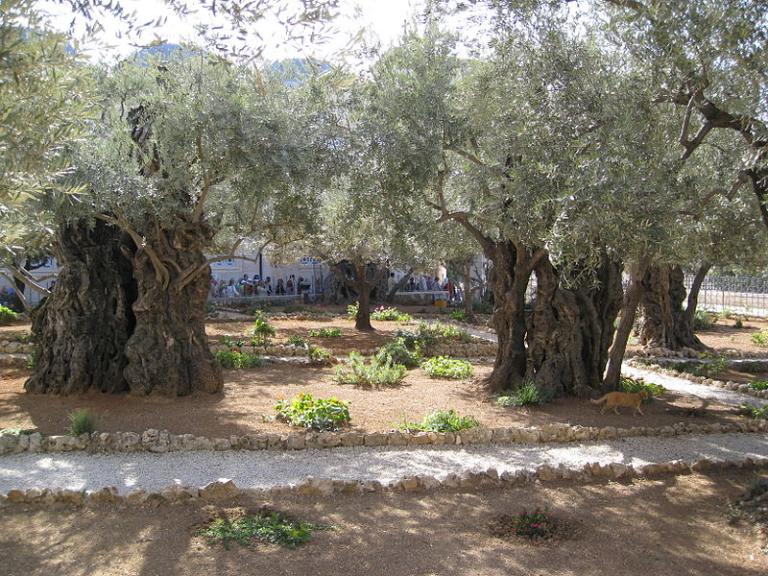
A portion of the Garden of Gethsemane as it appears today, with its ancient olive trees
(Wikimedia Commons public domain image)
This entry draws upon John W. Welch, et al., eds. Knowing Why: 137 Evidences That the Book of Mormon Is True (American Fork: Covenant Communications, 2017), 156-164:
One of the single most famous chapters in the Book of Mormon is Jacob 5, which recounts a lengthy olive tree allegory that it credits to a pre-Lehite Old World prophet, unknown to the Bible, that it identifies as Zenos. (As a matter of fact, Zenos is cited elsewhere in the Book of Mormon as well. He seems to have been popular among Nephite religious leaders.) Various inconclusive attempts have been made to identify him in surviving ancient extrabiblical records. Symbolic use of imagery derived from olive cultivation also exists throughout the Old and New Testaments. With that fact in mind, David Rolph Seely and John W. Welch of Brigham Young University have argued that “it is reasonable to postulate the existence of a fuller account of the olive tree allegory that predates most or all of these diverse and more partial uses” (159). And perhaps Zenos’s version is that “fuller account.
In any event, Jacob 5 plainly has roots deep in the ancient world.
Further, with its references to grafting, transplanting tender young branches, balancing the growth of the branches with the roots, nourishing, digging about, burning, weeding, and pruning, it also accurately represents many of the practices and scientific principles associated with growing and cultivating olives in the Mediterranean basin.
According to an article by several professional botanists:
Nearly all of the allegory in Jacob 5 corresponds exceptionally well with both ancient and modern botanical principles and horticultural practices. . . . It is hard to imagine that its author was not personally familiar with the minute details and practices involved in raising good olives in a Mediterranean climate. (163)
Moreover, although some very limited information about olive cultivation might be derivable through careful, focused study of the Bible and a few other books that were available during Joseph Smith’s early years (though likely not anywhere near where he lived), they contained only sparse details. And here’s another problem:
Joseph Smith probably had little knowledge of olive trees in New York, as they will not grow in the northeastern United States. (163)
For further reading, see:
John W. Welch, “The Last Words of Cenez and the Book of Mormon,” in Stephen D. Ricks and John W. Welch, eds., The Allegory of the Olive Tree: The Olive, the Bible, and Jacob 5 (Salt Lake City and Provo, UT: Deseret Book and FARMS, 1994), 305—321.
David Rolph Seely and John W. Welch, “Zenos and the Texts of the Old Testament,” in Stephen D. Ricks and John W. Welch, eds., The Allegory of the Olive Tree: The Olive, the Bible, and Jacob 5 (Salt Lake City and Provo, UT: Deseret Book and FARMS, 1994), 322—346.
David Rolph Seely, “The Allegory of the Olive Tree and the Use of Related Figurative Language in the Ancient Near East and Old Testament,” in Stephen D. Ricks and John W. Welch, eds., The Allegory of the Olive Tree: The Olive, the Bible, and Jacob 5 (Salt Lake City and Provo, UT: Deseret Book and FARMS, 1994), 290–304.
James E. Faulconer, “The Olive Tree and the Works of God: Jacob 5 and Romans 11,” in Stephen D. Ricks and John W. Welch, eds., The Allegory of the Olive Tree: The Olive, the Bible, and Jacob 5 (Salt Lake City and Provo, UT: Deseret Book and FARMS, 1994), 347–366.
John W. Welch and J. Gregory Welch, Charting the Book of Mormon: Visual Aids for Personal Study and Teaching (Provo, UT: FARMS, 1999), charts 81, 82, 83, and 95.
Wilford M. Hess, “Recent Notes about Olives in Antiquity,” BYU Studies 39/4 (2000): 115-126.
Wilford M. Hess, Daniel J. Fairbanks, John W. Welch, and Jonathan K. Diggs, “Botanical Aspects of Olive Culture Relevant to Jacob 5,”in Stephen D. Ricks and John W. Welch, eds., The Allegory of the Olive Tree: The Olive, the Bible, and Jacob 5 (Salt Lake City and Provo, UT: Deseret Book and FARMS, 1994), 484–562.
Wilford M. Hess, “Botanical Comparisons in the Allegory of the Olive Tree,” in Jacob through Words of Mormon, To Learn with Joy, Monte S. Nyman and Charles D. Tate Jr., eds. (Provo, UT: Religious Studies Center, Brigham Young University, 1990), 87–102.
Previous Post

May 9, 2020
Insights into the Book of Moses and other relevant topics
Next Post
May 9, 2020 Two Reports from Paradise?
Browse Our Archives
Select a Category Uncategorized
Select a Month October 2026 September 2026 August 2026 July 2026 June 2026 May 2026 April 2026 March 2026 February 2026 January 2026 December 2025 November 2025 October 2025 September 2025 August 2025 July 2025 June 2025 May 2025 April 2025 March 2025 February 2025 January 2025 December 2024 November 2024 October 2024 September 2024 August 2024 July 2024 June 2024 May 2024 April 2024 March 2024 February 2024 January 2024 December 2023 November 2023 October 2023 September 2023 August 2023 July 2023 June 2023 May 2023 April 2023 March 2023 February 2023 January 2023 December 2022 November 2022 October 2022 September 2022 August 2022 July 2022 June 2022 May 2022 April 2022 March 2022 February 2022 January 2022 December 2021 November 2021 October 2021 September 2021 August 2021 July 2021 June 2021 May 2021 April 2021 March 2021 February 2021 January 2021 December 2020 November 2020 October 2020 September 2020 August 2020 July 2020 June 2020 May 2020 April 2020 March 2020 February 2020 January 2020 December 2019 November 2019 October 2019 September 2019 August 2019 July 2019 June 2019 May 2019 April 2019 March 2019 February 2019 January 2019 December 2018 November 2018 October 2018 September 2018 August 2018 July 2018 June 2018 May 2018 April 2018 March 2018 February 2018 January 2018 December 2017 November 2017 October 2017 September 2017 August 2017 July 2017 June 2017 May 2017 April 2017 March 2017 February 2017 January 2017 December 2016 November 2016 October 2016 September 2016 August 2016 July 2016 June 2016 May 2016 April 2016 March 2016 February 2016 January 2016 December 2015 November 2015 October 2015 September 2015 August 2015 July 2015 June 2015 May 2015 April 2015 March 2015 February 2015 January 2015 December 2014 November 2014 March 2014 August 2013 February 2012
Follow Us!
TAKE THE
Religious Wisdom Quiz
I denounced Israel's opulent lifestyle—those who lie on beds of ivory and dine on choice lambs. What were they at ease in?
Select your answer to see how you score.
Their palaces Their security Zion Their wealth
Related posts from Sic et Non


Notes on Women, Priesthood, and General Conference

"The Book of Moses as a Temple Text"

TRENDING AT PATHEOS Latter-day Saint

Swimfan: Forgotten Aughts Pleasures
This is a recovery effort. In 2002, My Big Fat Greek Wedding...

Top Three Anti-Catholic Lies About Catholicism
This is my initial transcript for the video, "THE 3 WORST...

Pope Leo Celebrates Mass for Nurses & Docs...
I don't have any idea how he did it, but Pope Leo...

The Sermon on the Mount, Part I: Matthew...
The Sermon on the Mount, Part I (Matthew 4:12-5:12) St. Matthew moves...

What's up from Crossway: Reviewing some of their latest A few weeks...

Janie Learns the Way of the Cross: A...
Teaching children about Jesus' Passion can be challenging. Many parents and educators...
view all Latter-day Saint blogs
Ad-Free & Subscriber Log-In Subscription Support
- About Us
- 2026 Calendar
- Videos
- Podcasts
- Library of World Religions
- Faith In Media Tracker
- Advertise With Us
- Write for Us
- Privacy Policy
- Terms of Service
- Do Not Sell My Data
- Contact Us
- Radiant Digital
- Manage Newsletter Subscriptions
- Unsubscribe From Notifications
- Sitemap
Copyright 2008-2026, Patheos. All rights reserved.
Subscription Support Ad-Free & Subscriber Log-In
Follow Patheos