
BuddhistCatholicContemplativeEvangelicalGeneral ChristianHinduJewishLatter-day SaintMuslimNew VisionsProgressive Christian
Beliefs
- Buddhist
- Catholic
- Contemplative
- Evangelical
- General Christian
- Hindu
- Jewish
- Latter-day Saint
- More Voices
- Muslim
- New Visions
- Pagan
- Progressive Christian
Topics
- Religion News
- Food and Religion
- Sports and Religion
- Religious Art
- Religious Music and Entertainment
- Religious Events
- History and Religion
- Style and Religion
- Politics and Religion
- Women in Religion
- Recreation Outdoors and Religion
- Business Finance and Religion
- Careers Workplace and Religion
- Education and Religion
- Family Parenting and Religion
- Health Fitness and Religion
- Home and Religion
- Relationships and Religion
- Technology and Religion
- Travel and Religion
Columnists
- Buddhist Columnists
- Business Finance and Religion Columnists
- Careers Workplace and Religion Columnists
- Catholic Columnists
- Contemplative Columnists
- Education and Religion Columnists
- Evangelists Columnists
- Family Parenting and Religion Columnists
- General Christian Columnists
- Health Fitness and Religion Columnists
- Hindu Columnists
- History and Religion Columnists
- Home and Religion Columnists
- Jewish Columnists
- More Voices Columnists
- Latter Day Columnists
- Muslim Columnists
- New Visions Columnists
- Nonreligious Columnists
- Pagan Columnists
- Politics and Religion Columnists
- Progressive Columnists
- Recreation Outdoors and Religion Columnists
- Relationships and Religion Columnists
- Religion News Columnists
- Religious Art Columnists
- Religious Events Columnists
- Religious Music and Entertainment Columnists
- Sports and Religion Columnists
- Style and Religion Columnists
- Technology and Religion Columnists
- Travel and Religion Columnists
- Women in Religion Columnists
Resource Library
- 2026 Calendar
- Library of World Religions
- The 100 Most Holy Places on Earth
- Patheos Answers
- Podcasts
- Videos
- Faith Leaders Database
- Anglican Episcopalian
- Bahai
- Baptist
- Buddhism
- Christianity
- Confucianism
- Eastern Orthodoxy
- Hinduism
- Holiness and Pentecostal
- ISKCON
- Islam
- Judaism
- Lutheran
- Methodist
- The Church of Jesus Christ of Latter-day Saints
- New Age
- Paganism
- Presbytarian and Reformed
- Protestantism
- Religion Behind the Scenes
- Roman Catholic
- Scientology
- Shia Islam
- Sikhism
- Sufism
- Sunni Islam
- Taoism
- Zen
- See all religions
Research Tools
 Ad-Free & Subscriber Log-In Subscription Support
Ad-Free & Subscriber Log-In Subscription Support
Follow Patheos 

- Trending:
- Forgiveness
- |
- Marriage
- |
- Consciousness
- |
- Death Penalty
- |
- Election
- |
- Halloween

- Home
- Latter-day Saint
- Some jottings on the first chapter of Acts
Some jottings on the first chapter of Acts
Last updated on: May 4, 2020 at 12:46 am by Dan Peterson
Some jottings on the first chapter of Acts 2020-05-04T00:46:52-06:00 Dan Peterson
Patheos Explore the world's faith through different perspectives on religion and spirituality! Patheos has the views of the prevalent religions and spiritualities of the world.
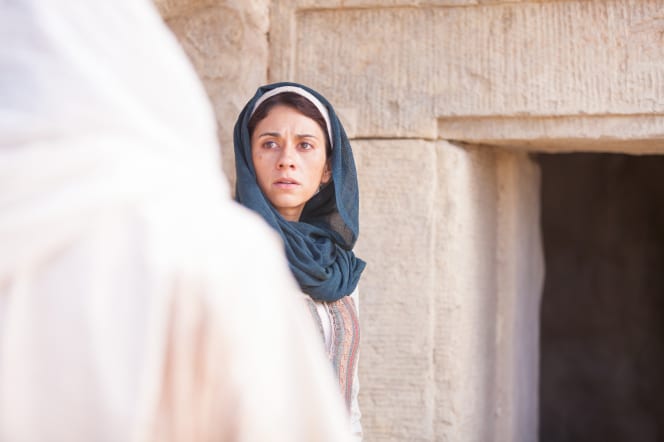
Mary Magdalene at the tomb of Jesus (LDS Media Library)
I offer here some thoughts that occurred to me as I read Acts 1 this morning. They regard the literality of the early Christian claim of Christ’s resurrection. For this blog entry (and for the sake of clarity and freshness), I’ll be using the English Standard Version (ESV) for the English text, unless I expressly indicate otherwise:
Acts 1:1-2:
In the first book, O Theophilus, I have dealt with all that Jesus began to do and teach,2 until the day when he was taken up, after he had given commands through the Holy Spirit to the apostles whom he had chosen.
The first book [πρῶτον λόγον; King James: former treatise; New American Standard: first account] to which Luke, the author of Acts, refers is plainly his own gospel. Scholars often speak of a coordinated two-part work that they call Luke-Acts. According to fairly strong tradition, Luke was a physician and, thus, among the best educated of the first generation of Christians. (He may have been a Gentile convert, or perhaps a Hellenized Jew.) The gospel of Luke begins with this explanation:
Inasmuch as many have undertaken to compile a narrative of the things that have been accomplished among us, 2 just as those who from the beginning were eyewitnesses [αὐτόπται (autoptai; literally “own eyes”)] and ministers of the word have delivered them to us, 3 it seemed good to me also, having followed all things closely for some time past, to write an orderly account for you, most excellent Theophilus, 4 that you may have certainty concerning the things you have been taught. (Luke 1:1-4).
This passage appears to suggest that Luke was relying for the writing of his gospel upon eyewitness testimony, perhaps even interviews, and there seems no reason to assume that he had abandoned that approach when he wrote the gospel’s sequel, the book of Acts. (For part of Acts, in fact, he may well have been Paul’s traveling companion and associate. [See the well-known “we” passages of Acts 16:10–17; 20:5–15; 21:1–18; 27:1–37; and 28:1-16.] If this is true, it would have afforded Luke plenty of time for talking, not only with Paul but with other early Christians. And, for many events, he would himself have been an eyewitness.)
Acts 1:3-4:
3 He presented himself alive [παρέστησεν ἑαυτὸν ζῶντα] to them after his suffering by many proofs [ἐν πολλοῖς τεκμηρίοις], appearing to them [ὀπτανόμενος αὐτοῖς] during forty days and speaking about the kingdom of God. 4 And while staying [συναλιζόμενος] with them he ordered them not to depart from Jerusalem.
Regarding 1:3’s “presented himself alive,” the relevant footnote in The UBS Greek New Testament: A Reader’s Edition (hereafter, UBS) gives the meaning of παρίστημι (from which παρέστησεν derives**)** as “to show,” “to present.” There is nothing in the verb to suggest metaphor.
Also in 1:3: ζῶντα (roughly zonta) is from the same Greek term that gives us words like zoo and zoology. It’s about animate — even animal — life. Literal. Not symbolic.
For the τεκμηρίοις of 1:3, the UBS gives “(decisive) proofs.”
The ESV footnote to 1:4’s staying offers the very down to earth eating as an alternative translation of συναλιζόμενος. It is a middle participle derived from the verb συναλίζω/συναλίζομαι. The Greek preposition σύν means “with,” “along with,” and shows up in such English words as symphony, sympathy, and synthesis. The UBS offers the relevant definition at 1:4 of “eat with (someone).” It could scarcely be more literal, even mundane. J. B. Phillips translates 1:4 as, simply, “On one occasion, while he was eating a meal with them, he emphasised that they were not to leave Jerusalem.”
Acts 1:9-10
9 And when he had said these things, as they were looking on [βλεπόντων αὐτῶν], he was lifted up, and a cloud took him out of their sight [ἀπὸ τῶν ὀφθαλμῶν αὐτῶν]. 10 And while they were gazing [ἀτενίζοντες] into heaven as he went, behold, two men stood by them in white robes, 11 and said, “Men of Galilee, why do you stand looking [βλέποντες] into heaven? This Jesus, who was taken up from you into heaven, will come in the same way as you saw [ἐθεάσασθε; etheasasthe] him go into heaven.”
The common Greek verb βλέπω (blepo), from which 1:9’s βλεπόντων and 1:11’s βλέποντες comes, simply means “to look.” It’s a usual verb for ordinary “looking.”
In 1:9, the “out of their sight” [ἀπὸ τῶν ὀφθαλμῶν αὐτῶν] is, literally, “from their eyes [ophthalmon].” (Think of ophthalmology and optics.) Martin Luther’s 1545 translation has “vor ihren Augen weg.” The 1995 Reina-Valera translation has “ocultó de sus ojos.” St. Jerome’s ancient Latin Vulgate has ab oculis eorum.
In 1:10, the participle ἀτενίζοντες comes from the verb ἀτενίζω, which means “to gaze at,” “to look intently at,” even “to stare.”
The ἐθεάσασθε of 1:11 is downright theatrical. The verb θεάομαι, from which it derives, means “to view” or “to gaze at.” It’s the word that gives us our noun theater.
These are words about literal seeing, not merely seeing “with the mind” or “in the mind’s eye.”
Finally, when Acts 1:15 says that “in those days Peter stood up [ἀναστὰς; anastas] among the brothers,” it uses a very ordinary verb that is directly related to the ἀναστάσεως (anastaseos) of Acts 1:21-23:
21 So one of the men who have accompanied us during all the time that the Lord Jesus went in and out among us, 22 beginning from the baptism of John until the day when he was taken up from us—one of these men must become with us a witness to his resurrection [ἀναστάσεως; anastaseos].” 23 And they put forward two, Joseph called Barsabbas, who was also called Justus, and Matthias.
The Greek ἀνάστασις (anastasis) , which we typically render as “resurrection,” simply means “standing up,” or “getting up.” There is nothing intrinsically mystical or spiritual or religious about it. Unless there’s reason to view it otherwise, it’s a very literal thing.
Small matters, in themselves. Certainly. But part of a much larger cumulative case through which I’m slowly thinking my way. This was physical. Real, not imaginary. To be understood literally. The witnesses, ordinary people, used ordinary language to describe what they really saw. That, certainly, is what Luke is saying.
Previous Post

May 2, 2020
BYU Education Week this August
Next Post
May 3, 2020 On temporary disembodiment
Browse Our Archives
Select a Category Uncategorized
Select a Month October 2026 September 2026 August 2026 July 2026 June 2026 May 2026 April 2026 March 2026 February 2026 January 2026 December 2025 November 2025 October 2025 September 2025 August 2025 July 2025 June 2025 May 2025 April 2025 March 2025 February 2025 January 2025 December 2024 November 2024 October 2024 September 2024 August 2024 July 2024 June 2024 May 2024 April 2024 March 2024 February 2024 January 2024 December 2023 November 2023 October 2023 September 2023 August 2023 July 2023 June 2023 May 2023 April 2023 March 2023 February 2023 January 2023 December 2022 November 2022 October 2022 September 2022 August 2022 July 2022 June 2022 May 2022 April 2022 March 2022 February 2022 January 2022 December 2021 November 2021 October 2021 September 2021 August 2021 July 2021 June 2021 May 2021 April 2021 March 2021 February 2021 January 2021 December 2020 November 2020 October 2020 September 2020 August 2020 July 2020 June 2020 May 2020 April 2020 March 2020 February 2020 January 2020 December 2019 November 2019 October 2019 September 2019 August 2019 July 2019 June 2019 May 2019 April 2019 March 2019 February 2019 January 2019 December 2018 November 2018 October 2018 September 2018 August 2018 July 2018 June 2018 May 2018 April 2018 March 2018 February 2018 January 2018 December 2017 November 2017 October 2017 September 2017 August 2017 July 2017 June 2017 May 2017 April 2017 March 2017 February 2017 January 2017 December 2016 November 2016 October 2016 September 2016 August 2016 July 2016 June 2016 May 2016 April 2016 March 2016 February 2016 January 2016 December 2015 November 2015 October 2015 September 2015 August 2015 July 2015 June 2015 May 2015 April 2015 March 2015 February 2015 January 2015 December 2014 November 2014 March 2014 August 2013 February 2012
Follow Us!
TAKE THE
Religious Wisdom Quiz
What Christian group believes in the doctrine of transubstantiation?
Select your answer to see how you score.
Catholics Pentecostals Baptists Protestants
Related posts from Sic et Non

An action movie and some vacuous theology


"The World's Sixteen Crucified Saviors"?

"The Loss of Jesus in the Small Plates...
TRENDING AT PATHEOS Latter-day Saint

Nearly every morning, I make the drive to Detroit with my high-school-age...

The Real AI Story Is Adoption Without Trust
Artificial intelligence has crossed a political threshold. It is no longer a...

A new article, written by Jeff Lindsay and Gale L. Pooley,...

Swimfan: Forgotten Aughts Pleasures
This is a recovery effort. In 2002, My Big Fat Greek Wedding...

Top Three Anti-Catholic Lies About Catholicism
This is my initial transcript for the video, "THE 3 WORST...

Pope Leo Celebrates Mass for Nurses & Docs...
I don't have any idea how he did it, but Pope Leo...
view all Latter-day Saint blogs
Ad-Free & Subscriber Log-In Subscription Support
- About Us
- 2026 Calendar
- Videos
- Podcasts
- Library of World Religions
- Faith In Media Tracker
- Advertise With Us
- Write for Us
- Privacy Policy
- Terms of Service
- Do Not Sell My Data
- Contact Us
- Radiant Digital
- Manage Newsletter Subscriptions
- Unsubscribe From Notifications
- Sitemap
Copyright 2008-2026, Patheos. All rights reserved.
Subscription Support Ad-Free & Subscriber Log-In
Follow Patheos