
BuddhistCatholicContemplativeEvangelicalGeneral ChristianHinduJewishLatter-day SaintMuslimNew VisionsProgressive Christian
Beliefs
- Buddhist
- Catholic
- Contemplative
- Evangelical
- General Christian
- Hindu
- Jewish
- Latter-day Saint
- More Voices
- Muslim
- New Visions
- Pagan
- Progressive Christian
Topics
- Religion News
- Food and Religion
- Sports and Religion
- Religious Art
- Religious Music and Entertainment
- Religious Events
- History and Religion
- Style and Religion
- Politics and Religion
- Women in Religion
- Recreation Outdoors and Religion
- Business Finance and Religion
- Careers Workplace and Religion
- Education and Religion
- Family Parenting and Religion
- Health Fitness and Religion
- Home and Religion
- Relationships and Religion
- Technology and Religion
- Travel and Religion
Columnists
- Buddhist Columnists
- Business Finance and Religion Columnists
- Careers Workplace and Religion Columnists
- Catholic Columnists
- Contemplative Columnists
- Education and Religion Columnists
- Evangelists Columnists
- Family Parenting and Religion Columnists
- General Christian Columnists
- Health Fitness and Religion Columnists
- Hindu Columnists
- History and Religion Columnists
- Home and Religion Columnists
- Jewish Columnists
- More Voices Columnists
- Latter Day Columnists
- Muslim Columnists
- New Visions Columnists
- Nonreligious Columnists
- Pagan Columnists
- Politics and Religion Columnists
- Progressive Columnists
- Recreation Outdoors and Religion Columnists
- Relationships and Religion Columnists
- Religion News Columnists
- Religious Art Columnists
- Religious Events Columnists
- Religious Music and Entertainment Columnists
- Sports and Religion Columnists
- Style and Religion Columnists
- Technology and Religion Columnists
- Travel and Religion Columnists
- Women in Religion Columnists
Resource Library
- 2026 Calendar
- Library of World Religions
- The 100 Most Holy Places on Earth
- Patheos Answers
- Podcasts
- Videos
- Faith Leaders Database
- Anglican Episcopalian
- Bahai
- Baptist
- Buddhism
- Christianity
- Confucianism
- Eastern Orthodoxy
- Hinduism
- Holiness and Pentecostal
- ISKCON
- Islam
- Judaism
- Lutheran
- Methodist
- The Church of Jesus Christ of Latter-day Saints
- New Age
- Paganism
- Presbytarian and Reformed
- Protestantism
- Religion Behind the Scenes
- Roman Catholic
- Scientology
- Shia Islam
- Sikhism
- Sufism
- Sunni Islam
- Taoism
- Zen
- See all religions
Research Tools
 Ad-Free & Subscriber Log-In Subscription Support
Ad-Free & Subscriber Log-In Subscription Support
Follow Patheos 

- Trending:
- Forgiveness
- |
- Marriage
- |
- Consciousness
- |
- Death Penalty
- |
- Election
- |
- Halloween

- Home
- Latter-day Saint
- Of Limhi and Seer Stones
Of Limhi and Seer Stones
Last updated on: May 18, 2020 at 12:24 am by Dan Peterson
Of Limhi and Seer Stones 2020-05-18T00:24:09-06:00 Dan Peterson
Patheos Explore the world's faith through different perspectives on religion and spirituality! Patheos has the views of the prevalent religions and spiritualities of the world.
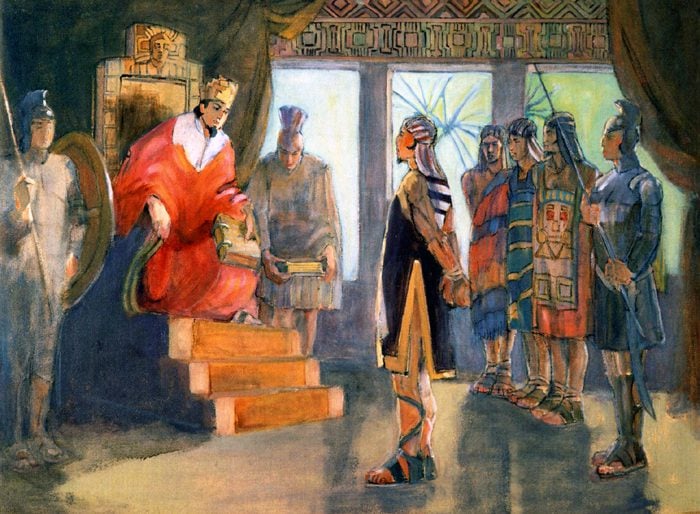
Ammon Stands Before Limhi (Minerva Teichert, ca. 1950; BYU Museum of Art)
From John W. Welch, et al., eds. Knowing Why: 137 Evidences That the Book of Mormon Is True (American Fork: Covenant Communications, 2017):
Knowing Why, pages 197-198, provides a short summary of John Gee, “Limhi in the Library,” Journal of Book of Mormon Studies 1, no. 1 (1992): 54–66.
If Mormon had not quoted extensively from his speeches, Limhi — son of King Noah, grandson of Zeniff, and a Nephite king in his own right — might be unknown to us. As John Gee pointed out, “Direct quotations of Limhi occur in the following places in the record: (1) The trial of Ammon, Amaleki, Helem, and Hem (Mosiah 7:8–15); (2) an official address given to all his subjects at a covenant renewal ceremony (Mosiah 7:17–33); (3) the discussion with Ammon about the records (Mosiah 8:5–21); and (4) the interrogation of the king of the Lamanites (Mosiah 20:13–22).”
Gee continues:
Something subtle and quite authentic has been done here in the Book of Mormon. All the direct quotations derive from situations where an official scribe would be on hand to write things down: a covenant renewal ceremony where the king would have ‘caused that the words which he spake should be written’ (Mosiah 2:8), two trials, and an inspection of the records where Limhi obviously hoped to get a translation of some otherwise mysterious records (Mosiah 8:6, 11–12). The quotes come from other official (i.e., court) records, scriptures, and personal accounts (e.g., Zeniff’s first-person narrative). (197)
This is very different, Gee argues, from the style of the novelists of Joseph Smith’s day — including Solomon Spalding [or Spaulding]. It also looks like real historiography.
***
On pages 199-200, Knowing Why briefly discusses the concept of a seer, including the reference at Mosiah 8:13:
Now Ammon said unto him: I can assuredly tell thee, O king, of a man that can translate the records; for he has wherewith that he can look, and translate all records that are of ancient date; and it is a gift from God. And the things are called interpreters, and no man can look in them except he be commanded, lest he should look for that he ought not and he should perish. And whosoever is commanded to look in them, the same is called seer.
In this regard, a good parallel is available in the Americas before Columbus:
There are . . . analogues among the ancient cultures of Mesoamerica, where ritual specialists would use “crystals” or “clear rocks” called zaztun (“stone of light”) “as a medium through which they receive revelation.” LDS Mesoamericanist Mark Alan Wright has noted the similarity between how Mayan ritual specialists use zaztun and the depiction of seership in Mosiah 8 and elsewhere in the the Book of Mormon. Hence, notions of seership in the Book of Mormon fit comfortably in [the] pre-Columbian American context. (200)
For further reading:
Steven C. Walker, “Seer,” in The Encyclopedia of Mormonism, ed. Daniel H. Ludlow (New York, N. Y.: Macmillan, 1992), 3:1292–1293.
Richard E. Turley Jr., Robin S. Jensen, and Mark Ashurst-McGee, “Joseph the Seer,” Ensign, October 2015, 49–54.
Michael Hubbard MacKay and Gerrit J. Dirkmaat, From Darkness Unto Light: Joseph Smith’s Translation and Publication of the Book of Mormon (Provo, UT and Salt Lake City, UT: Religious Studies Center, Brigham Young University, and Deseret Book, 2015).
Michael Hubbard MacKay and Nicholas J. Fredrick, Joseph Smith’s Seer Stones (Provo, UT and Salt Lake City, UT: Religious Studies Center, Brigham Young University, and Deseret Book, 2016).
Church of Jesus Christ of Latter-day Saints
Previous Post

May 16, 2020
Another Illustration of Our War with Science?
Next Post
May 17, 2020 Victor Hugo on Immortality?
Browse Our Archives
Select a Category Uncategorized
Select a Month October 2026 September 2026 August 2026 July 2026 June 2026 May 2026 April 2026 March 2026 February 2026 January 2026 December 2025 November 2025 October 2025 September 2025 August 2025 July 2025 June 2025 May 2025 April 2025 March 2025 February 2025 January 2025 December 2024 November 2024 October 2024 September 2024 August 2024 July 2024 June 2024 May 2024 April 2024 March 2024 February 2024 January 2024 December 2023 November 2023 October 2023 September 2023 August 2023 July 2023 June 2023 May 2023 April 2023 March 2023 February 2023 January 2023 December 2022 November 2022 October 2022 September 2022 August 2022 July 2022 June 2022 May 2022 April 2022 March 2022 February 2022 January 2022 December 2021 November 2021 October 2021 September 2021 August 2021 July 2021 June 2021 May 2021 April 2021 March 2021 February 2021 January 2021 December 2020 November 2020 October 2020 September 2020 August 2020 July 2020 June 2020 May 2020 April 2020 March 2020 February 2020 January 2020 December 2019 November 2019 October 2019 September 2019 August 2019 July 2019 June 2019 May 2019 April 2019 March 2019 February 2019 January 2019 December 2018 November 2018 October 2018 September 2018 August 2018 July 2018 June 2018 May 2018 April 2018 March 2018 February 2018 January 2018 December 2017 November 2017 October 2017 September 2017 August 2017 July 2017 June 2017 May 2017 April 2017 March 2017 February 2017 January 2017 December 2016 November 2016 October 2016 September 2016 August 2016 July 2016 June 2016 May 2016 April 2016 March 2016 February 2016 January 2016 December 2015 November 2015 October 2015 September 2015 August 2015 July 2015 June 2015 May 2015 April 2015 March 2015 February 2015 January 2015 December 2014 November 2014 March 2014 August 2013 February 2012
Follow Us!
TAKE THE
Religious Wisdom Quiz
Who cried at the tomb of Lazarus?
Select your answer to see how you score.
David John Peter Jesus
Related posts from Sic et Non


Some notes on the archaeology of the Bible


TRENDING AT PATHEOS Latter-day Saint

Swimfan: Forgotten Aughts Pleasures
This is a recovery effort. In 2002, My Big Fat Greek Wedding...

Top Three Anti-Catholic Lies About Catholicism
This is my initial transcript for the video, "THE 3 WORST...

Pope Leo Celebrates Mass for Nurses & Docs...
I don't have any idea how he did it, but Pope Leo...

The Sermon on the Mount, Part I: Matthew...
The Sermon on the Mount, Part I (Matthew 4:12-5:12) St. Matthew moves...

What's up from Crossway: Reviewing some of their latest A few weeks...

Janie Learns the Way of the Cross: A...
Teaching children about Jesus' Passion can be challenging. Many parents and educators...
view all Latter-day Saint blogs
Ad-Free & Subscriber Log-In Subscription Support
- About Us
- 2026 Calendar
- Videos
- Podcasts
- Library of World Religions
- Faith In Media Tracker
- Advertise With Us
- Write for Us
- Privacy Policy
- Terms of Service
- Do Not Sell My Data
- Contact Us
- Radiant Digital
- Manage Newsletter Subscriptions
- Unsubscribe From Notifications
- Sitemap
Copyright 2008-2026, Patheos. All rights reserved.
Subscription Support Ad-Free & Subscriber Log-In
Follow Patheos