
BuddhistCatholicContemplativeEvangelicalGeneral ChristianHinduJewishLatter-day SaintMuslimNew VisionsProgressive Christian
Beliefs
- Buddhist
- Catholic
- Contemplative
- Evangelical
- General Christian
- Hindu
- Jewish
- Latter-day Saint
- More Voices
- Muslim
- New Visions
- Pagan
- Progressive Christian
Topics
- Religion News
- Food and Religion
- Sports and Religion
- Religious Art
- Religious Music and Entertainment
- Religious Events
- History and Religion
- Style and Religion
- Politics and Religion
- Women in Religion
- Recreation Outdoors and Religion
- Business Finance and Religion
- Careers Workplace and Religion
- Education and Religion
- Family Parenting and Religion
- Health Fitness and Religion
- Home and Religion
- Relationships and Religion
- Technology and Religion
- Travel and Religion
Columnists
- Buddhist Columnists
- Business Finance and Religion Columnists
- Careers Workplace and Religion Columnists
- Catholic Columnists
- Contemplative Columnists
- Education and Religion Columnists
- Evangelists Columnists
- Family Parenting and Religion Columnists
- General Christian Columnists
- Health Fitness and Religion Columnists
- Hindu Columnists
- History and Religion Columnists
- Home and Religion Columnists
- Jewish Columnists
- More Voices Columnists
- Latter Day Columnists
- Muslim Columnists
- New Visions Columnists
- Nonreligious Columnists
- Pagan Columnists
- Politics and Religion Columnists
- Progressive Columnists
- Recreation Outdoors and Religion Columnists
- Relationships and Religion Columnists
- Religion News Columnists
- Religious Art Columnists
- Religious Events Columnists
- Religious Music and Entertainment Columnists
- Sports and Religion Columnists
- Style and Religion Columnists
- Technology and Religion Columnists
- Travel and Religion Columnists
- Women in Religion Columnists
Resource Library
- 2026 Calendar
- Library of World Religions
- The 100 Most Holy Places on Earth
- Patheos Answers
- Podcasts
- Videos
- Faith Leaders Database
- Anglican Episcopalian
- Bahai
- Baptist
- Buddhism
- Christianity
- Confucianism
- Eastern Orthodoxy
- Hinduism
- Holiness and Pentecostal
- ISKCON
- Islam
- Judaism
- Lutheran
- Methodist
- The Church of Jesus Christ of Latter-day Saints
- New Age
- Paganism
- Presbytarian and Reformed
- Protestantism
- Religion Behind the Scenes
- Roman Catholic
- Scientology
- Shia Islam
- Sikhism
- Sufism
- Sunni Islam
- Taoism
- Zen
- See all religions
Research Tools
 Ad-Free & Subscriber Log-In Subscription Support
Ad-Free & Subscriber Log-In Subscription Support
Follow Patheos 

- Trending:
- Forgiveness
- |
- Marriage
- |
- Consciousness
- |
- Death Penalty
- |
- Election
- |
- Halloween

- Home
- Latter-day Saint
- Literary craftsmanship and a jubilee celebration in Alma 29?
Literary craftsmanship and a jubilee celebration in Alma 29?
Last updated on: June 2, 2020 at 11:48 pm by Dan Peterson
Literary craftsmanship and a jubilee celebration in Alma 29? 2020-06-02T23:48:31-06:00 Dan Peterson
Patheos Explore the world's faith through different perspectives on religion and spirituality! Patheos has the views of the prevalent religions and spiritualities of the world.
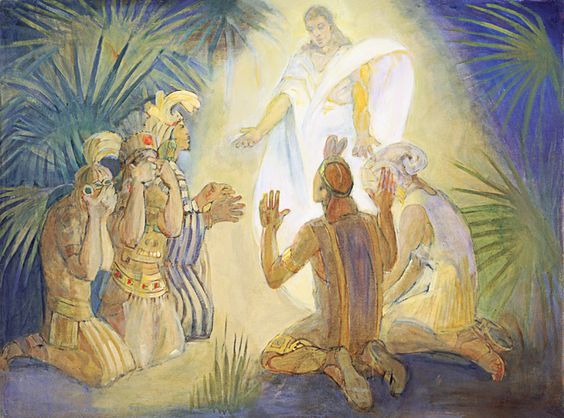
“An angel appears to Alma the Younger and the sons of Mosiah”
(Minerva Teichert, ca 1950-51; LDS.org)
John W. Welch, et al., eds. Knowing Why: 137 Evidences That the Book of Mormon Is True (American Fork: Covenant Communications, 2017), 314-318, treats Alma’s famous exclamation “O that I were an angel”:
I was especially struck by these paragraphs:
Alma’s use of trumpet imagery is interesting in light of the timing in which he wrote this thoughtful and moving piece of prophetic poetry—the 16th year of the reign of the judges. This was the 49th year since King Benjamin’s powerful oration at the coronation of his son Mosiah, an event some scholars believe was a jubilee celebration.
Christopher Wright explained, “The year of jubilee came at the end of the cycle of 7 Sabbatical Years.” Terrence L. Szink and John W. Welch documented, “The jubilee text of Leviticus 25 compares closely with two sections of Benjamin’s speech.” If this was a jubilee year, then Alma stepped down from the judgment-seat and began his missionary activities in the 42nd year, or the sixth sabbatical year, and Alma 29, marking the closure of one period in Alma’s ministry and beginning of a new, marks the next jubilee year.
In the 49th year, on the Day of Atonement, the “trumpet of the jubilee” would have again been sounded, “throughout all [the] land” (Leviticus 25:9), heralding in the next jubilee year. The Hebrew word yobel (carried into English as jubilee) literally means trumpet.
In the land of Israel, the trumpets would probably have been rams horns, but other kinds of horns could have been used, and some scholars have argued that loud shouting could also suffice. Alma’s expressed desire to “speak with the trump of God” and “with a voice of thunder” (Alma 29:1–2) thus seems “especially appropriate in this second identifiable jubilee season in Nephite history.” (314)
Textually, it is remarkable, to say the least, that the Book of Mormon manifests literary motifs associated with the jubilee in two places exactly 49 years apart. The rapid dictation of the Book of Mormon would hardly have allowed time for Joseph to count off the years and to mark these jubilees with such subtle sophistication, let alone to set the gorgeous language in Alma 29 so richly in this contextual background. (315)
But re-reading Alma 29 also reminds me of a column that I published in the Deseret News back on 20 June 2013:
“Intertextuality” is a word used to describe ways in which various texts refer to, or play off of, each other, often without explicitly indicating it. For example, a 2012 book titled “Seven Habits of Highly Fulfilled People” unmistakably alludes to Stephen Covey’s famous 1990 best-seller, “The 7 Habits of Highly Effective People.” Sometimes, authors hope that their audiences will keep the other text in mind.
The Book of Mormon contains numerous such examples, and probably quite a few remain to be discovered. John Welch has shown that legal language in the Book of Mormon tends to be highly consistent, perhaps indicating its dependence on underlying legal materials. Royal Skousen’s superb studies of the book’s textual history have established what he calls its “systematic nature”; its terminology and phrasing tend to be very consistent. I offer three non-legal examples first discussed by Professor Welch:
In Alma 36, Alma describes his conversion. At one point, he reports, “methought I saw, even as our father Lehi saw, God sitting upon his throne, surrounded with numberless concourses of angels, in the attitude of singing and praising their God” (36:22). Twenty-one of these words are quoted verbatim from 1 Nephi 1:8, where Lehi “thought he saw God sitting upon his throne, surrounded with numberless concourses of angels in the attitude of singing and praising their God.” These two passages are far apart. Yet, as Professor Welch points out, it’s “highly unlikely that Joseph Smith asked Oliver Cowdery to read back to him what he had translated earlier so that he could get the quote exactly the same. If that had happened, Oliver Cowdery would undoubtedly have questioned him and lost faith in the translation.”
Similar instances occur when, in Helaman 14:12, Samuel the Lamanite plainly quotes 21 words from King Benjamin (see Mosiah 3:8), and, very likely, when 3 Nephi 8:6-23, recounting the destruction in the New World at the crucifixion of Christ, mentions precisely the same natural phenomena prophesied by Zenos in 1 Nephi 19:11-12.
I would like to suggest two additional illustrations of Book of Mormon “intertextuality” that I, at least, don’t recall being mentioned anywhere else.
The first concerns Alma 29:1-2, in which Alma the Younger famously expresses his yearning to reach all humanity with the message of the gospel:
“O that I were an angel, and could have the wish of mine heart, that I might go forth and speak with the trump of God, with a voice to shake the earth, and cry repentance unto every people! Yea, I would declare unto every soul, as with the voice of thunder, repentance and the plan of redemption, that they should repent and come unto our God, that there might not be more sorrow upon all the face of the earth.”
Alma’s expression of his desire seems plainly based upon his own personal conversion experience, in which an angel appeared to him who “spake as it were with a voice of thunder, which caused the earth to shake,” and summoned him to repentance. “Doth not my voice shake the earth?” the angel asked, rhetorically. “He spake unto us, as it were the voice of thunder, and the whole earth did tremble beneath our feet” (see Mosiah 27:10-15; Alma 36:6-11).
The second proposed example suggests reliance upon the Old Testament story of Elijah, presumably available to the Nephites via the brass plates that Lehi brought with him from the Old World. (John Sorenson, incidentally, has suggested on other grounds that the brass plates originated in the northern kingdom of Israel, where Elijah lived and prophesied.)
In 1 Kings 19:11-12, we read of Elijah’s experience in the wilderness (perhaps in the Sinai) that “the Lord passed by, and a great and strong wind rent the mountains, and brake in pieces the rocks before the Lord; but the Lord was not in the wind: and after the wind an earthquake; but the Lord was not in the earthquake: And after the earthquake a fire; but the Lord was not in the fire: and after the fire a still small voice.” The Lord was “in” that “still small voice.”
The account of the destructions in 3 Nephi 8-11 tells of a great “storm,” “tempest,” “thunder” and “whirlwinds,” of fire and an earthquake that broke the rocks, ultimately followed by a “small voice” heralding the Savior’s appearance. Such literary crafting suggests that its author wanted us to think, while reading it, of the story of Elijah.
Previous Post

May 31, 2020
Two linguistic notes regarding Book of Mormon names
Next Post
June 1, 2020 Scientific reductionism and common sense
Browse Our Archives
Select a Category Uncategorized
Select a Month October 2026 September 2026 August 2026 July 2026 June 2026 May 2026 April 2026 March 2026 February 2026 January 2026 December 2025 November 2025 October 2025 September 2025 August 2025 July 2025 June 2025 May 2025 April 2025 March 2025 February 2025 January 2025 December 2024 November 2024 October 2024 September 2024 August 2024 July 2024 June 2024 May 2024 April 2024 March 2024 February 2024 January 2024 December 2023 November 2023 October 2023 September 2023 August 2023 July 2023 June 2023 May 2023 April 2023 March 2023 February 2023 January 2023 December 2022 November 2022 October 2022 September 2022 August 2022 July 2022 June 2022 May 2022 April 2022 March 2022 February 2022 January 2022 December 2021 November 2021 October 2021 September 2021 August 2021 July 2021 June 2021 May 2021 April 2021 March 2021 February 2021 January 2021 December 2020 November 2020 October 2020 September 2020 August 2020 July 2020 June 2020 May 2020 April 2020 March 2020 February 2020 January 2020 December 2019 November 2019 October 2019 September 2019 August 2019 July 2019 June 2019 May 2019 April 2019 March 2019 February 2019 January 2019 December 2018 November 2018 October 2018 September 2018 August 2018 July 2018 June 2018 May 2018 April 2018 March 2018 February 2018 January 2018 December 2017 November 2017 October 2017 September 2017 August 2017 July 2017 June 2017 May 2017 April 2017 March 2017 February 2017 January 2017 December 2016 November 2016 October 2016 September 2016 August 2016 July 2016 June 2016 May 2016 April 2016 March 2016 February 2016 January 2016 December 2015 November 2015 October 2015 September 2015 August 2015 July 2015 June 2015 May 2015 April 2015 March 2015 February 2015 January 2015 December 2014 November 2014 March 2014 August 2013 February 2012
Follow Us!
TAKE THE
Religious Wisdom Quiz
How many years did Solomon reign?
Select your answer to see how you score.
30 years 50 years 40 years 35 years
Related posts from Sic et Non


Some notes on the archaeology of the Bible


TRENDING AT PATHEOS Latter-day Saint

Nearly every morning, I make the drive to Detroit with my high-school-age...

The Real AI Story Is Adoption Without Trust
Artificial intelligence has crossed a political threshold. It is no longer a...

A new article, written by Jeff Lindsay and Gale L. Pooley,...

Swimfan: Forgotten Aughts Pleasures
This is a recovery effort. In 2002, My Big Fat Greek Wedding...

Top Three Anti-Catholic Lies About Catholicism
This is my initial transcript for the video, "THE 3 WORST...

Pope Leo Celebrates Mass for Nurses & Docs...
I don't have any idea how he did it, but Pope Leo...
view all Latter-day Saint blogs
Ad-Free & Subscriber Log-In Subscription Support
- About Us
- 2026 Calendar
- Videos
- Podcasts
- Library of World Religions
- Faith In Media Tracker
- Advertise With Us
- Write for Us
- Privacy Policy
- Terms of Service
- Do Not Sell My Data
- Contact Us
- Radiant Digital
- Manage Newsletter Subscriptions
- Unsubscribe From Notifications
- Sitemap
Copyright 2008-2026, Patheos. All rights reserved.
Subscription Support Ad-Free & Subscriber Log-In
Follow Patheos