
BuddhistCatholicContemplativeEvangelicalGeneral ChristianHinduJewishLatter-day SaintMuslimNew VisionsProgressive Christian
Beliefs
- Buddhist
- Catholic
- Contemplative
- Evangelical
- General Christian
- Hindu
- Jewish
- Latter-day Saint
- More Voices
- Muslim
- New Visions
- Pagan
- Progressive Christian
Topics
- Religion News
- Food and Religion
- Sports and Religion
- Religious Art
- Religious Music and Entertainment
- Religious Events
- History and Religion
- Style and Religion
- Politics and Religion
- Women in Religion
- Recreation Outdoors and Religion
- Business Finance and Religion
- Careers Workplace and Religion
- Education and Religion
- Family Parenting and Religion
- Health Fitness and Religion
- Home and Religion
- Relationships and Religion
- Technology and Religion
- Travel and Religion
Columnists
- Buddhist Columnists
- Business Finance and Religion Columnists
- Careers Workplace and Religion Columnists
- Catholic Columnists
- Contemplative Columnists
- Education and Religion Columnists
- Evangelists Columnists
- Family Parenting and Religion Columnists
- General Christian Columnists
- Health Fitness and Religion Columnists
- Hindu Columnists
- History and Religion Columnists
- Home and Religion Columnists
- Jewish Columnists
- More Voices Columnists
- Latter Day Columnists
- Muslim Columnists
- New Visions Columnists
- Nonreligious Columnists
- Pagan Columnists
- Politics and Religion Columnists
- Progressive Columnists
- Recreation Outdoors and Religion Columnists
- Relationships and Religion Columnists
- Religion News Columnists
- Religious Art Columnists
- Religious Events Columnists
- Religious Music and Entertainment Columnists
- Sports and Religion Columnists
- Style and Religion Columnists
- Technology and Religion Columnists
- Travel and Religion Columnists
- Women in Religion Columnists
Resource Library
- 2026 Calendar
- Library of World Religions
- The 100 Most Holy Places on Earth
- Patheos Answers
- Podcasts
- Videos
- Faith Leaders Database
- Anglican Episcopalian
- Bahai
- Baptist
- Buddhism
- Christianity
- Confucianism
- Eastern Orthodoxy
- Hinduism
- Holiness and Pentecostal
- ISKCON
- Islam
- Judaism
- Lutheran
- Methodist
- The Church of Jesus Christ of Latter-day Saints
- New Age
- Paganism
- Presbytarian and Reformed
- Protestantism
- Religion Behind the Scenes
- Roman Catholic
- Scientology
- Shia Islam
- Sikhism
- Sufism
- Sunni Islam
- Taoism
- Zen
- See all religions
Research Tools
 Ad-Free & Subscriber Log-In Subscription Support
Ad-Free & Subscriber Log-In Subscription Support
Follow Patheos 

- Trending:
- Forgiveness
- |
- Marriage
- |
- Consciousness
- |
- Death Penalty
- |
- Election
- |
- Halloween

- Home
- Latter-day Saint
- King Benjamin and the Blood of Christ
King Benjamin and the Blood of Christ
Last updated on: May 5, 2020 at 12:05 am by Dan Peterson
King Benjamin and the Blood of Christ 2020-05-05T00:05:19-06:00 Dan Peterson
Patheos Explore the world's faith through different perspectives on religion and spirituality! Patheos has the views of the prevalent religions and spiritualities of the world.
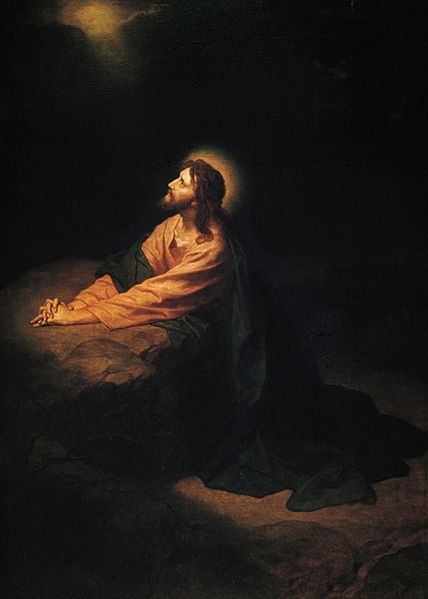
Heinrich Hofmann, “Christ in Gethsemane” (1886)
Wikimedia Commons public domain image
I share, here, some notes that I’ve taken from John W. Welch, et al., eds. Knowing Why: 137 Evidences That the Book of Mormon Is True (American Fork: Covenant Communications, 2017).
[In other words, this blog entry is partially made up of notes taken from a book. These notes are notes. From a book. The article from which the notes were taken is identified. I do not pretend that my notes here represent original research on my part. They are notes. I do not claim this as an original publication. It is a set of notes. I do not list blog entries among my publications. This blog entry is made up of notes. From a book. I’ve closely paraphrased what the book says. I’m simply sharing my notes. A week or two ago, I saw an article about a Latter-day Saint novelist who is sharing the writing of his newest novel live, online, complete with all of the false starts, revisions, crossed out lines, deleted paragraphs, and so forth. I have to confess that I found the idea quite unappealing. I myself wouldn’t want to do that. But I’m happy to share some portion of the notes that I take for my own non-fiction writing, thinking that some might find them of interest. I’m not trying to pretend that I am writing a new article of my own in such blog entries as this. I’m simply sharing my notes. Anybody who wants to brand me as a plagiarist for doing so is perfectly free to do that. But it seems a little bit silly to me and, knowing something of the history of those who’ve been making the charge of late, more than a little bit obsessive and malicious. I make no attempt to conceal the fact that these are notes. They are notes. And this nearly fifteen-year-old piece may be relevant, as well: http://mormanity.blogspot.com/2006/11/lds-apologists-daniel-peterson-john.html.]
King Benjamin’s coronation speech, recorded in the early chapters of the book of Mosiah in the Book of Mormon, was likely delivered in the context of a Nephite celebration of the Feast of Tabernacles, and, in the Jewish calendar, the Feast of Tabernacles follows Yom Kippur, the Day of Atonement. In the ancient Israelite temple, the rituals of the Day of Atonement included daubing and sprinkling the blood of sacrificial victims in order to purify various parts of the temple. (See Leviticus 16:14-19, 27.)
The book of Mosiah records that, immediately following King Benjamin’s mention of the atoning blood of Christ, the people cried out “O have mercy, and apply the atoning blood of Christ that we may receive forgiveness of our sins, and our hearts may be purified” (Mosiah 4:2). Furthermore, “It is perhaps ritually significant that Benjamin mentioned the words atone or atonement a total of seven times, the same number of times blood was sprinkled on the mercy seat and the altar” (190).
From the Mesoamerican perspective, the crowning of a king often occurred during harvest festivals, which included an enthronement ceremony involving a wooden tower or scaffold. (Compare Mosiah 2:7.) While on the tower, the Mesoamerican king would perform a ritual bloodletting, which sometimes entailed a shamanic vision, occasionally thought to provide information about future events. “Neither King Benjamin nor his successor Mosiah likely performed a bloodletting ritual, and Benjamin specifically disclaimed being divine (Mosiah 2:10, 26).” In that sense, his behavior may even have represented a conscious and public repudiation of surrounding customs. But he reported a vision of the future, including an eventual divine king who would shed his blood for the people. (191)
The account in the book of Mosiah seems to artfully combine Old World and New World concepts.
T. Benjamin Spackman, “The Israelite Roots of Atonement Terminology,” BYU Studies Quarterly 55, no. 1 (2016): 39–64.
Mark Alan Wright, “Axes Mundi: Ritual Complexes in Mesoamerica and the Book of Mormon,”Interpreter: A Journal of Mormon Scripture 12 (2014): 79–96.
Brant A. Gardner, Second Witness: Analytical and Contextual Commentary on the Book of Mormon, 6 vols. (Salt Lake City, UT: Greg Kofford Books, 2007–2008), 3:111–115, 151–156.
Terrence L. Szink and John W. Welch, “King Benjamin’s Speech in the Context of the Ancient Israelite Festivals,” in King Benjamin’s Speech: “That Ye May Learn Wisdom”, ed. John W. Welch and Stephen D. Ricks (Provo, UT: FARMS, 1998), 147–223.
Allen J. Christenson, “Annual FARMS lecture: Maya Harvest Festivals and the Book of Mormon,” Review of Books on the Book of Mormon 3, no. 1 (1991): 1–31.
Next Post

May 4, 2020 Trying to Get It Right
Browse Our Archives
Select a Category Uncategorized
Select a Month October 2026 September 2026 August 2026 July 2026 June 2026 May 2026 April 2026 March 2026 February 2026 January 2026 December 2025 November 2025 October 2025 September 2025 August 2025 July 2025 June 2025 May 2025 April 2025 March 2025 February 2025 January 2025 December 2024 November 2024 October 2024 September 2024 August 2024 July 2024 June 2024 May 2024 April 2024 March 2024 February 2024 January 2024 December 2023 November 2023 October 2023 September 2023 August 2023 July 2023 June 2023 May 2023 April 2023 March 2023 February 2023 January 2023 December 2022 November 2022 October 2022 September 2022 August 2022 July 2022 June 2022 May 2022 April 2022 March 2022 February 2022 January 2022 December 2021 November 2021 October 2021 September 2021 August 2021 July 2021 June 2021 May 2021 April 2021 March 2021 February 2021 January 2021 December 2020 November 2020 October 2020 September 2020 August 2020 July 2020 June 2020 May 2020 April 2020 March 2020 February 2020 January 2020 December 2019 November 2019 October 2019 September 2019 August 2019 July 2019 June 2019 May 2019 April 2019 March 2019 February 2019 January 2019 December 2018 November 2018 October 2018 September 2018 August 2018 July 2018 June 2018 May 2018 April 2018 March 2018 February 2018 January 2018 December 2017 November 2017 October 2017 September 2017 August 2017 July 2017 June 2017 May 2017 April 2017 March 2017 February 2017 January 2017 December 2016 November 2016 October 2016 September 2016 August 2016 July 2016 June 2016 May 2016 April 2016 March 2016 February 2016 January 2016 December 2015 November 2015 October 2015 September 2015 August 2015 July 2015 June 2015 May 2015 April 2015 March 2015 February 2015 January 2015 December 2014 November 2014 March 2014 August 2013 February 2012
Follow Us!
TAKE THE
Religious Wisdom Quiz
What did Moses do after breaking the tablets?
Select your answer to see how you score.
Left the camp Fasted for 30 days Returned to Sinai for new tablets Destroyed the calf
Related posts from Sic et Non

Notes on Women, Priesthood, and General Conference

"The Book of Moses as a Temple Text"


Some notes on the archaeology of the Bible
TRENDING AT PATHEOS Latter-day Saint

How to Make a Decision When You Can't...
Main point: It’s much more valuable to stay close to God so...

Archdiocese Hosts Military Marriage Retreat in Germany
RASTATT, Germany — The transient military lifestyle, with its frequent deployments and...

Nearly every morning, I make the drive to Detroit with my high-school-age...

The Real AI Story Is Adoption Without Trust
Artificial intelligence has crossed a political threshold. It is no longer a...

A new article, written by Jeff Lindsay and Gale L. Pooley,...

Swimfan: Forgotten Aughts Pleasures
This is a recovery effort. In 2002, My Big Fat Greek Wedding...
view all Latter-day Saint blogs
Ad-Free & Subscriber Log-In Subscription Support
- About Us
- 2026 Calendar
- Videos
- Podcasts
- Library of World Religions
- Faith In Media Tracker
- Advertise With Us
- Write for Us
- Privacy Policy
- Terms of Service
- Do Not Sell My Data
- Contact Us
- Radiant Digital
- Manage Newsletter Subscriptions
- Unsubscribe From Notifications
- Sitemap
Copyright 2008-2026, Patheos. All rights reserved.
Subscription Support Ad-Free & Subscriber Log-In
Follow Patheos