
BuddhistCatholicContemplativeEvangelicalGeneral ChristianHinduJewishLatter-day SaintMuslimNew VisionsProgressive Christian
Beliefs
- Buddhist
- Catholic
- Contemplative
- Evangelical
- General Christian
- Hindu
- Jewish
- Latter-day Saint
- More Voices
- Muslim
- New Visions
- Pagan
- Progressive Christian
Topics
- Religion News
- Food and Religion
- Sports and Religion
- Religious Art
- Religious Music and Entertainment
- Religious Events
- History and Religion
- Style and Religion
- Politics and Religion
- Women in Religion
- Recreation Outdoors and Religion
- Business Finance and Religion
- Careers Workplace and Religion
- Education and Religion
- Family Parenting and Religion
- Health Fitness and Religion
- Home and Religion
- Relationships and Religion
- Technology and Religion
- Travel and Religion
Columnists
- Buddhist Columnists
- Business Finance and Religion Columnists
- Careers Workplace and Religion Columnists
- Catholic Columnists
- Contemplative Columnists
- Education and Religion Columnists
- Evangelists Columnists
- Family Parenting and Religion Columnists
- General Christian Columnists
- Health Fitness and Religion Columnists
- Hindu Columnists
- History and Religion Columnists
- Home and Religion Columnists
- Jewish Columnists
- More Voices Columnists
- Latter Day Columnists
- Muslim Columnists
- New Visions Columnists
- Nonreligious Columnists
- Pagan Columnists
- Politics and Religion Columnists
- Progressive Columnists
- Recreation Outdoors and Religion Columnists
- Relationships and Religion Columnists
- Religion News Columnists
- Religious Art Columnists
- Religious Events Columnists
- Religious Music and Entertainment Columnists
- Sports and Religion Columnists
- Style and Religion Columnists
- Technology and Religion Columnists
- Travel and Religion Columnists
- Women in Religion Columnists
Resource Library
- 2026 Calendar
- Library of World Religions
- The 100 Most Holy Places on Earth
- Patheos Answers
- Podcasts
- Videos
- Faith Leaders Database
- Anglican Episcopalian
- Bahai
- Baptist
- Buddhism
- Christianity
- Confucianism
- Eastern Orthodoxy
- Hinduism
- Holiness and Pentecostal
- ISKCON
- Islam
- Judaism
- Lutheran
- Methodist
- The Church of Jesus Christ of Latter-day Saints
- New Age
- Paganism
- Presbytarian and Reformed
- Protestantism
- Religion Behind the Scenes
- Roman Catholic
- Scientology
- Shia Islam
- Sikhism
- Sufism
- Sunni Islam
- Taoism
- Zen
- See all religions
Research Tools
 Ad-Free & Subscriber Log-In Subscription Support
Ad-Free & Subscriber Log-In Subscription Support
Follow Patheos 

- Trending:
- Forgiveness
- |
- Marriage
- |
- Consciousness
- |
- Death Penalty
- |
- Election
- |
- Halloween

- Home
- Latter-day Saint
- Dante, Einstein, and the curvature of spacetime
Dante, Einstein, and the curvature of spacetime
Last updated on: May 15, 2020 at 11:49 pm by Dan Peterson
Dante, Einstein, and the curvature of spacetime 2020-05-15T23:49:09-06:00 Dan Peterson
Patheos Explore the world's faith through different perspectives on religion and spirituality! Patheos has the views of the prevalent religions and spiritualities of the world.

Dante holds a copy of his “Divine Comedy” in a fresco by Domenico di Michelino (1417-1491). With his right hand, he gestures toward a procession of sinners heading into Hell. Behind him on his right is Mount Purgatory, with repentant sinners toiling upward on its path. Behind him, to his left, is the city of Florence, including the dome of its cathedral and the tower of the Palazzo Vecchio. In the distance are the celestial spheres through which he will ascend during his tour of Paradise. Thus, all three books of the “Divina Commedia” — “Inferno,” “Purgatorio,” and “Paradiso” — are represented in this painting.
(Wikimedia Commons public domain image)
In a remarkable section (pages 77-88) of Carlo Rovelli, Reality Is Not What It Seems: The Journey to Quantum Gravity, translated by Simon Carnell and Erica Segre (Penguin, 2017), Rovelli, a prominent Italian theoretical physicist who currently directs the quantum gravity research group at the Centre de physique théorique in Marseilles, France, sets out to explain the nature of a “3-sphere” in order to help his readers grasp Albert Einstein’s vision of a universe that, given the curvature of spacetime, can be simultaneously finite and unbounded.
Such a universe is, I confess, very difficult for me to picture, but Rovelli probably does as good a job as it is possible to do.
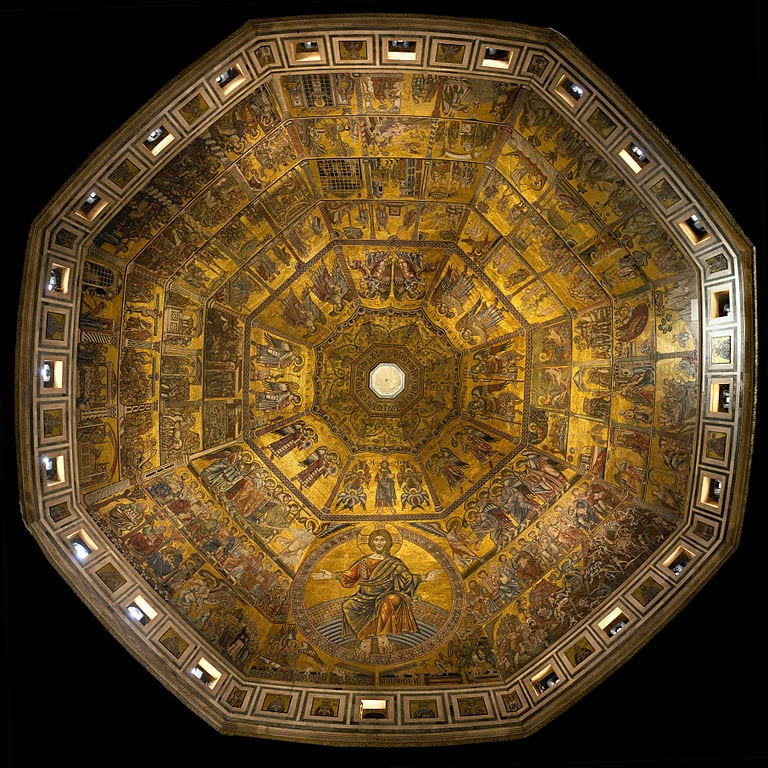
The mosaic ceiling of the Baptistry of San Giovanni in Florence, in a composite image created by Matthias Kabel in 2011 (Wikimedia Commons public domain image)
Then, quite unexpectedly — even though he is an Italian physicist — Rovelli immediately proposes that the illustrious Dante Alighieri, Italy’s greatest poet, had already intuited a 3-sphere cosmos in the Paradiso, the third volume of his early fourteenth-century Divina Commedia. And I must say that Rovelli makes a case for it. (The idea isn’t original with Rovelli; he credits its initial “discovery” to an American mathematician by the name of Mark Peterson, in 1979.) He connects it, too, to the interior design of the famous octagonal Baptistry of San Giovanni in Florence, which stands directly in front of the city’s remarkable Duomo or Cathedral.
Rovelli plainly admires Einstein enormously. But he has just previously been explaining that Einstein’s mathematical abilities were not the great physicist’s strength. Rather, what made Einstein amazingly unique was the power of his imagination. It’s interesting, in that light, to see Rovelli go on to link artistic inspiration or intuition with that in the sciences, and to use aesthetic language to appreciate the insights of both a great physicist and a great poet:
I don’t know if the young Einstein had encountered the Paradiso during his intellectual wanderings in Italy, and whether or not the vivid imagination of the Italian poet may have had a direct influence on his intuition that the universe might be both finite and without boundary. Whether or not such influence occurred, I believe that this example demonstrates how great science and great poetry are both visionary, and may even arrive at the same intuitions. Our culture is foolish to keep science and poetry separated: they are two tools to open our eyes to the complexity and beauty of the world.
Dante’s 3-sphere is only an intuition within a dream. Einstein’s 3-sphere has mathematical form and follows from the theory’s equations. The effect of each is different. Dante moves us deeply, touching the sources of our emotions. Einstein opens a road towards the unsolved mysteries of our universe. But both count among the most beautiful and significant flights that the mind can achieve. (88)
Previous Post

May 15, 2020
On reading Isaiah as Latter-day Saints
Next Post
May 15, 2020 Two (or three) very different conquests of Jerusalem
Browse Our Archives
Select a Category Uncategorized
Select a Month October 2026 September 2026 August 2026 July 2026 June 2026 May 2026 April 2026 March 2026 February 2026 January 2026 December 2025 November 2025 October 2025 September 2025 August 2025 July 2025 June 2025 May 2025 April 2025 March 2025 February 2025 January 2025 December 2024 November 2024 October 2024 September 2024 August 2024 July 2024 June 2024 May 2024 April 2024 March 2024 February 2024 January 2024 December 2023 November 2023 October 2023 September 2023 August 2023 July 2023 June 2023 May 2023 April 2023 March 2023 February 2023 January 2023 December 2022 November 2022 October 2022 September 2022 August 2022 July 2022 June 2022 May 2022 April 2022 March 2022 February 2022 January 2022 December 2021 November 2021 October 2021 September 2021 August 2021 July 2021 June 2021 May 2021 April 2021 March 2021 February 2021 January 2021 December 2020 November 2020 October 2020 September 2020 August 2020 July 2020 June 2020 May 2020 April 2020 March 2020 February 2020 January 2020 December 2019 November 2019 October 2019 September 2019 August 2019 July 2019 June 2019 May 2019 April 2019 March 2019 February 2019 January 2019 December 2018 November 2018 October 2018 September 2018 August 2018 July 2018 June 2018 May 2018 April 2018 March 2018 February 2018 January 2018 December 2017 November 2017 October 2017 September 2017 August 2017 July 2017 June 2017 May 2017 April 2017 March 2017 February 2017 January 2017 December 2016 November 2016 October 2016 September 2016 August 2016 July 2016 June 2016 May 2016 April 2016 March 2016 February 2016 January 2016 December 2015 November 2015 October 2015 September 2015 August 2015 July 2015 June 2015 May 2015 April 2015 March 2015 February 2015 January 2015 December 2014 November 2014 March 2014 August 2013 February 2012
Follow Us!
TAKE THE
Religious Wisdom Quiz
What did Daniel's three friends refuse to worship, resulting in their persecution?
Select your answer to see how you score.
A bronze snake A golden image A Persian king A cedar pole
Related posts from Sic et Non

A case of twin near-death experiences?

Toward a "Post-Materialist Science"?

In a sacred place, adjacent to a sacred...

A great American thinker on dogmatic scientific orthodoxy
TRENDING AT PATHEOS Latter-day Saint

How to Make a Decision When You Can't...
Main point: It’s much more valuable to stay close to God so...

Archdiocese Hosts Military Marriage Retreat in Germany
RASTATT, Germany — The transient military lifestyle, with its frequent deployments and...

Nearly every morning, I make the drive to Detroit with my high-school-age...

The Real AI Story Is Adoption Without Trust
Artificial intelligence has crossed a political threshold. It is no longer a...

A new article, written by Jeff Lindsay and Gale L. Pooley,...

Swimfan: Forgotten Aughts Pleasures
This is a recovery effort. In 2002, My Big Fat Greek Wedding...
view all Latter-day Saint blogs
Ad-Free & Subscriber Log-In Subscription Support
- About Us
- 2026 Calendar
- Videos
- Podcasts
- Library of World Religions
- Faith In Media Tracker
- Advertise With Us
- Write for Us
- Privacy Policy
- Terms of Service
- Do Not Sell My Data
- Contact Us
- Radiant Digital
- Manage Newsletter Subscriptions
- Unsubscribe From Notifications
- Sitemap
Copyright 2008-2026, Patheos. All rights reserved.
Subscription Support Ad-Free & Subscriber Log-In
Follow Patheos