
BuddhistCatholicContemplativeEvangelicalGeneral ChristianHinduJewishLatter-day SaintMuslimNew VisionsProgressive Christian
Beliefs
- Buddhist
- Catholic
- Contemplative
- Evangelical
- General Christian
- Hindu
- Jewish
- Latter-day Saint
- More Voices
- Muslim
- New Visions
- Pagan
- Progressive Christian
Topics
- Religion News
- Food and Religion
- Sports and Religion
- Religious Art
- Religious Music and Entertainment
- Religious Events
- History and Religion
- Style and Religion
- Politics and Religion
- Women in Religion
- Recreation Outdoors and Religion
- Business Finance and Religion
- Careers Workplace and Religion
- Education and Religion
- Family Parenting and Religion
- Health Fitness and Religion
- Home and Religion
- Relationships and Religion
- Technology and Religion
- Travel and Religion
Columnists
- Buddhist Columnists
- Business Finance and Religion Columnists
- Careers Workplace and Religion Columnists
- Catholic Columnists
- Contemplative Columnists
- Education and Religion Columnists
- Evangelists Columnists
- Family Parenting and Religion Columnists
- General Christian Columnists
- Health Fitness and Religion Columnists
- Hindu Columnists
- History and Religion Columnists
- Home and Religion Columnists
- Jewish Columnists
- More Voices Columnists
- Latter Day Columnists
- Muslim Columnists
- New Visions Columnists
- Nonreligious Columnists
- Pagan Columnists
- Politics and Religion Columnists
- Progressive Columnists
- Recreation Outdoors and Religion Columnists
- Relationships and Religion Columnists
- Religion News Columnists
- Religious Art Columnists
- Religious Events Columnists
- Religious Music and Entertainment Columnists
- Sports and Religion Columnists
- Style and Religion Columnists
- Technology and Religion Columnists
- Travel and Religion Columnists
- Women in Religion Columnists
Resource Library
- 2026 Calendar
- Library of World Religions
- The 100 Most Holy Places on Earth
- Patheos Answers
- Podcasts
- Videos
- Faith Leaders Database
- Anglican Episcopalian
- Bahai
- Baptist
- Buddhism
- Christianity
- Confucianism
- Eastern Orthodoxy
- Hinduism
- Holiness and Pentecostal
- ISKCON
- Islam
- Judaism
- Lutheran
- Methodist
- The Church of Jesus Christ of Latter-day Saints
- New Age
- Paganism
- Presbytarian and Reformed
- Protestantism
- Religion Behind the Scenes
- Roman Catholic
- Scientology
- Shia Islam
- Sikhism
- Sufism
- Sunni Islam
- Taoism
- Zen
- See all religions
Research Tools
 Ad-Free & Subscriber Log-In Subscription Support
Ad-Free & Subscriber Log-In Subscription Support
Follow Patheos 

- Trending:
- Forgiveness
- |
- Marriage
- |
- Consciousness
- |
- Death Penalty
- |
- Election
- |
- Halloween

- Home
- Latter-day Saint
- At the apparent ultimate boundary of science
At the apparent ultimate boundary of science
Last updated on: May 27, 2020 at 11:07 pm by Dan Peterson
At the apparent ultimate boundary of science 2020-05-27T23:07:56-06:00 Dan Peterson
Patheos Explore the world's faith through different perspectives on religion and spirituality! Patheos has the views of the prevalent religions and spiritualities of the world.
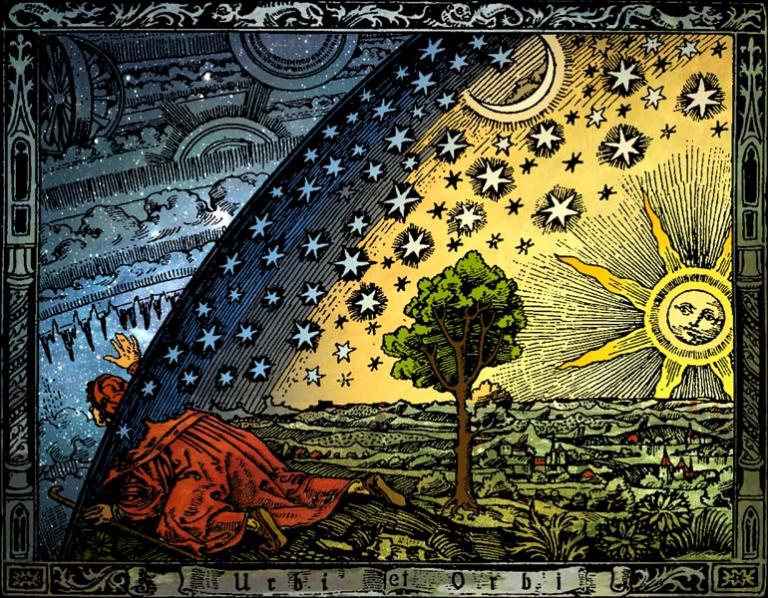
Science can no more reach behind or before the universe than it can reach outside it.
(A colorized version of the image created by Camille Flammarion [1842-1925])
Wikimedia Commons public domain image
The universe began approximately 13.8 billion years ago in a literally inconceivable explosion.
How do we know this? How was it discovered?
The so-called “Doppler effect” is relevant here, and a familiar example will explain it: If a train blows its whistle while sitting at rest in a train station, stationary listers will hear that whistle at the same pitch regardless of their location. However, as the train begins to move, those who are ahead of it will hear its whistle at a higher pitch, while listeners behind the train will hear the pitch of the whistle at a lower one. And the faster the train moves, the more pronounced will be the effect.
Anybody who has heard a train approaching and then continued to listen as it passes will have heard the difference.
The same thing, it turns out, happens with light waves as with sound waves.
Beginning with observations in 1912, the astronomer Vesto Slipher discovered that most spiral galaxies manifested notable “redshifts.” In other words, the light that reaches us from these galaxies seemed shifted toward the red end of the spectrum of visible colors. Slipher apparently didn’t conclude, at that time anyway, that this meant that they were receding from us at inconceivable speeds. Later, though, it was seen that the “redshift” was analogous to a moving train’s whistle. They appeared to be moving away.
I’ve already written here, very briefly — see “Einstein’s big mistake” — about Albert Einstein’s horrified reaction in 1917 to the implication of his equations that the universe is expanding, and about his vain attempt to evade that implication.
In 1922, though, the Russian scientist Alexander Friedmann (1888-1925) used the Einstein field equations to provide theoretical evidence that the universe is expanding. In 1927, the Belgian Catholic priest, mathematician, and astronomer Father Georges Lemaître independently reached a similar conclusion to Friedmann’s on a theoretical basis, but he also presented the first observational evidence for a linear relationship the recessional velocity of galaxies and their distance from us. Two years later, in 1929, the great American astronomer Edwin Hubble confirmed Lemaître’s findings and was able to identify an approximate correspondence between these “redshifts” and their distances from us. This was formulated as “Hubble’s Law,” which has now been officially renamed “Hubble–Lemaître’s law.”
The “redshift” was seen as powerful evidence for an expanding universe and for the Big Bang theory. Still, though, a rival cosmological theory, that of the so-called “steady-state,” continued to challenge the notion of an incredible primeval explosion. (The “Big Bang” was originally a term applied to the primordial explosion by the great British physicist Sir Fred Hoyle, who favored the alternative “steady-state” cosmology.) That rivalry was finally settled when, in 1964, the radio astronomers Arno Penzias and Robert Wilson discovered cosmic microwave background radiation that was interpreted as a kind of after-echo of the Big Bang. (This discovery won them the 1978 Nobel Prize in Physics.)
The scientific consensus today is not that the galaxies are all simply rushing away from Earth, as if we were the center of the universe. Rather, it is that they are moving rapidly away from each other, and that space itself is expanding.
So how do we come to believe, from an expanding universe, in a Big Bang? We simply roll the cosmic tape backwards. Go back in time and watch the universe contract, and contract, and contract. Eventually, we reach a point — literally, a geometric point — at which everything is inconceivably small. Then, for some reason, that point explodes — and space and time and matter all come into existence.
But what caused the explosion? Where did the “point” come from? It’s not clear that science can ever answer such questions. Why? Because physical matter, space, time, and the laws of physics all flared into existence at that point — at least, insofar as our universe is concerned. We have absolutely nothing — again, literally absolutely nothing — to go on in order to go beyond that point.
What was there before the Big Bang? Science cannot tell us. Why did the Big Bang occur 13.8 billion years ago? Why not 37.2 billion years ago, or 18.4 billion or 3.5 billion? Science cannot tell us. Why did it happen at all? Science cannot tell us. What caused it? Why is there anything? Science cannot tell us. There seems no way for science to reach beyond or behind it, any more than science can somehow reach outside our universe.
As one person has put it, it’s like a magician trying to pull a rabbit out of a hat. But without a hat. And without a magician. But, suddenly, there’s a rabbit.
Such, anyway, is how things seem to me right now.
Previous Post

May 27, 2020
The early Arab conquests and forced conversions
Next Post
May 27, 2020 Notes on racial and religious tolerance in early Islam
Browse Our Archives
Select a Category Uncategorized
Select a Month October 2026 September 2026 August 2026 July 2026 June 2026 May 2026 April 2026 March 2026 February 2026 January 2026 December 2025 November 2025 October 2025 September 2025 August 2025 July 2025 June 2025 May 2025 April 2025 March 2025 February 2025 January 2025 December 2024 November 2024 October 2024 September 2024 August 2024 July 2024 June 2024 May 2024 April 2024 March 2024 February 2024 January 2024 December 2023 November 2023 October 2023 September 2023 August 2023 July 2023 June 2023 May 2023 April 2023 March 2023 February 2023 January 2023 December 2022 November 2022 October 2022 September 2022 August 2022 July 2022 June 2022 May 2022 April 2022 March 2022 February 2022 January 2022 December 2021 November 2021 October 2021 September 2021 August 2021 July 2021 June 2021 May 2021 April 2021 March 2021 February 2021 January 2021 December 2020 November 2020 October 2020 September 2020 August 2020 July 2020 June 2020 May 2020 April 2020 March 2020 February 2020 January 2020 December 2019 November 2019 October 2019 September 2019 August 2019 July 2019 June 2019 May 2019 April 2019 March 2019 February 2019 January 2019 December 2018 November 2018 October 2018 September 2018 August 2018 July 2018 June 2018 May 2018 April 2018 March 2018 February 2018 January 2018 December 2017 November 2017 October 2017 September 2017 August 2017 July 2017 June 2017 May 2017 April 2017 March 2017 February 2017 January 2017 December 2016 November 2016 October 2016 September 2016 August 2016 July 2016 June 2016 May 2016 April 2016 March 2016 February 2016 January 2016 December 2015 November 2015 October 2015 September 2015 August 2015 July 2015 June 2015 May 2015 April 2015 March 2015 February 2015 January 2015 December 2014 November 2014 March 2014 August 2013 February 2012
Follow Us!
TAKE THE
Religious Wisdom Quiz
According to Galatians 5:22-23, what are these called: love, joy, peace, patience, kindness, goodness, faithfulness, gentleness, self-control?
Select your answer to see how you score.
The Ten Commandments The Gifts of the Spirit The Beatitudes The Fruit of the Spirit
Related posts from Sic et Non

A case of twin near-death experiences?

Toward a "Post-Materialist Science"?

A great American thinker on dogmatic scientific orthodoxy
Of Spheres, Spirals, Spindles, and the Divine
TRENDING AT PATHEOS Latter-day Saint

A new article, written by Jeff Lindsay and Gale L. Pooley,...

Swimfan: Forgotten Aughts Pleasures
This is a recovery effort. In 2002, My Big Fat Greek Wedding...

Top Three Anti-Catholic Lies About Catholicism
This is my initial transcript for the video, "THE 3 WORST...

Pope Leo Celebrates Mass for Nurses & Docs...
I don't have any idea how he did it, but Pope Leo...

The Sermon on the Mount, Part I: Matthew...
The Sermon on the Mount, Part I (Matthew 4:12-5:12) St. Matthew moves...

What's up from Crossway: Reviewing some of their latest A few weeks...
view all Latter-day Saint blogs
Ad-Free & Subscriber Log-In Subscription Support
- About Us
- 2026 Calendar
- Videos
- Podcasts
- Library of World Religions
- Faith In Media Tracker
- Advertise With Us
- Write for Us
- Privacy Policy
- Terms of Service
- Do Not Sell My Data
- Contact Us
- Radiant Digital
- Manage Newsletter Subscriptions
- Unsubscribe From Notifications
- Sitemap
Copyright 2008-2026, Patheos. All rights reserved.
Subscription Support Ad-Free & Subscriber Log-In
Follow Patheos