
BuddhistCatholicContemplativeEvangelicalGeneral ChristianHinduJewishLatter-day SaintMuslimNew VisionsProgressive Christian
Beliefs
- Buddhist
- Catholic
- Contemplative
- Evangelical
- General Christian
- Hindu
- Jewish
- Latter-day Saint
- More Voices
- Muslim
- New Visions
- Pagan
- Progressive Christian
Topics
- Religion News
- Food and Religion
- Sports and Religion
- Religious Art
- Religious Music and Entertainment
- Religious Events
- History and Religion
- Style and Religion
- Politics and Religion
- Women in Religion
- Recreation Outdoors and Religion
- Business Finance and Religion
- Careers Workplace and Religion
- Education and Religion
- Family Parenting and Religion
- Health Fitness and Religion
- Home and Religion
- Relationships and Religion
- Technology and Religion
- Travel and Religion
Columnists
- Buddhist Columnists
- Business Finance and Religion Columnists
- Careers Workplace and Religion Columnists
- Catholic Columnists
- Contemplative Columnists
- Education and Religion Columnists
- Evangelists Columnists
- Family Parenting and Religion Columnists
- General Christian Columnists
- Health Fitness and Religion Columnists
- Hindu Columnists
- History and Religion Columnists
- Home and Religion Columnists
- Jewish Columnists
- More Voices Columnists
- Latter Day Columnists
- Muslim Columnists
- New Visions Columnists
- Nonreligious Columnists
- Pagan Columnists
- Politics and Religion Columnists
- Progressive Columnists
- Recreation Outdoors and Religion Columnists
- Relationships and Religion Columnists
- Religion News Columnists
- Religious Art Columnists
- Religious Events Columnists
- Religious Music and Entertainment Columnists
- Sports and Religion Columnists
- Style and Religion Columnists
- Technology and Religion Columnists
- Travel and Religion Columnists
- Women in Religion Columnists
Resource Library
- 2026 Calendar
- Library of World Religions
- The 100 Most Holy Places on Earth
- Patheos Answers
- Podcasts
- Videos
- Faith Leaders Database
- Anglican Episcopalian
- Bahai
- Baptist
- Buddhism
- Christianity
- Confucianism
- Eastern Orthodoxy
- Hinduism
- Holiness and Pentecostal
- ISKCON
- Islam
- Judaism
- Lutheran
- Methodist
- The Church of Jesus Christ of Latter-day Saints
- New Age
- Paganism
- Presbytarian and Reformed
- Protestantism
- Religion Behind the Scenes
- Roman Catholic
- Scientology
- Shia Islam
- Sikhism
- Sufism
- Sunni Islam
- Taoism
- Zen
- See all religions
Research Tools
 Ad-Free & Subscriber Log-In Subscription Support
Ad-Free & Subscriber Log-In Subscription Support
Follow Patheos 

- Trending:
- Forgiveness
- |
- Marriage
- |
- Consciousness
- |
- Death Penalty
- |
- Election
- |
- Halloween

- Home
- Latter-day Saint
- Acts 2, with an axe to grind
Acts 2, with an axe to grind
Last updated on: May 4, 2020 at 11:53 pm by Dan Peterson
Acts 2, with an axe to grind 2020-05-04T23:53:08-06:00 Dan Peterson
Patheos Explore the world's faith through different perspectives on religion and spirituality! Patheos has the views of the prevalent religions and spiritualities of the world.
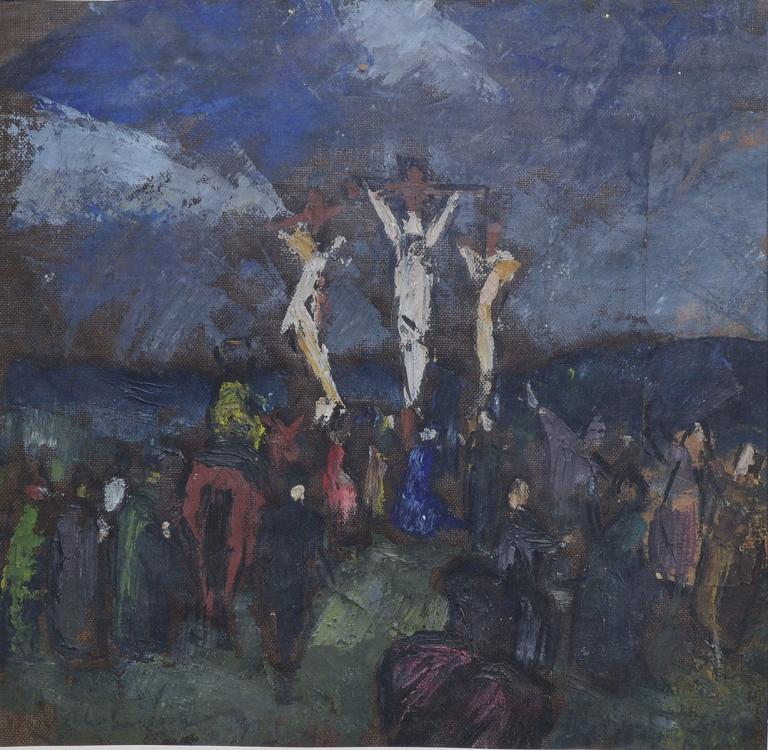
János Balázs (1904-1927), “Golgota” (1923); Wikimedia Commons public domain image
The principal action of Acts 2 occurs on Pentecost, as Acts 2:1 explains: “When the day of Pentecost arrived, they were all together in one place.”
The mainstream Christian holy day of Pentecost, which is still celebrated fifty days after Easter Sunday — meaning, of course, that it too always occurs on a Sunday — recalls the descent of the Holy Ghost upon the apostles and other disciples of Jesus while they were in Jerusalem marking the Festival of Weeks, or Shavuot (שבועות). The Greek word πεντηκοστή (pentēkostē) means “fiftieth.” The Feast or Festival of Weeks is a harvest festival that is celebrated seven weeks and one day after the first Sabbath of Passover or the Feast of Unleavened Bread.
Which is a long-winded way of explaining that the narrative of Acts 2 concerns the fiftieth day after the resurrection of Christ on Easter Sunday. According to Acts 1:3, Jesus intermittently appeared to his disciples “over a period of forty days” following his emergence from the tomb, presumably training them and preparing them for their new role as the leaders of the Church. (Ascension Day is traditionally celebrated on the fortieth day after Easter Sunday.) So Pentecost comes ten days after Christ ascended into heaven, and, so far as we are aware, it marks the apostles’ first public preaching after the death and resurrection of Jesus.
I’ll discuss only a very small part of the narrative, Acts 2:14, 22-24, 36, using the English Standard Version (ESV) as my English text. And, where it’s specifically cited, I’m also using Mikeal C. Parsons and Martin M. Culy, Acts: A Handbook on the Greek Text (Waco: Baylor University Press, 2003), to which I will refer as Parsons/Culy:
14 But Peter, standing with the eleven, lifted up his voice and addressed them: “Men of Judea and all who dwell in Jerusalem, let this be known to you, and give ear to my words. . . . 22 “Men of Israel, hear these words: Jesus of Nazareth, a man attested to you by God with mighty works and wonders and signs that God did through him in your midst, as you yourselves know [καθὼς αὐτοὶ οἴδατε]— 23 this Jesus, delivered up according to the definite plan and foreknowledge of God, you crucified and killed [προσπήξαντες ἀνείλατε] by the hands of lawless [ἀνόμων] men. 24 God raised him up, loosing the pangs of death, because it was not possible for him to be held by it. . . . 36 Let all the house of Israel therefore know for certain that God has made him both Lord and Christ, this Jesus whom you crucified [ὃν ὑμεῖς ἐσταυρώσατε].”
1:22 — “as you yourselves know” [καθὼς αὐτοὶ οἴδατε] — “This rhetorically powerful clause implies that the listeners were slow to accept the implications of what they knew to be true.” (Parsons/Culy 36).
1:23 — προσπήξαντες (literally, “having nailed up”)
1:23 — “killed” [ἀνείλατε] — The verb here comes from ἀναιρέω (“to bear away,” “to carry away,” “to destroy”). Its ending is already in the second person plural, which shows that Peter is directly addressing his audience. But it isn’t emphatic. Not yet.
1:23 — The “lawless men” (literally a-nomoi, “people without law”) were presumably the Romans and the Roman soldiers. They were Gentiles. But they were merely the instruments of the truly guilty, who killed Jesus “by the[ir] hands.” “You crucified and killed” him, Peter says to the “men of Judea and all who dwell in Jerusalem” (2:14) and to the “men of Israel” (1:22).
1:24 — “whom you crucified” [ὃν ὑμεῖς ἐσταυρώσατε] — The verb σταυρόω (“to crucify”) derives from the noun σταυρός (cross). Like ἀνείλατε above (“you [pl.] killed”), this verb, which is already in the second person plural, does not need an independently standing pronoun (“you” [pl.]” for its reference to be clear. The freestanding ὑμεῖς (“you” [pl.]), standing before the verb, is emphatic: “whom you killed.” “The overt fronted subject pronoun clearly identifies the agents of Jesus’ crucifixion, helps bring the speech to its climax, and implicitly calls for a response from the listeners” (Parsons/Culy 43).
Assuming that the account given by Luke in Acts 2 is essentially accurate, I’m very struck by this speech of Peter’s. It depicts belief in the resurrection of Jesus as very, very early. And Peter, who, with the other apostles, had been hiding out in an upper room immediately following the crucifixion of their leader, is now, less than two months later, both (1) flatly and fearlessly accusing his audience of a judicial murder against God’s chosen Christ and (2) publicly proclaiming that Jesus had risen from the tomb at a time when that tomb was presumably well known and when it could easily have been examined. The very authorities who had killed Jesus because they perceived him as a threat to them are still very much in power.
Previous Post

May 3, 2020
Emma, about Joseph
Browse Our Archives
Select a Category Uncategorized
Select a Month October 2026 September 2026 August 2026 July 2026 June 2026 May 2026 April 2026 March 2026 February 2026 January 2026 December 2025 November 2025 October 2025 September 2025 August 2025 July 2025 June 2025 May 2025 April 2025 March 2025 February 2025 January 2025 December 2024 November 2024 October 2024 September 2024 August 2024 July 2024 June 2024 May 2024 April 2024 March 2024 February 2024 January 2024 December 2023 November 2023 October 2023 September 2023 August 2023 July 2023 June 2023 May 2023 April 2023 March 2023 February 2023 January 2023 December 2022 November 2022 October 2022 September 2022 August 2022 July 2022 June 2022 May 2022 April 2022 March 2022 February 2022 January 2022 December 2021 November 2021 October 2021 September 2021 August 2021 July 2021 June 2021 May 2021 April 2021 March 2021 February 2021 January 2021 December 2020 November 2020 October 2020 September 2020 August 2020 July 2020 June 2020 May 2020 April 2020 March 2020 February 2020 January 2020 December 2019 November 2019 October 2019 September 2019 August 2019 July 2019 June 2019 May 2019 April 2019 March 2019 February 2019 January 2019 December 2018 November 2018 October 2018 September 2018 August 2018 July 2018 June 2018 May 2018 April 2018 March 2018 February 2018 January 2018 December 2017 November 2017 October 2017 September 2017 August 2017 July 2017 June 2017 May 2017 April 2017 March 2017 February 2017 January 2017 December 2016 November 2016 October 2016 September 2016 August 2016 July 2016 June 2016 May 2016 April 2016 March 2016 February 2016 January 2016 December 2015 November 2015 October 2015 September 2015 August 2015 July 2015 June 2015 May 2015 April 2015 March 2015 February 2015 January 2015 December 2014 November 2014 March 2014 August 2013 February 2012
Follow Us!
TAKE THE
Religious Wisdom Quiz
In Philippians, what does Paul say he has learned in any and every situation?
Select your answer to see how you score.
To give thanks To pray without ceasing To be content To trust God
Related posts from Sic et Non

“Once more unto the breach, dear friends, once...

A case of twin near-death experiences?

An action movie and some vacuous theology
Reflections on People Who Leave the Church
TRENDING AT PATHEOS Latter-day Saint

The First Eucharistic Controversy: Christ’s Real Presence
For Catholics, the Eucharist is the source and summit of the Christian...

What a Stop Sign Can Teach Us About...
How to Make a Decision When You Can't Hear God Main point:...

Archdiocese Hosts Military Marriage Retreat in Germany
RASTATT, Germany — The transient military lifestyle, with its frequent deployments and...

Nearly every morning, I make the drive to Detroit with my high-school-age...

The Real AI Story Is Adoption Without Trust
Artificial intelligence has crossed a political threshold. It is no longer a...

A new article, written by Jeff Lindsay and Gale L. Pooley,...
view all Latter-day Saint blogs
Ad-Free & Subscriber Log-In Subscription Support
- About Us
- 2026 Calendar
- Videos
- Podcasts
- Library of World Religions
- Faith In Media Tracker
- Advertise With Us
- Write for Us
- Privacy Policy
- Terms of Service
- Do Not Sell My Data
- Contact Us
- Radiant Digital
- Manage Newsletter Subscriptions
- Unsubscribe From Notifications
- Sitemap
Copyright 2008-2026, Patheos. All rights reserved.
Subscription Support Ad-Free & Subscriber Log-In
Follow Patheos