
BuddhistCatholicContemplativeEvangelicalGeneral ChristianHinduJewishLatter-day SaintMuslimNew VisionsProgressive Christian
Beliefs
- Buddhist
- Catholic
- Contemplative
- Evangelical
- General Christian
- Hindu
- Jewish
- Latter-day Saint
- More Voices
- Muslim
- New Visions
- Pagan
- Progressive Christian
Topics
- Religion News
- Food and Religion
- Sports and Religion
- Religious Art
- Religious Music and Entertainment
- Religious Events
- History and Religion
- Style and Religion
- Politics and Religion
- Women in Religion
- Recreation Outdoors and Religion
- Business Finance and Religion
- Careers Workplace and Religion
- Education and Religion
- Family Parenting and Religion
- Health Fitness and Religion
- Home and Religion
- Relationships and Religion
- Technology and Religion
- Travel and Religion
Columnists
- Buddhist Columnists
- Business Finance and Religion Columnists
- Careers Workplace and Religion Columnists
- Catholic Columnists
- Contemplative Columnists
- Education and Religion Columnists
- Evangelists Columnists
- Family Parenting and Religion Columnists
- General Christian Columnists
- Health Fitness and Religion Columnists
- Hindu Columnists
- History and Religion Columnists
- Home and Religion Columnists
- Jewish Columnists
- More Voices Columnists
- Latter Day Columnists
- Muslim Columnists
- New Visions Columnists
- Nonreligious Columnists
- Pagan Columnists
- Politics and Religion Columnists
- Progressive Columnists
- Recreation Outdoors and Religion Columnists
- Relationships and Religion Columnists
- Religion News Columnists
- Religious Art Columnists
- Religious Events Columnists
- Religious Music and Entertainment Columnists
- Sports and Religion Columnists
- Style and Religion Columnists
- Technology and Religion Columnists
- Travel and Religion Columnists
- Women in Religion Columnists
Resource Library
- 2026 Calendar
- Library of World Religions
- The 100 Most Holy Places on Earth
- Patheos Answers
- Podcasts
- Videos
- Faith Leaders Database
- Anglican Episcopalian
- Bahai
- Baptist
- Buddhism
- Christianity
- Confucianism
- Eastern Orthodoxy
- Hinduism
- Holiness and Pentecostal
- ISKCON
- Islam
- Judaism
- Lutheran
- Methodist
- The Church of Jesus Christ of Latter-day Saints
- New Age
- Paganism
- Presbytarian and Reformed
- Protestantism
- Religion Behind the Scenes
- Roman Catholic
- Scientology
- Shia Islam
- Sikhism
- Sufism
- Sunni Islam
- Taoism
- Zen
- See all religions
Research Tools
 Ad-Free & Subscriber Log-In Subscription Support
Ad-Free & Subscriber Log-In Subscription Support
Follow Patheos 

- Trending:
- Forgiveness
- |
- Marriage
- |
- Consciousness
- |
- Death Penalty
- |
- Election
- |
- Halloween

- Home
- Latter-day Saint
- “The Spacious Firmament on high”
“The Spacious Firmament on high”
Last updated on: April 20, 2020 at 10:46 pm by Dan Peterson
“The Spacious Firmament on high” 2020-04-20T22:46:37-06:00 Dan Peterson
Patheos Explore the world's faith through different perspectives on religion and spirituality! Patheos has the views of the prevalent religions and spiritualities of the world.

A night sky over Arizona (Wikimedia Commons public domain)
The Sabbath seems — especially during a period when we’re not getting out much — an unusually appropriate day on which to marvel at how very big and grand it all is. So I borrow here a couple of passages from David Wilkinson, God, Time and Stephen Hawking: An Exploration into Origins (London and Grand Rapids: Monarch Books, 2001):
Using these units [light years, each one of them “the distance travelled by light, at its constant speed of approximately 300,000,000 metres per second, over the time of one year”] the distance to the nearest star, Proxima Centauri, is about four light years.
Proxima Centauri and our Sun are among the stars that make up the Milky Way galaxy. This group of stars is visible on a clear night, if you can get away from street lighting, as a diffuse band of light across the sky. It contains 100 billion stars grouped together in a spiral pattern in a thin disc.
We are located about two-thirds of the distance away from the centre in the disc. At the centre there is a huge black hole the size of 2.5 million suns. The total diameter of the Milky Way is 100,000 light years. By multiplying this number by the 9.5 trillion kilometres (which is the distance of one light year), you can work out how long it would take to do a fly-drive!
As you might expect the story does not end there. The nearest galaxy to us can be seen from the southern hemisphere. It is called the Large Magellanic Cloud and is at a distance of 160,000 light years. At one-tenth the size of the Milky Way, it is quite a small galaxy, having only a mere 10 billion stars! (32-33)
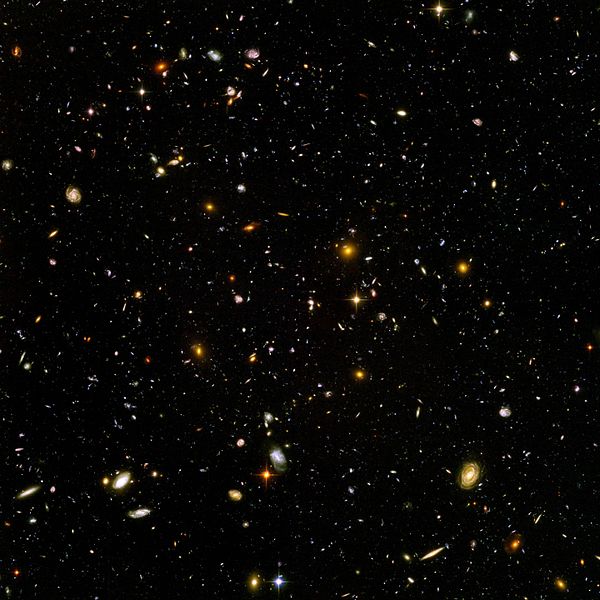
The Hubble Ultra Deep Field is an image of a small region of space in the constellation Fornax, composited from Hubble Space Telescope data accumulated over a period from September 3, 2003 through January 16, 2004, subsequent to the 1998 undertaking described immediately below. The patch of sky in which the galaxies reside was chosen because it had a low density of bright stars in the near-field.
(NASA and the European Space Agency)
In 1998, astronomers pointed the Hubble Space Telescope at one seemingly bland patch of sky for ten days, long enough to try to detect the first faint light from the beginning of time. The resulting picture was breathtaking. Some 4000 galaxies can be seen in a piece of sky that’s about as big as a grain of sand at arms length. As light travels at a constant speed, the light from these galaxies has taken billions of years to reach the mirror on the Hubble Space Telescope. We are seeing galaxies close to the beginning of the universe itself. (31)
Not a few people, viewing such wonders — or, much closer to home, contemplating sunsets or inspecting snowflakes, looking over the Grand Canyon or watching the ocean surf — have felt themselves drawn irresistibly to thoughts of God. Here, for example, is a poem by the English essayist Joseph Addison (1672-1719):
The Spacious Firmament on high,
With all the blue Ethereal Sky,
And spangled Heav’ns, a Shining Frame,
Their great Original proclaim:
Th’ unwearied Sun, from day to day,
Does his Creator’s Pow’r display,
And publishes to every Land
The Work of an Almighty Hand.
Soon as the Evening Shades prevail,
The Moon takes up the wondrous Tale,
And nightly to the list’ning Earth
Repeats the Story of her Birth:
Whilst all the Stars that round her burn,
And all the Planets, in their turn,
Confirm the Tidings as they rowl,
And spread the Truth from Pole to Pole.
What though, in solemn Silence, all
Move round the dark terrestrial Ball?
What tho’ nor real Voice nor Sound
Amid their radiant Orbs be found?
In Reason’s Ear they all rejoice,
And utter forth a glorious Voice,
For ever singing, as they shine,
The Hand that made us is Divine.
But it’s not only non-scientists and pre-moderns who, reflecting on the unfathomable vastness of the cosmos, have intuited the divine.
Allan Sandage (1926-2010), for instance — my near neighbor when I was growing up in San Gabriel, California — was one of the most influential astronomers of the twentieth century. A graduate of the California Institute of Technology and the leading protégé of Edwin Hubble, he discovered the first quasar and was the first to determine reasonably accurate values for the “Hubble constant” and for the age of the universe. Commencing in 1983, when he was in his late fifties, he became a fairly outspoken Christian. This is what Sandage said. This is what Allan Sandage said:
It was my science that drove me to the conclusion that the world is much more complicated than can be explained by science. It is only through the supernatural that I can understand the mystery of existence.
I find it quite improbable that such order came out of chaos. There has to be some organizing principle. God to me is a mystery, but is the explanation for the miracle of existence, why there is something instead of nothing.
The world is too complicated in all parts and interconnections to be due to chance alone. I am convinced that the existence of life with all its order in each of its organisms is simply too well put together. Each part of a living thing depends on all its other parts to function. How does each part know? How is each part specified at conception? The more one learns of biochemistry the more unbelievable it becomes unless there is some type of organizing principle — an architect.
I close with words from Moses 1, in the Pearl of Great Price:
And behold, the glory of the Lord was upon Moses, so that Moses stood in the presence of God, and talked with him face to face. And the Lord God said unto Moses: For mine own purpose have I made these things. Here is wisdom and it remaineth in me. And by the word of my power, have I created them, which is mine Only Begotten Son, who is full of grace and truth. And worlds without number have I created; and I also created them for mine own purpose; and by the Son I created them, which is mine Only Begotten. (Moses 1:31-33)
Previous Post

April 18, 2020
A Nephite Feast of Tabernacles
Next Post
April 19, 2020 Fifteen years ago
Browse Our Archives
Select a Category Uncategorized
Select a Month October 2026 September 2026 August 2026 July 2026 June 2026 May 2026 April 2026 March 2026 February 2026 January 2026 December 2025 November 2025 October 2025 September 2025 August 2025 July 2025 June 2025 May 2025 April 2025 March 2025 February 2025 January 2025 December 2024 November 2024 October 2024 September 2024 August 2024 July 2024 June 2024 May 2024 April 2024 March 2024 February 2024 January 2024 December 2023 November 2023 October 2023 September 2023 August 2023 July 2023 June 2023 May 2023 April 2023 March 2023 February 2023 January 2023 December 2022 November 2022 October 2022 September 2022 August 2022 July 2022 June 2022 May 2022 April 2022 March 2022 February 2022 January 2022 December 2021 November 2021 October 2021 September 2021 August 2021 July 2021 June 2021 May 2021 April 2021 March 2021 February 2021 January 2021 December 2020 November 2020 October 2020 September 2020 August 2020 July 2020 June 2020 May 2020 April 2020 March 2020 February 2020 January 2020 December 2019 November 2019 October 2019 September 2019 August 2019 July 2019 June 2019 May 2019 April 2019 March 2019 February 2019 January 2019 December 2018 November 2018 October 2018 September 2018 August 2018 July 2018 June 2018 May 2018 April 2018 March 2018 February 2018 January 2018 December 2017 November 2017 October 2017 September 2017 August 2017 July 2017 June 2017 May 2017 April 2017 March 2017 February 2017 January 2017 December 2016 November 2016 October 2016 September 2016 August 2016 July 2016 June 2016 May 2016 April 2016 March 2016 February 2016 January 2016 December 2015 November 2015 October 2015 September 2015 August 2015 July 2015 June 2015 May 2015 April 2015 March 2015 February 2015 January 2015 December 2014 November 2014 March 2014 August 2013 February 2012
Follow Us!
TAKE THE
Religious Wisdom Quiz
Who taught Apollos about the gospel of Jesus Christ.
Select your answer to see how you score.
Timothy Barnabas Aquila and Priscilla Paul
Related posts from Sic et Non

"The Book of Moses as a Temple Text"

A case of twin near-death experiences?

Toward a "Post-Materialist Science"?

"An Early Christian Context for the Book of...
TRENDING AT PATHEOS Latter-day Saint

The First Eucharistic Controversy: Christ’s Real Presence
For Catholics, the Eucharist is the source and summit of the Christian...

What a Stop Sign Can Teach Us About...
How to Make a Decision When You Can't Hear God Main point:...

Archdiocese Hosts Military Marriage Retreat in Germany
RASTATT, Germany — The transient military lifestyle, with its frequent deployments and...

Nearly every morning, I make the drive to Detroit with my high-school-age...

The Real AI Story Is Adoption Without Trust
Artificial intelligence has crossed a political threshold. It is no longer a...

A new article, written by Jeff Lindsay and Gale L. Pooley,...
view all Latter-day Saint blogs
Ad-Free & Subscriber Log-In Subscription Support
- About Us
- 2026 Calendar
- Videos
- Podcasts
- Library of World Religions
- Faith In Media Tracker
- Advertise With Us
- Write for Us
- Privacy Policy
- Terms of Service
- Do Not Sell My Data
- Contact Us
- Radiant Digital
- Manage Newsletter Subscriptions
- Unsubscribe From Notifications
- Sitemap
Copyright 2008-2026, Patheos. All rights reserved.
Subscription Support Ad-Free & Subscriber Log-In
Follow Patheos