
BuddhistCatholicContemplativeEvangelicalGeneral ChristianHinduJewishLatter-day SaintMuslimNew VisionsProgressive Christian
Beliefs
- Buddhist
- Catholic
- Contemplative
- Evangelical
- General Christian
- Hindu
- Jewish
- Latter-day Saint
- More Voices
- Muslim
- New Visions
- Pagan
- Progressive Christian
Topics
- Religion News
- Food and Religion
- Sports and Religion
- Religious Art
- Religious Music and Entertainment
- Religious Events
- History and Religion
- Style and Religion
- Politics and Religion
- Women in Religion
- Recreation Outdoors and Religion
- Business Finance and Religion
- Careers Workplace and Religion
- Education and Religion
- Family Parenting and Religion
- Health Fitness and Religion
- Home and Religion
- Relationships and Religion
- Technology and Religion
- Travel and Religion
Columnists
- Buddhist Columnists
- Business Finance and Religion Columnists
- Careers Workplace and Religion Columnists
- Catholic Columnists
- Contemplative Columnists
- Education and Religion Columnists
- Evangelists Columnists
- Family Parenting and Religion Columnists
- General Christian Columnists
- Health Fitness and Religion Columnists
- Hindu Columnists
- History and Religion Columnists
- Home and Religion Columnists
- Jewish Columnists
- More Voices Columnists
- Latter Day Columnists
- Muslim Columnists
- New Visions Columnists
- Nonreligious Columnists
- Pagan Columnists
- Politics and Religion Columnists
- Progressive Columnists
- Recreation Outdoors and Religion Columnists
- Relationships and Religion Columnists
- Religion News Columnists
- Religious Art Columnists
- Religious Events Columnists
- Religious Music and Entertainment Columnists
- Sports and Religion Columnists
- Style and Religion Columnists
- Technology and Religion Columnists
- Travel and Religion Columnists
- Women in Religion Columnists
Resource Library
- 2026 Calendar
- Library of World Religions
- The 100 Most Holy Places on Earth
- Patheos Answers
- Podcasts
- Videos
- Faith Leaders Database
- Anglican Episcopalian
- Bahai
- Baptist
- Buddhism
- Christianity
- Confucianism
- Eastern Orthodoxy
- Hinduism
- Holiness and Pentecostal
- ISKCON
- Islam
- Judaism
- Lutheran
- Methodist
- The Church of Jesus Christ of Latter-day Saints
- New Age
- Paganism
- Presbytarian and Reformed
- Protestantism
- Religion Behind the Scenes
- Roman Catholic
- Scientology
- Shia Islam
- Sikhism
- Sufism
- Sunni Islam
- Taoism
- Zen
- See all religions
Research Tools
 Ad-Free & Subscriber Log-In Subscription Support
Ad-Free & Subscriber Log-In Subscription Support
Follow Patheos 

- Trending:
- Forgiveness
- |
- Marriage
- |
- Consciousness
- |
- Death Penalty
- |
- Election
- |
- Halloween

- Home
- Latter-day Saint
- “The Four Proven or Minimal Facts Argument” for the Resurrection of Jesus
“The Four Proven or Minimal Facts Argument” for the Resurrection of Jesus
Last updated on: April 12, 2020 at 2:57 pm by Dan Peterson
“The Four Proven or Minimal Facts Argument” for the Resurrection of Jesus 2020-04-12T14:57:01-06:00 Dan Peterson
Patheos Explore the world's faith through different perspectives on religion and spirituality! Patheos has the views of the prevalent religions and spiritualities of the world.
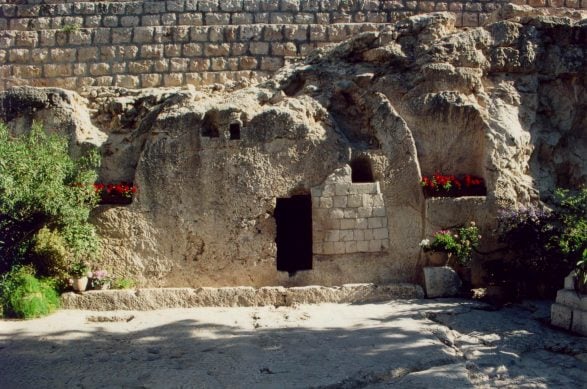
The Garden Tomb in Jerusalem (Wikimedia Commons public domain photo)
For the record: I don’t actually believe that the Garden Tomb is the right place. But it’s familiar, it will serve as a good illustration, and, anyhow, we don’t know exactly where the right place is (though it’s probably within a few hundred yards) and, so far as we know, have no photographs of it.
An apologetic that is sometimes used, particularly by Evangelical Protestants (such as William Lane Craig, Gary Habermas, and Michael Licona), to defend the idea of the resurrection of Christ is what is often called “the four proven or minimal facts argument.” I base the following notes on the summary of that argument given at Robert Hutchinson, Searching for Jesus: New Discoveries in the Quest for Jesus of Nazareth — and How They Confirm the Gospel Accounts (Nashville: Thomas Nelson, 2015). I’m simply taking notes here, so I’m not concerned to form what immediately follows into an argument. That will come later, as part of a much larger case. I observe, though, that Evangelical apologists like Gary Habermas currently favor a six- or seven-facts argument, not a four-facts defense.
In essence, all these authors argue that certain facts about Jesus’ final days can be established historically and that, when a reasonable person contemplates these facts without biases, the most plausible conclusion is that Jesus of Nazareth really did rise from the grave. (235)
Here are the four basic facts:
Fact 1: After his crucifixion, Jesus was buried by Joseph of Arimathea in a tomb. (235)
The burial of Jesus is attested in all four Gospels and in the even earlier writings of Paul. Accordingly, scholars regard the sources for these reports as extremely early — dating to within five to seven years of the crucifixion, if not earlier. William Lane Craig thinks it extremely unlikely that the benevolence of Joseph of Arimathea, a Jewish aristocrat who was a member of the Sanhedrin, was a fictional Christian invention. After all, he reasons, early Christians were notably hostile to Jewish leadership in Jerusalem, which they blamed for engineering Jesus’ judicial murder. Even John A. T. Robinson (1919-1983), a controversially liberal Anglican cleric who taught at Trinity College, Cambridge, acknowledged that the burial of Jesus in the tomb is “one of the earliest and best-attested facts about Jesus.”
Fact 2: On the Sunday after the crucifixion, Jesus’ tomb was found empty by a group of his women followers. (235)
The emptiness of the tomb is mentioned by multiple independent sources. William Lane Craig and others have contended in particular that the story of the women at the tomb is likely to be authentic because ancient Jews scarcely allowed women to serve as witnesses. Thus, if the story were simply invented, it is difficult to imagine why women would have been given the starring role in it. The New Testament scholar Ben Witherington III sees other elements in the story as potentially embarrassing: Mary Magdalene, for instance, has a questionable past (Luke 8:2) and she herself suggests the possibility that Jesus’ body may have been stolen from the tomb (Luke 20:2). Under the so-called “criterion of embarrassment,” he holds it to be very unlikely that the early Christian community would have invented fictional details that could serve to undermine its case.
Fact 3: On separate occasions and under diverse circumstances, different individuals and groups of people experienced appearances of Jesus alive from the dead. (236)
The very skeptical German New Testament critic Gerd Lüdemann declares that “It may be taken as historically certain that Peter and the disciples had experiences after Jesus’ death in which Jesus appeared to them as the risen Christ.”
Fact 4: The original disciples suddenly and sincerely came to believe that Jesus was risen from the dead despite their having every predisposition to the contrary. (236)
In Jesus’ day, Jews expected a conquering messiah who would liberate Israel. Moreover, while they anticipated a general resurrection at the end of the world, they did not expect an individual resurrection prior to that time. Accordingly, the conviction of Jesus’ death and resurrection went directly against their preconceived notions. As the Catholic New Testament scholar Luke Timothy Johnson says, “some sort of powerful, transformative experience is required to generate the sort of movement earliest Christianity was.”
On the basis of such arguments, fortified by others, such folks as William Lane Craig, Gary Habermas, Michael Licona, and, quite independently, N. T. Wright argue that the best explanation for the data is the idea that Jesus actually did rise from the dead.
Of course, there are certain scholars who deny some of these claimed facts. John Dominic Crossan, for instance, does not believe that Jesus was really buried in a rock-cut tomb. Some deny that the tomb was really found empty. (I’ll eventually respond to these positions.) And, yes, there are a very small number of mostly non-academics who maintain, against the vast consensus of both believing and unbelieving scholarly opinion, that Jesus never existed at all. For present purposes, I’ll ignore them.
Previous Post

April 12, 2020
Truly, he is risen!
Next Post
April 12, 2020 "Make No Mistake"
Browse Our Archives
Select a Category Uncategorized
Select a Month October 2026 September 2026 August 2026 July 2026 June 2026 May 2026 April 2026 March 2026 February 2026 January 2026 December 2025 November 2025 October 2025 September 2025 August 2025 July 2025 June 2025 May 2025 April 2025 March 2025 February 2025 January 2025 December 2024 November 2024 October 2024 September 2024 August 2024 July 2024 June 2024 May 2024 April 2024 March 2024 February 2024 January 2024 December 2023 November 2023 October 2023 September 2023 August 2023 July 2023 June 2023 May 2023 April 2023 March 2023 February 2023 January 2023 December 2022 November 2022 October 2022 September 2022 August 2022 July 2022 June 2022 May 2022 April 2022 March 2022 February 2022 January 2022 December 2021 November 2021 October 2021 September 2021 August 2021 July 2021 June 2021 May 2021 April 2021 March 2021 February 2021 January 2021 December 2020 November 2020 October 2020 September 2020 August 2020 July 2020 June 2020 May 2020 April 2020 March 2020 February 2020 January 2020 December 2019 November 2019 October 2019 September 2019 August 2019 July 2019 June 2019 May 2019 April 2019 March 2019 February 2019 January 2019 December 2018 November 2018 October 2018 September 2018 August 2018 July 2018 June 2018 May 2018 April 2018 March 2018 February 2018 January 2018 December 2017 November 2017 October 2017 September 2017 August 2017 July 2017 June 2017 May 2017 April 2017 March 2017 February 2017 January 2017 December 2016 November 2016 October 2016 September 2016 August 2016 July 2016 June 2016 May 2016 April 2016 March 2016 February 2016 January 2016 December 2015 November 2015 October 2015 September 2015 August 2015 July 2015 June 2015 May 2015 April 2015 March 2015 February 2015 January 2015 December 2014 November 2014 March 2014 August 2013 February 2012
Follow Us!
TAKE THE
Religious Wisdom Quiz
True or False: Cornelius was a Roman centurion who was the first Gentile convert.
Select your answer to see how you score.
TRUE FALSE
Related posts from Sic et Non

An action movie and some vacuous theology

Without Moroni statues, is the Church rejecting its...

"The World's Sixteen Crucified Saviors"?

"The Loss of Jesus in the Small Plates...
TRENDING AT PATHEOS Latter-day Saint

The Sermon on the Mount, Part I: Matthew...
The Sermon on the Mount, Part I (Matthew 4:12-5:12) St. Matthew moves...

What's up from Crossway: Reviewing some of their latest A few weeks...

Janie Learns the Way of the Cross: A...
Teaching children about Jesus' Passion can be challenging. Many parents and educators...

Looking For Good Catholic Writing - October 2026
He alone extends the heavens, and he walks upon the waves of...

In "Irreplaceable," our book on vocation and technology, Trevor Sutton and I...

I was strolling through the top floor of the brand new Parthenon...
view all Latter-day Saint blogs
Ad-Free & Subscriber Log-In Subscription Support
- About Us
- 2026 Calendar
- Videos
- Podcasts
- Library of World Religions
- Faith In Media Tracker
- Advertise With Us
- Write for Us
- Privacy Policy
- Terms of Service
- Do Not Sell My Data
- Contact Us
- Radiant Digital
- Manage Newsletter Subscriptions
- Unsubscribe From Notifications
- Sitemap
Copyright 2008-2026, Patheos. All rights reserved.
Subscription Support Ad-Free & Subscriber Log-In
Follow Patheos