
BuddhistCatholicContemplativeEvangelicalGeneral ChristianHinduJewishLatter-day SaintMuslimNew VisionsProgressive Christian
Beliefs
- Buddhist
- Catholic
- Contemplative
- Evangelical
- General Christian
- Hindu
- Jewish
- Latter-day Saint
- More Voices
- Muslim
- New Visions
- Pagan
- Progressive Christian
Topics
- Religion News
- Food and Religion
- Sports and Religion
- Religious Art
- Religious Music and Entertainment
- Religious Events
- History and Religion
- Style and Religion
- Politics and Religion
- Women in Religion
- Recreation Outdoors and Religion
- Business Finance and Religion
- Careers Workplace and Religion
- Education and Religion
- Family Parenting and Religion
- Health Fitness and Religion
- Home and Religion
- Relationships and Religion
- Technology and Religion
- Travel and Religion
Columnists
- Buddhist Columnists
- Business Finance and Religion Columnists
- Careers Workplace and Religion Columnists
- Catholic Columnists
- Contemplative Columnists
- Education and Religion Columnists
- Evangelists Columnists
- Family Parenting and Religion Columnists
- General Christian Columnists
- Health Fitness and Religion Columnists
- Hindu Columnists
- History and Religion Columnists
- Home and Religion Columnists
- Jewish Columnists
- More Voices Columnists
- Latter Day Columnists
- Muslim Columnists
- New Visions Columnists
- Nonreligious Columnists
- Pagan Columnists
- Politics and Religion Columnists
- Progressive Columnists
- Recreation Outdoors and Religion Columnists
- Relationships and Religion Columnists
- Religion News Columnists
- Religious Art Columnists
- Religious Events Columnists
- Religious Music and Entertainment Columnists
- Sports and Religion Columnists
- Style and Religion Columnists
- Technology and Religion Columnists
- Travel and Religion Columnists
- Women in Religion Columnists
Resource Library
- 2026 Calendar
- Library of World Religions
- The 100 Most Holy Places on Earth
- Patheos Answers
- Podcasts
- Videos
- Faith Leaders Database
- Anglican Episcopalian
- Bahai
- Baptist
- Buddhism
- Christianity
- Confucianism
- Eastern Orthodoxy
- Hinduism
- Holiness and Pentecostal
- ISKCON
- Islam
- Judaism
- Lutheran
- Methodist
- The Church of Jesus Christ of Latter-day Saints
- New Age
- Paganism
- Presbytarian and Reformed
- Protestantism
- Religion Behind the Scenes
- Roman Catholic
- Scientology
- Shia Islam
- Sikhism
- Sufism
- Sunni Islam
- Taoism
- Zen
- See all religions
Research Tools
 Ad-Free & Subscriber Log-In Subscription Support
Ad-Free & Subscriber Log-In Subscription Support
Follow Patheos 

- Trending:
- Forgiveness
- |
- Marriage
- |
- Consciousness
- |
- Death Penalty
- |
- Election
- |
- Halloween

- Home
- Latter-day Saint
- From my readings: “Nothingness” in ancient Egyptian thinking
From my readings: “Nothingness” in ancient Egyptian thinking
Last updated on: April 29, 2020 at 11:10 pm by Dan Peterson
From my readings: “Nothingness” in ancient Egyptian thinking 2020-04-29T23:10:33-06:00 Dan Peterson
Patheos Explore the world's faith through different perspectives on religion and spirituality! Patheos has the views of the prevalent religions and spiritualities of the world.
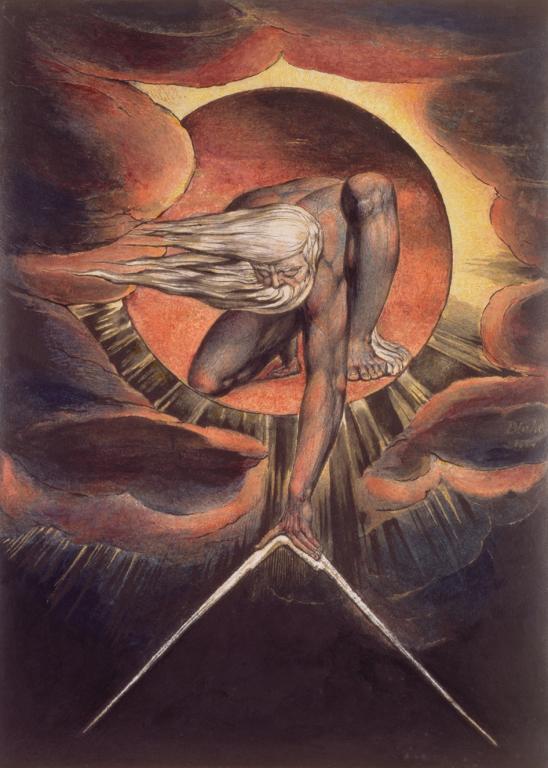
William Blake (1757-1827), “The Ancient of Days,”shows God as a geometer, imposing measure and order upon chaos (Wikimedia Commons public domain image)
I continue here with some notes from John H. Walton, Genesis 1 as Ancient Cosmology (Winona Lake, IN: Eisenbrauns, 2011). I see them as potentially relevant to such varied topics as the idea of creation ex nihilo, understanding the story of creation presented in the first chapters of Genesis, and properly interpreting the “destruction” of the Nephites and especially of the Jaredites in the Book of Mormon:
Walton cites the eminent Egyptologist Erik Hornung, now retired from the University of Basel in Switzerland:
“that which is nameless does not exist,” implying that material properties are not criteria for the distinction [between existent and nonexistent] . . . With this distinction between existent and nonexistent in mind, we see that, for the Egyptians, creation did not involve transformation of the nonexistent into the existent (which is what most moderns would most easily consider to be the definition of “creation”). Instead, space is created for the existent as the nonexistent is pushed behind boundaries or beyond limits while yet remaining alongside that which is existent. . . . When a pharaoh such as Ramesses II is said to “make rebellious foreign lands non-existent,” it does not mean that he annihilates them or sends them into oblivion but that he drives them out of the realm of the existent beyond the boundaries into the realm of the nonexistent. Hornung offers his summary conclusion: “For [Egyptians] the nonexistent is the inexhaustible, unrealized primal matter.” (25)
Again citing Hornung:
One could say that in Egypt “the nonexistent” signified quite generally that which is inchoate, undifferentiated, unarticulated, and unlimited; or in affirmative form, the entirety of what is possible, the absolute, the definitive. In comparison with the nonexistent, the existent is clearly defined, and articulated by boundaries and discriminations. (26)
Citing the American Egyptologist James Peter Allen:
What lies outside the biosphere of earth, sky, and Duat is not “nothingness” but a universe that is the antithesis of all that defines the world. It is infinite, where the world is bounded; formless and chaotic, where the world is shaped and ordered; inert, where the world is active; and wholly uniform in substance (water), where the world is materially diverse. (26)
Walton in his own voice, commenting on the foregoing:
This Egyptian view of nonexistence is not found throughout the ancient world and thus constitutes a unique element of the Egyptian cognitive landscape. But the inchoate nature of this nonproductive, nondiversified, nonfunctional precosmic state is evidenced more widely and in a variety of forms, as can be discerned by evaluation of the literature left by other ancient cultures. . . . [T]he Egyptian view of nothingness/nonexistence points to the fact that the Egyptian ontology was nonmaterial. It is this belief that we will show was common throughout the ancient Near East. (26)
[Postscript: To those who eagerly scan these blog entries in hopes of finding evidence of plagiarism: The entries that I identify as “notes” are, as I say, notes. In the particular case above, they are notes from John H. Walton, Genesis 1 as Ancient Cosmology (Winona Lake, IN: Eisenbrauns, 2011). They are notes from that text. I do not count them as my original creation. I do not count them as a publication of mine. They are notes, of the kind that I would, in the old days, have written onto an index card or into a notebook for future use. I share them here because I think that some might find them of interest, and also because using them as blog entries gives me an incentive to extract them from my readings. (It’s plainly easier and faster to read and to mark passages than to copy out notes from those marked passages, but making double use of them [here currently, and as resource material for a planned future book] makes the task more agreeable to me.) Sometimes, as here, they will be all or mostly actual quotations. Some other times, they will all or mostly be my closely paraphrased jottings, or something in between the two.]
Previous Post

April 28, 2020
"Can We Trust the Gospels?"
Next Post
April 29, 2020 From my reading: "Arab Voices"
Browse Our Archives
Select a Category Uncategorized
Select a Month October 2026 September 2026 August 2026 July 2026 June 2026 May 2026 April 2026 March 2026 February 2026 January 2026 December 2025 November 2025 October 2025 September 2025 August 2025 July 2025 June 2025 May 2025 April 2025 March 2025 February 2025 January 2025 December 2024 November 2024 October 2024 September 2024 August 2024 July 2024 June 2024 May 2024 April 2024 March 2024 February 2024 January 2024 December 2023 November 2023 October 2023 September 2023 August 2023 July 2023 June 2023 May 2023 April 2023 March 2023 February 2023 January 2023 December 2022 November 2022 October 2022 September 2022 August 2022 July 2022 June 2022 May 2022 April 2022 March 2022 February 2022 January 2022 December 2021 November 2021 October 2021 September 2021 August 2021 July 2021 June 2021 May 2021 April 2021 March 2021 February 2021 January 2021 December 2020 November 2020 October 2020 September 2020 August 2020 July 2020 June 2020 May 2020 April 2020 March 2020 February 2020 January 2020 December 2019 November 2019 October 2019 September 2019 August 2019 July 2019 June 2019 May 2019 April 2019 March 2019 February 2019 January 2019 December 2018 November 2018 October 2018 September 2018 August 2018 July 2018 June 2018 May 2018 April 2018 March 2018 February 2018 January 2018 December 2017 November 2017 October 2017 September 2017 August 2017 July 2017 June 2017 May 2017 April 2017 March 2017 February 2017 January 2017 December 2016 November 2016 October 2016 September 2016 August 2016 July 2016 June 2016 May 2016 April 2016 March 2016 February 2016 January 2016 December 2015 November 2015 October 2015 September 2015 August 2015 July 2015 June 2015 May 2015 April 2015 March 2015 February 2015 January 2015 December 2014 November 2014 March 2014 August 2013 February 2012
Follow Us!
TAKE THE
Religious Wisdom Quiz
Who was the first Judge of Israel?
Select your answer to see how you score.
Othniel Samson Gideon Deborah
Related posts from Sic et Non


Some notes on the archaeology of the Bible


TRENDING AT PATHEOS Latter-day Saint

In "Irreplaceable," our book on vocation and technology, Trevor Sutton and I...

I was strolling through the top floor of the brand new Parthenon...

What Does Gêvâh Mean For Kimberley Guifoyle &...
This week, a lot of the news is focused on Kimberly Guilfoyle....

INNER CIRCLE: Profound Mystery (Of Christ In All...
Ephesians 5:31-32 “For this reason, a man will leave his father and...

Do Not Rejoice When Your Enemy Falls: The...
Turning an execution into a public spectacle is a disturbing expression of...

'The Chosen' S6 Trailer: The Passion Gets Very...
Not many watching 'The Chosen' worry about spoilers, but just because they...
view all Latter-day Saint blogs
Ad-Free & Subscriber Log-In Subscription Support
- About Us
- 2026 Calendar
- Videos
- Podcasts
- Library of World Religions
- Faith In Media Tracker
- Advertise With Us
- Write for Us
- Privacy Policy
- Terms of Service
- Do Not Sell My Data
- Contact Us
- Radiant Digital
- Manage Newsletter Subscriptions
- Unsubscribe From Notifications
- Sitemap
Copyright 2008-2026, Patheos. All rights reserved.
Subscription Support Ad-Free & Subscriber Log-In
Follow Patheos