
BuddhistCatholicContemplativeEvangelicalGeneral ChristianHinduJewishLatter-day SaintMuslimNew VisionsProgressive Christian
Beliefs
- Buddhist
- Catholic
- Contemplative
- Evangelical
- General Christian
- Hindu
- Jewish
- Latter-day Saint
- More Voices
- Muslim
- New Visions
- Pagan
- Progressive Christian
Topics
- Religion News
- Food and Religion
- Sports and Religion
- Religious Art
- Religious Music and Entertainment
- Religious Events
- History and Religion
- Style and Religion
- Politics and Religion
- Women in Religion
- Recreation Outdoors and Religion
- Business Finance and Religion
- Careers Workplace and Religion
- Education and Religion
- Family Parenting and Religion
- Health Fitness and Religion
- Home and Religion
- Relationships and Religion
- Technology and Religion
- Travel and Religion
Columnists
- Buddhist Columnists
- Business Finance and Religion Columnists
- Careers Workplace and Religion Columnists
- Catholic Columnists
- Contemplative Columnists
- Education and Religion Columnists
- Evangelists Columnists
- Family Parenting and Religion Columnists
- General Christian Columnists
- Health Fitness and Religion Columnists
- Hindu Columnists
- History and Religion Columnists
- Home and Religion Columnists
- Jewish Columnists
- More Voices Columnists
- Latter Day Columnists
- Muslim Columnists
- New Visions Columnists
- Nonreligious Columnists
- Pagan Columnists
- Politics and Religion Columnists
- Progressive Columnists
- Recreation Outdoors and Religion Columnists
- Relationships and Religion Columnists
- Religion News Columnists
- Religious Art Columnists
- Religious Events Columnists
- Religious Music and Entertainment Columnists
- Sports and Religion Columnists
- Style and Religion Columnists
- Technology and Religion Columnists
- Travel and Religion Columnists
- Women in Religion Columnists
Resource Library
- 2026 Calendar
- Library of World Religions
- The 100 Most Holy Places on Earth
- Patheos Answers
- Podcasts
- Videos
- Faith Leaders Database
- Anglican Episcopalian
- Bahai
- Baptist
- Buddhism
- Christianity
- Confucianism
- Eastern Orthodoxy
- Hinduism
- Holiness and Pentecostal
- ISKCON
- Islam
- Judaism
- Lutheran
- Methodist
- The Church of Jesus Christ of Latter-day Saints
- New Age
- Paganism
- Presbytarian and Reformed
- Protestantism
- Religion Behind the Scenes
- Roman Catholic
- Scientology
- Shia Islam
- Sikhism
- Sufism
- Sunni Islam
- Taoism
- Zen
- See all religions
Research Tools
 Ad-Free & Subscriber Log-In Subscription Support
Ad-Free & Subscriber Log-In Subscription Support
Follow Patheos 

- Trending:
- Forgiveness
- |
- Marriage
- |
- Consciousness
- |
- Death Penalty
- |
- Election
- |
- Halloween

- Home
- Latter-day Saint
- Faraday and Maxwell
Faraday and Maxwell
Last updated on: April 9, 2020 at 11:26 pm by Dan Peterson
Faraday and Maxwell 2020-04-09T23:26:50-06:00 Dan Peterson
Patheos Explore the world's faith through different perspectives on religion and spirituality! Patheos has the views of the prevalent religions and spiritualities of the world.
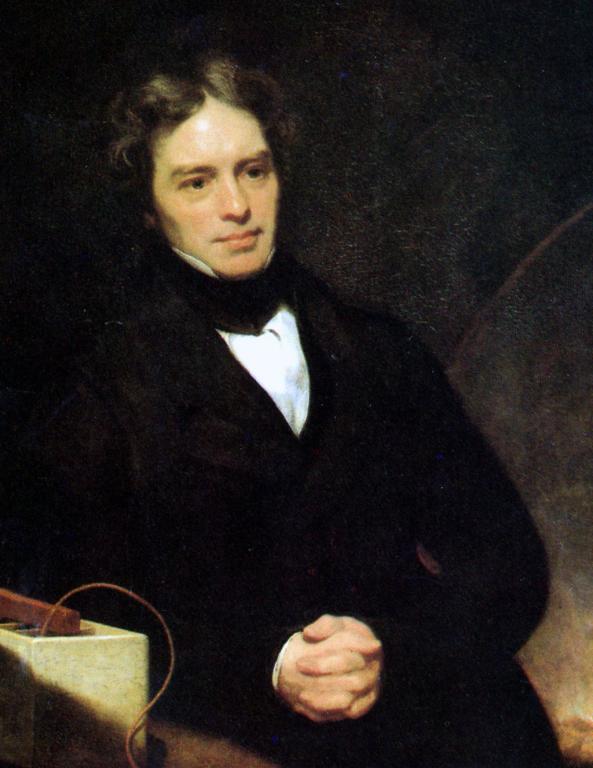
A portrait of Michael Faraday (1791-1867), by Thomas Phillips (created ca. 1841-1842)
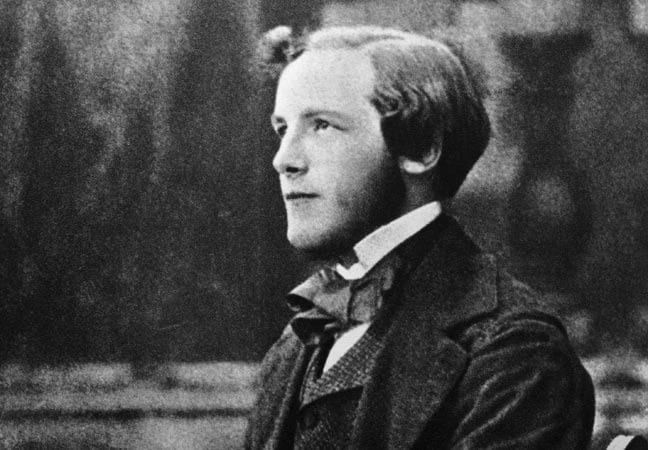
James Clerk Maxwell (1831-1879) as a student at Trinity College, Cambridge
(Wikimedia Commons public domain photo)
Below, I offer some notes from Carlo Rovelli, Reality Is Not What It Seems: The Journey to Quantum Gravity, translated by Simon Carnell and Erica Segre (Penguin, 2017), mingled with some comments of my own. Carlo Rovelli is an Italian theoretical physicist who has worked in both Italy and the United States and who, at least at the time the book was published, was the director of the quantum gravity research group at the Centre de physique théorique in Marseilles, France. His previous book for a popular audience, Seven Brief Lessons on Physics, was an international bestseller that was translated into at least forty-one languages beyond its original Italian:
The great Isaac Newton gave us a world made up of space, time, and particles. But he was baffled as to how particles, or objects made from particles, could interact at a distance. The crack of a ball on a bat, and the ball’s subsequent flight into deep center field, are intelligible as direct interactions between objects in contact with each other. But how does the Earth control the motions of the Moon? How does the Moon govern Earth’s tides?
Enter Faraday and Maxwell, whom Rovelli calls “science’s oddest couple” (39):
Michael Faraday is an impoverished Londoner without formal education, who works first in a bookbindery, then in a laboratory, where he excels, gains his master’s confidence and grows into the most brilliant experimenter of nineteenth-century physics and its greatest visionary. Without knowing mathematics, he writes one of the best books of physics ever written, virtually devoid of equations. He sees physics with his mind’s eye, and with his mind’s eye creates worlds. James Clerk Maxwell is a rich Scottish aristocrat and one of the greatest mathematicians of the century. Despite being separated by a gulf in intellectual style as well as social origin, they succeed in understanding each other — and, together, combining two kinds of genius, they open the door to modern physics. (39-40)
Working with glass rods, magnets, iron cages, bobbins, and needles, Faraday visualizes lines of force — fields — existing between objects. He’s now given us a world of space, time, particles, and fields. Distant objects, it’s true, don’t directly affect each other. But their interacting fields do. And Maxwell, recognizing the genius of Faraday’s insight, translates the verbal notion of “Faraday lines” of force into a page of equations, now known simply as “Maxwell’s equations,” which describe the behavior of electric and magnetic fields.
Today, Maxwell’s equations are used daily to describe all electric and magnetic phenomena, to design antennae, radios, electric engines and computers. And this is not all: these same equations are needed to explain how atoms function (they are held together by electrical forces), and why the particles of the material that forms a stone adhere together, or how the Sun works. They describe an amazing number and range of phenomena. Almost everything that we witness taking place — with the exception of gravity, but little else besides — is well described by Maxwell’s equations.
But there is more. There is still what is perhaps the most beautiful success of science: Maxwell’s equations tell us what light is. (44-45)
Only a few years later, these waves, anticipated theoretically by Maxwell, will be revealed by the German physicist Heinrich Hertz; and just a few years later still, Guglielmo Marconi builds the first radio.
All modern communications technology — radio, television, telephones, computers, satellites, wi-fi, the internet, etc. — is an application of Maxwell’s prediction; the Maxwell equations are the basis for all calculations made by telecommunications engineers. (46)
They are an astonishing illustration of the power of mathematics — a power well worth reflection — to describe the physical world, even in advance of empirical observation:
Our entire current technology is founded on the use of a physical thing — electromagnetic waves — which was not discovered empirically; it was predicted by Maxwell, simply by searching for the mathematical description accounting for the intuition Faraday got from bobbins and needles. (47)
Previous Post

April 9, 2020
Designing a Temple for Dubai
Next Post
April 10, 2020 "Christ and the Work of Suffering"
Browse Our Archives
Select a Category Uncategorized
Select a Month October 2026 September 2026 August 2026 July 2026 June 2026 May 2026 April 2026 March 2026 February 2026 January 2026 December 2025 November 2025 October 2025 September 2025 August 2025 July 2025 June 2025 May 2025 April 2025 March 2025 February 2025 January 2025 December 2024 November 2024 October 2024 September 2024 August 2024 July 2024 June 2024 May 2024 April 2024 March 2024 February 2024 January 2024 December 2023 November 2023 October 2023 September 2023 August 2023 July 2023 June 2023 May 2023 April 2023 March 2023 February 2023 January 2023 December 2022 November 2022 October 2022 September 2022 August 2022 July 2022 June 2022 May 2022 April 2022 March 2022 February 2022 January 2022 December 2021 November 2021 October 2021 September 2021 August 2021 July 2021 June 2021 May 2021 April 2021 March 2021 February 2021 January 2021 December 2020 November 2020 October 2020 September 2020 August 2020 July 2020 June 2020 May 2020 April 2020 March 2020 February 2020 January 2020 December 2019 November 2019 October 2019 September 2019 August 2019 July 2019 June 2019 May 2019 April 2019 March 2019 February 2019 January 2019 December 2018 November 2018 October 2018 September 2018 August 2018 July 2018 June 2018 May 2018 April 2018 March 2018 February 2018 January 2018 December 2017 November 2017 October 2017 September 2017 August 2017 July 2017 June 2017 May 2017 April 2017 March 2017 February 2017 January 2017 December 2016 November 2016 October 2016 September 2016 August 2016 July 2016 June 2016 May 2016 April 2016 March 2016 February 2016 January 2016 December 2015 November 2015 October 2015 September 2015 August 2015 July 2015 June 2015 May 2015 April 2015 March 2015 February 2015 January 2015 December 2014 November 2014 March 2014 August 2013 February 2012
Follow Us!
TAKE THE
Religious Wisdom Quiz
Who was the Roman emperor during Jesus’ birth?
Select your answer to see how you score.
Tiberius Caesar Augustus Nero Herod
Related posts from Sic et Non
Divine Light (with an aside concerning Hollywood darkness)

"We're captive on the carousel of time"
"Eternity, Family, and Cosmos"
TRENDING AT PATHEOS Latter-day Saint

Letters on Living the Faith by C.S. Lewis
Most of us met C.S. Lewis as a public intellectual. Mere Christianity....

When Halloween Unmasks Married Hearts
Written by Dr. David K. Ewen from Eternal Truth Bible College Behind...

Aristotle. He’s been called the father of logic, the father of the...

Methodist Central Hall and Westminster Abbey
Situated on the same square is Methodist Central Hall and Westminster Abbey. ...

57th Dove Awards Honor Dolly Parton, Crown New...
On gospel music’s biggest night, the 57th annual GMA Dove Awards honored...

The First Eucharistic Controversy: Christ’s Real Presence
For Catholics, the Eucharist is the source and summit of the Christian...
view all Latter-day Saint blogs
Ad-Free & Subscriber Log-In Subscription Support
- About Us
- 2026 Calendar
- Videos
- Podcasts
- Library of World Religions
- Faith In Media Tracker
- Advertise With Us
- Write for Us
- Privacy Policy
- Terms of Service
- Do Not Sell My Data
- Contact Us
- Radiant Digital
- Manage Newsletter Subscriptions
- Unsubscribe From Notifications
- Sitemap
Copyright 2008-2026, Patheos. All rights reserved.
Subscription Support Ad-Free & Subscriber Log-In
Follow Patheos