
BuddhistCatholicContemplativeEvangelicalGeneral ChristianHinduJewishLatter-day SaintMuslimNew VisionsProgressive Christian
Beliefs
- Buddhist
- Catholic
- Contemplative
- Evangelical
- General Christian
- Hindu
- Jewish
- Latter-day Saint
- More Voices
- Muslim
- New Visions
- Pagan
- Progressive Christian
Topics
- Religion News
- Food and Religion
- Sports and Religion
- Religious Art
- Religious Music and Entertainment
- Religious Events
- History and Religion
- Style and Religion
- Politics and Religion
- Women in Religion
- Recreation Outdoors and Religion
- Business Finance and Religion
- Careers Workplace and Religion
- Education and Religion
- Family Parenting and Religion
- Health Fitness and Religion
- Home and Religion
- Relationships and Religion
- Technology and Religion
- Travel and Religion
Columnists
- Buddhist Columnists
- Business Finance and Religion Columnists
- Careers Workplace and Religion Columnists
- Catholic Columnists
- Contemplative Columnists
- Education and Religion Columnists
- Evangelists Columnists
- Family Parenting and Religion Columnists
- General Christian Columnists
- Health Fitness and Religion Columnists
- Hindu Columnists
- History and Religion Columnists
- Home and Religion Columnists
- Jewish Columnists
- More Voices Columnists
- Latter Day Columnists
- Muslim Columnists
- New Visions Columnists
- Nonreligious Columnists
- Pagan Columnists
- Politics and Religion Columnists
- Progressive Columnists
- Recreation Outdoors and Religion Columnists
- Relationships and Religion Columnists
- Religion News Columnists
- Religious Art Columnists
- Religious Events Columnists
- Religious Music and Entertainment Columnists
- Sports and Religion Columnists
- Style and Religion Columnists
- Technology and Religion Columnists
- Travel and Religion Columnists
- Women in Religion Columnists
Resource Library
- 2026 Calendar
- Library of World Religions
- The 100 Most Holy Places on Earth
- Patheos Answers
- Podcasts
- Videos
- Faith Leaders Database
- Anglican Episcopalian
- Bahai
- Baptist
- Buddhism
- Christianity
- Confucianism
- Eastern Orthodoxy
- Hinduism
- Holiness and Pentecostal
- ISKCON
- Islam
- Judaism
- Lutheran
- Methodist
- The Church of Jesus Christ of Latter-day Saints
- New Age
- Paganism
- Presbytarian and Reformed
- Protestantism
- Religion Behind the Scenes
- Roman Catholic
- Scientology
- Shia Islam
- Sikhism
- Sufism
- Sunni Islam
- Taoism
- Zen
- See all religions
Research Tools
 Ad-Free & Subscriber Log-In Subscription Support
Ad-Free & Subscriber Log-In Subscription Support
Follow Patheos 

- Trending:
- Forgiveness
- |
- Marriage
- |
- Consciousness
- |
- Death Penalty
- |
- Election
- |
- Halloween

- Home
- Latter-day Saint
- “Cunningly devised fables”?
“Cunningly devised fables”?
Last updated on: April 12, 2020 at 2:21 pm by Dan Peterson
“Cunningly devised fables”? 2020-04-12T14:21:20-06:00 Dan Peterson
Patheos Explore the world's faith through different perspectives on religion and spirituality! Patheos has the views of the prevalent religions and spiritualities of the world.
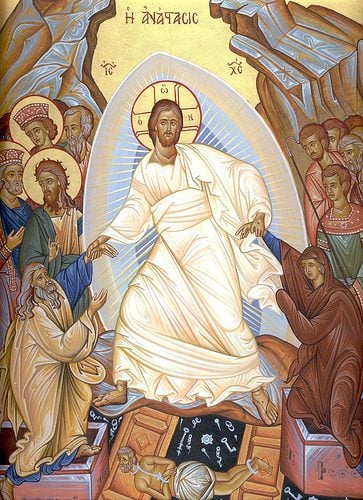
An icon of the resurrection of Jesus Christ (Wikimedia Commons public domain)
In this image, Christ is pulling Adam (on the left) and Eve (on the right) from their tombs. Beneath his feet, Satan lies bound and you can see the broken doors of the gates of Hell (and parts of the shattered lock mechanism of those gates).
I published this column in the Deseret News at Easter season in 2013. And, yes, the book to which the column refers remains still unfinished:
Modern people commonly assume that pre-modern people were stupid, inhabiting a primitive fantasy world detached from reality, unenlightened by science, and awash in superstition. Such gullible minds, some modern “realists” claim, merely imagined the resurrection of Christ.
This is a largely baseless prejudice. Pre-modern people knew death intimately, in a way that most of us today don’t. For them, death occurred at home, in battle, through accidents, or as a result of plague, not in a sterile hospital staffed by cool, efficient professionals. It was up close, personal, and very visible. Family or friends typically disposed of the bodies of their dead. They couldn’t delegate that final service to others.
Thus, to suggest that the first Christians believed that Jesus rose from the tomb because they didn’t grasp the nature of death is to speak flat nonsense. Nobody knew better than they did that dead bodies don’t return to life.
When, on Easter morning, Mary Magdalene and the other women reported their encounter with the angels at the empty tomb to the apostles, “their words seemed to them as idle tales, and they believed them not” (Luke 24:11). Even after Peter himself had gone to the sepulcher, seeing it vacant and Jesus’ burial shroud neatly folded within, he “departed, wondering in himself at that which was come to pass” (Luke 24:12; John 20:7). He didn’t naively rush to believe.
Jesus appeared to ten of the remaining eleven apostles that evening, but Thomas wasn’t there with them. And then, despite their collective testimony that “We have seen the Lord,” he insisted “Except I shall see in his hands the print of the nails, and put my finger into the print of the nails, and thrust my hands into his side, I will not believe” (John 20:25).
The New Testament accounts suggest not gullibility on the part of the first Christian disciples, but skepticism. The skepticism that some imagine is reserved for enlightened moderns. In the ancient world, as in ours, the dead don’t commonly return.
But skepticism maintained too long is foolishness, and the disciples’ incredulity was shattered by their experience with the risen Lord. The seeming defeat of the cross was swallowed up in the fact of the resurrection. The disciples were transformed. On the Saturday of Passover weekend, while the Lord’s body lay in his tomb—though, unannounced to mortals, he was at work organizing the proclamation of the Gospel among the spirits of the dead (1 Peter 3:18-20; 4:6; Doctrine and Covenants 138) —the disciples, fearing further arrests and executions, literally discouraged at the apparent failure of their leader, were in hiding.
And yet, the four gospels testify that, with the exception of Thomas, they saw Jesus alive again the next day. “My Lord and my God,” said Thomas to Jesus when he too had actually seen the risen Savior (John 20:28).
Jesus trained them for forty subsequent days and then commanded that they await the descent of the Holy Spirit upon them before acting further (Acts 1:3-4). That descent occurred at Pentecost, fifty days after the crucifixion. Instantly, the remaining apostles were out on the streets of Jerusalem, boldly testifying, at great personal risk, of Christ’s resurrection (see Acts 2-4). Soon thereafter, this small band of Galilean peasants were carrying that revolutionary message across the Mediterranean, witnessing of “that which was from the beginning, which we have heard, which we have seen with our eyes, which we have looked upon, and our hands have handled, of the Word of life” (1 John 1:1). And this seemingly failed little Jewish messianic movement proceeded to change world history.
But what of those who haven’t directly met the resurrected Jesus? “Thomas,” said the Savior, “because thou hast seen me, thou hast believed: blessed are they that have not seen, and yet have believed” (John 20:29).
“Did not our heart burn within us,” reflected Cleopas and his companion along the road to Emmaus after they realized the identity of the third man who had walked with them “while he talked with us by the way?” (Luke 24:32).
Even today, many can bear similar testimony. Someday I hope to demonstrate at book length that Christians have sound historical reason to do so. “We have not followed cunningly devised fables,” insisted Peter, “when we made known unto you the power and coming of our Lord Jesus Christ, but were eyewitnesses of his majesty” (2 Peter 1:16).
Previous Post

April 10, 2020
"Christ and the Work of Suffering"
Next Post
April 10, 2020 A Great Cloud of Witnesses
Browse Our Archives
Select a Category Uncategorized
Select a Month October 2026 September 2026 August 2026 July 2026 June 2026 May 2026 April 2026 March 2026 February 2026 January 2026 December 2025 November 2025 October 2025 September 2025 August 2025 July 2025 June 2025 May 2025 April 2025 March 2025 February 2025 January 2025 December 2024 November 2024 October 2024 September 2024 August 2024 July 2024 June 2024 May 2024 April 2024 March 2024 February 2024 January 2024 December 2023 November 2023 October 2023 September 2023 August 2023 July 2023 June 2023 May 2023 April 2023 March 2023 February 2023 January 2023 December 2022 November 2022 October 2022 September 2022 August 2022 July 2022 June 2022 May 2022 April 2022 March 2022 February 2022 January 2022 December 2021 November 2021 October 2021 September 2021 August 2021 July 2021 June 2021 May 2021 April 2021 March 2021 February 2021 January 2021 December 2020 November 2020 October 2020 September 2020 August 2020 July 2020 June 2020 May 2020 April 2020 March 2020 February 2020 January 2020 December 2019 November 2019 October 2019 September 2019 August 2019 July 2019 June 2019 May 2019 April 2019 March 2019 February 2019 January 2019 December 2018 November 2018 October 2018 September 2018 August 2018 July 2018 June 2018 May 2018 April 2018 March 2018 February 2018 January 2018 December 2017 November 2017 October 2017 September 2017 August 2017 July 2017 June 2017 May 2017 April 2017 March 2017 February 2017 January 2017 December 2016 November 2016 October 2016 September 2016 August 2016 July 2016 June 2016 May 2016 April 2016 March 2016 February 2016 January 2016 December 2015 November 2015 October 2015 September 2015 August 2015 July 2015 June 2015 May 2015 April 2015 March 2015 February 2015 January 2015 December 2014 November 2014 March 2014 August 2013 February 2012
Follow Us!
TAKE THE
Religious Wisdom Quiz
How many years from Abraham to Jesus?
Select your answer to see how you score.
2500 years 1500 years 1000 years 2000 years
Related posts from Sic et Non

An action movie and some vacuous theology


"The World's Sixteen Crucified Saviors"?

"The Loss of Jesus in the Small Plates...
TRENDING AT PATHEOS Latter-day Saint

A new article, written by Jeff Lindsay and Gale L. Pooley,...

Swimfan: Forgotten Aughts Pleasures
This is a recovery effort. In 2002, My Big Fat Greek Wedding...

Top Three Anti-Catholic Lies About Catholicism
This is my initial transcript for the video, "THE 3 WORST...

Pope Leo Celebrates Mass for Nurses & Docs...
I don't have any idea how he did it, but Pope Leo...

The Sermon on the Mount, Part I: Matthew...
The Sermon on the Mount, Part I (Matthew 4:12-5:12) St. Matthew moves...

What's up from Crossway: Reviewing some of their latest A few weeks...
view all Latter-day Saint blogs
Ad-Free & Subscriber Log-In Subscription Support
- About Us
- 2026 Calendar
- Videos
- Podcasts
- Library of World Religions
- Faith In Media Tracker
- Advertise With Us
- Write for Us
- Privacy Policy
- Terms of Service
- Do Not Sell My Data
- Contact Us
- Radiant Digital
- Manage Newsletter Subscriptions
- Unsubscribe From Notifications
- Sitemap
Copyright 2008-2026, Patheos. All rights reserved.
Subscription Support Ad-Free & Subscriber Log-In
Follow Patheos